The digital Faustian pact

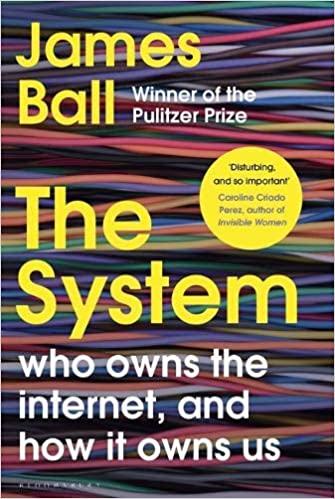
James Ball’s The System: who owns the internet and how it owns us is pretty sobering reading, not least as 2020 has turned online access into even more of a necessity than it already was. (Though I can’t be the only person in despair at the prospect of yet another Zoom/Teams/Hangout etc, & mystified as to why some people are so sure we’ll all want to stick with working from home forever now. )

Anyway, the book. It’s a nice overview of all of the dysfunctions of the modern internet – corporate and state surveillance, monopolies, hackers and fraud, and the belated beginning of tougher regulation. It’s particularly good at explaining enough of the origins and technologies to make it clear how things have turned out the way they have. For instance, the reminder that key innovations were funded by the US government so none of the pioneers thought about business models – in contrast to the older communications networks, where billing was an important engineering requirement. A fateful oversight. For hence the toxic reliance on advertising – and there’s a great chapter on this – with its constant need to get people to click.

This book is far, far better on the potential for, and drivers of, surveillance than the over-rated rhetorical doorstop of Shoshana Zuboff’s Surveillance Capitalism book. I also really enjoyed learning from The System about some new things about the physical internet infrastructure – the Border Gateway Protocol was new to me – how packets make their way through the physical network. It’s frankly terrifying, the reliance on a short-term fix that started life scribbled on a couple of napkins decades ago and hasn’t changed too much since.

All in all, although some of the material is fairly familiar now, a very well-informed book and also really well written. For me, worth it for the chapter on advertising alone, which explains the origins of the online ad market and horrifying extent of the tracking targeted ads requires. We have a systemic Faustian pact – great free services in exchange for our souls. If I were in charge of regulating the online world, advertising and the business models would be my number one target. Regulators are supposed to be agnostic about business models – but there needs to be a mixed economy of models for that rule to apply.

51WyNJFC2RL._SX333_BO1,204,203,200_


When ideas were lethal

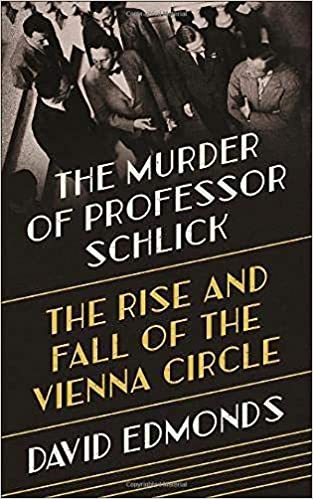
Continuing my 1920s run, I very much enjoyed The Murder of Professor Schlick: The Rise and Fall of the Vienna Circle by David Edmonds. Edmonds was also co-author (with John Eidinow) of the equally enjoyable Wittgenstein’s Poker, and has a real knack for explaining ideas within the intellectual climate of the times, and also for the sheer story-telling about the lives of those involved – including how their friendships and rivalries shaped their work.

For example, yes we do indeed need to know that Gustav Bergmann, although a minor figure in the history of philosophy, and not a nice person (‘rude, arrogant, insecure and argumentative’), used to lie on a table in the middle of the lecture hall, smoking a cigar, and blow smoke at whichever poor student was to speak next. This was post-war, having escaped Europe. The apparent trivia do illuminate character.

One of my favourites is Kurt Godel, although another strange character. Introverted and disturbed, he starved to death at home while his wife was in hospital. I often think about the incompleteness theorem though, and the way it has far wider scope than is perhaps realised.

In the end I slightly preferred The Murder of Professor Schlick to Time of the Magicians, but this might have been the reduced prominence in the former of both Wittgenstein and the appalling Heidegger. People commented after my earlier post that I need to give Wittgenstein a chance, and recommended some Wittgenstein-made-simple things to read (OK, I exaggerate – W-made-a-bit-clearer). Afraid I’ll pass on those. Enough of the 1920s/1930s for now – years when ideas were lethal.

518xEhS71OL._SX311_BO1,204,203,200_

Modern thinking and the 1920s

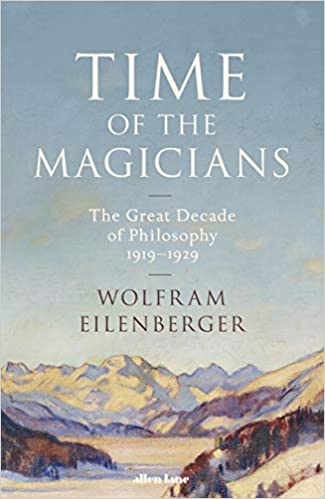
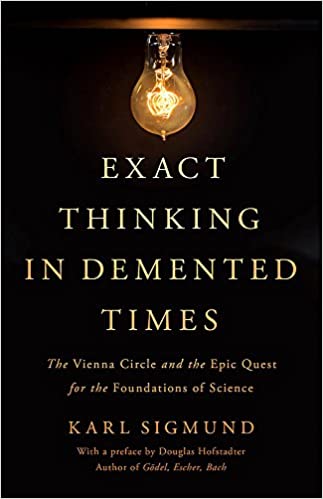
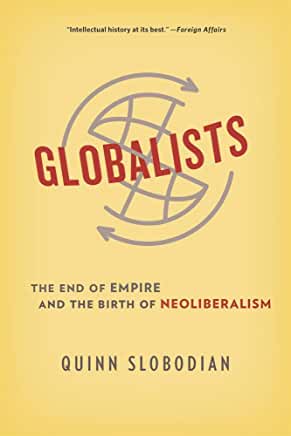
There have been lots of books of late about the Vienna Circle and 1920s philosophy, and I’ve been reading them all. It started with Exact Thinking in Demented Times by Karl Sigmund, which I bought for the title and stayed to enjoy. When lock-down started in March Cheryl Misak’s biography of Frank Ramsey: A Sheer Excess of Powers (Ramsey was the English translator of Wittgenstein) was a welcome diversion. Lately I finished Wolfram Eilenberger’s Time of the Magicians: The Invention of Modern Thought 1919-1929, which ranges over the lives and thought of Walter Benjamin, Ernst Cassirer, Martin Heidegger and – again – Ludwig Wittgenstein. Along the way I read Quinn Slobodian’s economics-inflected Globalists. And now I’ve started David Edmonds’ The Murder of Professor Schlick: The Rise and Fall of the Vienna Circle, a cracking read at least so far: Chapter 1 has set me up to read the rest of it over the weekend.

Whether I could give you pithy summaries of the philosophical world views of the protagonists is another matter entirely. Take Time of the Magicians. My undergraduate exposure to Wittgenstein in the late 1970s was an aversion therapy that will last a lifetime – it was impossible for me to understand a word. Heidegger is famously incomprehensible. Walter Benjamin is hardly known for his pellucid prose and after all influenced the Frankfurt School. All three of them, Eilenberger writes, rejected the conventions of academic philosophy and aimed for a “constellation of dramatic tensions that hover around the word ‘cult’.” And of course they succeeded, with three entirely different cults – linguistic philosophy, existentialism and cultural Marxism.

Cassirer is the least well-known of the bunch and yet seemed to me, reading this, the most sympathetic. Perhaps this reflects my being able to grasp what he was on about. Sadly, he represents old-fashioned thought as against the modernists. The Stanford Encyclopedia bills him as a bridge between the analytic and continental traditions in philosophy, between science and the humanities.

I confess to glazing over at paragraphs explaining Dasein, but the tale around the philosophy is compelling stuff – extraordinary characters and lives (except poor old bourgeois Cassirer, at least in the 1920s), intellectual rivalries, and ideas mattering. Perhaps that’s why the intellectual ferment of Vienna, Berlin, Cambridge etc in the 1920s is so compelling – especially knowing what came in the decades afterwards. Or perhaps all these authors are responding to a sense in the air that another hinge in history is upon us. Or perhaps it’s just the centenary effect. In any case, I’ve enjoyed all of these books, Dasein notwithstanding.

41jkX5RN0EL._SX323_BO1,204,203,200_

41uw6vtLMhL._SX321_BO1,204,203,200_71j43+pvfeL._AC_UY436_QL65_518xEhS71OL._SX311_BO1,204,203,200_51b8OjIvx1L._AC_UY436_QL65_

The joy of teaching

I picked up Syllabus: The Remarkable, Unremarkable Document that Changes Everything by William Germano and Kit Nicholls thinking it might be a quirky little history of the course syllabus. after all, I enjoy reading other people’s syllabuses/syllabi. However, it’s really a passionate book about teaching well, using the syllabus as a framework within which to discuss how to embark with students on the joint endeavour of learning. I like its philosophy: “People learn far more by doing things than by watching others do things. If we accept that this is true, then it quickly becomes clear that a syllabus isn’t primarily a shopping list or manifest: it’s a design for student work.”

The chapters cover: how to generate energy and community in the classroom or lecture hall; how to pace the course; what reading lists are for; understanding students’ contexts, abilities and concerns; grading and giving honest feedback; and finally back to how to design the syllabus. Some of the insights and advice will be familiar to lecturers, some not so much – there are some really good ideas. I also like the way they portray designing the syllabus as a way of furthering ones own ideas; certainly in my case Markets, State and People began life as a course syllabus. I’ve always found teaching a great way to learn things myself: how can you explain anything you don’t understand yourself? How else to hear those terrific questions from enthusiastic people who haven’t yet been socialised into how they ‘ought’ to think?

The book is very nicely written too. For example, this made me laugh:

IMG_1298Oh yes.

One for all who value teaching.

41f2mXA2k1L._SX322_BO1,204,203,200_

Why competition is good

I would be an even bigger fan of Michelle Meagher’s provocative book if she had stuck with the subtitle – How Big Business is Harming Our Society and What to Do About It – and not gone for the title ‘Competition is Killing Us’. Because it’s the absence of competition that’s killing us – as indeed this very accessible and well-argued book goes on to explain. There is a footnote on page 2 referring to a glossary explaining that ‘competition’ as used here doesn’t mean, well, competition, or rivalry between firms contesting with each other for customers. Here it is used to mean big businesses eating up more and more market share, lobbying to get the rules of the market economy shaped to their own advantage, and generally subtracting value from society rather than adding it.

This is a shame. It means the book adds to the general confusion on this point, as I think quite a lot of people hear ‘business’ when they see ‘competition’. When economists talk about competition, though, this does not mean arranging things in the interests of business. Far from it. Economists love competition (on my definition) while businesses hate it. I particularly love competition, having spend 8 years as a member of the Competition Commission and recently having been a member of the Furman Review panel.

Other than this – quite a major point, and one which I failed to persuade Michelle about before the book was published – this is a great book and well worth  a read. It’s of the moment too. Our own Competition and Markets Authority is gearing up to tackle the market power of the digital giants, as is the European Commission with its greater impact, and even – perhaps – the US with the publication of a pretty fierce House Judiciary committee report this week. It does feel like we are seeing the tide turning away from big companies and in favour of fewer mergers, tighter corporate governance rules, and a far, far greater emphasis on the need for business to serve society rather than profiting at society’s expense.

41SmtVCNHYL._SX324_BO1,204,203,200_