White elephants and icons

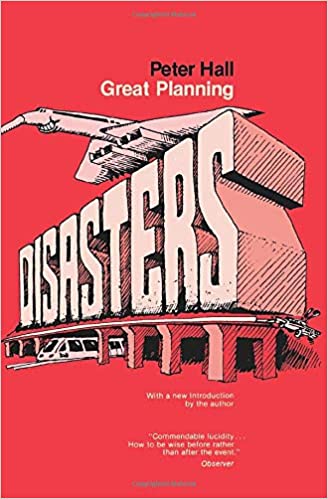
I just read a marvellous 1980 book, Great Planning Disasters by Peter Hall. The first half of the book consists of specific case studies. To qualify, the cases have to have been costly, involved processes of planning by public authorities, and have been perceived by many people to have gone wrong. Those included are London’s third airport saga (indeed), London’s ‘motorways’ (no, they don’t exist),  Concorde, San Francisco’s BART system, and the Sydney Opera House. Also included are two schemes that looked like they would be disasters but turned out not to be: California’s new university campuses and the British Library.

One of the interesting things about the book is having an additional 40 years of hindsight. The London airport saga continues, with Heathrow now having not just a 4th and indeed a 5th terminal but still not an additional runway. Stansted has become London’s 3rd airport, sort of, though we have the bijou London City as well. Concorde alas is no more: I remember still the exhilaration the crowd I was in felt at an open air concert in Kew Gardens felt when it flew overhead toward Heathrow, after the announcement the small fleet would be retired. The British Library has been a clear success. The Sydney Opera House had to have a major refurbishment. But as I ask my students when we discuss cost benefit analysis, do you think it should never have been built: is it an icon or a white elephant?

The second part of the book draws out the themes from the case studies, discussing it from the perspective of the actors and their incentives: affected communities, bureaucrats and politicians. One theme in all the case studies is that major projects take a long time to conceive, plan, approve and fund, and during that time political actors change, as does the zeitgeist. Individuals can have a big impact. One striking example is that an influential and forceful advocate of locating the new British Library next door to the British Museum (where he was chair of trustees) became an influential and forceful advocate of its actual site next to St Pancras when he was made chair of the new national libraries’ board. Technology changes too, costs rise – always – and demand forecasts over decades are almost sure to be wrong, albeit in an unknown direction.

There is no easy answer to the conundrum of how to avoid great disasters. The book recommends taking care with forecasting techniques, having regard to distributional consequences (and how this affects the politics), and communicating the uncertainties. I think the conclusion I draw, having been thinking about this, is that planning big projects is a political, not merely a (complicated) technical, decision. That makes two things important: building enough consensus, and aligning all the interventions that could make a project a self-fulfilling success. Oh, and multiplying the initial cost estimates many times over, except not too much to scare people from approving and investing in the first place.

51tb2xTystL._SX326_BO1,204,203,200_

Sense about data

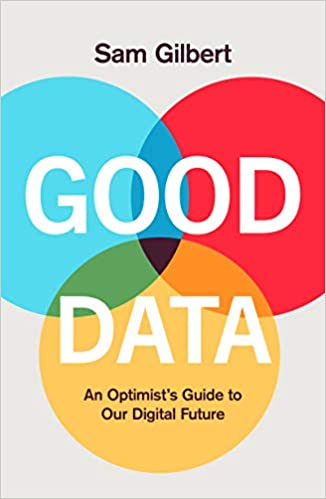
I don’t agree with absolutely everything Sam Gilbert writes in his book Good Data: An Optimist’s Guide to the Digital Future. But this is one of the best books I’ve read about the new world of the data-driven economy and society. Now, I am biased in the sense that Sam is a colleague, a research affiliate at the Bennett Institute. On the other hand he has terrific credentials for writing objectively about what has become a contentious subject, having worked as an early employee of a successful data-driven start up (insurer Bought By Many) and having undertaken academic research into these questions. (It was here at Cambridge and it sounds like it was tough going – sorry, Sam.)

As the book notes, the prevailing narrative in the academic and even policy world is the “surveillance society” one: our privacy is being massively invaded without our consent by evil capitalists who retain all the profits. Regular readers of this blog will know my view that Shoshana Zuboff’s book Surveillance Capitalism is almost literally unreadable, but nevertheless the trope has stuck. Yet, as Sam points out, the data driving targetted advertising isn’t individual data but aggregated behavioural data. The early section walks the reader through how you actually use Facebook to advertise. He also makes the point that people don’t mind their public profile data being used to advertise to them; they sometimes are disturbed by ads that do use behavioural data but – and the book describes how – it is reasonably easy to change settings so it doesn’t happen. Instead you get irrelevant ads.

Does the surveillance capitalism theory matter? Sam argues that it does because it is leading businesses to close, or not start up, because of the regulatory or reputational uncertainty around using data analytics. Analytical tools that helped smaller companies compete with Amazon have been shut down. He says, and I strongly agree: “Allowing your search data to be collected, anonymised, aggregated with other people’s data and put into the public domain is a benefit to society.” I’d probably go further: much as care is needed about anonymisation and privacy, the surveillance trope in its focus on individuals is a neoliberal as can be. The data economy could be a social or a gift economy, not an individualist one: a positive sum game not a zero sum one. The book gives examples of societally positive things that are not happening because of the chilling effect of the dominant debate.

Of course, it’s not simple. But some odd decisions are being taken. One example I learned here is that the German government in 2017 set rules requiring autonomous vehicles to be strict utilitarians: if there is an unavoidable collision, the algorithm must minimise the total number of casualties, not prioritising its own occupants. I thought economists were the last utilitarians of this kind.

The book completely acknowledges that big tech companies need to have legitimacy and their power must be acceptable to the societies in which they operate. That’s certainly not where we are. Their behaviour has significantly degraded their social licence to operate. Sam offers a useful checklist of policy approaches to restore this. I have some ideas that don’t feature here, including the ones we suggested in the Furman review regarding interoperability and the scope for competition in ways similar to open banking. I’m also far less of a fan of the ad-driven business model than Sam is, not that I’d ban it; the drive for clicks to attract advertisers does seem to be at the heart of some of the worst effects of Facebook and Google. He and I would agree on making the ad tech market far more transparent and honest. I’d also consider either an ad tax or a public option: a strong competitor with a different business model which would force competition along the quality dimension.

Having quibbled, this is a terrific book. Knowledgable, thoughtful and very well written too. Also, Sam is a great colleague so I hope you’ll buy his book….. even if (especially if?) you already disagree.

412rqRRw6UL._SX324_BO1,204,203,200_


Epic reading

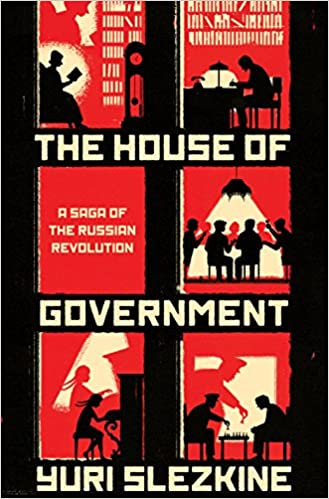
Well. It’s been a slow blogging start to March because I’ve been reading Yuri Slezkine’s 1000-page The House of Government. What an amazing book.

It’s an account of the Russian Revolution and the early years of Lenin and Stalin up to the second world war. The book is unlike anything I’ve read before, and is utterly compelling. It braids together an argument presenting early-Soviet Bolshevism as a millenarian religious sect, the sequence of events that led up to the Terror to a large degree as reflected in literature and literary debates, and the perspective of the families who lived in the House of Government, the huge mansion blocks opposite the Kremlin that housed the nomenklatura. The extent of the sources on which the book is based is simply staggering, from archival records to newspapers to personal letters and photographs, and evidently also many conversations with people who had been children at the time. The fact that throughout many hundreds of pages we have met and seen the wives and children makes the final section – parents arrested in the night and never seen again, young children sent to orphanages after their early years of privilege – incredibly affecting.

The device of using the building as the lens on history is what makes the personal thread so effective, but clearly also means this is – despite its length – an incomplete account of early Soviet history. Indeed, it assumes a lot of background knowledge, which I could more or less dredge up from 1st year comparative politics. Nor do I know what I think about Bolshevism as a sect of true believers: it seems plausible in some ways, but again is unlikely to be the whole story. At least, other forms of Marxism are available.

But you shouldn’t approach The House of Government as you would an ordinary history book, even though the people are real, and their words from letters and diaries are quoted at length. It’s obviously a very personal interpretation. I did end up thinking that along with Svetlana Alexeivich’s Second Hand Time, this book opened an emotional window on the USSR that help understand it current-day Russia: traumatic historical events cast a long shadow. Get ready to read an epic. And to read it with a table or pillow to prop it on.

51EQ6khSn-L._SX327_BO1,204,203,200_


Where *is* the internet?

I’m not sure ‘read’ is the right verb for Networks of New York by Ingrid Burrington, but I looked at it this week. It’s a sketchbook of various bits of internet kit from cables below ground to antennae on rooftops, with notes about the physical kit that makes up the system getting people online, and about the ownership of the kit. I’ve been growing  slightly obsessed by how little is known about the physical internet. So far, James Ball’s The System and Andrew Blum’s Tubes are the only entries on my list of books about this. I was pleased to find out about Ingrid Burrington, who has a number of articles on this and related subjects. But if anybody knows of other books or papers about the physical infrastructure of the internet and the ownership of it (especially for the UK) I’d love to know.

51K1ob-y2IL


Railways and culture

The Europeans: Three Lives and the Making of a Cosmopolitan Culture by Orlando Figes is a history of the emergence of a common European culture in music, art and literature in the late 19th century, told mainly through a narrative about three people: leadingopera singer Pauline Viardot (no, me neither), her husband, manager and also expert on Spanish art and music Louis Viardot, and the Russian novelist Ivan Turgenev, who ended up in a menage a trois with the Viardots.

For me, though, rather than this domestic drama, the main attractions were the railways, the publishing techniques and business models, the intellectual property debates, the great exhibitions. All the splendid artistic creations rested on these physical and institutional structures. Some artists and novelists learned to market themselves effectively to ensure commercial success – Zola was one for example, while poor Turgenev was far less worldly. The book even tells of a 19th century superstar economics effect, driven by technology on the supply side and the emergence of mass demand on the demand side, Sherwin Rosen avant la lettre. The Franco-Prussian war started to break the shared culture, and of course the first half of the 20th century torpedoed it. The book is a cracking read.

51VeT22XOHL._SX324_BO1,204,203,200_