What’s wrong – and right – with economics

I didn’t expect to enjoy Robert Skidelsky’s new book, What’s Wrong With Economics: A Primer for the Perplexed, for he has long been forthright about his low opinion of economics and economists; and so it proved.

He makes some good points, nevertheless. Indeed, some I strongly agree with, as do a lot of other economists. For example, many of us would agree about the importance of studying economic history; even some of the nerdiest econometricians and theorists I know devour the big new econ history books. Likewise about the importance of taking into account psychological realism – behavioural economics, hello! (Though standard rational calculation of self-interest often matches reality better – it’s all about the context.) Institutional economics is everywhere now, in the tradition of Coase, Williamson, et al. Lord Skidelsky approves of it (albeit preferring the old institutionalism to the new transactions-cost based approach); he just seems to be under the misapprehension that it’s a neglected part of the discipline.

In sum, there is indeed much here that I and many other economists of my acquaintance agree with. Big ticks to history, institutions, psychological realism, even to acquaintance with sociology or anthropology.

So why did I not enjoy the book? It talks about “the poverty of neoclassical economics under its carapace of techniques.” This is absurd. While certainly there is some excess ‘mathiness‘, technique is a vital thing in any discipline. Even historians have techniques, and models (‘the causes of the first world war’). Does this carapace consist of too much ‘theory’? As Beatrice Cherrier has blogged, there has been a significant shift to applied work in economics, even though its description as the ’empirical turn’ has been over-stated.

But above all, despite insisting on the importance on both economic history and the history of economic thought, the book is ahistorical in its approach to economics. It attacks an economics it labels as ‘mainstream’ or ‘neoclassical’. Whatever it means by mainstream, this isn’t what most economists do. As ever in such critiques, the book only talks about macroeconomics, doesn’t cite a single piece of applied microeconomics, but above all ignores the fact that economics has changed in the past 10, 20, 30 years.

I do think there are serious methodological issues in the present (‘mainstream’) economic paradigm – my next book, Cogs and Monsters, out around this time next year, will be about this.

Meanwhile, What’s Wrong With Economics is concise, clearly and elegantly written and spends half its length demonstrating that the other half is – well, about what’s right with economics.51FqQfM-ouL._SX325_BO1,204,203,200_

Deaths of despair

Many people will be familiar with Anne Case’s and Angus Deaton’s work on deaths of despair – the increase in death rates in the United States due to suicide, (legal and illegal) drug overdose and alcoholism, and the fact that life expectancy in the US has now declined for three years in a row. The research is brought together in compelling form in their new book, called Deaths of Despair and the Future of Capitalism.

The scale of this slow disaster is staggering. “In 2017158,000 Americans died from what we call deaths of despair… That is the equivalent of three full 737 MAXs falling out of the sky every day with no survivors.” “Opioids prescribed by physicians accounted for fully a third of all opioid deaths in 2017 and a quarter of the 70,237 drug overdose deaths that year. This overall number is greater than the peak annual number of deaths from HIV, from guns or from automobile crashes. It is greater than the total number of Americans who died in Vietnam. The cumulative total from 2000 to 2017 is greater than the total number of Americans who died in the two world wars.”

Much of the book is concerned with descriptive analysis of the patterns within these totals. The short answer is: white, working age people with no college degree. While on many indicators things are worse for African-Americans, the trends have been improving for them. Education stands out strikingly as a key differentiator. While the adverse trend is most noticeable from around 2000, for Americans with high school education only things have been getting worse, in terms of despair, in every cohort for decades.

The figures here are for the US, and some of the causes are US specific. Its racial legacy from slavery is unique. Its appalling “health care” system stands out as a major culprit – the costs, the perverse incentives it creates, the lack of coverage. But not only healthcare. The pharma industry is portrayed as a rent-extracting machine. The authors criticise the FDA for approving opioids for general prescription, particularly OxyContin: “The FDA was essentially putting a government stamp of approval on legalized heroin.”

However, it may be that the US and its particular form of weaponized capitalism is only an extreme and early version of something happening elsewhere. The education divide – whose causes and consequences I think we still need to understand in the round – is manifest throughout the western economies. The skill-biased technical change, the “assortative mating”, the concentration of good jobs in big cities, are all occurring throughout the west. Life expectancy gains in the UK have halted and reversed for some groups, and the recent Marmot Review highlights serious inequalities and challenges. Interestingly, the trends seem to be more adverse in English-speaking countries in general. But not unique.

When you consider the harm a number of other industries are doing to us, their customers – highly processed and sugary foods and drinks, finance, tech, as well as pharma and alcohol – it’s perhaps surprising there hasn’t been even more of a backlash against modern capitalism. The final section of the book runs through the broad economic trends behind the adverse outcomes for the once-robust white working class, and lists what could be done. Each item on this list is a major challenge, not least politically – reform US healthcare, anyone? But it extends also to improving corporate governance, anti-trust enforcement, higher minimum wages, improving educational outcomes. The system is broken and every bit of it needs fixing. This is a sobering – and essential –  book.

41CFS16tOFL._SX327_BO1,204,203,200_

Slightly random reading

I just re-read John McMillan’s Reinventing the Bazaar: A Natural History of Markets, as I keep recommending it to people and thought I’d better check how well it had aged. The answer is pretty well, although if he were to write it now there would surely be more about matching and digital markets. I won’t review it here though, as Laurent Franckx has done so at Goodreads. He concludes:

“I would highly recommend this book to any non-economist with a serious interest in understanding how economists really think about markets, or to economists who are interested in finding more real-world illustrations of the issues they discuss in their academic papers. The book is not very recent (first published in 2003). In the meanwhile, there has been an increased effort from great economists with real scientific credentials (rather than celebrity economists) to write for a general audience. But this book remains rather unique in its scope and balance.”

51NGTZGBDZL._SX310_BO1,204,203,200_Another book that landed here recently and I have skimmed is Neil Monnery’s A Tale of Two Economies: Hong Kong, Cuba and the Two Men Who Shaped Them. Monnery wrote the excellent (2017) Architect of Prosperity about Sir John Cowperthwaite’s shaping of colonial Hong Kong. Who he, you might ask? Indeed, that was part of the interest – an unknown who had laid the foundations for modern Hong Kong’s role as a financial and trading centre. This new book is, intriguingly, a compare and contrast of Cowperthwaite and Che Guevara, or rather an assessment of the natural experiment of two polar opposite economic systems, both intended to deliver the same aim of economic development and lasting prosperity.

51k2HlN0WhL._SX311_BO1,204,203,200_I’ve also read Gertrude Himmelfarb’s On Looking into the Abyss, picked up after the recent news of her death. There were some obits that made me think I should fill this gap in my knowledge. This book is a collection of lectures assessing post-modernism in history (an interesting read alongside the lead letter in the latest issue of the The Point about English literature). It didn’t wow me but I was interested to see how a collection of lectures turned out, as I’m preparing a series of my public lectures over 8 years for a new book next year (to be titled Cogs and Monsters).

Meanwhile, there’s always my recent book, Markets, States and People, to read – very kindly reviewed in the FT by Giles Wilkes. 🙂

41tDMjIpEQL._SX329_BO1,204,203,200_

Growth, stagnation, and degrowth

There’s a new wave of interest in the degrowth idea, recently summed up in the New Yorker by John Cassidy. The degrowthers are mainly inspired by environmental concerns – how can consumption possibly continue to increase without limit without destroying the planet? – and the article also refers to Vaclav Smil’s recent book Growth, which adds to this seeming common sense the intellectual heft of energy physics and logistic curves.

I have no ideological commitment to the view that measured GDP growth will always revert to 1.5-2%, and found much food for thought in Smil. However, there is a misunderstanding in the degrowth movement about what growth implies for physical material and energy use, well explained by Noah Smith in his recent Bloomberg column. My colleague Dimitri Zenghelis also does an excellent job here of debunking degrowth, arguing it is not the best or only way to be green.

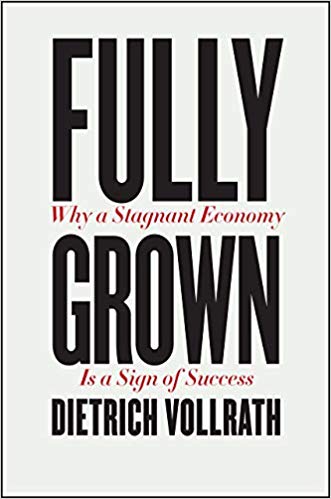
Smith refers to another recent book, Fully Grown: Why a Stagnant Economy is a Sign of Success by Dietrich Vollrath, to make the point that we can probably expect slower growth (Smil’s S-curve is flattening out) but this is very different from degrowth or zero growth.

The basic point is that the degrowth argument doesn’t either acknowledge intangible output growth or explain what somehow needs to be taken away from the economy when there is a new innovationto keep growth below zero. On the first point, think about oral rehydration therapy or mini-aspirin – new uses of existing materials which produce improved health outcomes that people are willing to pay for, whose value far exceeds the materials costs (sugar, salt and water; salicylic acid). On the second, if somebody invents a new item everybody wants to purchase – the way smartphones arrived in 2007, say – then what would we stop them buying to keep total growth at zero? And how?

Prof Vollrath’s book, which I read at the proof stage, is tremendous. He portrays the recent slowdown as an inevitability, the result of economic success. Past gains in health, and lower fertility rates due to reduced infant mortality and higher incomes, explain population ageing in the rich economies. Demography is reducing potential growth. We are on the whole also taking more leisure, with a trend decline in hours worked. Purchases of services are taking over from material goods as a share of expenditure, and productivity growth is slower in the service sector (for familiar, Baumol reasons). These two trends go a long way to explaining reduced growth.

The second half of the book explores other potential reasons for the growth slowdown, such as increased market power (see Thomas Phillippon), inequality (Piketty) or too much government tax and regulation – and sets out the data explaining why none has a big enough effect to explain a lot of the trend slowdown. “I see no obvious reason why the growth rate would accelerate in the near future,” Vollrath concludes.

I really enjoyed Fully Grown, which gave me much food for thought. It also is simply excellent on the data sources, growth accounting, and trends. But I don’t think it tells the whole story about innovation either. Vollrath accepts (as Robert Gordon does not) that there are significant technological advances under way; but he sees these as making production more efficient and thus accelerating the shift to services: an ever-smaller part of the economy is becoming super-efficient.

The catch, I think, is in using real GDP per capita as the sole indicator of growth. It is a conceptually flawed measure for an intangible/services economy. Consider a haircut, a service for which there is at least a volume measure (which many services do not have). If the price of haircuts goes up, real GDP as constructed goes down; but if the price is rising because people are substituting from cheap cuts at Big Jim’s Trims round the corner to expensive cuts in Covent Garden, it actually means that they are purchasing a haircut plus a bundle of quality attributes – lovely salon, free cup of tea, head massage, an hour’s talking therapy from a charming hairdresser….. In some four-fifths of the economy, the Price x Quantity = Revenue equation used to construct the growth statistics does not work. Either we should be quality-adjusting many more purchases (and this has its own problems) or there isn’t even a volume measure (what is a unit of management consultancy??)

Anyway, read Vollrath and Smil, devote energy to cherishing the environment. Read our Benett Institute report out in 10 days on how to take a more rounded view of economic progress, including environmental impact, by considering wealth. But ignore the fashionable lure of degrowth.

41utBzmOnNL._SX329_BO1,204,203,200_

How do we know if things have got better?

As someone interested in public policy, from the doing perspective as well as for research and teaching, thinking about social welfare is at the heart of matters for me. What does it mean to think about a government intervention or other collective action ‘making things better’ – for whom, and by how much? I think economists have been pretty poor at addressing these questions, despite past waves of interest in welfare economics – the last of them quite some time ago.

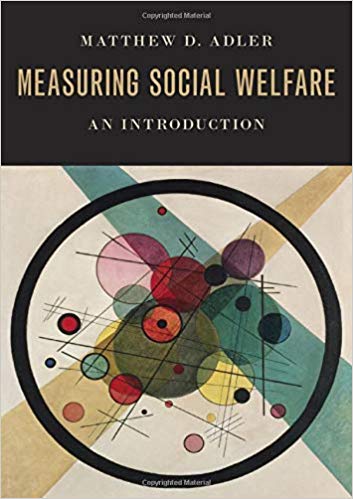
So I pounced on Matthew Adler’s Measuring Social Welfare: An Introduction when my colleague Anna Alexandrova pointed it out to me. The book does a thorough job of setting out, in not too technical a manner, how to apply a social welfare approach to public choices. Adler advocates a ‘welfare-consequentialist’ approach: decisions need to be evaluated according to their outcomes, which depend on the pattern of individual well-being outcomes. He also argues that interpersonal comparisons – and hence rules for ranking these – are essential. The inability to take account of distributional issues, and different marginal utilities of income and consumption at different income levels, makes cost-benefit analysis – ranking policies by summing the monetary equivalents of individuals’ wellbeing –  inadequate. I agree: CBA pretends policy decisions can be non-normative, which is clearly incorrect (and what’s more this pretence has had significant distributional and hence ethical consequences).

Although it spares the reader the algebra of social choice theory, the book is quite theoretical but does include some examples in later chapters, looking at regulations aiming to limit risks (such as health and safety rules or pollution rules). I’m still thinking through what Adlers’ social welfare approach might mean in practice, though. Its approach is a long way from being translatable into a set of policy rules like the Treasury’s Green Book. Nevertheless, this is an important read if economists are going to renew welfare economics.

414AzFL41DL._SX351_BO1,204,203,200_