Frank Ramsey

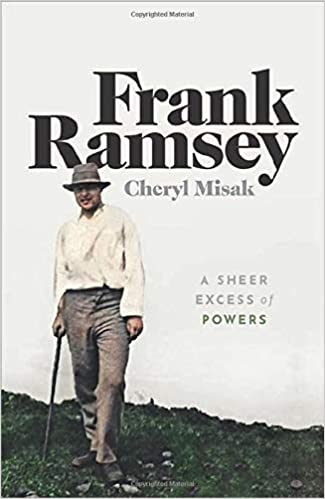
Cheryl Misak’s biography Frank Ramsey: A Sheer Excess of Powers is terrific. It’s the first full biography of the lost genius of economics, philosophy and maths – he died at the age of just 26 having already made fundamental contributions in each field, each of which has its Ramsey rule or principle. There’s also the ‘Ramsey effect’ of having a brilliant idea only to discover that Frank Ramsey had it first. There is an earlier biography of him by Karl Sabbagh, Shooting Star, which is also well worth a read but it doesn’t have the scale or ambition of this new one.

Misak takes us to the intellectual environment of the 1920s, Moore and also Russell ascendant in Cambridge philosophy, Keynes in economics, logical positivism and the Vienna circle getting into gear. The personal story – growing up in Cambridge as one of four children of a not particularly inspired and narrowly religious mathematics don – is threaded alongside the intellectual journey. Ramsey was sent to Winchester, which sounds hellish, then did the maths Tripos at Trinity College – his entire life centred on Cambridge.

As a teenage undergraduate student he was identified as the right person to translate Wittgenstein’s Tractatus – the only person who might understand it. Wittgenstein – what an absolutely dreadful man. I for one have also always found both early and late Wittgenstein totally unintelligible, although accepting there does seem to be a consensus that he was a genius. Ramsey seems to have thought so, while disagreeing with key arguments in the Tractatus; they continued their conversation until Ramsey’s death, albeit with Wittgenstein having a big sulk of several years in the middle, refusing to correspond with him.

Anyway, on graduation Ramsey was snapped up by Kings as a Fellow (at 21), and embarked on foundational work in mathematics with massively influential sidelines in Philosophy and economics. (The biography has useful boxes written by distinguished scholars explaining Ramsey’s main contributions in each field.) Economists such as Keynes and Pigou used him to check their maths, and he also reviewed submissions to the Economic Journal for Keynes. Sraffa was a friend. There are intriguing signs in his last paper that Ramsey would have taken forward the pragmatism of C.S.Peirce (another pretty unintelligible writer – or maybe it’s me and philosophy…). Who knows what other contributions he would have made in economics.

But Ramsey was no narrow, dull academic. He socialised with the Bloomsbury set, advocated free love, went to Vienna to be psychoanalysed, joined societies, played tennis, and like everyone at the time wrote countless letters – Misak has clearly spent vast amounts of itme in the archives.

A sheer excess of powers. A shooting star. Both seem apt descriptions. In just a few years he had published a dozen or so transformational papers spanning three fields. It must be Ramsey’s tragic early death that explains why he isn’t more widely known. This biography is my book of the year so far.

41EkntdNYUL._SX323_BO1,204,203,200_


Increasing returns in time and space

I’ve been mulling over increasing returns for a while (it will feature in my next book, Cogs and Monsters, in 2021) and returned to the question this morning as I prepare to write something on agglomeration economics for my colleagues Michael Kenny, Anna Alexandrova and Cleo Chassonnery-Zaigouche, for their research project Expertise Under Pressure. The essay question is pretty broad, concerning the influence economics has had on policy debates about cities. The key concept is that of agglomeration economies.

Going to the bookshelves – in imagination to the ones quarantined in my office and grabbing the ones at home off the shelves – I started on the agglomeration journey first with Paul Krugman’s 1991 Geography and Trade: “I have spent my whole professional life as an international economist thinking and writing about economic geography without being aware of it.” My copy is the 1995 paperback edition. The new economic geography was later crystallised in the textbook The Spatial Economy by Fujita, Krugman and Venables.

510NlW+Q-wL._SX332_BO1,204,203,200_

At about the same time, already intrigued by technology, I discovered Brian Arthur through Increasing Returns and Path Dependence in the Economy. To my mind the rebirth of economic geography – and economic history – is clearly linked to the spread of digital technologies, a link made so clear by Ed Glaeser in Triumph of the City and in terrific papers such as Non-Market Interactions, Information Technology and the Future of Cities, and Reinventing Boston.

Now for a weekend re-reading some of this good stuff.

512z9P3p7sL._SX328_BO1,204,203,200_

Lockdown reading

Like everyone, doing the normal day job seems to take longer, and then there’s the mad upsurge in corona-related webinars and meetings. With that and the loss of travel time, I seem to have been reading less. However, I have read a few interesting books.

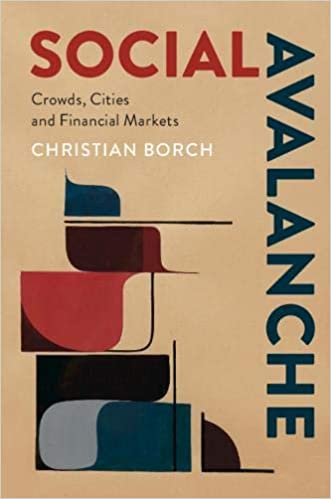
Two were thankyous from Cambridge University Press for some reviewing I did for them. Social Avalanche: Crowds, Cities and Financial Markets by Christian Borch takes a sociological lens to the kind of non-linear dynamics of some areas of economics – including agglomeration, or rational bubbles, say. It was an education for me to read about the ‘crowd theory’ of late 19th century and early 20th century sociology and its decline as the discipline drew away from the implication that people were easily turned from individuals who thought for themselves into an unthinking mob. Borch argues that the earlier theorists in fact saw a tension between individuality and social influence – which of course seems perfectly sensible when you put it like that. The book looks at cities and also at algorithmic financial markets, though I’m not sure the latter adds a lot to Donald Mackenzie’s fascinating work on high-frequency trading. Still, I enjoyed it, once I’d figured out the rhythm of academic sociology writing – hard going at first.

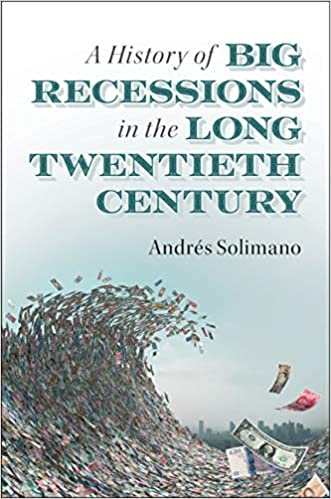
41R4tIro1VL._SX329_BO1,204,203,200_The other was A History of Big Recessions in the Long 20th Century by Andres Solimano. The text here is pretty broad brush so anybody who has read some economic history won’t get much out of the words. The translation was a bit patchy too: it took me a long time to realise that ‘Russian miltary mystic’ actually meant ‘mystique’ rather than a Rasputin-like figure I hadn’t heard of. But the assembly of all this data in one book is terrific, a great resource.

51z63meuI0L._SX329_BO1,204,203,200_I also read Matthew Syed’s Rebel Ideas: The Power of Diverse Thinking, which is a well-written journalistic take on Scott Page‘s marvellous books, including The Difference and The Diversity Bonus. Still, a very readable intro to the importance of cognitive diversity.

41hNuiVWC5L._SX324_BO1,204,203,200_ In between, a couple of Simenon novels – they are all marvellous and the new Penguin editions very stylish – and Maria Popova’s Figuring, which is hard to summarise but rather enjoyable.

31t0lvL6HWL._SX322_BO1,204,203,200_


Summer 1978

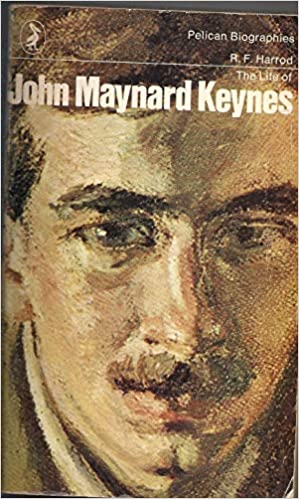
In my recent reminiscences about Peter Sinclair, one of the memories was that he had sent us pre-reading for the summer before we started at Brasenose. The one I could remember was Roy Harrod’s The Life of J.M. Keynes. As I write down in my notebook everything I read, I was able to go back to the summer of 1978 and see what else I had read before starting the course. Peter’s other choice, it turns out, was Economic Philosophy by Joan Robinson.

51ohbwolveL._SX297_BO1,204,203,200_Our philosophy tutor, the late Michael Woods, recommended Bertrand Russell’s The Problems of Philosophy. Vernon Bogdanor, presumably mindful of the limitations of the British A level curriculum and the first term’s politics course, suggested: America in the 20th Century, Democracy in France since the 18th century and  20th Century Russia.

It underlines again how lucky I’ve been in the education I received.

Experts: can’t live with them, can’t live without them

Thank goodness for some beautiful sunshine yesterday. We’re lucky enough to have a garden so I spent Sunday afternoon outside reading Sheila Jasanoff’s 1990 book The Fifth Branch: Science Advisers as Policymakers. If life goes back to something reasonably normal, I’m hoping we’ll be able to welcome her to Cambridge in the autumn. The issue of the role of scientific advice and scientists in policy decisions felt topical a while ago when we planned this kind of discussion; my goodness it’s topical now.

The book was researched and written during and after the initial Reagan assault on the legitimacy of government to regulate business. US politics was starting to polarise between free market, small government attitudes on the one hand and growing concern about environmental standards and other social issues on the other hand. In modern societies, the scope of areas where technical regulation is needed or useful is large. This context made the role of the expert adviser both more influential and harder to imagine as being completely impartial. It has also of course enabled some business lobbies – the ‘merchants of doubt‘ – to exploit the fact that scientists disagree about certain issues, even if majority opinion is clear. Although much of The Fifth Branch traces the tension in this specific American context – and particularly with the US adversarial legal tradition – it is now evident everywhere.

One of the threads runnning through the book is how scientists themselves act to establish their authority, the ‘boundary work’ to establish who is an expert to whom people (especially policymakers) should listen. Jasanoff also writes about the emergence of ‘science policy’ as distinct from science in academic or laboratory contexts, there being some important distinctions. Apart from the greater need on the part of policymakers for the state of knowledge rather than new work at the frontier, science policy incorporates some of the constraints of policymaking in the expert knowledge – for example, an understanding of what is politically feasible or what trade-offs policy decision-makers have to take into account. Decisions have to be made even if scientific evidence is inconclusive or not universally agreed in the expert community.

The growing band of experts advising government, as the complexity of societies increased and hence the need for technical input, constitute the ‘fifth branch. Michael Lewis’s terrific book The Fifth Risk (blog post here) alludes to this. He describes the destruction by the Trump Administration of the body of and access to scientific advice in the US now. It was a terrifying book even before the pandemic – for instance, this includes the nuclear experts safeguarding the stores of radioactive material in the western US. The Talking Politics podcast has an updated discussion here.

It is going to be interesting to see what happens to people’s trust in experts now. On social media there is some discussion among people realising that epidemiologists use models, and models whose predictions are highly sensitive to assumptions – in particular to the assumption of how widespread the virus is in the population. Will the post-pandemic era, whenever that is, lead to a re-evaluation of the epidemiologists’ authority? It will all depend of course on how things turn out.

One thing that’s clear is that – just as some economists predicted the 2008 financial crisis but never swayed the weight of opinion among financial policy-makers – some experts predicted a global pandemic but their warnings were not enough to get governments to prepare. As the Bennett Institute’s Steve Unger writes in this blog post, it’s hard to keep the sense of urgency about high impact but rare crises going for long in government. Now, though, thinking about ‘expertise under pressure‘ couldn’t be more timely. Any government would wish not to need science advice as much as they need it now – but they do, with all its uncertainties.

31pmhDcP5xL._SX331_BO1,204,203,200_