
Robot wars – the prequel

[amazon_link id=”B00BIOFLWE” target=”_blank” ]America’s Assembly Line[/amazon_link] by David Nye is fascinating. It’s a history of the origins of the assembly line and mass production, with a strong focus on the motor industry, and traces the spread of mass production through other manufacturing and non-manufacturing sectors (such as housebuilding). The organisation of the line evolved over time, and varied in different places. The imperative of wartime production was an important driver. Post-war, the cybernetics revolution led to far greater automation. On the other hand, the Toyota lean production system brought in greater flexibility for workers on the line.

[amazon_image id=”B00BIOFLWE” link=”true” target=”_blank” size=”medium” ]America’s Assembly Line[/amazon_image]

The public loved the product of the assembly line, affordable mass-produced consumer goods. “In a typical American town, a working class family that couldn’t afford both a bathtub and a car was more likely to opt for a car,” Nye writes of the 1920s. (There’s a parallel with the well known factoid about the greater prevalence of mobile phones than toilets in Indian households now – any kind of means of communication seems peculiarly compelling.) Access to assembly line products, alongside the growth of a suburban middle class, spread far faster in the US than in Europe.

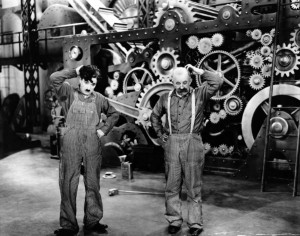
The relationship between machines and workers is an important theme in the book. Although Henry Ford famously paid $5 a day, double the going rate, many workers left before they qualified for it, so hard was the work. The unions had to fight hard to get recognition in the industry. The factories were notorious for robbing workers of any autonomy, and for speeding up the line to extract greater effort. Although 1927 had even brought a symphony to the Model T (premiered by the Boston Symphony Orchestra) he pressure of the assembly line soon became a frequent theme in films, songs and TV – Charlie Chaplin’s Modern Times being a prominent example.
The monotony and conformity of mass production also meant it was slow to spread in Europe, where the markets were anyway far smaller and therefore less able to sustain huge volumes. And there was a culture clash: “British workmen regularly stopped the assembly line for tea breaks.” More importantly, though, “No European nation could develop an American style production system unless it also embraced mass consumption.” None did before the war – the Soviet Union was most interested in Ford’s methods, but could not provide the workers capable of doing the jobs.

Through the post-war era, opinion divided between the welcome given to consumer products and welfare capitalism – Ford also offered savings plans, medical care in the factory, educational programmes – and the cultural distrust of conformity and the alienation of labour on the assembly line. The latter was, again, most pronounced in Europe. And yet European consumers were just as keen on cheap goods. Vice President Richard Nixon famously showed Nikita Kruschev around a model home at the American National Fair exhibition in Moscow in 1959 – Francis Spufford’ superb book [amazon_link id=”0571225241″ target=”_blank” ]Red Plenty[/amazon_link] brings this scene to life. Nixon presented Kruschev with a nice paradox about the benefits of mass produced goods and homes, in that American consumers had a vast choice: “We do not wish to have decisions made at the top by government officials who say all homes should be built in the same way.”

“Commodity fetishism meant that there was a widespread desire for what the assembly line produced but an equally widespread disdain for the work involved,” writes Nye. At the same time, concern began to grow – in line with automation – that the jobs involved were vanishing anyway. The fear of robots eliminating the need for humans emerged around this time.

No matter. Consumerist capitalism was even more heavily criticised by the counter-culture of the 1960s, culminating in 1968. And by the 1970s the far greater flexibility of the Toyota system was outperforming the rigidity of Fordism. By 1990, Volvo was advertising its abandonment of the assembly line. It had small teams assembling an entire vehicle. It took 4 months to train a Volvo worker, compared to 4 hours on a conventional line, but worker turnover was low and productivity high, and problems solved by individual teams with no spillover to the rest of the plant.

Yet the effect of automation on jobs remained a constant. The western economies ‘deindustrialised’. Detroit started its gothic decline – so well captured by photographers Yves Marchand and Romain Meffre in their book [amazon_link id=”3869300426″ target=”_blank” ]The Ruins of Detroit[/amazon_link]. and by the incomparable Bruce Springsteen, voice of blue collar America. Nye concludes: “Americans accepted mass production as though it were part of the natural order, with its subdivision of work, its interchangeable parts, and its organization of everyday life in terms of efficiency and productivity. Year after year they expected higher wages, more consumer goods and a general acceleration of experience. By 2013, however, this was an outdated and unsustainable economic order. The classic assembly line had been based on a large semi-skilled working class, not on robots and outsourcing.”

[amazon_image id=”3869300426″ link=”true” target=”_blank” size=”medium” ]The Ruins of Detroit[/amazon_image]

Robots, in short, don’t buy washing machines and fridges, and all the skills of the Mad Men won’t change that.

This book is an excellent companion read to the current robot debate – nicely summed up in this Economist article.

Why predictions about technology are always wrong

I’m greatly enjoying [amazon_link id=”B00BIOFLWE” target=”_blank” ]America’s Assembly Line[/amazon_link] by David E Nye. The early chapters are about the Ford Motor Company, and the way a number of incremental innovations in different processes added up to the huge social innovation of mass production. Professor Nye makes forcefully the point so many techno-enthusiasts overlook, which is that technologies have to be used as well as invented. As he points out, the Chinese invented gunpowder and used it for fireworks, the Aztecs invented the wheel – for children’s toys, and the ancient Greeks invented a steam engine but regarded it as a curiosity. I couldn’t agree more strongly with this theme of the importance of the social and cultural context for technology, and its productivity benefits.

[amazon_image id=”B00BIOFLWE” link=”true” target=”_blank” size=”medium” ]America’s Assembly Line[/amazon_image]

The chapter on the early stages of the Ford story set out in some detail the explanation Paul David gave in his well-known 1989 essay (pdf) The Dynamo and the Computer: An Historical Perspective for the length of time it takes for a technology – the electric dynamo, enabling factories to use electricity effectively – to be adopted. A key reason is the different kind of building needed for distributed power, rather than machines clustered around a central drive-shaft.

I often use Prof David’s point about “technological presbyopia” – this being the term for middle-aged eyesight, when short-sighted people like me become simultaneously long-sighted when it comes to small print. With any new technology, people have a tendency to over-hype the short-term effects massively (so we get tech bubbles) and under-estimate the huge long-term effects (for example, that railways made urbanisation possible). The error of hype is because new technologies often have such great wow factors. The error of not noticing profound change is precisely because many people find it hard to see the cumulative effect of all the many contextual changes needed for a technology to be widely used.

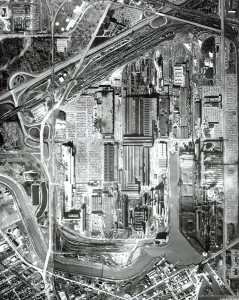
The Ford factory moved twice in relatively quick succession, from a 1904 plant in Piquette Avenue where the Model T was designed (3 stories high, a block long, 39 feet wide), to Highland Park (buildings dating from 1909 and 1914), where the first assembly line was created, to the River Rouge plant, operational from the 1920s, where the whole of the vertically integrated process from steel smelting to final product was co-located. The Highland Park’s buildings were built of steel-reinforced concrete and could carry heavy machinery on the upper floors. There was room to lay out an assembly line. The buildings were lighter, so workers could see better. The increase in productivity was stupendous – the price of a Model T car in 1910 dollars fell from $950 to $214 in 1921. And of course, Henry Ford famously paid his workers twice the going rate so they could afford to buy the product they were making.

The public fascination with the factories was intense. By 1916 Ford had 25 full-time tour guides. Even branch assembly plants had 20,000 visitors a year. River Rouge had 166,000 visitors in the year as late as 1940. It’s hard to imagine now. (You can still visit it.) There are industrial museums, of course, and some historic sites such as Cadbury World in Bournville (main purpose of visit seems to be buying chocolate, though) and attract tourists but not factories still in operation. It’s a shame. I’ve been lucky enough to make lots of visits to factories in various jobs, and always find it fascinating.

River Rouge complex from above

Turing’s Cathedral, remarkable men and even more remarkable women

I’ve loved this book, [amazon_link id=”014101590X” target=”_blank” ]Turing’s Cathedral: The Origins of the Digital Universe[/amazon_link] by George Dyson. It’s a history of the days when computers were so new and rare that they had names – ENIAC, MANIAC, JOHNNIAC, Baby – and of the early history of the Institute for Advanced Studies at Princeton, and of bits of the career of John Von Neumann and other mathematicians and engineers. It’s the story of the days when the world had 53 kilobytes of random access memory altogether, a significant proportion of them in Princeton, New Jersey.

[amazon_image id=”014101590X” link=”true” target=”_blank” size=”medium” ]Turing’s Cathedral: The Origins of the Digital Universe (Penguin Press Science)[/amazon_image]

It’s also about the relationship between the Second World War, and subsequent military funding for Cold War atomic research, and digital innovation. Military needs so often drive major technological innovations. Part of the story concerns Norbert Wiener and Julian Bigelow, researching how to improve the trajectory of anti-aircraft fire during the war, as London was blitzed. My late mother, as she explains in this video, sat outside the gun emplacements in East London during the Blitz shouting instructions to gunners as they aimed at aircraft overhead – she could have done with the innovation a bit sooner. (It was lovely to have this excuse to watch it again and remember her on UK Mothers’ Day.)

One of the things I love about the story is the sense it gives of the atmosphere of the new research establishment and the personalities, and the way invention rests on both a collection of happenstances and a large number of individuals. Turing’s Cathedral has similarities to some other recent histories of innovation, such as Jenny Uglow’s outstanding [amazon_link id=”0571216102″ target=”_blank” ]The Lunar Men[/amazon_link].

Dyson is very good at describing the people involved, all extraordinary, from John von Neumann down. For example, a paragraph summing up Gödel’s famous incompleteness result (which I sometimes think I understand, if I concentrate hard – after all, I did read Douglas Hofstadter’s [amazon_link id=”0140289208″ target=”_blank” ]Gödel, Escher, Bach[/amazon_link] – twice) is followed by this:

“After retreating to the sanatorium at Purkersdorf, where he was diagnosed with nervous exhaustion, he returned to Princeton in September of 1935, where he fell into an even more severe depression, resigning his position and returning to Austria at the end of November. He readmitted himself to the sanatorium in Rekawinkel, and then recovered sufficiently to spend several weeks with his future wife, Adele Nimbursky (nee Porkert), a Viennese cabaret dancer.”

Whoah! Tell me more about the Viennese cabaret dancer! The IAS website tells me he had met her when he was 21, in the Vienna nightclub ‘The Moth’. It was his second relationship with an unsuitable older woman, to the annoyance of his parents.

I also like Bernetta Miller, an administrator at the IAS in its early days. She was the fifth woman to get a pilot’s licence in the US, received the Croix de Guerre in World War I for assisting the injured Allied troops and visiting the front lines to take cigarettes to the men, and then became bursar of the American School in Istanbul. After the war she settled with her partner Betty Faville, and stood between Albert Einstein and the world until fired by Robert Oppenheimer, who didn’t like her. He goes down in my estimation, I must say. Strong women – like Bernetta Miller and indeed Kathleen Coyle – not only helped win the war, but were vital to the far harder task of building post-war society.

Bernetta Miller

There’s so much more, most of it about the construction of the computers. Do, do read it. I’ve not quite finished yet, but this line from the Introduction sums up the book: “In answering the Entscheidungsproblem [David Hilbert’s ‘Decision problem’], Turing proved that there is no systematic way to tell, by looking at a code, what that code will do. That’s what makes the digital universe so interesting, and that’s what brings us here.” We don’t know where we’re going, but it helps to understand the origins.

Digital origins and robotic futures

I’ve been waiting for ages for the paperback of George Dyson’s [amazon_link id=”014101590X” target=”_blank” ]Turing’s Cathedral: The Origins of the Digital Universe[/amazon_link], and a couple of chapters in am already *loving* it. It’s the kind of book that stuffs in all sorts of information, well suited to a magpie mind like mine. For example, did you know that Francis Bacon knew in 1623 that two symbols sufficed to represent all information? “A man may exprese and signifie the intentions of his mind, at any distance of place, by objects … capable of a two-fold difference onely.” Turing of course formalized this in his 1936 paper. He noted: “Being digital should be of more interest than being electronic.” The electronics distracted us, however. Dyson follows this section with a diversion into the history of the site of Princeton’s Institute for Advanced Study during the Revolutionary War. Perfect.

[amazon_image id=”014101590X” link=”true” target=”_blank” size=”medium” ]Turing’s Cathedral: The Origins of the Digital Universe (Penguin Press Science)[/amazon_image]

Coincidentally, I was reading bits of and about Bacon’s [amazon_link id=”1440042500″ target=”_blank” ]Novum Organum[/amazon_link]  recently, particularly about his notion of myths that distract us from scientific knowledge. The key myth or ‘idol’ he labels ‘Idols of the Market Place’: “Men associate through conversation, but words are applied according to the capacity of ordinary people. Therefore shoddy and inept application of words lays siege to the intellect in wondrous ways.” This was for my presentation at The Story 2013, in which I talked about the usefulness of models and equations, rather then verbal narratives, for describing aspects of the world. After all – as Margaret Bray and others have pointed out – the London Underground map is a useful model, not an accurate representation of London’s geography.

[amazon_image id=”1176418432″ link=”true” target=”_blank” size=”medium” ]Novum Organum[/amazon_image]

A useful model

Robots have been on my mind anyway, having been thinking about Luddites and jobs. This book, [amazon_link id=”1448659817″ target=”_blank” ]The Lights in the Tunnel[/amazon_link] by Martin Ford, looks rather interesting, from this extract from the introduction. I couldn’t agree more with this statement: “The evidence is pretty clear: a race between technology and our ability to reform our political and economic systems is really no race at all. So if we can foresee that technology is likely to have a highly disruptive impact on our economy in the coming years and decades, then we really need to start thinking about that well in advance.“

[amazon_image id=”1448659817″ link=”true” target=”_blank” size=”medium” ]The Lights in the Tunnel: Automation, Accelerating Technology and the Economy of the Future: 1[/amazon_image]

Robots and Luddites

For various reasons, I’ve been thinking about Luddites. My husband called me a Luddite for mildly complaining that our TV set-up has become so complicated that I no longer know how to play a DVD. Seriously, though, the ‘robots are eating our jobs’ argument has been gaining traction – in the interesting Brynjolfsson and McAfee book [amazon_link id=”0984725113″ target=”_blank” ]Race Against the Machine[/amazon_link], in Paul Krugman’s Robots column, and assessed in this recent Economist survey article (with handy links).

Oddly this is simultaneous with the interest in Robert Gordon’s argument that the days of significant technology-driven productivity gains are over, in his paper Is US Economic Growth Over? The awesome analytical power of economics tells us these arguments can’t both be true at the same time, even if it doesn’t tell us which one is correct.

Luddites have an unfair reputation, as if they should have realised that the tide of technological change was unstoppable so why bother protesting? Eric Hobsbawm once argued (in The Machine Breakers) that there wasn’t a big difference between the Luddites of 1811-13 and the “collective bargaining by riot” that had been going on for donkey’s years. Besides, expressing opposition to one’s job becoming technologically redundant is highly (individually) rational. In my part of the world, East Lancashire, the big riots were in the 1820s – our ‘local’ riot was written up in the lovely book [amazon_link id=”1871236177″ target=”_blank” ]Riot! [/amazon_link] by William Turner. The ‘[amazon_link id=”0140600132″ target=”_blank” ]Captain Swing[/amazon_link]’ riots in the South occurred in the 1830s.

Machine-prompted industrial unrest is the result of the combination of the normal innovation-driven dynamics of capitalism with the failure of the system to find a way of sharing productivity gains outside their originating sector. So inequality, not innovation, is why the robots matter now.