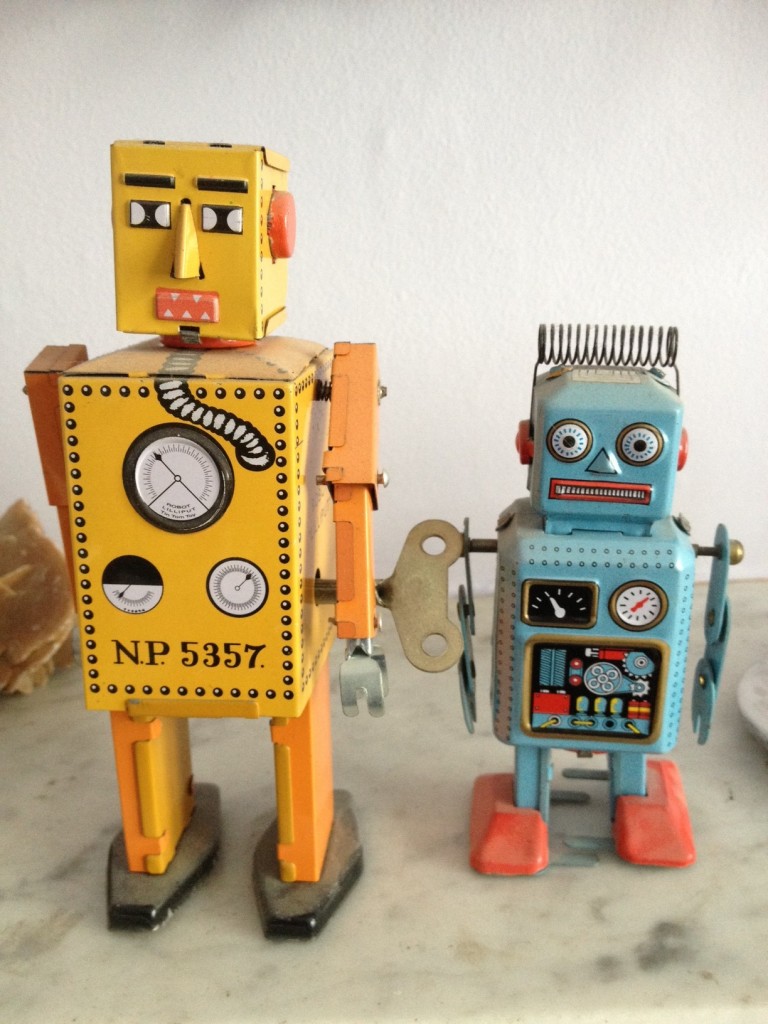
The robots are coming. Or are they?

This morning I warmed up for work by reading some intriguing articles that have been much linked-to in recent days: an interview with Jaron Lanier about his new book [amazon_link id=”1451654960″ target=”_blank” ]Who Owns The Future?[/amazon_link]; a Mother Jones article Welcome Robot Overlords, Please Don’t Fire Us; and an essay about how the intellectual left must re-engage with practical political economy.

[amazon_image id=”1451654960″ link=”true” target=”_blank” size=”medium” ]Who Owns the Future?[/amazon_image]

All three articles are inspired by the economic precariousness of the (former?) middle classes, the loss of jobs in the middle of the income distribution compared to the top and bottom, and the downward dip in real incomes in the middle too. We’re not scared about robots turning rogue and killing humans, but we are scared about them taking on the 9-to-5 grind, the commute, the office politics…. Robot angst has also shown up in economics with the excellent book by Brynjolfsson and McAfee, [amazon_link id=”0984725113″ target=”_blank” ]Race Against the Machine[/amazon_link], and in Paul Krugman’s blog posts.

[amazon_image id=”0984725113″ link=”true” target=”_blank” size=”medium” ]Race Against the Machine: How the Digital Revolution is Accelerating Innovation, Driving Productivity, and Irreversibly Transforming Employment and the Economy[/amazon_image]

The underlying hypothesis is that the way robots substitute for humans today is different from the way machines have substituted for us in the past; that they can now perform cognitive rather than physical tasks and the technical change is therefore capital-biased. It will be good for capital but not people. The ‘therefore’ in that sentence is an assumption, which might turn out to be true. I have an open mind on it.

However, there are some questions I’d pose before we let technological determinism run away with us.

1. The pattern of shifts in employment and income distribution – the hollowing out of the middle – is common to all OECD countries but rates of robotisation differ widely. What’s the linkage?

2. Why has automation so far coincided with increases in returns to education but will from now on be linked to decreasing returns to education?

3. The debate tends to focus on creative and routine admin or manufacturing jobs but the most heavily-automated sector of the economy is finance, which has seen the biggest increases in real incomes. How has this happened and why would it be different elsewhere?

My alternative hypothesis is that the returns to any new technology, whatever its bias, will be determined by social and political factors. So that leads me to think James Harkin’s LA Review of Books essay challenging people to stop being distracted by ‘nudge’ politics and think about the classic political economy questions of social structure and income distribution is the most optimistic of this morning’s three reads.


Big data 2.0

As I read a long Foreign Affairs article about Big Data and its ramifications this morning, it struck a real chord with a passage I’d just read in James Gleick’s interesting (although rambling) book [amazon_link id=”0007225741″ target=”_blank” ]The Information[/amazon_link].

[amazon_image id=”0007225741″ link=”true” target=”_blank” size=”medium” ]The Information: A History, A Theory, A Flood[/amazon_image]

He describes the use of the newfangled telegraph to send for the first time almost instantaneous news about the weather in different, distant parts of the country – fine in York, raining in Manchester. “The telegraph enabled people to think of the weather as a widespread and interconnected affair, rather than an assortment of local surprises.” Gleick quotes a commentator of 1848: “The telegraph may be made a vast national barometer.” (Tom Standage’s [amazon_link id=”0753807033″ target=”_blank” ]The Victorian Internet[/amazon_link] is a brilliant book about this particular communication medium.)

The possibility of weather reports led to the 1854 etablishment of the Meteorlogical Office by the Government, headed by Admiral FitzRoy, famously captain of [amazon_link id=”014043268X” target=”_blank” ]The Beagle[/amazon_link]. In 1860 he began issuing the first weather forecasts. The science of meteorology, and understanding of a global interconnected system, was built on the foundation of the local weather information conveyed by telegraph.

The new book, [amazon_link id=”1848547900″ target=”_blank” ]Big Data[/amazon_link], by Cukier and Mayer-Schoenberger appreciates the transformative scope of today’s Big Data 2.0 – in the article they write: “Big data is different: it marks a transformation in how society processes information. In time, big data might change our way of thinking about the world.” What the change will be is impossible to predict.

[amazon_image id=”1848547900″ link=”true” target=”_blank” size=”medium” ]Big Data: A Revolution That Will Transform How We Live, Work and Think[/amazon_image]

What will the robots do for us?

The social and economic aspects of new technologies have been my abiding interest for years, naturally from the perspective of my training as an economist.[amazon_link id=”0262018624″ target=”_blank” ] Robot Futures [/amazon_link]by Illah Reza Nourbakhsh has the same interest from the perspective of a Professor of Robotics, and director of the Community Robotics, Education, Technology and Empowerment Lab at Carnegie Mellon. It’s an eye-opening book (and a short, clearly written one).

[amazon_image id=”0262018624″ link=”true” target=”_blank” size=”medium” ]Robot Futures[/amazon_image]

There are two key messages I took from the book. First, we’ve already gone a long way towards weaving robots into everyday life without realising it. The advances in the physical manifestations of robots (which Prof Nourbakhsh divides into perception, cognition and action) will before long join up with recent innovations online, in the pooling of information including from social media. The issues we’re grappling with such as online privacy and identity will move off the screen onto the pavement. We might soon meet robots on the street who know everything about us. Already due to smartphones, he writes: “Nothing is transient because everything can be captured and shared. Expectations of privacy have to shift….. As robots decide automatically just what to record and publish, so our sense of internet identity will have to change. We humans will no longer be the only species that records events and publishes them online…. When you run into a well-connected robot, it will be unclear from first impressions whether the robot knows everything about your day….”

Or, to take another example, prosthetics and robotics are merging already; how far should that merger go? Science fiction ([amazon_link id=”0586057242″ target=”_blank” ]I, Robot[/amazon_link] and on) is stepping into life, and there are countless emotional, ethical and other issues.

The second message is about the economic and political issues, and is that unless there is a public debate about advances in robotics, their development will be commercial. As the book puts it, the early adopters are business and the military. Prof Nourbakhsh writes: “I have served on funding boards and I have seen technical content dwarf social impact in the eyes of nearly all the reviewers in the room. This needs to change; broader impact must become an authentic criterion for funding.” His lab specializes in socially focused robotics development, but I don’t imagine there are many others, or much social science thinking about the issues yet. There needs to be – it will be upon us soon.

The book has a useful summary of the state of robotics research, which has been uneven. Batteries/energy are still a big hurdle. It opened my eyes to the diversity of machines gathered under the term, including industrial robots, those innovative joints restoring movement to injured or disabled people, drones, household devices and so on. It touches on the ethics of how robots should be treated: “Never before have we had the chance to dehumanize socially agile non-humans. If this happens, then we face the odd technological side-effect that, as we dehumanize our relationships with robots, so we may incidentally dehumanize our relationships with people.”

In short, a lot of food for thought in 130 pages (albeit somewhat steeply priced).

These robots are nice but dim…

Machines and foreigners

I’ve been reading in the area of overlap between labour market analysis, theory of the firm and trade theory. Well, to be strictly accurate, at the edges of those three areas of economics closest to each other, for their isn’t all that much overlap. David Autor comes closest in his recent work on inequality, technology and globalization. Richard Baldwin and others have come at it from the other side with their work on trade in tasks, bringing trade theory closer to theories of production. There’s more on the overlap between technology and the labour market of course. Standout books for me are Claudia Goldin and Ian Katz, [amazon_link id=”0674035305″ target=”_blank” ]The Race Between Education and Technology[/amazon_link], and Frank Levy and Richard Murnane, [amazon_link id=”0691124027″ target=”_blank” ]The New Division of Labour[/amazon_link].

[amazon_image id=”0674035305″ link=”true” target=”_blank” size=”medium” ]Race between Education and Technology[/amazon_image]

In addition there has been the whole recent ‘the robots are eating our jobs‘ riff – but I’m more convinced than ever that this is over-simplified. For one thing, you just can’t think properly about the robots without adding offshoring and trade into the mix. Just as a shift in the ease of trade is similar to an advance in technology in its economic effects, a big increase in the potential for using foreign workers for some functions is similar to using more technology.

I’ll be writing something up eventually and will post it when I do.

MOOCs versus universities?

Online higher education experiments are proliferating, and some of the world’s most distinguished and ancient universities are dipping their toes into the new technology-enabled possibilities. It is absolutely certain that the technology will disrupt the university business, as the conventional pathway to higher education has become much more costly. I mean this literally – not that students are being charged more or that government funding has been cut or the structures changed, but that the main cost of delivering higher education is the salary bill for staff and the higher education sector is affected by [amazon_link id=”0300179286″ target=”_blank” ]Baumol’s cost disease[/amazon_link]. So as soon as substituting some capital for labour (or some peer-provided labour for paid labour) becomes possible, as with online courses, some universities will do so.

What is not at all clear is the form the technological disruption will take. Just recently, I’ve come across a couple of interesting essays on the issues at stake. One is William G Bowen’s [amazon_link id=”0691159300″ target=”_blank” ]Higher Education in the Digital Age[/amazon_link].

[amazon_image id=”0691159300″ link=”true” target=”_blank” size=”medium” ]Higher Education in the Digital Age[/amazon_image]

In the first half his focus is the unsustainable cost pressure and the scope for productivity improvement. He notes that the technology has already led to some improvements in the ‘scholarly infrastructure’ – JSTOR and online libraries facilitate research, as does the capacity for data-based empirical work impossible before cheap computer power and online data sources. Collaboration has become easier. Students can take tests online and their work can be marked by machine in some cases. In the second half Bowen turns to the implications of the technology revolution. He is moderately sympathetic to MOOCs and in particular their scope for enhancing access to higher education, but pleads for a portfolio approach to instruction and argues against the disintermediation of human instructors. Universities are particularly important as institutions, he argues, to defend freedom of thought and pass on values to successive generations of students. While agreeing in theory, one does have to question how impressive all universities are as institutional bulwarks, or how brightly all academics shine as role models for their students. After all, although we’re no longer in the era of [amazon_link id=”1447222814″ target=”_blank” ]The History Man[/amazon_link], many academics have no interest in their teaching responsibilities and are entirely focused on their own research and careers.

Another essay is by Andrew Delbanco (who also comments on Bowen’s essay in his book), drawing from his forthcoming book [amazon_link id=”0691130736″ target=”_blank” ]College: What it Was, Is and Should Be[/amazon_link]. (I’ve not yet read this).

[amazon_image id=”0691130736″ link=”true” target=”_blank” size=”medium” ]College: What it Was, Is, and Should Be[/amazon_image]

He notes that there is already – at least in the US – quite a wide range of higher education offers, in for-profit universities and online courses as well as cheaper community colleges, albeit all looked down on by the grand universities. There is some variety in the UK too, with the Open University, Birkbeck, Buckingham University, FE colleges. Delbanco also notes the great hopes for TV as a means of extending educational access – the OU in Britain used TV broadcasts as course material pre-internet; indeed my big brother used to appear lecturing on chemistry, and the family would gather round the set at an ungodly hour in the morning to watch him talk about things we didn’t understand at all.

This is a useful reminder, because it flags up one function of higher education neither author writes about, namely the signalling role of a degree (see Mike Spence’s models). The signal a Princeton or Oxford degree sends to potential employers is at least as important as the improved quality of education a student might have received there. Attending university is also a positional good because access is limited, and all the more so as fees rise. So MOOCs will have big consequences for traditional universities, but need not be an existential threat to the best of them.

Delbanco concludes that face-to-face will always be important in HE: “No matter how anxious today’s students may be about gaining this or that competence in a ferociously competitive world, many still crave the enlargement of heart as well as mind that is the gift of true education. It’s hard for me to believe that this kind of experience can happen without face-to-face teaching and the physical presence of other students.”

I agree with him that human encounters will always be part of learning, for the transfer of tacit knowledge, the stirring of the passion to understand, the exchange of complex ideas. I’m less certain this has to happen in universities. Philosophy cafes, public lectures, book clubs and the like may well substitute for formal teaching in a university, especially when the quality of the latter is mixed at best and dismal in many cases.

Both Bowen and Delbanco see the technology as an opportunity to spread learning and the love of learning, and so it is. It has spread access to ‘books’ and music and images already. Yet it seems to me highly likely that many universities will be as thoroughly disintermediated as the gatekeepers of other parts of the culture, and this will not be a bad thing. If I were running a university now, I’d be focused on the quality of the core purposes of the institution – including the quality of teaching, the poor relation in too many of them – because the more-or-less captive market is being liberated. I would also look to use online offers to change the character of the university experience rather than making it a cut-price version of the existing product. Why not build a community of learners and researchers out of previous students or local communities? Why not at the same time open the physical space of the university much more to the local community? Shouldn’t they be running their book clubs on campus, and be able to borrow e-books from the library?

We’ll end up with a much wider variety of means for people to learn, at all stages of their lives not just 18-21. We might or might not end up with more innovative and better universities depending on how well they respond to the challenge.