Not all automation is equal

Democratic Capitalism at the Crossroads: Technological change and the future of politics by Carles Boix is a good complement to the widely reviewed The Technology Trap by Carl Frey. It takes a political science perspective on the same deep trends in technology, and even uses the same geographic shorthand for the succession of technological/economic paradigms: Manchester, Detroit and Silicon Valley.

Coming from a different perspective, Boix provides new-to-me insights, and particularly about similarities between the sucessive technological revolutions. For example, in an 1835 book, The Philosophy of Manufactures, Andrew Ure described the factory as “a vast automaton composed of various mechanical and intellectual organs, acting in uninterrupted concert for the production of a common object, all of them being subordinate to a self-regulated moving force.” Echoes of cybernetic visions – see for example Eden Medina’s fantastically interesting Cybernetic Revolutionaries on Project CyberSyn. Or a 1934 book, The Mechanization of Industry by Harry Jerome, which estimated that almost half the labour productivity gains in the first 30 years of the 20th century resulted from “the mechanization of the handling systems”. Echoes of the role of logistics now, for example set out in the McKinsey’s study into US productivity in the late 1990s – Walmart and wholesaling.

After the historical section, Boix goes on to the implications for politics today, and particularly the increased vote for extremist parties – the highest since the 1930s. Writing this on the day “Boris”Johnson is expected to become the UK’s prime minister, with Donald Trump beginning extra-judicial deportations from the US, and strongmen on the march in other countries, it is hard to be optimistic. However, Boix, like Frey, implicity raises one question without addressing it: what made the production paradigm of the mid-20th century. which also led to massive automation, able to deliver widely shared gains, and why is the direction of the earlier and later technological revolutions so different? I haven’t seen a persuasive answer.

415Rzs1j8qL._SX327_BO1,204,203,200_

An Adam Smith for our times

Jesse Norman is one of the most thoughtful of the UK’s MPs, a principled Conservative, and has followed up his earlier biography of his hero Edmund Burke with Adam Smith: What He Thought and Why It Matters. It’s an excellent overview of Smith’s life and work. It would make a terrific read for economics students but also has much to interest those who’ve read every book about Adam Smith going. Like many recent books about Adam Smith (such as Emma Rothschild’s Economic Sentiments and Nicholas Phillipson’s biography An Enlightened Life), it reclaims the Theory of Moral Sentiments as having equal importance to The Wealth of Nations.

Part of Jesse Norman’s aim is to dissociate Smith from the ‘free market’, invisible hand caricature of many conservative economists and thinkers. The first part of the book is a pretty standard biography, nicely done. The second part is a history of how neoclassical economics came to hijack Adam Smith, stripping away from his thinking much of its richness and depth, not only in terms of human behaviour (not narrowly self-interested in Smith) but also in terms of institutional context (dynamic, contingent, evolutionary). The book has a nice section on Vernon Smith, whose experimental work in the 1980s was an early critique of the assumptions of neoclassical general equilibrium theory. In effect, it argues, much of modern neoclassical economics as it peaked in the late 20th century was foreign to Smith’s approach. What Smith did do was: “Set out the field of political economy with markets at its centre,” but in a way that makes institutions and historical sensibility equally central.

(There is also a section on Smith’s strong, principled opposition to the slave trade. It can never be said often enough that economics got the label ‘the dismal science’ from Carlyle because economists were prominent campaigners against slavery.)41Rqw3Bgi4L._SX324_BO1,204,203,200_The book ends with a section on ‘why it matters’ and what a Smithian perspective would be on the economy now. Norman notes the tyranny of the arid mainstream perspective in policy economics right up to the financial crisis (although academic economics had by then already started to move decisively away from free marketism): “What is so striking about that crisis in retrospect is not, even, the egregious self-enrichment of the previous decade, or the specific failures of policy, law and enforcement involved. It is the intellectual grip which the language of free markets held on almost all the parties concerned, regardless of the often very different reality.” Indeed, free marketism still has a strong grip on policy, given that so many policymakers were trained in their economics when it was still at its peak.

What is to be done about this. “We need a new master narrative for our times,” Norman writes (italics his). The book calls for political renewal too. Who could disagree? (Although that makes it disappointing that Jesse Norman declared himself a supporter of Mr Johnson in the current Conservative leadership campaign.) It concludes, of course, that returning to the true Adam Smith can help shape the new narrative with markets still central to economic life but understood in the context of a political economy in which institutions, historical context and human nature play their proper role.


Thinking strategically about platforms

Digital platforms have been very much a focus of policy attention of late, with reports on the problems and challenges they raise published by the UK (several, including the Furman Review), Australia, Germany, European Commission & others. The platforms these various reports discuss are the big ones, and the concerns range from competition policy to employment practices to online harms.

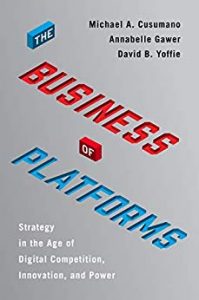
A terrific new book by Michael Cusumano, Annabelle Gawer and Devid Yoffie, The Business of Platforms, points out though that most of the digital platforms that are not big are dead: four in five fail. The book is aimed at people running or starting platforms, offering advice on (as the subtitle puts it). “Strategy in the Age of Digital Competition, Innovation and Power).” The book very nicely links business strategy to the underlying economic characteristics of digital, and I think is probably in this respect the best tech business book since Shaprio and Varian’s (now old, 1998) Information Rules.

It starts by pointing out that there is nothing inevitable about network effects (direct and indirect) kicking in: they have to be nurtured: “Companies and governments have to make the right srategic and policy decisions in order to drive strong network effects.” These can include technical standards, for example, or ensuring competition thrives at the right times and points. The book also distinguishes between two types of platform, requiring different strategies (although there are a groing number of hybrids). Innovation platforms create value by enabling third parties to develop products or service on top of the platform, while transaction platofrms create value by matching different sides of a market.

Key challenges for all, though, involve solving the ‘chicken and egg’ problem (because different sides of the platform depend on each other) by appropriate pricing and cross-subsidy, and figuring out a business model. (And in my view the dependence of so many on advertising is a major weakness & can’t be sustained). The book uses the framework to explore the many platform failures. It also has a chapter on how non-platform incumbents can respond to the digital challenge (it’s tough…), and looks briefly at issues such as the use and governance of data, and also the importance of working with regulators rather than against them and recognizing the responsibilities that come with (market and other) power. “Every major company we cited in this book has been the subjject of government investigations, local regulatory oversight, and intense media scrutiny.”

All in all, highly recommended. If you know the economics, the case studies and management literature covered will be informative, and if you know the business details, the economic framework should be useful. I very much enjoyed reading it.

41rS0XlCETL._SY346_


Industrial policy – back to the future?

Jon Agar’s new book, Science Policy Under Thatcher, is an interesting dissection – based on newly released government documents from the National Archives – of the u-turn in science policy in the UK in 1987. The campaign against cuts to government funding of research had begun a year earlier, with the launch in January 1986 of Save British Science. Agar argues that those cuts did not mark a specific science policy shift; that came the following year with three changes: a restructuring of science advice to government to increase central control of the machinery; the document A Strategy for the Science Base, which distinguished three tiers of institution, namely a few research-intensive universities, teaching-focused centres, and near-market entities; and finally – under the ideological influence of the Number 10 Policy Unit and its adviser George Guise – a focusing of government funds on pure, ‘curiosity-driven’ science and major cuts to near-market research funding, along with the privatisation of government research labs undertaking such activities.

This was a significant shift away from the previous conventional wisdom. It had emphasised the need for government-funded research to deliver identifiable economic returns. For the Thatcherites, this meant the bad old ways of winner-picking, and civil servants pre-empting the decisions of private sector managers and investors who were far better placed to take risks and judget markets. The switch to funding ‘market failure’ pure science was part and parcel of the dumping of industrial policy (a contradiction in terms, more or less, to the free marketeers).

Interestingly, we have now a policy u-turn back through another 180 degrees. And although I strongly support the need for government to engage with research across the entire spectrum from far from market to near-market, there is a danger of making the same mistakes all over again as policy makers go back round the goldfish bowl. The enthusiasm for ‘sector deals’ makes me very uneasy, as these are almost always the outcome of successful lobbying efforts, and probably encouraging anti-competitive outcomes. After all, which companies are in the ‘auto sector’ today – and which will be in 10 or 15 years? What about new entrants – how do they get in on ‘sector deals’? Similarly, although ‘mission oriented’ policy is terrific in theory – who could argue with a mission like ‘decarbonise the economy’ or ‘deliver high quality social care’ – in practice it risks translating into officials getting involved in battery technologies and enthusing consultancies with the potential new opportunities.

The experience of the 1980s should also make those interested in science policy and industrial policy now reflect a bit before concluding that back to the pre-1987 future* is the right way forward. ‘Should the government mainly fund basic science or near-market research?’ is the wrong question. Governments of course should fund basic science, which is a classic market failure. But the policy challenge isn’t about money so much as co-ordination and facilitation – ensuring industry standards emerge fast enough and at the right level to grow new markets, enforcing competition law, using government procurement to give investors confidence there will be demand for innovations in areas such as health care or education, making sure the financial tax and regulatory system provides incentives to invest in growing tech businesses, and so on.

The overview of the 1987 policy switch is contained in the final chapter of the book, and as it contrasts with previously-published versions of Thatcher’s science policy there will no doubt be further debate about it among historians of science policy. Agar’s account seems (to this non-expert) very well documented and persuasive. The earlier chapters single out specific issues or episodes, such as civil nuclear power, the environment, and the public debates over AIDS and IVF (the Warnock Commission – my colleague Sarah Franklin and her team have done tremendous archival and interview-based research on this). The book could have done with a bit more synthesis as it’s easy to get lost in the weeds. On the other hand, the detail is deeply fascinating for anybody interested in the mechanics of government and policy-making. I really enjoyed reading it.

41DKy7B2g6L._SX331_BO1,204,203,200_

*The UK government provided John DeLorean with significant fiscal incentives to produce his futuristic car – which was then only used in the movie Back to the Future

Social butterflies?

When somebody is called a social butterfly, it isn’t usually a very positive evaluation. Social Butterflies: Reclaiming the Positive Power of Social Networks by Michael Sanders and Susannah Hume use the term in a neutral, descriptive way to characterise modern life: fluidity between social categories, more means of communication with more people, and above all amplified mutual influence – for good but also, very obviously, bad, whether that’s bank runs or fake news. As they write, “The rise of social media has sent our social instincts into overdrive.” Not so much butterflies as scorpions online, perhaps.

The book is a behavioural economics perspective on social capital – both the authors were previously researchers at the UK’s Behavioural Insights Team aka Nudge Unit. It starts with a section on group behaviour. looking at the ‘them and us’ instinct and resulting stereotyping and discrimination. It then moves on to social choice architecture – how can nudges be used to shape positive social interactions and outcomes. This includes questions such as how social norms shift, how habitual behaviours shift, how information moves through social networks, and shaping group dynamics. Then there’s a final part discussing policy interventions to build social capital: “Our aim with this book is to sketch out a roadmap to a society where there is more belonging, more trust and – we hope – less discrimination and confirmity.”

These days this seems like a forlorn hope. As the Conclusion observes, the authors started out writing in a mood of cheery optimism and then, well, stuff happened. It’s no coincidence that academic interest in social capital (including ours at the Bennett Institute) has revived after quite a long hiatus, given the state of the world and the polarisation evident in some may countries and political systems. Furthermore, they observe, social influence has negative connotations of pressure to confirm, for many people. I’m not wholly persuaded that nudge approaches are the answer to the apparent decline in social capital or trust; they turn the lens on individuals and the book is full of jolly examples of individual change. Although society is composed of individuals, perhaps collective outcomes are not best thought of as the sum of individual choices… is the solution to the problems inflicted by social media to be found in the choice architecture of Facebook and Twitter? For sure their engineering principles should take account of the social consequences but I wouldn’t want to rely on that.

Still, the book does have lots of interesting examples, relevant to people running teams or organisations as much as to policymakers. It’s engagingly written – and is for sure asking an important question.

5185mShiLwL._SX323_BO1,204,203,200_