Configuring the lumpy economy

Somebody at the University of Chicago Press has noticed how my mind works, and sent me Slices and Lumps: Division + Aggregation by Lee Anne Fennell. It’s about the implications of the reality that economic resources are, well, lumpy and variably slice-able. The book starts with the concept of configuration: how to divide up goods that exist in lumps to satisfy various claims on them, and how to put together ones that are separate to satsify needs and demands. The interaction between law (especially property rights) and economics is obvious – the author is a law professor. So is the immediate implication that marginal analysis is not always useful.

This framing in terms of configuration allows the book to range widely over various economic problems. About two thirds of it consists of chapters looking at the issues of configuration in specific contexts such as financial decisions, urban planning, housing decisions. The latter for example encompasses some physical lumpiness or indivisibilities and some legal or regulatory ones. Airbnb – where allowed – enables transactions over excess capacity due to lumpiness, as home owners can sell temporary use rights.

The book is topped and tailed by some general reflections on lumping and slicing. The challenges are symmetric. The commons is a tragedy because too many people can access resources (slicing is too easy), whereas the anti-commons is too because too many people can block the use of resources. Examples of the latter include redevelopment of a brownfield site where there are too many owners to get to agree to sell their land but also patent thickets. Property rights can be both too fragmented and not fragmented enough. There are many examples of the way policy can shape choice sets by changing them to be more or less chunky – changing tick sizes in financial markets, but also unbundling albums so people can stream individual songs. Fennell writes, “At the very least, the significance of resource segmentation and choice construction should be taken into account in thinking innovatively about how to address externalities.” Similarly, when it comes to personal choices, we can shape those by altering the units of choice – some are more or less binary (failing a test by a tiny margin is as bad as failing by a larger one), others involve smaller steps (writing a few paragraphs of a paper).

Woven through the book, too, are examples of how digital technology is changing the size of lumps or making slicing more feasible – from Airbnb to Crowd Cow, “An intermediary that enables people to buymuch smaller shares of a particular farm’s bovines (and to select desired cuts of meat as well),” whereas few of us can fit a quarter of a cow in the freezer. Fennell suggests renaming the ‘sharing economy’ as the ‘slicing economy’. Technology is enabling both finer physical and time slicing.

All in all, a very intriguing book.310j5Yg+swL._SX331_BO1,204,203,200_Slices and Lumps

 

The gorilla problem

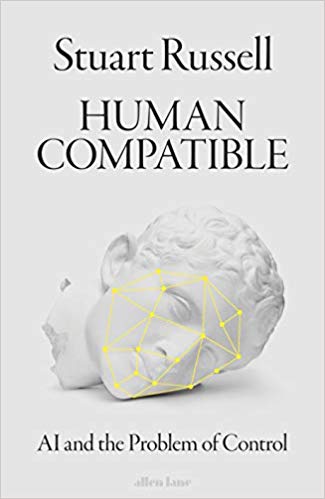
I was so keen to read Stuart Russell’s new book on AI, Human Compatible: AI and the Problem of Control, that I ordered it three times over. I’m not disappointed (although I returend two copies). It’s a very interesting and thoughtful book, and has some important implications for welfare economics – an area of the discipline in great need of being revisited, after years – decades – of a general lack of interest.

The book’s theme is how to engineer AI that can be guaranteed to serve human interests, rather than taking control and serving the specific interests programmed into its objective functions and rewards. The control problem is much-debated in the AI literature, in various forms. AI systems aim to achieve a specified objective given what they perceive from data inputs including through sensors. How to control them is becoming an urgent challenge – as the book points out, by 2008 there were more objects than people connected to the internet, giving AI systems ever more extensive access, input and output, to the real world. The potential of AI is their scope to communicate – machines can do better than any number n of humans because they access information that isn’t kept in n separate brains and communicated imperfectly between them. Humans have to spend a ton of time in meetings, machines don’t.

Russell argues that the AI community has been too slow to face up to the probability that machines as currently designed will gain control over humans – keep us at best as pets and at worst create a hostile environment for us, driving us slowly extinct, as we have gorillas (hence the gorilla problem). Some of the solutions proposed by those recognising the problem have been bizarre, such as ‘neural lace’ that permanently connects the human cortex to machines. As the book comments: “If humans need brain surgery merely to survive the threat posed by their own technology, perhaps we’ve made a mistake somewhere along the line.”

He proposes instead three principles to be adopted by the AI community:

  • the machine’s only objective is to maximise the realisation of human preferences
  • the machine is initially uncertain about what those preferences are
  • the ultimate source of information about human preferences is human behaviour.

He notes that AI systems embed uncertainty except in the objective they are set to maximise. The utility function and cost/reward/loss function are assumed to be perfectly known. This is an approach shared of course with economics. There is a great need to study planning and decision making with partial and uncertain information about preferences, Russell argues. There are also difficult social welfare questions. It’s one thing to think about an AI system deciding for an individual but what about groups? Utilitarianism has some well-known issues, much chewed over in social choice theory. But here we are asking AI systems to (implicitly) aggregate over individuals and make interpersonal comparisons. As I noted in my inaugural lecture, we’ve created AI systems that are homo economicus on steroids and it’s far from obvious this is a good idea. In a forthcoming paper with some of my favourite computer scientists, we look at the implications of the use of AI in public decisions for social choice and politics. The principles also require being able to teach machines (and ourselves) a lot about the links between human behaviour, the decision environment and underlying preferences. I’ll need to think about it some more, but these principles seem a good foundation for developing AI systems that serve human purposes in a fundamental way, rather than in a short-term instrumental one.

Anyway, Human Compatible is a terrific book. It doesn’t need any technical knowledge and indeed has appendices that are good explainers of some of the technical stuff.  I also like it that the book is rather optimistic, even about the geopolitical AI arms race: “Human-level AI is not a zero sum game and nothing is lost by sharing it. On the other hand, competing to be the first to achieve human level AI without first solving the control problem is a negative sum game. The payoff for everyone is minus infinity.” It’s clear that to solve the control problem cognitive and social scientists and the AI community need to start talking to each other a lot – and soon – if we’re to escape the fate gorillas suffered at our hands.

41M3a7N6caL._SX323_BO1,204,203,200_

Human Compatible by Stuart Russell


Complexity across boundaries

Summer, with its leisurely hours for reading, seems a long time ago. I have managed Barbara Kingsolver’s excellent novel Unsheltered. And also, discovered down one of the by-ways of Twitter or the Internet, Worlds Hidden in Plain Sight, edited by David Krakauer. This is a collection of columns by researchers at the Santa Fe Institute dating back to its establishment in 1984.

SFI is of course the best-known centre for the study of complexity across disciplinary boundaries, and its work on economics is always at least intriguing and often far more. Like any collection of essays this is a mixed bag. One striking feature is how much more focused the later ones become on the social sciences and the humanities, compared to the earlier focus on biology and physics. I don’t know if this is an artefact of the selection or actually reflects the balance of work there, but it’s also obvious I suppose that human activity and society is inherently complex. A few of the essays – although intended for a not-entirely-specialist audience – are utterly incomprehensible to someone who isn’t a disciplinary expert. I suspect one or two were also incomprehensible to their authors. And the most recent batch consist of some disappointingly banal essays for a newspaper.

In between, however, I found much food for thought – particularly on the lessons at disciplinary borders: information science, economics, anthropology, biology…. As one 2011 essay by Krakauer puts it, we have to recognize that “many of our most pressing problems and interesting challenges reside at the boundaries of existing disciplines and require the development of an entirely new kind of sensibility that remains ‘disciplined’ by careful empirical experiment, observation and analysis.”

What else? There’s a brilliant 2009 essay by Ole Peters, entirely justifying the cost of the book, explaining in a few pages with great clarity why ignoring the non-ergodicity of economic and financial variables has led to catastrophic policy errors. A 2012 Robert May essay alerted me to a calculation I’ve not spotted before by Ben Friedman (my thesis adviser) that before the crisis running the US financial system “took one third of all profits earned on investment capital,” up from 10% three decades earlier.

And I’ve been thinking about information – the way ideas and imagination, not mechanical or physical constraints, limit social progress; and puzzling how the role of information in energy use and social complexity, a running thread. One day I’m going to have to get my head properly around information theory.

Like all collections, this book has the merit of being easy to dip into and read in chunks. It’s a great overview of the work of SFI, one of the most interesting research centres anywhere. More power to their elbow.

31rf40dFhDL._SX331_BO1,204,203,200_Worlds Hidden in Plain Sight


Growth and civilisation

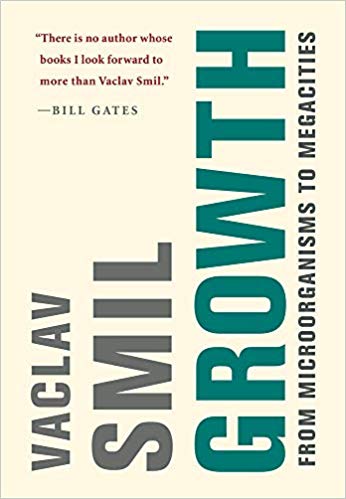
I’ve been slowly reading Growth: From Microorganisms to Megacities by Vaclav Smil. Slowly only because of the size of the book, which means reading it at home. It’s a somewhat eccentric but really rather compelling read. The subtitle indicates its ambition. We do literally go from the growth dynamics of archaea and bacteria all the way to empires, with the common thread being the argument that physics places fundamental limits meaning that almost everything follows the logistic S curve and thus reaches an asymptote – although predicting where the points of inflection will occur is a different matter. “Natural growth taking place on earth is always limited.”

In the final section on economies, Smil quite rightly points out that even if measures of economic activity – notably GDP – remain non-stationary series, such activity is rooted in energy use – echoes here of his tremendous Energy and Civilization. Much of economics has ignored this, regarding early work on energy use in the economy – such as Georgescu-Roegen – as a bit weird, although this is perhaps changing with the onward march of environmental economics. Smil is more sceptical than I am about whether the process of dematerialization of economic growth has shifted the asymptote of the growth curve up and out; I don’t think the concept of sustainable consumption is empty, whereas he does. (Although when it comes to regarding ‘the Singularity’ as nonsense, he and I are at one). He concludes that unless there are strict limits on material consumption, human civilization is doomed, and one gets the firm impression he’s putting his money on doom.

However, the joy of this book is less in the big picture than in the detail. And what a lot of it! The mind boggles at Smil’s extensive reading and absorption of information. We get the speed at which marathons are run – over the entire course of human history; the growth rates of piglets and weight of chicekns over time; sales of small non-industrial motors over time; the envelope for the maximum speed of travel; Kuznets cycles; Zipf’s law for city size….  The middle section of chapters offer a fantastic overview of technical progress over long periods in a wide range of technologies. I love all this detail.

Growth is therefore a tremendous work of synthesis, the biggest of pictures in pointilist form. If Bill Gates hadn’t named Vaclav Smil as his favourite author (“I wait for new Vaclav Smil books the way some people wait for the next Star Wars movie.“), one could imagine him (Smil) as a character in a Borges story. Best of all is the passing comment that nearly all the calculations for all his post-1984 books have been done on a TI-35-Galaxy Solar calculator. Talk about sustainable consumption.

41sJqD+KMbL._SX344_BO1,204,203,200_Before embarking on Smil, we had a week of holiday so I read some non-work books, standout among them The Kites by Romain Gary, whose oeuvre I’m now racing through.


Going to extremes

Richard Davies obviously made the kind of road trip many of us only dream of to write Extreme Economies: from Akita in Japan to Santiago in Chile, from Glasgow to Kinshasa. The locations he chose illustrate one of three characteristics – survival (refugee camps in Jordan, post-tsunami Aceh, a US prison in Louisiana), failure (Panama’s Darien Gap, Kinshasa in DRC, and post-industrial Glasgow), and the future (ageing Japan, digital Estonia, unequal Chile. As the book sums it up: “The year 2030, for most people on earth, will be a cocktail of these three cities: an urban society that is old, technologically advanced, and economically unequal.”

The book is a great read – I tore through it. An economist who can write so well while at the same time explaining the economic principles so clearly is always a joy. I will admit to being rather envious of the opportunity he had to visit all these places. Getting out and visiting should be required for all economists, whether they are writing about development and progress as Davies is, or about industrial organisation or education. You always learn something not only relevant but also important. One of the things I did love about this book was the painless administering of some substantial chunks of economic research – it’s an ideal read for eager 6th form students or undergraduates. It might encourage them to appreciate that economics is not only important but also exciting.

The book also includes some important threads. One is the environment as an economic as well as intrinsically valuable asset. Darien’s economy depends on extraction from the jungle, living now on its future potential: “The puzzle is why, in a region where everyone knows the environment is being degraded, the people of Darien can’t manage the economy in a way that stops it happening.” This segues into a discussion of the ‘tragedy of the commons’. Later, though, it’s Glasgow’s social capital, another overlooked asset, that’s pinpointed as one source of failure: “When an economic force is shared, unseen and hard to measure, you will do too little to protect it.” I couldn’t agree more. Social capital features in all the examples here, either as a source of resilience or a cause of failure. It isn’t a sufficient explanation of economic outcomes – for example, in the chapter on refugee camps in Jordan, one thrives and the other fails because of external forces shaping the structure of the camps and their economic potential – but it is a necessary element.

Davies picks this up in the conclusion: “The biggest gap in economics is the way it completely ignores social capital.” This is why our Bennett Institute Wealth Economy team is exploring the measurement of social capital. Economics doesn’t entirely ignore it – it gets lables such as ‘institutions’ or ‘goodwill’ – but is treated as a black box at best. So I agree with the book that economics will have more to offer the world if we measure and understand better the “subtler and more human aspects of income and wealth.”

Meanwhile, I recommend enjoying the tour through the rebuilt Aceh, refugee camps in Jordan, the market in Kinshasa, Lousiana’s Angola prison and all the other economies featured here. And I hope some TV producer will pick up the book and take its author round the world all over again to film it.

51-otaNMNtL._SX323_BO1,204,203,200_