Finance and the world

One of the highlights of my career as a  financial journalist was a trip to the Chicago Board of Trade in its open outcry days. It must have been around 1993. I can still remember the physical sensation caused by the explosion of the noise of human voices shouting orders in the huge trading pits as soon as the bell rang. It was an extraordinary experience. But one shouldn’t romanticise open outcry. And as Donald Mackenzie records in Trading at the Speed of Light, one CME trader said to him after the closing bell had rung (this was in 2000): “Look at my glasses. They’re all dirty.” Flecked with spittle from the shouting melee.

I loved this book. I’ve been a keen follower of Prof Mackenzie’s research on high frequency trading since his early articles in the London Review of Books as well as a previous book, An Engine, Not A Camera. Prof Mackenzie describes his research endeavour as ‘material political economy’, and it concerns the interaction between the physics and (literal) construction of financial markets, and specifically HFT, and regulatory or political decisions, or power relations.

HFT is a world which is Einsteinian: the speed of light is the constraint on trade, and what traders (human or algorithmic) know about the market is determined by their physical location and physical connectivity: where are they, to the millimetre; how close to a geodesic curve is their communications connection (and is it fibre optic or wireless or microwave); is it raining (which interferes with certain parts of the radio spectrum more than others); to what extent have they programmed trading activities into hardware (chips and C++) for speed?

I’ve always been deeply fascinated by the physical dependencies and consequences of the online world. For example, I was right to predict in The Weightless World that – rather than the death of distance – digitalisation would enhance the agglomeration effects that concentrated people in certain places (we will see if this changes post-pandemic but I’d still reckon not.) Currently I’m somewhat preoccupied with where the internet is, and with the huge physical investments Big Tech companies have made, the weight of digital activity on climate and minerals.

Trading at the Speed of Light is an amazing, detailed account of why material reality matters for virtual outcomes, and conversely, in the financial markets. Everybody with the slightest interest in modern finance should read it (Prof Mackenzie helpfully flags sections that are technical enough to be readily skipped). The book is based on years’-worth of interviews and attending conferences and visiting remote data centres and masts, snapping photos.

The book describes the arms-race of speed and pushing ever-closer to physical limits. A key interview quotation appears mid-way: “I don’t think there’s any other industry than the finance industry that can pay for it ….It’s mind-numbing to look at this whole industry where you have a lot of people with extended training that spend night and day shaving nanoseconds. Where, if you could put that brainpower to something else, maybe somehthing different……”

Indeed. And yet the HFT we have today is the product of decisions taken by people, politicians persuaded by lobbyists. One of the things I learned from the book is that forex trading remains far more artisanal than share trading, albeit still automated. Alas, this was because of the political power of the banks involved rather than anybody’s deep foresight. Human decisions shape markets shape the world, but the consequences are rarely if ever forseen.

Who knows where it will all end (although, presumably, not well). The book ends by pointing out that ‘material political economy’ is the right lens to turn on both crypto (energy-devouring, CO2-spewing monsters) and the world of Big Tech with its datacentres and algorithmic advertising market. At least in these two cases, regulators are perhaps more aware of the societal challenges than their equivalents were in the early days of algorithmic share and futures trading. But it’s a good while since financial markets served their societies rather than predating on them.

411IYpQbpKS._SX327_BO1,204,203,200_


Getting to Fair

Where do the days go? I’ve split my reading time between several books this past week or so, and finished only one: To Be Fair: The Ultimate Guide to Fairness in the 21st Century, by Ben Fenton. This is a wonderfully readable book (written by an ex-journalist) that both summarizes a wide range of scholarly literature on fairness – from psychology and evolutionary science to history – and at the same time advocates strongly for the need to put fairness at the centre of public life and policy.

The first part of the book is a summary of what different disciplinary approaches can tell us about fairness. I had read some of this (eg Frans De Waal’s primate studies) but not all. The main message is how profoundly important fairness is to humans. The second part looks at fairness (and its absence) in different contexts, such as sport, politics, business, tax, law and tech. I found these more interesting, and took away lots of nuggets of insight.

I liked the chapters on business and on media/communications best. There is a lot of injustice to skewer in either case. For example, the book points out: “Business and finance words that aren’t about stability are likely to be about sharing: equity, shares, dividend.” Of course there are lots of other business and finance words, but I liked the point. Or about private equity types: “To them fairness is a word for suckers. I am not sure why we keep letting them get away with it.”

Nor am I. The inequality scarring many societies today is fundamentally unfair – there is an absence of justice – and it has been getting worse. This past year I’ve been veering between optimism that this crisis will prove a turning point leading to major reform of an unfair economic system, and pessimism that such trends are only reversed after a period of significant conflict. After all, nothing changed after the 2008 financial crisis. I still can’t decide – who knows? But To Be Fair has found its moment.

41MwypL7YLL._SX311_BO1,204,203,200_

The unknown pioneer

Many people – including economists, I suspect – won’t recognise the name Colin Clark. Yet he has at least as much claim as Simon Kuznets to be known as one of the pioneers of national income accounting. I came across Clark’s work when researching my book on GDP, and was pleasantly surprised to know that he had been a Fellow (and much earlier a student) at my Oxford college, Brasenose. Eventually I put two and two together and realised that the very nice chap I had spoken to at various events was Colin Clark’s youngest son David, another Brasenose student.

Anyway, this is all by way of preamble to saying how much I’ve enjoyed reading Alex Millmow’s biography, The Gypsy Economist: The Life and Times of Colin Clark. This is the first biography of somebody who worked as a young man with Keynes, taught Richard Stone, and produced some of the first modern statistics on national income; and later corresponded with Kuznets and Lewis, creating the field of development economics alongside them. In 1984 the World Bank honoured him as one of the 10 pioneers of development economics, along with Hirschman, Myrdal, Rostow, Bauer and others. Clark was influential in the Labour Party, being particularly close to Hugh Dalton, before spending many years in Australia, as a government economist in Queensland. Later he returned to England for some years, where he was involved in the founding of the Institute for Economic Affairs.

It is natural to ask why, given his scholarly work, Clark is so unknown now. After all, Stone, Lewis and Kuznets all went on to win the Nobel. The answer probably lies in that career history, and political trajectory. Actually, Clark not only left academia for years to take up a policy role, he also seems to have torpedoed his chances in two other ways. One – emerging clearly from between the lines of the book – is that he was a maverick character, possibly even cantankerous. The other is that he converted to Catholicism and became an ardent advocate of ‘distributivism’, which seems to have been a romantic philosophy advocating small rural communities and the virtue of farming. The biography quotes throughout many comments to the effect that Clark was brilliant but his books and papers were disorganised – lacked an organising analytical framework – and were sloppy in many regards. One typical comment described him as, “Brilliant, original, provocative, eccentric and sometimes just plain wrong.”

Having said this, there are many fascinating aspects of Clark’s thinking that emerge here, including some themes that have re-emerged in economics more recently. One is an early and lasting interest in increasing returns to scale, stimulated by working with Allyn Young. The second is simply the opening up of development economics through the empirics of long-run trends: Clark, like Kuznets, did not focus on (what became) GDP but – in his case – on statistics including income distribution, leisure, macroeconomic stability, and natural resource use and depletion. His Catholicism made him interested in non-state, non-business economic institutions such as churches but also friendly societies and unions – an openness to the economic role of a variety of community institutions only just returning in today’s mainstream economics. It also meant he was pro-population growth (he & his wife had 9 children themselves), considering it essential for per capita growth as modern endogenous growth theories imply, and a fierce critic of the Ehrlich ‘population time bomb’ argument.

This very informative biography made me rather ashamed not to have known anything about Colin Clark until a few years ago, even when his papers were sitting in my college library. I learned a lot more from reading it. The book fills a gap in the history of economic thought, and about the history of policy economics in Australia. (Alas, it’s priced for libraries.)

418HQ4uAGRL._SX329_BO1,204,203,200_


Banks versus business

The latest in my catch-up reading has been British Business Banking: The Failure of Finance Provision for SMEs by Michael Lloyd. This is obviously a bit niche but of great interest as the vacuum in finance for growing businesses has often been identified as one of the reasons for the UK’s weakness in translating an excellent research base into lasting commercial success and eventually productivity gains. The stock of bank lending to SMEs in the UK was £166bn at the end of 2018, according to an OECD survey. (It will perforce have increased signigicantly in 2020.) If this sounds a lot, it was only about one tenth the stock of their residential mortgages. The UK banking sector just doesn’t do much business lending.

I’ve long thought lack of competition is a key part of the story. The commercial banking sector has consolidated steadily over the decades – I’m old enough to remember some of those swallowed up, like Williams and Glyns and National Provincial. In this book Michael Lloyd argues that while the development of an oligopoly might have been part of the cause of the SME finance gap, introducing more competition won’t be part of the cure now. There has been some new entry such as Santander, but the newcomers are not interested in the SME sector either.

He anyway sees the gap as a quasi-cultural one, linked to the “free market” philosophy embraced more eagerly in the UK even than in the US, and in the centralisation of banking decisions. He advocates a restoration of relationship banking spearheaded by a state Investment Bank. What we are getting instead is a National Infrastructure Bank – needed, but unlikely to do a lot for SMEs around the country. However, I find the relationship argument persuasive: I’d see it in terms of a vast loss of information that has come about through bank mergers and centralisation. Automated decisions are based on too little information, whereas old-fashioned bankers in boots would have a wealth of information about local SMEs.

It’s a hard problem to solve even with a government willing to have a go. Still, this is an interesting book for those worrying at the issue, well worth a read.

51BZBixw1DL._SX331_BO1,204,203,200_

And, not or: state and market

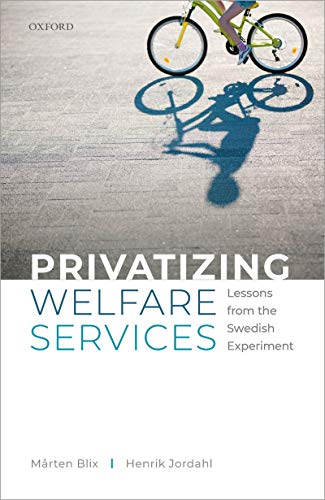
A holiday weekend, so I’m working my way through the book pile. I’ve raced through the absolutely excellent Privatizing Welfare Services: Lessons from the Swedish Experiment by Mårten Blix and Henrik Jordahl. This should go on any public policy course reading list in future, and is also a must-read for the policy world too. Lessons from other countries can be valuable, and in the UK we tend mainly to look at the US and to a lesser degree other Anglophone places, so this overview of Sweden’s experience is very welcome.

For Sweden has experienced a transformation in the past 4 decades from the post-war comprehensive cradle-to-grave welfare state to one where 17% of public services are provided by the private sector. This includes major services in healthcare, nurseries and schools, and elderly social care. As the book says, there has been a large amount of evaluation of the reinvention of Sweden’s welfare state, but not much of it in English. So this critical overview is invaluable.

The authors argue that without reform, the old-style welfare state would have become increasingly costly and ineffective. Citizens were by the 1980s dissatisfied with quality. The first, and controversial, steps came in the mid-1980s; for example in 1984 the first private pre-school received public funding. The economic crisis of 1992 cemented what seemed inevitable. However, service privatization has proceeded gradually if steadily rather than in a Thatcher-style ideological wave. This meant that its evident early successes, in expanding availability and improving choice, made it too popular for Social Democrat governments to reverse. In addition, different municipalities proceeded at different paces, so successes spread by imitation.

The book is organized thematically. Chapters cover quasi-markets, spending controls and efficiency, welfare reform, competition and choice, management of welfare services, and public opinion. Its conclusions are nuanced. Service privatisation has generally been effective in improving outcomes and improving the financial sustainability of the social contract, the authors conclude. But there are challenges.

One is the existence of information asymmetries between the state and private providers (I’m reminded of the excellent Hart, Schleifer and Vishny paper, which also always goes on my reading lists). Another is that the world is constantly changing, so no arrangement of collective choices is likely to stay unchanged for ever; it must respond to context. However, the other point that leaps out for me is the benefit of having both public and private service provision. This both reduces the information asymmetries (as the state is a provider too), and ensures that competition occurs along more dimensions than price alone (mitgating against cost and quality reductions for the sake of profit). All conclusions consistent with the view I set out in Markets, State and People.

The only downside – it is, alas, an expensive book. But one well worth recommending to your library.

41NO38pXKPL