
Does economics need *more* physics envy?

It’s often said by critics of economics that the problem is economists have physics envy: they want to describe the economy using models that are over-complicated in the mathematics, mimicking classical physics, and under-sophisticated in its understanding of how humans actually make choices. But in [amazon_link id=”1408827379″ target=”_blank” ]Forecast: What Physics, Meteorology and the Natural Sciences Can Teach Us About Economics[/amazon_link] by Mark Buchanan argues that economists haven’t been paying enough attention to physical.

[amazon_image id=”1408827379″ link=”true” target=”_blank” size=”medium” ]Forecast: What Physics, Meteorology, and the Natural Sciences Can Teach Us About Economics[/amazon_image]

He makes the argument in the context of financial economics and its discrediting by the financial crisis. I find it a wholly persuasive thesis. Rational choice theorising just cannot account for the data on financial markets – the numerous self-reinforcing large price movements without specific causes, the long persistence in the absolute size of price movements, the fractal character of the movements on annual, monthly, daily, hourly, nano-secondly timescales. However, models from statistical physics can do so. The empirics of financial markets are similar to those of earthquakes, for example, well described by power laws. Economists should be using these tools as their starting point for theorising rather than starting with theories that fit the data about as well as Cinderella’s glass slipper fits the feet of the Ugly Sisters. It astonishes me that so many economists are so resistant to believing the evidence of the data – as I wrote describing here last autumn’s ESRC symposium on macroeconomics and the reception physicist J.P.Bouchaud got from some of the other participants.

Forecast is a useful and very accessible guide to the physics models, although this is not untrodden territory in pop science. For example, Philip Ball’s [amazon_link id=”0099457865″ target=”_blank” ]Critical Mass[/amazon_link] covers it too. There were a few points when I felt it over-claimed. For example, Mr Buchanan compares events in California’s electricity market in summer 2000 to the financial market events of 1998 or 2008, when it turned out later that Enron traders were manipulating the market. From this he concludes: “Blind faith in the benefits of privatization has had negative social consequences, including the deterioration of overall social trust, the dissolution of traditional non-market relations based on social norms and the replacement of cultural incentives to ‘do a good job’ with purely monetary incentives.” This is a perfectly valid line of argument, made by many other people – [amazon_link id=”0374533652″ target=”_blank” ]Michael Sandel[/amazon_link] most prominently of late – but it is a different argument entirely from the rest of the book, and I think isn’t supported here. There are one or two other points where the book canters through a separate area – such as behavioural economics and fast versus slow thinking – interesting but not related to the main argument.

For the main point here is about the prevalence of disequilibrium in economies, and the consequent inappropriateness of equilibrium as the starting point for economic modelling; the inadequacy of comparative statics in a dynamic world; and the role of social influence in markets. There is a very interesting section on the way the ‘wisdom of crowds’ is valid for independent decisions but destroyed when people know what others think, when it is replaced by the ‘unwarranted confidence of crowds’.

The most intriguing point the book raised for me concerned the predictability of financial market prices. Markets seem to have two phases of behaviour, like water versus ice, and the transition from one to the other is particularly interesting. “When the number of participants is smaller than a certain threshold… the market always has some predictability in its movements,” Buchanan writes of some experimental research (by Yi-Cheng Zhang and Damian Challet, written up in the book [amazon_link id=”0198566409″ target=”_blank” ]Minority Games: Interacting Agents In Financial Systems[/amazon_link]). Beyond a threshold number of people, the predictability vanishes. The number is related to the amount of history participants take into account in their expectations of the future – beyond that “the space of strategies becomes effectively covered or crowded.” There will be somebody in the market who will pounce on any predictable pattern to arbitrage it, and any predictability vanishes.

Economists who have already read about complexity economics – say in Paul Ormerod’s [amazon_link id=”0571279201″ target=”_blank” ]Positive Linking[/amazon_link] or his older [amazon_link id=”0465053564″ target=”_blank” ]Butterfly Economics[/amazon_link], or Alan Kirman’s [amazon_link id=”0415594243″ target=”_blank” ]Complex Economics[/amazon_link] or Benoit Mandelbrot’s [amazon_link id=”1846682622″ target=”_blank” ]The Misbehaviour of Markets[/amazon_link] – will find much of the material in Forecast familiar. But even they will find some new insights. Economists who haven’t paid much attention to these areas should read this book and apply some of our profession’s (supposed) newly-found humility to its argument. And this is a very accessible book for non-economists (and indeed for non-physicists), who will find it interesting and wonder why on earth some economists resist learning across the disciplinary boundary.

What will the robots do for us?

The social and economic aspects of new technologies have been my abiding interest for years, naturally from the perspective of my training as an economist.[amazon_link id=”0262018624″ target=”_blank” ] Robot Futures [/amazon_link]by Illah Reza Nourbakhsh has the same interest from the perspective of a Professor of Robotics, and director of the Community Robotics, Education, Technology and Empowerment Lab at Carnegie Mellon. It’s an eye-opening book (and a short, clearly written one).

[amazon_image id=”0262018624″ link=”true” target=”_blank” size=”medium” ]Robot Futures[/amazon_image]

There are two key messages I took from the book. First, we’ve already gone a long way towards weaving robots into everyday life without realising it. The advances in the physical manifestations of robots (which Prof Nourbakhsh divides into perception, cognition and action) will before long join up with recent innovations online, in the pooling of information including from social media. The issues we’re grappling with such as online privacy and identity will move off the screen onto the pavement. We might soon meet robots on the street who know everything about us. Already due to smartphones, he writes: “Nothing is transient because everything can be captured and shared. Expectations of privacy have to shift….. As robots decide automatically just what to record and publish, so our sense of internet identity will have to change. We humans will no longer be the only species that records events and publishes them online…. When you run into a well-connected robot, it will be unclear from first impressions whether the robot knows everything about your day….”

Or, to take another example, prosthetics and robotics are merging already; how far should that merger go? Science fiction ([amazon_link id=”0586057242″ target=”_blank” ]I, Robot[/amazon_link] and on) is stepping into life, and there are countless emotional, ethical and other issues.

The second message is about the economic and political issues, and is that unless there is a public debate about advances in robotics, their development will be commercial. As the book puts it, the early adopters are business and the military. Prof Nourbakhsh writes: “I have served on funding boards and I have seen technical content dwarf social impact in the eyes of nearly all the reviewers in the room. This needs to change; broader impact must become an authentic criterion for funding.” His lab specializes in socially focused robotics development, but I don’t imagine there are many others, or much social science thinking about the issues yet. There needs to be – it will be upon us soon.

The book has a useful summary of the state of robotics research, which has been uneven. Batteries/energy are still a big hurdle. It opened my eyes to the diversity of machines gathered under the term, including industrial robots, those innovative joints restoring movement to injured or disabled people, drones, household devices and so on. It touches on the ethics of how robots should be treated: “Never before have we had the chance to dehumanize socially agile non-humans. If this happens, then we face the odd technological side-effect that, as we dehumanize our relationships with robots, so we may incidentally dehumanize our relationships with people.”

In short, a lot of food for thought in 130 pages (albeit somewhat steeply priced).

These robots are nice but dim…

Robot wars – the prequel

[amazon_link id=”B00BIOFLWE” target=”_blank” ]America’s Assembly Line[/amazon_link] by David Nye is fascinating. It’s a history of the origins of the assembly line and mass production, with a strong focus on the motor industry, and traces the spread of mass production through other manufacturing and non-manufacturing sectors (such as housebuilding). The organisation of the line evolved over time, and varied in different places. The imperative of wartime production was an important driver. Post-war, the cybernetics revolution led to far greater automation. On the other hand, the Toyota lean production system brought in greater flexibility for workers on the line.

[amazon_image id=”B00BIOFLWE” link=”true” target=”_blank” size=”medium” ]America’s Assembly Line[/amazon_image]

The public loved the product of the assembly line, affordable mass-produced consumer goods. “In a typical American town, a working class family that couldn’t afford both a bathtub and a car was more likely to opt for a car,” Nye writes of the 1920s. (There’s a parallel with the well known factoid about the greater prevalence of mobile phones than toilets in Indian households now – any kind of means of communication seems peculiarly compelling.) Access to assembly line products, alongside the growth of a suburban middle class, spread far faster in the US than in Europe.

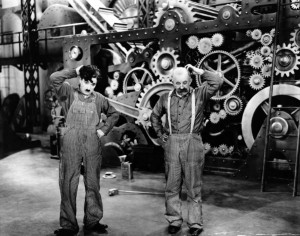
The relationship between machines and workers is an important theme in the book. Although Henry Ford famously paid $5 a day, double the going rate, many workers left before they qualified for it, so hard was the work. The unions had to fight hard to get recognition in the industry. The factories were notorious for robbing workers of any autonomy, and for speeding up the line to extract greater effort. Although 1927 had even brought a symphony to the Model T (premiered by the Boston Symphony Orchestra) he pressure of the assembly line soon became a frequent theme in films, songs and TV – Charlie Chaplin’s Modern Times being a prominent example.

The monotony and conformity of mass production also meant it was slow to spread in Europe, where the markets were anyway far smaller and therefore less able to sustain huge volumes. And there was a culture clash: “British workmen regularly stopped the assembly line for tea breaks.” More importantly, though, “No European nation could develop an American style production system unless it also embraced mass consumption.” None did before the war – the Soviet Union was most interested in Ford’s methods, but could not provide the workers capable of doing the jobs.

Through the post-war era, opinion divided between the welcome given to consumer products and welfare capitalism – Ford also offered savings plans, medical care in the factory, educational programmes – and the cultural distrust of conformity and the alienation of labour on the assembly line. The latter was, again, most pronounced in Europe. And yet European consumers were just as keen on cheap goods. Vice President Richard Nixon famously showed Nikita Kruschev around a model home at the American National Fair exhibition in Moscow in 1959 – Francis Spufford’ superb book [amazon_link id=”0571225241″ target=”_blank” ]Red Plenty[/amazon_link] brings this scene to life. Nixon presented Kruschev with a nice paradox about the benefits of mass produced goods and homes, in that American consumers had a vast choice: “We do not wish to have decisions made at the top by government officials who say all homes should be built in the same way.”

“Commodity fetishism meant that there was a widespread desire for what the assembly line produced but an equally widespread disdain for the work involved,” writes Nye. At the same time, concern began to grow – in line with automation – that the jobs involved were vanishing anyway. The fear of robots eliminating the need for humans emerged around this time.

No matter. Consumerist capitalism was even more heavily criticised by the counter-culture of the 1960s, culminating in 1968. And by the 1970s the far greater flexibility of the Toyota system was outperforming the rigidity of Fordism. By 1990, Volvo was advertising its abandonment of the assembly line. It had small teams assembling an entire vehicle. It took 4 months to train a Volvo worker, compared to 4 hours on a conventional line, but worker turnover was low and productivity high, and problems solved by individual teams with no spillover to the rest of the plant.

Yet the effect of automation on jobs remained a constant. The western economies ‘deindustrialised’. Detroit started its gothic decline – so well captured by photographers Yves Marchand and Romain Meffre in their book [amazon_link id=”3869300426″ target=”_blank” ]The Ruins of Detroit[/amazon_link]. and by the incomparable Bruce Springsteen, voice of blue collar America. Nye concludes: “Americans accepted mass production as though it were part of the natural order, with its subdivision of work, its interchangeable parts, and its organization of everyday life in terms of efficiency and productivity. Year after year they expected higher wages, more consumer goods and a general acceleration of experience. By 2013, however, this was an outdated and unsustainable economic order. The classic assembly line had been based on a large semi-skilled working class, not on robots and outsourcing.”

[amazon_image id=”3869300426″ link=”true” target=”_blank” size=”medium” ]The Ruins of Detroit[/amazon_image]

Robots, in short, don’t buy washing machines and fridges, and all the skills of the Mad Men won’t change that.

This book is an excellent companion read to the current robot debate – nicely summed up in this Economist article.

A policy no-brainer

Some years ago it was my privilege to be involved with some work with James Heckman, commissioning him to look at skill policies in Scotland (the paper is published in [amazon_link id=”0691122563″ target=”_blank” ]New Wealth for Old Nations[/amazon_link]). So I’ve been aware of his absolute passion – this is no overstatement – for directing policies to help ensure children have the best possible chances in life. His careful econometric work, for which he won (with Daniel McFadden) the Nobel memorial prize in economics in 2000, identifies the causes of later disadvantage as lying in children’s earliest years, and in the development of non-cognitive skills and emotions as well as cognitive skills, on which so much policy attention is focused.

This work is encapsulated in a new Boston Review book he has written, [amazon_link id=”0262019132″ target=”_blank” ]Giving Kids a Fair Chance (A Strategy That Works)[/amazon_link], which includes as always some responses to Prof Heckman’s essay. The discussion is US-centric, but the analysis certainly applies elsewhere. The strategy promised in the subtitle is: “that predistribution – improving the early lives of disadvantaged children – is far more effective than simple redistribution in promoting social inclusion and, at the same time, at promoting economic efficiency and workforce productivity. Predistributional policies are both fair and economically efficient.” This is a rare and worthwhile combo – although, as he would point out, it does take the state into family life in ways that can feel uncomfortable, even when the families in question are impoverished or chaotic or damaged.

The responses make some good points. Emphasising early interventions should not make policy-makers give up on later interventions. Appreciating non-cognitive skills should not lead to the patronising and damaging assumption that children from poor backgrounds can’t make the grade academically. One contributor takes issue with Heckman’s emphasis on poor mothering rather than poor parenting, noting the damage caused by absent fathers.

Still, I agree with Carol Dweck’s summing up: “His review of the scientific evidence is compelling and makes the case that parental training and educational enrichment in the early years have critical and lasting effects on children.” There are not many areas of public policy where the evidence is so clear and experts from across the disciplines have such a high degree of consensus. Politicians have no excuse for not acting on it.

[amazon_image id=”0262019132″ link=”true” target=”_blank” size=”medium” ]Giving Kids a Fair Chance (Boston Review Books)[/amazon_image]

It’s not a young woman’s world

Do economics and fiction mix? It’s hard to think of many successful novels of economics – I’ve posted here before about economics/business and culture and here about economists as fictional heroes.

This week I read a novel applying economic principles to a young woman’s analysis of her life. [amazon_link id=”B00B1UUGCK” target=”_blank” ]It’s Saying Goodbye to Verena: What is Your Life Worth?[/amazon_link] by Ivy Turow.

[amazon_image id=”B00B1UUGCK” link=”true” target=”_blank” size=”medium” ]Saying Goodbye to Verena: What is Your Life Worth[/amazon_image]

The pseudonymous author’s website indicates that it’s quasi-autobiographical. The heroine is a seemingly accomplished young woman who has discovered that she’s a misfit in the world of work and concludes, using the economic analysis she’s learned at university, that she isn’t economically viable. Her rational solution is that she should end her life. The website pins the blame on corporate capitalism. “I simply don’t have sharp enough teeth to flourish in today’s corporate society. The thing is, I don’t think I’m alone in this predicament. This book is for all of those who find themselves in the same boat,” says Ivy Turow. “It shouldn’t matter who I am and what I look like. Sadly, women’s achievements are often considered less important than their appearance.”

The novel is a book of two halves. The first few chapters describe the heroine’s experiences of work, and her dawning realisation that it’s a man’s world, that diligent application to the job isn’t rewarded, and power games matter in corporate life. The author’s writing style is clunky but lively, and this part is a good read. The passion of real experience shines through. I have every sympathy with her, too. It is a man’s world, and the status and potential of women in the workplace have definitely gone backward since I started work in the 1980s – not that it was great then. What’s more, the UK is low down the international league table for women’s achievement in key positions of power such as politics and the boardroom. The more this is shouted about, the better. While the book emphasises the main character’s struggles because she’s female (at least as I read it), the website emphasises the problems affecting her generation, with a system stacked against them by the voracious baby-boomers. This issue is equally valid.

The second half of the book is less successful. It turns into a kind of Socratic dialogue in which the heroine explains ideas ranging from game theory to Foucault’s analysis of power to her patient friend over lunch. I think the claim is that the economic non-viability of women in modern capitalism can be proven analytically, but the first part of the book trying to demonstrate the point through the emotional power of a good story and sympathetic character actually does a better job of making the point. And actually, I disagree with her claim to be setting out a “proof” because this half of the book omits the sociology of patriarchal power that’s described so effectively in the first half. She could also have made a more interesting point about social norms – having shown that most people are weak and allow an unscrupulous minority to set the standards of behaviour, the interesting debate about why those norms change and whether they can be improved is missing. I would argue that they can change substantially, as attitudes to top pay shifted between the 1970s and 1980s.

Still, the book is quite a digestible way of encountering these ideas. It’s interesting – not great fiction but a passionate and welcome contribution to a debate we should be having on why career structures in particular and society more generally have become once again so heavily stacked against young women.