Accountancy, innovation and cyberattacks: slightly random reading

I’ve been attending the NBER’s Conference on Research in Income and Wealth in Washington and one of the lunchtime speakers was Baruch Lev, talking about his recent book, The End of Accounting. Having heard the talk, I’ll have to read it. The argument is essentially that companies’ financial reporting is decreasingly useful as a guide to company performance, and any potentially useful information is deeply hidden in the required figures, which – Lev argues – bear little relation to reality, are heavily manipulated, and involve many dubious assumptions. It’s safe to say he isn;t a fan of the accountancy standards bodies – nor they, presumably, of his work.

Just before leaving London I finished Thomas Rid’s Rise of the Machines, a history of cybernetics from the perspective of an expert on defence and security. Much of the story he recounts is familiar to anyone who has read lots on computer and internet history, but the perspective is distinctive. Of course the tale starts with the information needs of the military in World War 2, but it also ends with security. There is a fascinating chapter on a mid-1990s Russian cyber-attack on the US, code named Moonlight Maze – apparently the first time so many of the details of this attack have been pieced together. This chapter was particularly interesting in the light of recent Russian activities in the US and elsewhere. Here is quite a detailed description referring to Rid’s book.

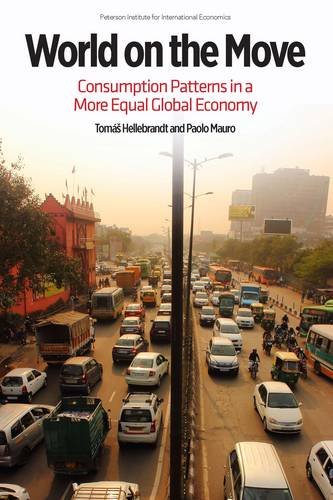
I also polished off a short book, World on the Move: Consumption patterns in a More Equal Global Economy by Tomas Hellebrandt and Paulo Mauro. It looks at demographic and income distribution data and projections to make predictions about future demand growth – especially for transportation and infrastructure. It’s more of a reference work than a good read but I’m sure useful for some readers.

One of the conference speakers was Eric von Hippel, who kindly signed a copy of his book Free Innovation for me, so that’s next on the agenda. And this being Washington, I’ll almost certainly drop into Kramer Books and leave with a few purchases.
511QxdU0B0L51SA665GkSL415db3y94YL

Should economic policy be joined-up and strategic – or not?

Yesterday was the formal launch of the new, independent Industrial Strategy Commission – of which I’m a member. Its chair Kate Barker explained in an article in the FT today why an industrial strategy is important: “Economic theory has always stressed the role government must play in correcting “market failures”. These include the absence of markets for new goods, social benefits in excess of private benefits where there are externalities, the public good of basic research, and uncertainties that will limit private investment due to information asymmetries in financial markets. Clear economic and social challenges lie ahead for the UK that are not going to be solved unless this government and its successors set a strategic direction and stick to it.”

Next to hers was an article by Janan Ganesh, dismissing (very stylishly) the whole thing as a bad idea: “The dread is that clamour for a New Economy — a more scientific, less London-centric Eden to justify the two-year slog of EU exit — will cause these interventions to grow from the fiddly to the invasive without gaining a jot in usefulness.” 

There are many reasons she’s right and he’s wrong, and some of them were set out at the launch by speakers including Carolyn Fairbairn, director general of the CBI, and Juergen Maier, UK CEO of Siemens. They include the obvious fact that governments do all kinds of things that affect the economy – education, training, standards, infrastructure, research funding – and they might as well be joined-up and strategic as not. There are lessons to learn from past mistakes, and there will be new mistakes. There will also be massive lobbying and – as Ganesh says – it’s important to make sure post-Brexit Britain has a tough competition policy to enable new entry into markets. But it’s lazy thinking to conclude “markets” should be left to get on with it. After all, that’s the approach since 1980 that has left us with productivity a quarter lower than France or the Netherlands.

Many of the more positive reasons are set out in a book I’ve been reading, Efficiency, Finance, and Varieties of Industrial Policy edited by Akbar Norman and Joseph Stiglitz. The opening chapter by Mario Cimoli and Giovanni Dosi makes very effectively the case that ‘industrial’ policy is more important in a knowledge economy than in an ‘industrial’ economy: the non-rival character of knowledge increases both the potential benefits of complementarities and network effects, and the extent of co-ordination problems. One of the interesting features of the book is that it covers policy in developing as well as developed economies, so introducing a wide range of discussion of institutions – one of the absolutely key issues in making a strategy to address co-ordination problems a success.

51qi1gygHBL

Cities are the future!

It’s been one of my obsessions for some years that the UK economy is damagingly, dangerously, London-centric. Well, the polity as well as the economy; I argue here in a new VoxEU e-book with my colleague Prof Rob Ford that the ‘anti-Brussels’ Brexit vote can be considered an anti-Whitehall and anti-Westminster vote. Anyway, for years I’ve been working with people in Greater Manchester to chip in my small contribution to the city devolution agenda. This has started to bear fruit in the city devolution agenda, given real momentum by George Osborne in his time as Chancellor, and continuing with the forthcoming election of a Greater Manchester mayor.

One of the people at the heart of Manchester’s long campaign for the devolution of economic power, and political accountability, is Mike Emmerich. Now running his own company (Metrodynamics), Mike spent 20 years in public service, latterly in Manchester, where he played a pivotal role in bringing about the devolution revolution. He has written a terrific book about this important moment in the life of the country’s cities – and the nation: Britain’s Cities, Britain’s Future. The book is the latest in my ‘Perspectives‘ series, so clearly I loved it enough to publish it, with my partners at LPP. Setting that aside, though, the next few years are going to be a challenging time for the UK as the government sets about getting the worst possible Brexit deal (or so it often seems).

Even without this impending upheaval – the UK’s economic record has been pretty dismal, our level of productivity stubbornly much, much lower than in the other big OECD economies, the regional disparities among the widest in Europe and a substantial ‘left behind’ population in terms of both income and geography. Whatever we’ve been doing in terms of economic policy hasn’t been a terrific success. Mike’s book makes a persuasive case for taking advantage of recent signs of urban renewal in the big cities outside London and ensuring that the momentum continues. He blogged about it here if you want a foretaste of the book.51cT3hSZocL._SX326_BO1,204,203,200_


Statistics vs truthiness

I thoroughly enjoyed reading Howard Wainer’s Truth or Truthiness: Distinguishing Fact From Fiction By Learning to Think Like a Data Scientist. I even laughed out loud occasionally, as there’s a lot of wit on display here, and one gets a strong sense of Wainer’s personality. This is not usual in a book about statistics (although having said that, Angrist and Pischke also do quite well on the clarity and fun front, especially for econometricians.)

Truth or Truthiness a collection of essays in effect, published as a response to this brave new world of truthiness (ie. lies that people believe because they want to) in politics and public debate. Wainer writes very clearly about statistics in general, and his main theme here, causal inference. This is of course dear to the heart of economists, and gratifyingly Wainer recognises that the profession is more scrupulous than most disciplines about causation. The book starts by underlining the importance of having a clear counterfactual in mind and thinking – thinking! – about how it might be possible to estimate the size of any causal effect. As Wainer puts it, “The real world is hopelessly multivariate,” so untangling the causality is never going to happen without careful thought.

I also discovered that one aspect of something that’s bugged me since my thesis days – when I started disaggregating macro data – namely the pitfalls of aggregation, has a name elsewhere in the scholarly forest: “The ecological fallacy, in which apparent structure exists in grouped (eg average) data that disappaears or even reverses on the individual level.” It seems it’s a commonplace in statistics – here’s one clear explanation I found. Actually, I think the aggregation issues are more extensive in economics; for example I once heard Dave Giles do a brilliant lecture on how time aggregation can lead to spurious autocorrelation results.

Having said how much I enjoyed reading Truth or Truthiness, I’m not sure who it’s aimed at who isn’t already really interested in statistics. For newcomers to Wainer, I’d recommend his wonderful earlier books, Picturing the Uncertain World, and Graphical Discovery. They’re up there with Edward Tufte’s books on intelligent visualisation (rather than the decorative visualisation that’s become unfortunately common).

51ZBzzdWQwL

The polarised republic

Cass Sunstein’s #Republic: Divided Democracy in the Age of Social Media is very timely, as we all, horrified, watch the American republic splinter ever more irreparably since the election last November. The book links the literature on filter bubbles and social media dynamics with the actual political impact in the US context, and the constitutional implications.

It cites the growing empirical literature on political polarisation as a result of the spread and increasing use of social media, especially Facebook. (Of course, conventional media have contributed to the polarisation as well – there are some empirical studies such as this one.) Some of the figures Sunstein cites are startling, such as the polling showing that both Republicans and Democrats have growing increasingly likely to express “displeasure” if their child were to marry someone with the opposite political affiliation (49% and 33% respectively in 2010, up from 5% and 4% in 1960, presumably higher still now). This far exceeds the “displeasure” expressed about inter-racial relationships.

Much of the book concerns the scope for deliberative democracy, or getting people to talk to each other and talk through problems. Technology could in principle enable this, although it currently does the opposite. At the same time, the other occasions on which we would all ‘meet’ different kinds of people, from different classes and races, and different opinions, have shrunk. There is more social sorting in real life. The conventional broadcast media are being displaced, and narrower themselves. (Not to mention now being under attack by Trump and Bannon.) Sunstein isn’t too starry eyed about democracy, though: “For many political questions, what matters is getting the facts straight, and for that you need experts, not deliberative opinion polls.” Hooray!

Communications and the media are exceptionally important in a democracy (cf Amartya Sen) and are at the epicentre of the current maelstrom of populism. I was interested in Sunstein’s emphasis on the importance of media ‘solidarity goods’, a special form of merit good that promotes social interaction, debate, understanding, a sense of shared citizenship and solidarity. He suggests solidarity goods are essential to build social capital.

The book resists the temptation to offer quick fixes – there aren’t any. Instead it underlines the priciples of any measures that might make things better: exposing people to material and ideas they wouldn’t otherwise choose or experience; ensuring citizens have a range of common experiences; ensuring policy debates have substance – ‘expertise’. It’s clear to me there are some sharp questions about the regulatory framework governing social media and the online world in general, questions regulators have been pretty keen to avoid so far. It’s time for them to do so now.

Untitled