FT Business Book longlist

The Financial Times Business Book of the Year longlist has just been published, and most of the titles sit in my two favourite categories: economics and technology. Even better, I’ve read five of the books already, and they are all excellent candidates, although I have my preferences. If I had to pick from these, I’d be torn between Lo and Tirole. But there are lots on the longlist still to read… quite a few of these are very tempting.

Here are the shortlisted books I’ve reviewed on this blog.

The Wisdom of Finance by Mihir Desai

[amazon_link asins=’1788160045′ template=’ProductAd’ store=’enlighteconom-21′ marketplace=’UK’ link_id=’09eceed8-7fff-11e7-a7d4-0bcc1040a822′]

Adaptive Markets by Andrew Lo

[amazon_link asins=’0691135142′ template=’ProductAd’ store=’enlighteconom-21′ marketplace=’UK’ link_id=’406e7c9d-7fff-11e7-9214-c945e126918f’]

Grave New World by Stephen King

[amazon_link asins=’0300218044′ template=’ProductAd’ store=’enlighteconom-21′ marketplace=’UK’ link_id=’650e8df4-7fff-11e7-aead-cb3a97a7be8a’]

The Great Leveler by Walter Scheidel (I don’t seem to have written a review of it, though I cite it here)

[amazon_link asins=’0691165025′ template=’ProductAd’ store=’enlighteconom-21′ marketplace=’UK’ link_id=’b6131034-7fff-11e7-98b2-e306b5666937′]

The other title I’ve read, having had the privilege of helping prepare the English edition, is

Economics for the Common Good by Jean Tirole; out in October, with superb insight into using economics in public policy, and also into the strengths and limits of economic research

[amazon_link asins=’0691175160′ template=’ProductAd’ store=’enlighteconom-21′ marketplace=’UK’ link_id=’dad2424a-7fff-11e7-95f3-5fcb61484d6e’]
Other minds

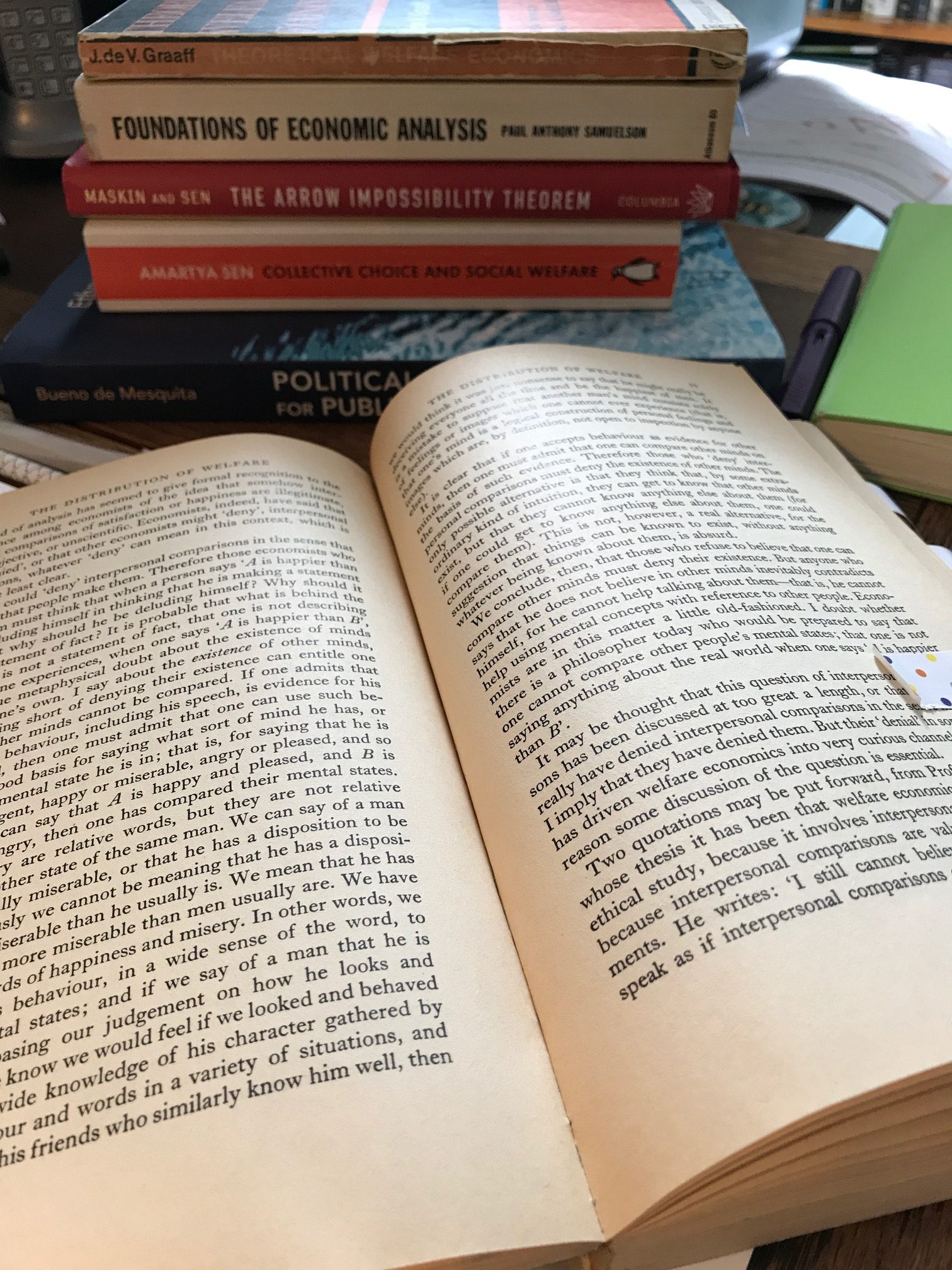
I’ve been dipping back into a lot of my collection on welfare economics, for various reasons. I.M.D. Little (A Critique of Welfare Economics) has a wonderfully spiky style, absent from modern academic writing (well, any kind of style really):

“It is clear that if one accepts behaviour as evidence for other minds, then one must admit that one can compare other minds on the basis of such evidence. Therefore those who ‘deny’ interpersonal welfare comparisons must deny the existence of other minds. The only possible alternative is that by some extraordinary kind of intuition, they can get to know that other minds exist but that the cannot know anything about them.”

IMG_4275(I’m having what I believe we now call an Adonis Day of idling around ….)

[amazon_link asins=’0198281196′ template=’ProductAd’ store=’enlighteconom-21′ marketplace=’UK’ link_id=’f5cd2df4-7f5d-11e7-b557-1f2e425fc33b’]


Must read

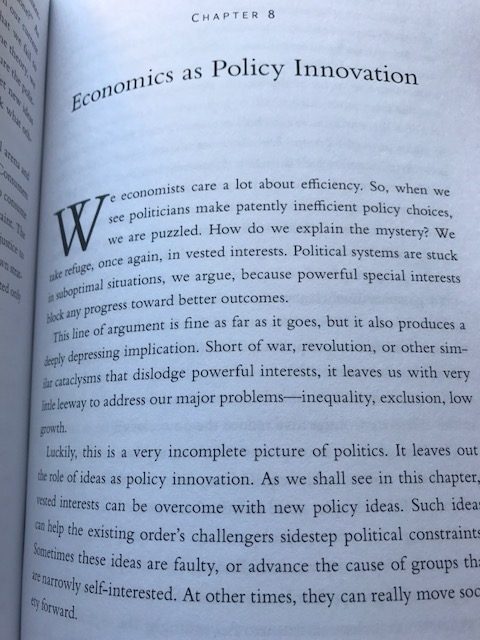
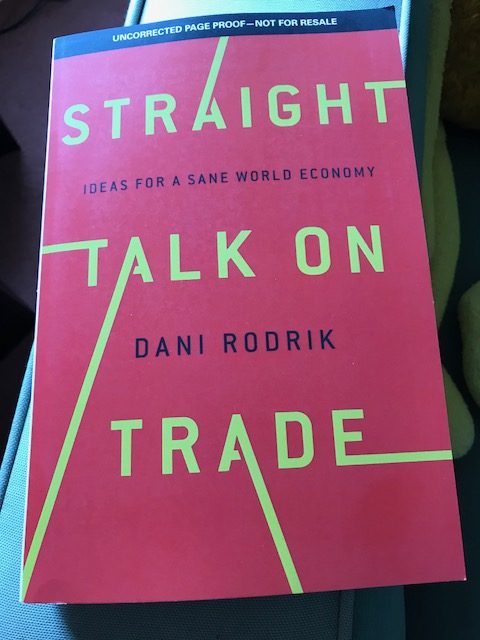
Hooray! Proofs of Dani Rodrik’s new book have arrived here.

IMG_4272There’s something good on every page I’ve opened.

IMG_4273Pre-order now folks – it’s out in November. Here’s the book blurb.

[amazon_link asins=’B0728P4S9C’ template=’ProductAd’ store=’enlighteconom-21′ marketplace=’UK’ link_id=’ddb4403f-7d9b-11e7-9365-3bcaf235af2b’]

It’s political correctness gone – profitable

The Google memo affair has sent me quickly to the proofs of a book coming out next month, Scott Page’s The Diversity Bonus. (Here is all the blurb for the book,)

[amazon_link asins=’B06ZZ6DBTQ’ template=’ProductAd’ store=’enlighteconom-21′ marketplace=’UK’ link_id=’e299aa86-7cd1-11e7-ad90-7be27361206a’]

Page wrote an excellent book a few years ago, The Difference, covering his early research on how and why diversity contributed to better (faster & more accurate) problem-solving.

[amazon_link asins=’0691138540′ template=’ProductAd’ store=’enlighteconom-21′ marketplace=’UK’ link_id=’09393558-7cd2-11e7-b124-333f3e50c3eb’]

The new book, judging from the intro, looks at how diversity contributes to profit. By ‘diversity’ he means a range of different cognitive approaches. Identity is one contributory factor to cognitive diversity, because it reflects the different experiences, networks and knowledge different types of people have; but it is not the only factor. However, it is a relatively easy one to monitor. What’s more, the more multi-dimensional and complex the business activity (eg coding, systems engineering), the more profitable it will be to have cognitively diverse teams. In other words, even if it were true that women were less likely on average to be good coders because of their biology – a doubtful proposition as today’s FT leader and many others (such as Prof Wendy Hall here ) point out – Google should still be eager to hire more of us.

If political correctness is profitable, is it still political correctness? Anyway, I’m looking forward to reading the book properly.

The business also sent me back to Simone de Beauvoir’s The Second Sex.

[amazon_link asins=’009974421X’ template=’ProductAd’ store=’enlighteconom-21′ marketplace=’UK’ link_id=’fdc546cd-7cd2-11e7-9db5-13b228cd4cb6′]

“In human society nothing is natural and a woman, like much else, is a product elborated by civilization. The intervention of others in her destiny is fundamental: if this action took a different direction, it would produce quite a different result. Woman is determined not by her hormones or mysterious instincts but by the manner in which her body and her relation to the world are modified by the action of others than herself. The abyss that separates the adolescent boy and girl has been deliverately widened between them since earliest childhood.”

‘Destiny’ is not predetermined. Biology does not mean women can’t become coders, chief executives, or economists. Even if the distributions of aptitude for certain activities differ by sex among adults  –  and it seems highly unlikely that the between-group differences are larger than the within-group variation – those distributions are the outcome of two decades of socialisation and social constraints.


Summer frivolity

The reason for the 2 weeks’ silence here was of course my summer holiday – when I read fewer serious books than usual because I spent a couple of hours a day writing my next book (a public policy economics textbook for Princeton University Press). Among the detective novels and other fiction though, I did read East West Street by Philippe Sands which is absolutely as brilliant as all the reviews have said, and could not be more timely.

[amazon_link asins=’147460191X’ template=’ProductAd’ store=’enlighteconom-21′ marketplace=’UK’ link_id=’4b574038-7ac3-11e7-b768-b76a842aa7e6′]


It wasn’t all frivolous detective novels. As well as the Sands, Linda Grant’s The Dark Circle stood out, and Jessie Burton’s The Miniaturist, though I wasn’t so keen as others on Zadie Smith’s Swing Time. I also really enjoyed MFK Fisher’s The Gastronomical Me.

Having now read half a year’s worth of fiction in a fortnight, though, it’s time to pick my next economics book. In the pile are two Piketty-related volumes: Anti-Piketty: Capital for the 21st Century and The Contradictions of Capital in the 21st Century (or ‘pro-Piketty’). Also some September publication proofs. Both Scott Page’s The Diversity Bonus and Dennis Rasmussen’s The Infidel and the Professor are tempting but I think I have to start with Eli Cook’s The Pricing of Progress: Economic Indicators and the Capitalization of American Life. This looks from a very quick skim like a pre-history of GDP from a US perspective.

[amazon_link asins=’0674976282′ template=’ProductAd’ store=’enlighteconom-21′ marketplace=’UK’ link_id=’e1391ceb-7ac2-11e7-ac43-a99fff5b0e4a’]