Trains and other illth

I thoroughly enjoyed reading Ruskinland: How John Ruskin Shapes Our World by Andrew Hill over the weekend. As the subtitle indicates, it isn’t a biography but rather an exploration of the influence Ruskin has had in a number of domains, from helping establish the National Trust as steward of the countryside – and encouraging the formation of the Sierra Club in the US – to shaping views about art, to influencing views about capitalism and the dignity of labour on the left of the political spectrum.

I’ve never read a biography of Ruskin, and he doesn’t emerge from this book as an obviously likeable character. In fact, pretty weird. The book I have read (bought at Brantwood, Ruskin’s home in the Lake District) is his famous anti-capitalism, anti-industrialism tract, Unto This Last. Ruskinland sent me back to it, and it still seems completely unconvincing and hyperbolic, for all that no sentient being would deny the horrors of the Industrial Revolution, or even modern capitalism.

Count me in on the need to ensure environmental sustainability, decent pay and working conditions, well-crafted homes etc. But it’s vacuous not to recognise the trade-offs involved in machine-enabled growth. Machines, mass production, raised standards of living, increasingly freed women from domestic drudgery. Trains – which Ruskin hated despite using them a lot – enabled people to escape the social constraints of village life and find urban anonimity. Unto This Last seems to me unadulterated romantic conservatism. Sustainability is easier for the rich. As Hill agrees, Ruskin was also an illiberal ultra-Tory. And adds: “Like today’s Twitterati and online opinionistas, he often adopted an extreme stance for effect.” Counterproductively so, in may case.

So Ruskinland hasn’t changed my views, but it’s a great read & the issues it raises are absolutely pertinent today as we survey the ‘illth’ (that handy Ruskinian neologism) being created by modern capitalism.

41GHcMwWhGL._SX350_BO1,204,203,200_

The Technology Trap

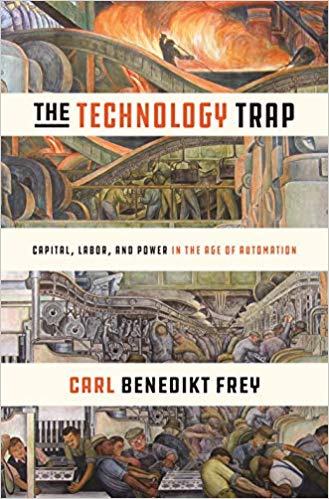
Anybody interested in the economic impact of digital and AI, in particular on jobs, will want to read Carl Frey’s new book, The Technology Trap: Capital, Labor and Power in the Age of Automation. He is probably best known for his rather gloomy work with Michael Osborne (original pdf version here) highlighting the vulnerability of many jobs – almost half in the US – to automation in the next couple of decades. The book expands on the issues that will determine the actual outcomes, and is – as the title indicates – still quite pessimistic.

The structure of the book is historical, with sections on pre-industrial technologies, the Industrial Revolution (which saw widening inequalities), the mass production era (which reduced inequalities and created an affluent middle class), the recent polarization in the era of globalisation and digital, and future prospects. The key distinction Frey draws in between technologies which substitute for labour and those which complement it. Whereas the 19th century and the present seem to involve the replacement of people with machines, the 20th century innovations needed increasingly skilled labour to work with them.

Although I am probably not as gloomy about future prospects for work and incomes, I really enjoyed reading the book, which covers a wide range of technological applications in addition to the well-known historical examples. It leaves open two questions. One is about the present conjuncture: what explains the combination of seemingly rapid technological change and adoption with – in at least some OECD economies – very low unemployment rates? The answer might just be ‘long and variable lags’ but the question surely needs addressing.

The broader question, or set of questions, is really about the interaction between technology and labour market and other economic institutions. Although automation is likely to have the same general effects everywhere, the outcomes for workers will be refracted through very different national job markets, education systems, tax systems and so on. How much can any individual country lean successfully against the wind? Frey is not (unlike Robert Gordon) US-centric but does not get into these issues.

And beyond the response to technological change, what is it that determines the direction of technical change in the first place? The book treats the labour substitution or complementing as exogenous. But why were electric unit drives in auto plants and internal combustion engines created as complementary and yet automation in today’s car industry seems like it will substitute for labour? It seems to me this must be an institutional story too, but I don’t think it’s been told yet.

51VabazLy7L._SX327_BO1,204,203,200_[easyazon_link identifier=”069117279X” locale=”UK” tag=”enlighteconom-21″]The Technology Trap[/easyazon_link]


Economic booms in space, not time

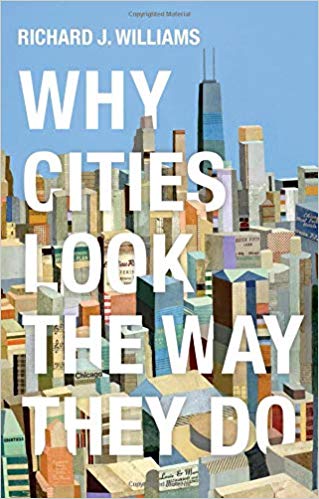
All economic growth has occured through urbanisation, but modern industrial capitalism dramatically so. Robert Hall once drew a parallel between economic booms in time (business cycles) and space (cities). This is a preamble to saying I’ve always enjoyed books about cities, or perhaps it’s an excuse for my interest. Recently I polished off The Ghosts of Berlin by Brian Ladd, a sort of history through architecture and urban form. This week it was Why Cities Look the Way They Do by Richard Williams. It argues that cities are the result of the interaction of many different processes occuring through time, and the chapters each explore some of these – culture, war, sex – and also money, work and power. In other words, there’s nothing intentional about how cities look, for all the efforts of the planners. Different cities are used as examples; the book’s focus is mainly big global cities but others such as Liverpool and Portland and San Paolo feature too.

I particularly liked the money chapter’s observations on real estate. It points out that some iconic supposedly residential towers such as 432 Park Avenue in New York are only half occupied and that this is intended. For they are not homes but investment assets, whose owners don’t care if they’re never occupied. Money buys space, and the emptiness is a store of value in the context of economic agglomeration. Of course there’s a poignant contrast with a city like Detroit, which is emptying, but whose spaces mark depreciation, not appreciation, of the asset. The chapter about the culture industry and its self-contradictions is nicely spiky, as is the one about the hipsterisation of industrial buildings in the modern world of work. As someone who grew up in an old-fashioned industrial place, I’m happy with the hipsterisation process; Manchester now is a better urban environment for its humans now than it was in the early 80s even though it’s lost the gritty culture/music scene of that era. But I can understand the regrets for lost authenticity.

Why Cities… has loads of pictures, too. The author is an art historian, so reading it prompts one to look. Very enjoyable.

[easyazon_link identifier=”0745691811″ locale=”UK” tag=”enlighteconom-21″]Why Cities Look the Way They Do[/easyazon_link]

515sNhdlmsL._SX317_BO1,204,203,200_


The limits of technocracy in competition policy

For reasons I needn’t go into, I spent much of today reading The Anti-trust Paradigm: Restoring a Competitive Economy by Jonathan Baker. It’s a very lawyerly in style and US-focused book. With that caveat, it’s actually a good overview of the current debate about competition policy, and the Chicago School versus neo-structuralist (aka ‘hipster’) clash going on in the US at the moment. One of its strengths is that it’s pretty even-handed. Although the book argues for sticking with an economics-based anti-trust policy, focused on consumer welfare, it also argues that the Chicago School goes too far beyond this with its set of presumptions (for instance, that vertical mergers are basically always fine, or that false positives preventing mergers that are not anti-competitive are far more costly than false negatives that let anti-competitive mergers go ahead).

The book sets the scene with the evidence on increasing concentration in US markets, and the adverse implications decreasingly vigorous competition has for the economy. What I particularly like about the book though is that it sets competition policy in its political context, making the case for a technocratic approach – to avoid the dangers of political capture and cronyism – but within the boundaries of a broader political settlement. Baker argues that for much of the post-war period, US anti-trust policy was shaped by the consensus about the form of American capitalism, delivering widely shared benefits including through the welfare system. Never explicit, this nevertheless set the climate for the decisions made by regulators and judges. He portrays the crumbling of this settlement, the growth of market power across the economy, as the backdrop for the decreasing consensus about anti-trust policy. In this situation, technocratic enforcement cannot function.

There is a section on digital markets, which I was interested in of course; it essentially briefly sums up the state of debate in a growing literature. And a final chapter advocating a more forceful American anti-trust policy (the US gets compared unfavourably to Europe) but one that abandons the cul-de-sac of the pure Chicago School. Although the application of anti-trust policy in America has diverged considerably from Europe, despite being underpinned by the same economic analysis, this is a useful book to understand the present US debate – and also why its conclusions are not very relevant to this side of the Atlantic.

41VXxLuHKSL._SX327_BO1,204,203,200_[easyazon_link identifier=”B07NT7KT36″ locale=”UK” tag=”enlighteconom-21″]The Antitrust Paradigm: Restoring a Competitive Economy[/easyazon_link]


Interdisciplinary reading

Recently I’ve attended a couple of interdisciplinary events and it’s interesting to see which books are cited by groups of natural scientists, computer scientists, social scientists and humanities scholars when they’re in conversation with each other. Here’s what I noted:

The poems of William Blake

The Poetry and Music of Science by Tom McLeish

41sQCo09PuL._SX317_BO1,204,203,200_

How to Grow a Human, forthcoming by Philip Ball

[easyazon_link identifier=”022665480X” locale=”UK” tag=”enlighteconom-21″]How to Grow a Human: Adventures in How We Are Made and Who We Are[/easyazon_link]

41Ou7JDC+GL._SX329_BO1,204,203,200_A Question of Trust by Onora O’Neill

The Human Use of Human Beings by Norbert Wiener517qXMsSvJL._SX316_BO1,204,203,200_[easyazon_link identifier=”B06XCY5JCK” locale=”UK” tag=”enlighteconom-21″]The Human Use Of Human Beings: Cybernetics And Society[/easyazon_link]

Engineering Rules forthcoming by JoAnne Yates and Craig Murphy

Calling Bullshit, forthcoming by Jevin West

Human Compatible, forthcoming from Stuart Russell

71CZkaKJjPL._AC_UL436_[easyazon_link identifier=”0241335205″ locale=”UK” tag=”enlighteconom-21″]Human Compatible: AI and the Problem of Control[/easyazon_link]