Time and times

I went into my office on Friday to pick up some books out of their quarantine, mainly things i need to get papers written, but I also rescued Changing Times: Economics, Policies and Resource Allocation in Britain Since 1951 by Martin Chick. I’ve torn through it, a very interesting book.

As the subtitle indicates, it’s a history of postwar economic policy in the UK, ranging over six decades and issues spanning industrial policy, macro and trade policies, environmental, labour market, health and education policies. It’s also only 400 pages, to give an indication of the quite long focal length it necessarily requires. Given this broad span, the structure of the book is provided by the theme of time. Time in two senses: how policies relate to the distribution of economic welfare between generations; and the importance of assets, stocks as well as flows, and in particular the state’s withdrawal from investment in the future over this period.

This doesn’t 100% work as a thematic structure but it is nevertheless extremely interesting to reflect on some familiar trends and episodes in postwar economic history through this lens. Chick also draws on a huge range of the economics literature in order to cover the various policy areas, and has obviously spent hours in the National Archives reading Treasury papers and other policy documents. (Indeed, by the <6 degrees of separation rule, he lodged with my in-laws while staying at Kew to do the archive work.)

My favourite chapter was the one on privatisation of state-owned industries, which politely eviscerates the rationale for the policy. As Chick writes: “What was perhaps under-appreciated at the time of privatisation was the historical novelty of trying to induce large sunk investment from utilities operating in competitive markets.” After all, profit rates in the utilities sector are never spectacular. He goes on to interpret nationalisation as being “preferred to regulation as a means of extracting for consumers the benefits of improvements in productivity.” Privatisation was introducing risk into areas “from which it had been absent for decades”, the risk of costly, lumpy investments not delivering an adequate return, and technological risk – as well as altering the distribution of returns.

However, there is loads of interest in every chapter even for someone who has read a lot of the economic and political history of this period. For instance, the London smog of 5-8th December 1952 is thought to have led to the deaths of 4000 Londoners, a staggering number. Yet it wasn’t until 7 months later that the government even appointed the Beaver Committee on Air Pollution. The same chapter on environmental policy is super-interesting on the relationship between stocks and flows of different types of natural asset – fish vs oil.

Chick concludes the book: “Considerations of time and space affect all of the major issues of concern today (housing, utility output, global warming, infrastructure, educational opportunities, access to healthcare, trade, the internet and so on).” I have quibbles about the book – for instance, it would have been nice to replace dense paragraphs describing data and trends with some charts. But in the end, what’s not to like about a book with references ranging from Derek Parfit and Frank Ramsey to articles about the Cod Wars of the 1970s or technical reports on council house sales?

511RSt2j1pL._SX324_BO1,204,203,200_

Ultimate price

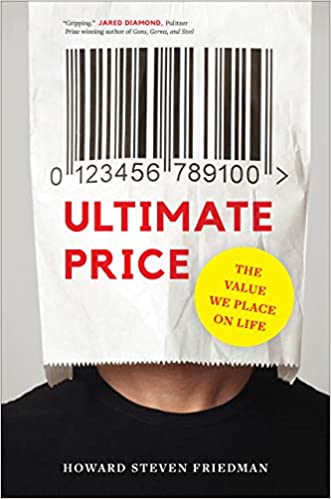
The weeks are speeding past in a blur of Zooms. However, I’ve found time to read – alongside the rivalry, gore, sex and drama of Tom Hollander’s RubiconUltimate Price: The Value We Place on Life by Howard Steven Friedman.

This is an unpromising subject in some ways: policies and regulations often place an implicit, or sometimes explicit, value on human life. How is that value determined? Is it consistent in different domains? What’s the fair and ethical way to make such judgments, which are inevitable when it comes to deciding which costly safety measures to enforce through regulation or whether to purchase an expensive drug for medical treatments, or how much to compensate crime or accident victims.

The short answers are that the value of life – even the dry-sounding Value of a Statistical Life – is inconsistently established and rarely debated. Monetary values and lives never feel like they belong in the same conversation. Rather, the issue is often the subject of industry lobbying and political horsetrading. Some regulations – eg environmental ones imposing costs on industry – are massively scrutinised. Others – eg extra airline security – are not. Some lives are valued at millions, others – including foreign civilians killed by drones, say – are not valued at all. Cost benefit analysis is sometimes uncomfortable, consistent cost benefit analysis even more so.

I picked up the book with a slight sense of duty as I do one lecture on this area, and can report that it’s very clear and well-informed. It has loads of thought-provoking examples. There is a US focus (health insurance) but the applications are wide. It will make a great supplementary read, giving students loads of examples to get them thinking and plenty of additional references. There isn’t as much as you might think giving an overview of these issues so I welcome this one and will add it to the reading list.

41u8lwg0maL._SX329_BO1,204,203,200_

Self-evident truths?

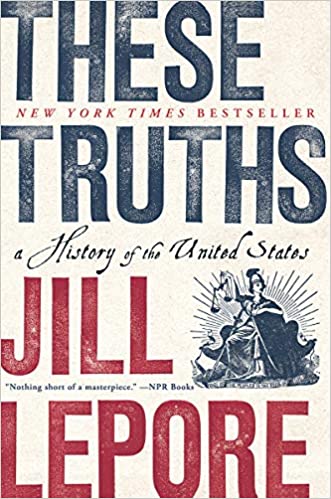
Reading Jill Lepore’s These Truths: A History of the United States has been quite a commitment – 800 pages and too big to carry around even as a paperback. It was well worth it. What a brilliant book.

Even at such a length, to cover the history of the US from Columbus to Trump requires a long focal length. The thread Lepore draws through the entire text is slavery and race, America’s original sin, and the intention of the Founding Fathers (“We hold these truths to be self-evident…”) and meaning of the American constitution. What does the founding dedication to equality mean in practice? But this is too reductive. This is a dense, rich book well worth the two weeks it has taken me to read.

Lepore is a wonderful writer, which helps. Consider the early section where she discusses the deal at the 1787 constutional convention to count a slave as three-fifths of a person for the purposes of determining states’ populations and therefore representation in Congress – a deal that gave southern states a lasting advantage in the legislature. During a break, Madison asked after the whereabouts of one of his slaves, Anthony: “Anthony had gone looking to be five-fifths of a person.” He had run away.

Or this: “Walter Lippman wore a three piece pinstripe suit the way a tiger wears his skin, but the cue to his acuity came in the raised eyebrows, as pointed as the tip of an arrow.”

The more modern sections are more familiar, but I like the way Lepore uses certain themes to ensure the book is more than one thing after another. The key ones for the 20th century are the media – the term “fake news” was in circulation in the 1930s, when Goebbels was an admirer of Edward Bernays, and both opinion polling and modern lobbying and campaigning were taking off – and computer technology. “Computers are often left out of the study of history and government, but starting at the end of the Second World War, history and government cannot be understood without them. Democracies rely on an informed electorate; .computers … would both explode and unsettle the very nature of knowledge.”

It turns out – now I look her up – Lepore has a podcast called The Last Archive, which must be worth a listen. I came across These Truths in a New York Times article about what Joe Stiglitz is reading – many other appealing reads on his list.

5144yTIgfeL._SX329_BO1,204,203,200_

Law and technology, power and truth

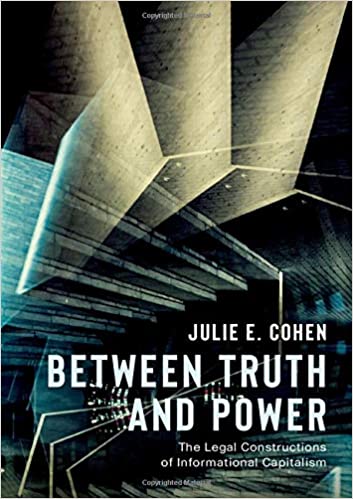
I’d been looking forward to reading Between Truth and Power: The Legal Constructions of Informational Capitalism by Julie Cohen. I start out sympathetic to the key argument that the legal system is the product its society – the material economic and technological and also the political conditions. Therefore current legal contests reflect underlying changes in these same forces, and the final legal system for the digital era is still in the process of being shaped. Law and the implementation of technologies in society influence each other – the ‘rules of the game’ are not exogenous.

There are indeed some interesting insights in the book. I most enjoyed some of the earlier parts, which are more descriptive of the extension of the idea of intangibles, ideas, as “intellectual property”. This is not new – James Boyle for one has written superbly about it. But the detail here is interesting, plenty of nuggets about the US legal system and how truly, gobsmackingly awful it can be.

I also appreciated the chapter on regulation, and its basic point that many regulators are now having to “move into the software auditing business”, and indeed may have to evaluate software controls designed to evade regulation. Implications here for analysing regulation in the digital economy in terms of hyper-asymmetric information and algorithmic complexity.

On the whole though, I was disappointed. The book is almost entirely US focused – and is upfront about it – but the US system is distinctive even compared to other common law jurisdictions. Nowhere else, for instance, has its 1st Amendment fetishism. It would have been terrific to have some reflections on the extra-territoriality of US lawmaking and court judgements in the digital domain.

The book has some tantalising reflections about the limitations of law, based on concepts of individual rights, in the face of collective effects: as I’ve been arguing for a while eg here, digital power spells the end of individualism, including what we all now call the neoliberalism that gave birth to it. More on this would have been great.

There’s also just too much sub-Zuboffian rhetoric (rather than argument) about the ‘surveillance-industrial complex’. I’m all too willing to believe this exists, so all the more disappointed when the analysis is so vague. There’s also a lot of allusion to Foucault – “biopolitics”, “governmentality” –  in the book without it ever – as far as I spotted – actually citing and deploying The Birth of Biopolitics.

All in all, there’s a lot of detail in this book that didn’t, at least for me, cohere. Too many trees, not enough overview of the wood. Perhaps it’s time for me to try the highly-praised The Code of Capital by Katarina Pistor.

514dfgTAVfL._SX351_BO1,204,203,200_

Angry Man

Angrynomics by Eric Lonergan and Mark Blyth is a rip-roaring read, and I wish I’d been in the pub with them as they discussed the state of the world and how to set it to rights. Not that I wholly agree with them, although disagreeing would obviously be half the fun. Normally I hate dialogue formats, as they’re usually constructed as a kind of semi-polite Punch and Judy show, presenting polarised views that are never intended to be reconciled. Lonergan and Blyth – it even sounds like a Victorian music hall act – agree on the basics so they riff of each other here in a more positive way.

Their basic thesis is that there are two kinds of anger abroad in the world: moral outrage (good) and tribal anger (bad), both reactions to the way the global economy has affected people since 1989.

Increased inequality is part of the story, genuine economic grievance in the rust belt and its equivalents, and another part is the cynical exploitation of tribalism or identitarianism by some politicians. So Lonergan and Blyth wear their left-of-centre hearts on their sleeves. The dialogues then describe and discuss the economic aspects of the political changes amply described in the now-extensive ‘decline of democracy’ literature – the micro, the macro/monetary, inequality (including, importantly, intergenerational), technological change – concluding with what to do now.

One huge gap evident right at the start is a passing parenthesis that the expression of anger is a largely male phenomenon. The book never picks this up; there is surely an important gender aspect to the way work has changed.

I disagree with dating the anger phenomenon to the collapse of communism in 1989, which removed a coherent (albeit flawed) ideology to oppose neoliberalism. Surely the hinge was the crisis of the 1970s, Thatcher and Reagan, and the early 1980s recession. That was the start of de-industrialisation, and the scarring of people’s economic prospects for the rest of their lives, and their children’s. These sea changes take time and there is never a single moment. As the book notes, too little has been reformed since 2008/9, but my view is that looking back with the hindsight of 2030, the combination of the Financial Crisis and the Covid depression will prove to be another hinge. (The book pre-dates the pandemic.)

As for the proposals, I think they get the role of competition all wrong, blaming excessive competition in tech and telecoms – whaaaaat??? – for the race to the bottom in employment practices. Amazon reports low profits because it reinvests so much revenue in continuing world domination, not because it has scrappy margins due to competitors snapping at its heels. I understand little about current monetary and alternative proposals, but as a diehard microeconomist find it hard to understand how administered negative prices in a market dominated by the state (ie central bank) can function well. Regulate the financial sector firmly – a big yes. The book has an interesting idea about government auctions of collective data rights – like spectrum auctions – which answers my profound objection to the proposal ‘create property rights in personal data and sell them’, namely that the value in data is collective, is due to aggregation.

Anyway, my copy has a combination of big ticks and scrawls of ‘nonsense!’ in the margins. A very satisfying read.


5128FT5whgL._SX324_BO1,204,203,200_