Rhetoric and reality in economics

There are plenty of ill-informed criticisms of economics, alongside the very valid criticisms of the subject. It’s frustrating if one wants to see the discipline move in desirable directions – a higher proportion of women and people who aren’t white & middle class, less ‘boys’ toys’ abstraction, more open (again) to history, sociology and other related subjects, etc – because responding to ill-founded critiques is such a waste of time. Yet the false myths need busting if real reform is to take place.

A recent article by Larry Elliott in the Guardian was outstandingly ill-informed. So much so that it prompted some of the UK’s most esteemed economists to write an excellent reply in Prospect. Their most important single point is, perhaps, that the econ-bashers are feeding the dangerous current in politics of disparaging expertise. We economists need to be duly modest about what we know, but we certainly know more than, say, some current members of the Cabinet.

I tweeted the link to the Prospect article, which led someone to come back on Twitter with this.

NelsonSmythe
@DianeCoyle1859 @prospect_uk Gonna throw a bit of Deidre McCloskey’s ‘Rhetoric of Economics’ in here: https://t.co/vyGzJiHRjx
21/12/2017 08:42

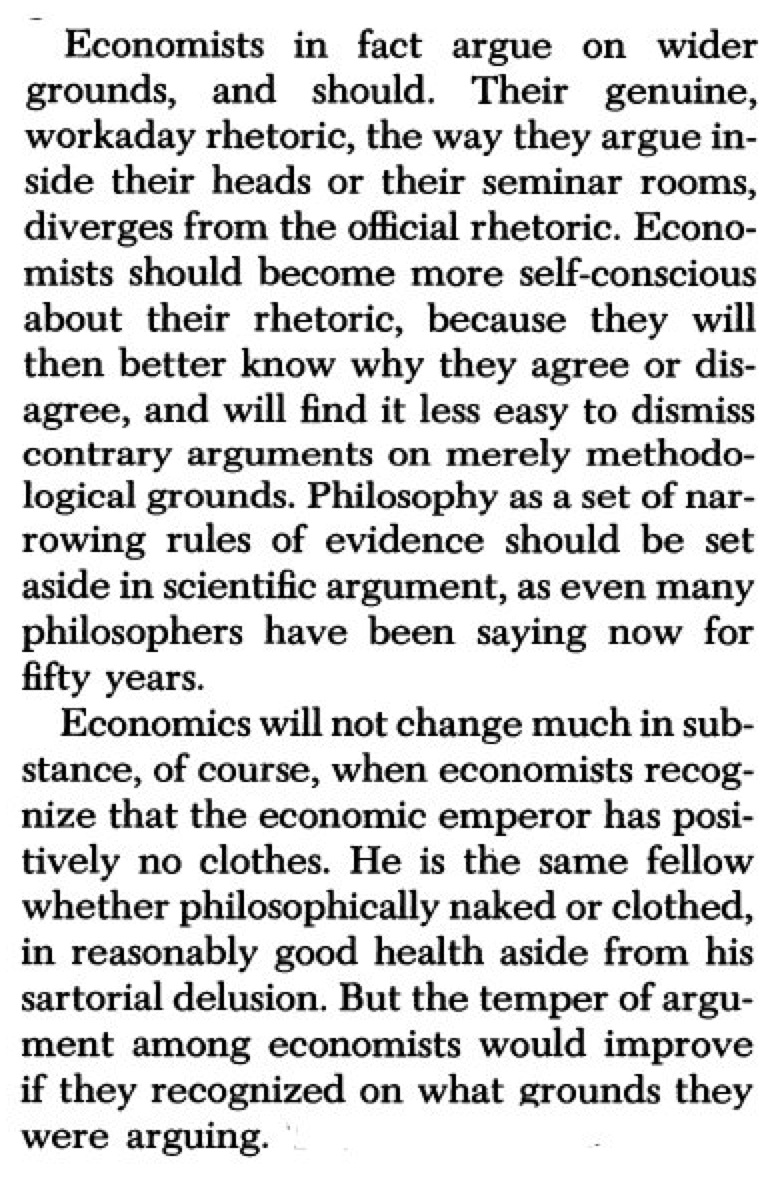
Here is the McCloskey quotation:

rhetSo I turned to my copy of McCloskey’s 1985 Rhetoric of Economics and particularly the postscript to the 1998 edition. There she is at some pains to correct readers of the 1st edition who’d concluded she is ‘against’ mathematics in economics, saying: “A lot of good work gets done in economics, new facts and new ideas. Economists are not stupid or lazy, not at all. I love the field. I belong to the mainstream.” Her target is what she describes as the ‘sandbox for boys’ games’ – ultra-mathematical and abstract – far from a wholesale criticism of maths in econ. Famously, she also condemns the unthinking worship of statistical significance – and indeed any economist worth their salt will also be absorbing the recent papers by Alwyn Young and by Ioannides et al in the Economic Journal.

Still, one can’t plonk The Rhetoric of Economics (remember, pub. 1985) down as a killer retort to the economists’ demolition of the latest dangerously misleading attack. As the Prospect economists note:

The way economics is done has been transformed in the past 30 years with an empirical revolution, meaning we now use fine-grained data on individuals, households and firms. In a recent survey of published work in top journals, over three quarters of papers analysed data collected either by the researchers themselves or from secondary sources. Economists provide evidence, increasingly using randomised control trials, or big data. Often this leads to theories being supported or knocked down: this is the bread and butter of modern economics.

My 2007 book The Soulful Science described a lot of the change since the 1980s this refers to. Perhaps it’s too much to hope for, but I do wish people who condemn economics would actually pay more attention to #whateconomistsreallydo

[amazon_link asins=’0299158144′ template=’ProductAd’ store=’enlighteconom-21′ marketplace=’UK’ link_id=’7c4e574b-e63a-11e7-91c8-2bf7df35326f’]

Winner of the 2017 Enlightened Economist Prize

As ever, it has been much harder to select one book from my longlist than it was to narrow it down to those ten. After mulling it over for a few days, I can announce today that the winner is Jean Tirole’s Economics for the Common Good. My review of it is here. It has been widely reviewed elsewhere – here is The Economist and the FT and Breaking Views.

[amazon_link asins=’0691175160′ template=’ProductAd’ store=’enlighteconom-21′ marketplace=’UK’ link_id=’06df1dbf-e26c-11e7-bb98-d949a51002a5′]

The reason – apart from it being a great read about the economics profession and about the kinds of policy problem on which economics can shed real light – is that in these times of disparaging ‘experts’ and ignoring evidence, it is great to have such a distinguished economist explaining for a wide audience the importance of evidence and expertise.

Festival of Economics 2017, Bristol Festival of Ideas, Bristol

Festival of Economics 2017, Bristol Festival of Ideas, Bristol

Photo courtesy of Bhagesh Sachania Photography

Rational, level-headed, compelling, cheerful – our ‘Perspectives’ series

Seeing the materials for the latest in our Perspectives series – Driverless Cars: On A Road to Nowhere by Christian Wolmar – has prompted me to boast a little. This is the 14th title in the series, which started out as an experiment to see if there was any appetite for short, focused books about economics and related subjects. In my heart of hearts, I wasn’t at all sure we’d succeed, so my expectations have been greatly exceeded!

Christian’s book is a wonderful, and passionate, tirade against driverless car hype, but the book is also very persuasively argued. My scepticism about this particular technology is now pretty solid. As this bit of Giles Chapman’s blurb puts it, “This is just what the robot evangelists don’t want you to read: a rational, levelheaded, compelling yet cheerful analysis of why the driverless car‘s route to success is so uncertain.”

[amazon_link asins=’1907994750′ template=’ProductAd’ store=’enlighteconom-21′ marketplace=’UK’ link_id=’5e570c50-e0f2-11e7-8500-fda5e69b3f47′]

It’s difficult to single out individual titles. But to mention a few, both Dave Birch’s books have been best sellers for us – Before Babylon, Beyond Bitcoin and his earlier Identity is the New Money. The recent book by Rebecca and Jack Harding, The Weaponization of Trade is a really thought-provoking analysis of the links between rhetoric and reality, and between trade and international security relations. I have a personal soft spot for Mike Emmerich’s Britain’s Cities, Britain’s Future and Kate Barker’s Housing: Where’s the Plan? because of my own interests. But then when I start looking at the list, I also have to praise – well, all of them. Like David Metz’s Travel Fast or Smart? Julia Unwin’s Why Fight Poverty? …..

[amazon_link asins=’1907994653′ template=’ProductAd’ store=’enlighteconom-21′ marketplace=’UK’ link_id=’695c66b3-e0f2-11e7-a14d-1dadeee0f1d6′]  [amazon_link asins=’1907994122′ template=’ProductAd’ store=’enlighteconom-21′ marketplace=’UK’ link_id=’6ded5ffc-e0f2-11e7-b9fa-094389b37c0e’]

[amazon_link asins=’1907994629′ template=’ProductAd’ store=’enlighteconom-21′ marketplace=’UK’ link_id=’7a5ef479-e0f2-11e7-8b2f-73ec2e21b5d9′]  [amazon_link asins=’1907994726′ template=’ProductAd’ store=’enlighteconom-21′ marketplace=’UK’ link_id=’8340f85a-e0f2-11e7-bd35-c15feebe9217′]

There’s an offer for people who want to pre-order Driverless Cars: On A Road to Nowhere and other special offers available – and still time to order as perfect stocking fillers!

Management as a productive resource

I’ve been browsing through Edith Penrose’s Theory of the Growth of the Firm, having read the biography by Angela Penrose, No Ordinary Woman. Published in 1959, it is an interesting narrative approach to the dynamics of individual firms, with plentiful examples from case studies. One can see that it was heading in a very different direction methodologically from mainstream economics, and hence why Penrose was taken up by business schools instead.

Yet mainstream economics is arguably rediscovering her core reasoning:
“The emphasis is on the internal resources of the firm – on the productive services available to a firm from management within the firm. … the experience of management will affect the productive services that all its other resources are capable of rendering.” The manager’s mind interprets the environment in which the firm is operating, the expectations of future demand and the directions in which to expand, she continues. It is not only the objective resources available, but how the management of the firm can use them, and how they understand the competitive environment in which they are operating. All of this reminded me very much of the recent World Management Survey work by Nick Bloom, John Van Reenen and colleagues looking at the importance of management quality for firm productivity. They write: “Economists have long puzzled over the astounding differences in productivity between firms and countries. In this paper, we present evidence on a possible explanation for persistent differences in productivity at the firm and the national level — namely, that such differences largely reflect variations in management practices.” Maybe Penrose was less puzzled than many.

[amazon_link asins=’0199573840′ template=’ProductAd’ store=’enlighteconom-21′ marketplace=’UK’ link_id=’ac0aff01-df57-11e7-9537-312c01a5bbfa’] [amazon_link asins=’0198753942′ template=’ProductAd’ store=’enlighteconom-21′ marketplace=’UK’ link_id=’b118f0e0-df57-11e7-8ea6-397ed5129588′]

Enlightened Economist Prize 2017 – longlist

I’m late this year with drawing up my longlist. The rules are that the contenders are the books I happen to have read this past 12 months (they don’t have to have been published in 2017), and the choice of the ultimate winner is mine alone. Criteria include: interest and importance, enjoyability/readability/accessibility, and being related to economics (ruling out my history and pop science reading). Links are to reviews on this blog.

With that, and in no particular order, the 2017 longlist is:

The Undoing Project by Michael Lewis

[amazon_link asins=’0141983043′ template=’ProductAd’ store=’enlighteconom-21′ marketplace=’UK’ link_id=’71160bc8-dda2-11e7-b592-abce019d03d7′]

Hall of Mirrors by Barry Eichengreen

[amazon_link asins=’0190621079′ template=’ProductAd’ store=’enlighteconom-21′ marketplace=’UK’ link_id=’7c963a85-dda2-11e7-900b-2f45ff556929′]

The Financial Diaries by Jonathan Morduch and Rachel Schneider

[amazon_link asins=’B01M5IMF5J’ template=’ProductAd’ store=’enlighteconom-21′ marketplace=’UK’ link_id=’877ee4f8-dda2-11e7-bf0b-9b213d2ae746′]

The Wisdom of Finance by Mihir Desai

[amazon_link asins=’1788160045′ template=’ProductAd’ store=’enlighteconom-21′ marketplace=’UK’ link_id=’9f5f9015-dda2-11e7-9e67-07ff59b5f5fc’]

Beating the Odds by Justin Yifu Lin and Celestin Monga

[amazon_link asins=’0691176051′ template=’ProductAd’ store=’enlighteconom-21′ marketplace=’UK’ link_id=’afe2669d-dda2-11e7-93c8-570b42414e18′]

The Pricing of Progress by Eli Cook

[amazon_link asins=’0674976282′ template=’ProductAd’ store=’enlighteconom-21′ marketplace=’UK’ link_id=’b681a684-dda2-11e7-b751-0333d1be144f’]

Adaptive Markets by Andrew Lo

[amazon_link asins=’0691135142′ template=’ProductAd’ store=’enlighteconom-21′ marketplace=’UK’ link_id=’bc87b509-dda2-11e7-9f04-09ebf6d4afc5′]

Economics for the Common Good by Jean Tirole

[amazon_link asins=’0691175160′ template=’ProductAd’ store=’enlighteconom-21′ marketplace=’UK’ link_id=’caa0903b-dda2-11e7-9310-a70b04f63adb’]

Straight Talk on Trade by Dani Rodrik

[amazon_link asins=’0691177848′ template=’ProductAd’ store=’enlighteconom-21′ marketplace=’UK’ link_id=’d2611edc-dda2-11e7-bd7c-b31b367d0892′]

The Attention Merchants by Timothy Wu

[amazon_link asins=’1782394850′ template=’ProductAd’ store=’enlighteconom-21′ marketplace=’UK’ link_id=’d9279697-dda2-11e7-b0de-f5fc8096900e’]


I’ll decide on the winner before Christmas. The Prize is the offer of a fine lunch or dinner should the prizewinner and I find ourselves in the same place. Oh, and the glory.

By the way, my nominations for the best non-econ books I read this year are:

Second Hand Time and The Unwomanly Face of War by Svetlana Alexievich

[amazon_link asins=’0141983523′ template=’ProductAd’ store=’enlighteconom-21′ marketplace=’UK’ link_id=’0ddbdde5-dda3-11e7-a6a5-5fe1e4dbabd2′] [amazon_link asins=’1910695114′ template=’ProductAd’ store=’enlighteconom-21′ marketplace=’UK’ link_id=’148b98ff-dda3-11e7-a984-5d05f5e7fc18′]

The Deluge by Adam Tooze

[amazon_link asins=’0141032189′ template=’ProductAd’ store=’enlighteconom-21′ marketplace=’UK’ link_id=’1a9b1c9b-dda3-11e7-b818-65777a7f07d2′]

East West Street by Philippe Sands

[amazon_link asins=’147460191X’ template=’ProductAd’ store=’enlighteconom-21′ marketplace=’UK’ link_id=’21c0f139-dda3-11e7-b2cf-652d6c92d343′]