
April reads (yes, another month has flashed past)

It’s been a busy, busy academic year so it seems I’m only managing monthly round-ups here at the moment. A little more though on two books i’ve read in the past few days.

One was Mark Fabian’s Beyond Happy. Mark, who was a postdoc with us and is now an associate prof at Warwick University, is a true academic expert on wellbeing. He has a definitive recent scholarly book on this A Theory of Subjective Wellbeing. Beyond Happy is aimed at general readers, and is a lovely book. It refers to the literature in philosophy, psychology and economics to offer practical advice – not ‘how to be happy’, but how to make sure your life is meaningful, full of purpose, rewarding: “Wellbeing is about living a pleasant, fulfilling and valuable life. In recent decades we’ve been too narrowly fixated on the pleasant part, and an a crude way too. We’ve gone in for materialism, hedonism and tranquillity.” He also emphasises – in contrast to the dreadful ‘wellness’ industry – that wellbeing is a social phenomenon. Relationships and community make a huge difference. The book is a bit denser than the typical self-help book because it does synthesise the academic literature, but is correspondingly more rewarding.

The other was Markus Gabriel’s Doing Good. I encountered Markus at several workshops in Oxford and Hamburg in recent years as he developed his arguments that “the business of business is doing good.” The book advocates for ‘ethical capitalism’, with a chief philosopher or ethics officer in every business, having the same board status as the finance director. And extending the vote to children so the voice of the future is better represented in democracies. For my tastes, the book is too utopian, focused as it is on why societies need ethical capitalism rather than how they might get there. I tried to imagine how I’d react to its arguments if I were a troglodyte Milton Friedman-loving, greed is good, free marketeer; and am not sure it would make a dent in my certainties. Still, it’s an elegantly argued book that might provide woolly-liberal me with some ammunition.

Other reads this month:

Three state of the nation books – I’ve reviewed them for the FT in the near future – The Land Where Nothing Works by A.G. Hopkins, Challenging Inequalities by Paul Johnson, and Yesterday: the United Kingdom from Thatcher to Covid by Brian Harrison

Holiday reads with the family in Whitstable:

Number Go Up by Zeke Faux – very funny (sceptical) perspective on the crypto world

Death in the East by Abhir Mukerjee – another in this excellent detective series set in India as the independence struggle heats up

Down Cemetary Road – Mick Herron’s first novel.

Careless People by Sarah Wynn Williams. I was late to this whistleblower’s account of what it’s like inside Meta. Eyebrow raising.

Death of an Ordinary Man by Sarah Perry – a beautiful reflection on death, and life, as she recounts her father-in-law’s last days

And since then:

Tyll by Daniel Kehlmann – odd novel set in 15th century Germany, but compelling

The Playbook by James Shapiro – history of the Federal Theatre Project in the New Deal, and its downfall

Silent Voices by Ann Cleves – a Vera novel, just what I needed one exhausted evening. Though I found this less well-written than some of her others in the series.

IMG_7411Whitstable – a great place to read on holiday
Politics by numbers

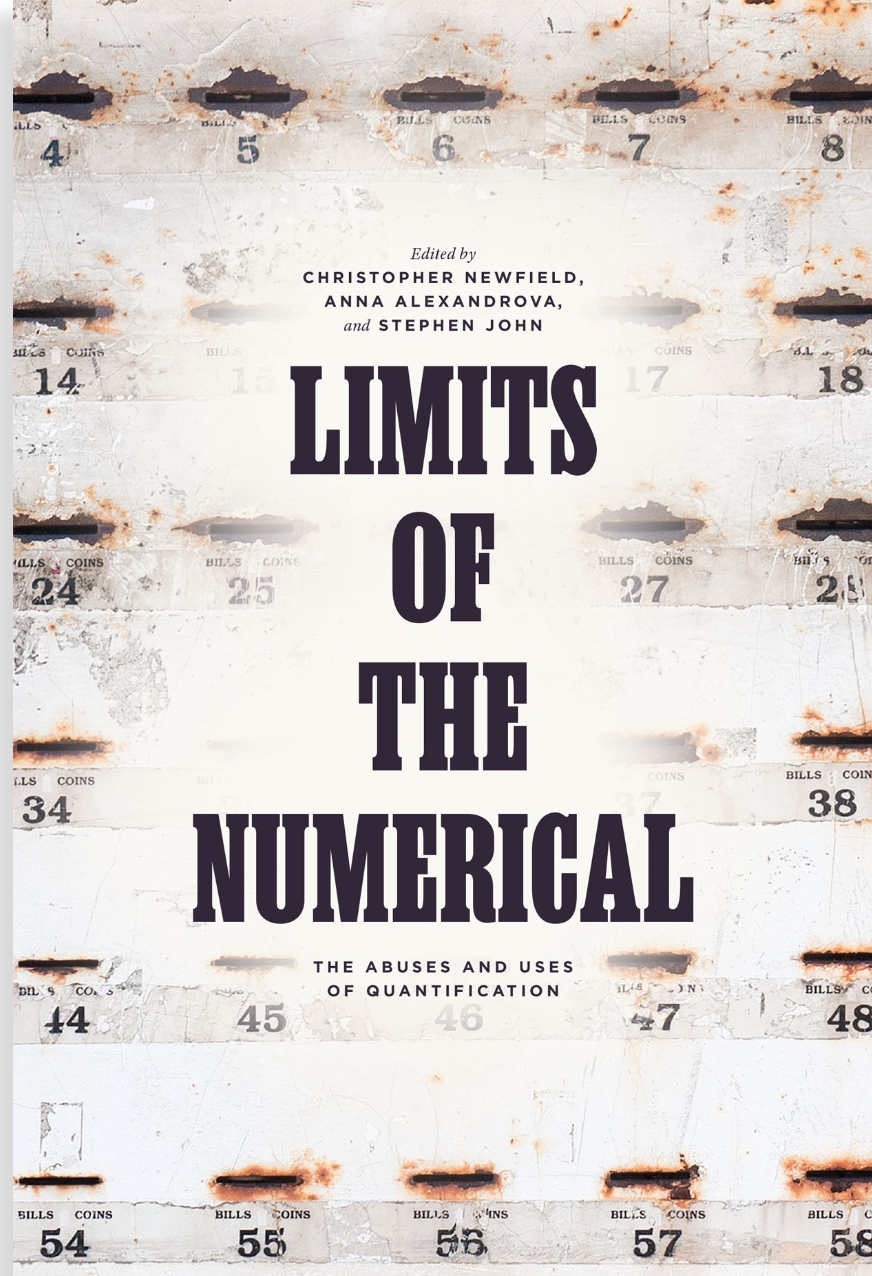
Limits of the Numerical: the abuses and uses of quantification (editors Christopher Newfield, my dear colleague Anna Alexandrova, and Stephen John) is right up my street. It’s a collection of thoughtful essays exploring exactly what the subtitle says, some general and some relating to specific issues of quantification in education and healthcare, and (by Anna and Ramandeep Singh) the measurement of wellbeing.

The aim of the volume is to move beyind what it characterises as the Original Critique (set out in some classics like Desrosières and Porter). This critique points to the historical context of measurement and quantification, and the use of the presumed authority and objectivity of numbers as an instrument of politics or power. As the introduction points out, the Original Critique assumes this deployment of numerical thinking is successful. Yet in recent years expertise – generally involving evidence and numbers – has been steadily demonized, and independent evidence-based agencies have either been targets for populism or lost legitimacy more broadly.

One sign of the demise of expertise was the New Public Management era of Blair and Clinton, disciplining experts by use of quantitative targets. Subsequently populists have deployed numbers against experts too, but in their case appealing to public opinion or crowd size. Thus, “The numerical idiom became just another part of the degraded rhetoric of politics.” But perhaps the real nail in the coffin of quantified expertise was the financial crisis and its aftermath: whatever the experts were doing, it didn’t deliver: “Against the promise of governance by the numbers, the 2008 meltdown and everyday experience both revealed a regime of incompetence, political interference and elite bias.”

There are interesting dives into the spread and effects of higher education rankings – as the book notes, audit culture here has become performative, bringing into being the measureable phenomena; orphan drugs – featuring the “unholy alliance” between patients and pharma companies seeking to profit from financial incentives to develop drugs for rare diseases; and climate science.

I was particularly interested in the chapter on the measurement of wellbeing as Anna and I are co-authors on this subject, and indeed I attended an excellent conference on wellbeing research last week. The chapter sets out the different definitions and hence methods of quantification of wellbeing and sets out what it calls “Letwin’s dilemma” after the former minister who helped introduce wellbeing measurement to UK official statistics. The dilemma is that most philosophical and psychological approaches recognise separate dimensions of wellbeing, but a political sponsor needs a simple, measurable and comparable concept  to compete with other ‘hard’ metrics in the choices facing givernments. This is a genuine dilemma; but the chapter argues against what has become the single metric in policy debates, a scale-based measure of Life Satisfaction, as too reductive and detached from underlying psychological phenomena. This is exactly the debate I had at the conference with Richard Layard, the UK’s most influential researcher on wellbeing.

I polished off the book in just over a day, and it would interest anybody working on the sociology and politics of measurement and related areas, taking forward the now well-known critique of quantification and linking it persuasively to the political trends of the past decade.

Screenshot 2022-07-09 at 13.14.54