Facts and values (statistical version)

The trouble with reading two books simultaneously is that it slows down the finishing. But I have now finished a terrific novel, You Don’t Have to Live Like This by Benjamin Markovits – a sort of state of the United States novel except it seems like another age in this grotesque situation of Donald Trump apparently going to become President. And also The Cost of Living in America: A Political History of Economic Statistics, 1880-2000 by Thomas Stapleford.

The title might mark it out as a bit of a niche read – yes, ok – but it is truly a very interesting book. The key underlying message is that all statistics are political, and none more so than a price index. The account is one of the recurring, and recurringly failing, attempts to turn conflicts over the allocation of resources into a technical matter to be resolved by experts. The systematic state collection of statistics is part of the 19th-20th century process of the rationalization of governance as well as being itself “a form of rationalized knowledge making”. Theodore Porter’s well-known Trust in Numbers: The pursuit of Objectivity in Science and Public Life has documented the political appeal of developing and using impersonal, quantitative measures and rules. In my experience, statisticians themselves are far more aware than politicians (or indeed economists) of the highly judgmental nature of their work.

The Cost of Living in America presents the history of the development of price measurement in the US, with a division between the labor movement’s emphasis on the standard of living and cost of living, and the increasingly technocratic development of a price index for use in macroeconomic management. The former began with the study of ‘baskets’ of goods and a debate about what working families needed to maintain their standard of living and keep up with the norm. This was affected by context. For example, the price of certain staples including housing rose faster in wartime. New goods appeared. The debate about price indices increasingly revolved around whether to try to measure the cost of a fixed level of satisfaction, or the cost of a fixed basket of goods?

By the time of the Boskin Commission, this had been resolved decisively in favour of a constant utility index, the minimum change in expenditure needed to keep utility unchanged. (Robert Gordon has since said the Commission under-stated the over-statement of inflation.) This made accounting for quality change and new goods a pressing issue. Many economists started to agree that the statisticians had not adequately accounted for these in their price indices. Economists including Robert Gordon and Zvi Griliches focused on this question, Griliches developing the hedonics approach.

Stapleford writes: “If economists were to claim that their discipline had any claim to neutral technical knowledge, surely that claim required them to have neutral apolitical facts – namely economic statistics. … A constant-utility index was surely the proper form for a cost-of-living index, but the idea that one could compare ‘welfare’ in two different contexts [eg two separate time periods or two countries] without introducing subjective (and probably normative) judgments seemed implausible at best.” Yet applying price indices to macroeconomic analysis of growth or productivity  rather than labour disputes helped depoliticise them. And hedonics tackled the problem by redefining goods as bundles of characteristics. As the book notes, governments became keen on their statisticians applying hedonics, from the mid-90s, when they realised that it implied very rapid declines in some prices and hence higher productivity growth. (And the ‘accuracy’ of price indices is in question again now because of the ‘productivity puzzle‘.)

But this is an uncomfortable resolution. Although this elegant solution links national income statistics to neoclassical utility theory, there seems a category mismatch between a set of accounts measuring total production with the idea that value depends on utility. Setting aside the fact that hedonic methods are not applied to a large proportion of consumer expenditure anyway, this piece of statistical welding is coming under huge strain now because the structure of production in the leading economies is being transformed by digital.

One of the many consequences of the Brexit vote and Trumpery is that economists (and others) are again thinking about distribution. The issue is usually framed as the distribution of growth – when it is there, who gets it? I think the question raised for our economic statistics is far more fundamental: we need to recognise the normative judgements involved in the construction of the growth statistics to begin with. Actually existing macroeconomic statistics embed a tacit set of assumptions about welfare, and a production structure which is becoming redundant. But that of course is my favourite theme.
31nh-hpypcl

Algorithms and (in)justice

It’s been one of those weeks. One of those years, actually – David Bowie *and* Leonard Cohen. Listening to ‘Democracy‘ as I write this.

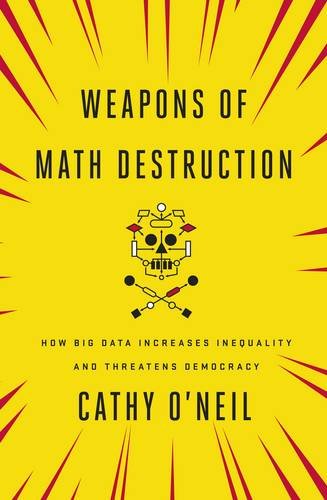
Still, I have managed to read Cathy O’Neil’s excellent Weapons of Math Destruction, about the devastation algorithms in the hands of the powerful are wreaking on the social fabric. “Big data processes codify the past. They do not invent the future. Doing that requires moral imagination, and that’s something only humans can provide. Sometimes that will mea putting fairness ahead of profit.”

The book’s chapters explore different contexts in which algorithms are crunching big data, sucked out of all of our recorded behaviours, to take the human judgement out of decision-taking, whether that’s employing people, insuring them or giving them a loan,  sentencing them in court (America, friends), ranking universities and colleges, ranking and firing teachers….. in fact, the scope of algorithmic power is increasing rapidly. The problems boil down to two very fundamental points.

One is that often the data on a particular behaviour or characteristic is not observed, or unobservable – dedication to work, say, or trustworthiness. So proxies have to be used. Past health records? Postcode? But this encodes unfairness against individuals, those who are reliable even though living on a bad estate, and does so automatically with no transparancey and no redress.

The other is that there is a self-reinforcing dynamic in the use of algorithms. Take the example of the US News US college ranking. Students will aim to get into those with a high ranking, so they have to do more of whatever it takes to get a high ranking, and that will bring them more students, and more chance of improving their ranking. Too bad that the ranking depends on specific numbers: SAT scores of incoming freshmen, graduation rates and so on. These seemed perfectly sensible, but when the rankings they feed into are the only thing that potential students look at, institutions cheat and game to improve these metrics. This is the adverse effect of target setting on addictive crystal meth. Destructive feedback loops are inevitable, O’Neil points out, whenever numerical proxies are used for the criteria of interest, and the algorithm is a black box with no humans intervening in the feedback loops.

The book is particularly strong on the way apparently objective scoring systems are embedding social and economic disadvantage. When the police look at big data to decide which areas to police more harshly, the evidence of past arrests takes them to poor areas. A negative feedback loop – they are there more, they arrest more people for minor misdemeanours, the data confirms the area as more crime-ridden. “We criminalize poverty, believing all the while that our tools are not only scientific but fair.” Credit scoring algorithms, those evaluating teachers using inadequate underlying models, ad sales targetting the vulnerable – the world of big data and algos is devastating the lives of people on low incomes. Life has always been unfair. It is now unfair at lightning speed and wearing a cloak of spurious scientific accuracy.

O’Neil argues that legal restraints are needed on the use of algorithmic decision-making by both government agencies and the private sector. The market will not be able to end this arms race, or even want to as it is profitable.

This is a question of justice, she argues. The book is vague on specifics, calling for transparency as to what goes in to the black boxes and a regulatory system. I don’t know how that might work. I do know that until we get effective regulation, those using big data – including especially the titans like Facebook and Google – have a special responsibility to consider the consequences.

51aemrp8fbl

The trade-investment-service-intellectual property nexus

I’ve managed to resist reviewing Richard Baldwin’s new book The Great Convergence: information technology, trade and the new globalization until now, and it has taken serious self-restraint as the book is so relevant to (among other things) the Brexit debate. I would for one thing force every Cabinet member to read it and not allow them to keep their jobs unless they could pass an exam based on it. Anyway, the book’s published on 14th November and now it’s November my self-denying ordinance can end.

The Great Convergence offers a compelling framework for thinking about how trade is organized and why and how it benefits whom. The first part is a historical overview of trade leading up to the first, the Old Globalization or the 19th century. This phenomenon, due to steam power reducing trading costs, industrialization and a context of relative global peace led to the Great Divergence: the major economies of Asia, which had been richer than the West, fell behind, dramatically so over the course of two centuries. The New Globalization, since the 1980s, driven by the new information and communication technologies, has taken the rich countries’ share of global output back to its 1914 level in little over two decades. China is the standout story, going from uncompetitive in 1970 to 2nd biggest in the world by 2010, but other rapidly industrializing nations in the New Globalization are Korea, India, Poland, Indonesia and Thailand (ie. a different group from the notorious BRICs).

However, as the book goes on to document, the New Globalization is a completely different kind. Trade over distance has three costs: the costs of moving goods, ideas and people. When moving goods got cheap, the first explosion of trade occurred, but ideas were costly to move so the innovations of the industrial revolution were not easily exported. The Old Globalization was the result of low shipping costs and high communication costs. ICTs have reduced the latter significantly, so industrial competitiveness is defined in terms of production networks, interlinked supply chains, that cross national borders. Knowledge has been offshored, and the rapid growth in a few previously poorer countries has come about because of their geographical location, close enough to G7 industrial centres that managers can travel there, sharing knowledge within the confines of the production network.

This means the New Globalization happens at the level of stages of production and occupations. This makes it harder to predict who will be affected – which jobs will be offshored, which areas most affected. “Nations are no longer the only natural unit of analysis”. Much of the book describes a new data set making it possible for economists to begin to explore the ‘value added’ pattern of trade created by the switch from trading finished goods toward trading components in global production chains. The picture is going to be utterly different – the famous example being the iPhone which is sourced conventionally as a Chinese export to the US but where the value added is concentrated in the American business and the Chinese import a lot of the components they assemble and re-export with not much value added at that stage.

This is one insight the Brexiteers need to appreciate, although the Nissan letter suggests at least some members of the government realise the signficance. British businesses are woven into supply chains with our near neighbours: we aren’t importing prosecco and salami so much as gear boxes. Brexit threatens to tear apart these links. If the cost appears to be too high, the multinationals at the head of the supply chains will relocate chunks of their production networks, and won’t care if they’re exporting gear boxes to the Czech Republic rather than Britain.

The book adds: “Twenty-first century supply chains involve the whole trade-investment-service-intellectual property nexus, since bringing high quality, competitively priced goods to customers in a timely manner requires international coordination of production facilities via the continuous two-way flow of goods, people, ideas and investments. Threats to any of these flows become barriers to global value chain participation…” Baldwin adds that the movement of people is still a binding constraint on globalization, and face-to-face communication – and so distance – remain important. He argues that the improving quality of telepresence is changing this, but I think that remains to be seen.

Ultimately, trade policy today is not just about trade nor about nations. It involves deploying the nation’s productive resources through overseas connections. This is why 90% of the economics profession thought, and thinks, Brexit so damaging, and the idea that the UK has more economic self-determination outside the EU a delusion. The Great Convergence is not about Brexit – it ranges far wider. I can’t imagine a better and more accessible analysis of trade and globalization in the digital era.

51dsa3wrnl

(20 November: minor typos corrected)

Wanting to change

Anybody who reads Duncan Green’s excellent blog, From Poverty to Power, won’t be entirely surprised by the approach he takes in his equally excellent new book, How Change Happens. It is based on two pillars. One is Amartya Sen’s capabilities approach to human development (‘the freedoms to do and to be’), and I’ve always thought that when you appreciate its ethical and practical merits, it’s hard to take any other approach. The other is the need for systems thinking when it comes to considering economic policies or other interventions – in any context, really, but certainly in the case of development.

“Change in complex systems occurs in slow steady processes such as demographic shifts, and in sudden, unforseeable jumps,” Green writes. Mostly, change is extremely, painfully slow. It turns out to be impossible to do one thing because another, linked thing gets in the way. Events and crises open the way for the big shifts – being an economist, I think of this in terms of what it takes to move a co-operative game to a new focal point. But even then, the direction of the jump is contingent, messy, unpredictable. It anyway depends on the prevailing climate of ideas and norms – so part of the challenge is to be ready to take advantage of a crisis by having done all the contextual spade work, all the while getting on with the day job of trying to bring about incremental changes in the previous state of affairs.

Needless to say, this does not make for a concise ten-point plan in the final chapter (although it does try to sum up the whole in a ‘power and systems approach’ in the final few pages). The book has some interesting practical ideas, however. I like the principle of looking for ‘positive deviance’ – look for examples of people or activities that succeed against enormous odds, for outliers, and use them as ‘social proof’ so others copy whatever it is. This is exactly the way new technological innovations spread: the ideas are there, a few people try, and others imitate them. There are loads of examples of advocacy and development organisations and initiatives that have been able to implement responsive, adaptable changes (many of these brought Tim Harford’s Adapt to mind). Other suggestions are harder to see how to implement. The book argues that principled leadership matters. I agree. But where is it? How do donors encourage it?

Green concludes that many organisations in the aid world, including his own, need to move away from linear thinking and get wiser to context and the whole complex environment (actual and political) in which they operate. I hope they follow his advice and this book is certainly well worth anyone working in this world reading. The one element missing, though, seems to be the meta-analysis of the development agency ecosystem itself, and the prevailing ideas. For example, how do you get social innovation akin to technological innovation in a world of impact assessment and RCTs? Or indeed combine fleetness of foot with a genuine need to understand ‘what works’? Understanding one’s own cognitive biases or limitations is a tall order. What’s more, the aid world has incentive structures built in that will discourage change. In a variation on the old lightbulb joke (How many psyhologists does it take to change a lightbulb? Only one, but the lightbulb has to really want to change), how change happens is that a lot of people have to want change to happen.

Anyway, there’s no excuse for not reading the book, as it’s also published as an open access pdf. I hope lots of activists read and digest and change their approach, but suspect it will prove difficult for many.

41qmgmtc-bl

Not the smartest animals

The title of Frans de Waal’s latest book is a rhetorical question: Are We Smart Enough to Know How Smart Animals Are? I thoroughly enjoyed reading it. De Waal’s deep knowledge shines through every sentence, as does his delight in all the creatures (especially other primates) he has spent his career studying. The book is about the evolution of cognition and emotion in animals (including humans). It particularly debunks Skinner’s behaviourism – mental processes as a black box, but manipulable using reward and punishment. (This of course the approach behind the present fashion for behavioural economics, a fashion I find troubling because some of its enthusiasts do so clearly see themselves as omniscient scientists ordering society for the better by manipulating the choices of their less intelligent subjects.)

I learned a lot from the book, including that the elephant brain is the one with the most neurons (about 3 times as many as we do). The neural differences between humans and other primates are not sufficient to make us unique in all aspects (although we clearly are in some, notably language). De Waal argues we should assume continuity, a spectrum of cognitive abilities between different animals, rather than sharp and wide distinctions. He notes that psychology is moving to accept this assumption, but the social sciences tend to assume human discontinuity – “But what does it mean to be human?” he reports social scientists asking him. “I usually answer with the iceberg metaphor, according to which there is a vast mass of cognitive, emotional and behavioural similarities between us and our primate kin. But there is also a tip containing a few dozen differences. The natural sciences try to come to grips with the whole iceberg, whereas the rest of academia is happy to stare at the tip.”

The scientific project must therefore be to develop a unitary theory of different cognitions, how cognition operates in general, and then in the case of each particular species. The book emphasises two important contributors: sense perceptions (is vision the most important to the species? or hearing, or smell?); and social relations (is it a species with strict social hierarchies, like chimpanzees, or solitary, like the octopus?) “Cognition and perception cannot be separated… they go hand in hand,” he writes. (Interesting to reflect on what this means for AI. The question is not so much what androids dream of as what they see or hear.)

To crown a wonderful book, it ends with a quotation from David Hume: “Tis from the resemblance of the external actions of animals to those we ourselves perform, that we judget their internal likewise to resemble ours; and the same principle of reasoning, carried one step farther, will make us conclude that since our internal actions resemble each other, the causes, from which they are derived, must also be resembling. When any hypothesis, therefore, is advanced to explain a mental operation, which is common to men and beasts, we must apply the same hypothesis to both.” As Hume summed it up, “No truth appears to me more evident than that beasts are endowed with thought and reason as well as men.”

41ikzreoutl-_sx309_bo1204203200_41xmrpmkokl-_sx324_bo1204203200_