Fear, greed, fairness, imagination and finance

I’ve thoroughly enjoyed reading Adaptive Markets: Financial Evolution at the Speed of Thought by Andrew Lo. I should say that, apart from being a distinguished MIT finance professor and the co-author of the classic A Non-Random Walk Down Wall Street, Andrew is an old friend. But this should not put off any readers. This new book will become another essential read for anybody interested in financial markets.

The book aims to do what ultimately all of economics must do, and situate economic decisions and behaviour in the context of our biology and evolutionary history. Behavioural economics and finance have gone some way toward this in introducing the now-familiar heuristics such as loss aversion and framing effects, and herding is a familiar phenomenon in finance models. The issue with these has been how if at all they relate to rational choice models and the Efficient Markets Hypothesis. The Adaptive Markets Hypothesis is a synthesis, proposing that context makes the difference, and when conditions are sufficiently stable for long enough, financial markets are efficient. Otherwise, fear, greed, fairness, imagination – the characteristics evolution has given the human brain – kick in.

The opening chapter starts with a powerful demonstration of the potential efficiency of markets: after the Space Shuttle Challenger tragically exploded on 28 January 1986, a five month inquiry pinned the blame on a part, the O-ring, manufactured by one of four contractors, Morton Thiokol. Yet on the day of the accident, the share price of Morton Thiokol plummeted – the markets knew the company was to blame almost immediately, without the expert verdict: “Somehow the stock market in 1986 was able to aggregate all the information about the Challenger accident within minutes, come up with the correct conclusion and apply it to the assets of the company.”  The decline in its market capitalization – about $200m – was  almost exactly equal to the damages, settlement and reduced future cash flow, a later study found.

But often, of course, financial markets are all too obviously sometimes not efficient. The intellectual challenge is to figure out when they are in which mode. The book voyages through neuroscience, psychology, evolutionary biology and AI to try to answer this. The Adaptive Markets Hypothesis reverses the conventional framing: rather than thinking about a rational benchmark with a set of psychological quirks sometimes kicking in, we are a collection of quirks, but sometimes we can get beyond the heuristics to rational choice.

Frustratingly, although perhaps inevitably, there is no neat list of conditions for being in efficient rather than non-efficient mode: it depends, in particular on having had enough time in stable conditions to learn from experience. But Andrew does hold out hope for the prospects of being able to make better investment decisions – with socially useful outcomes – and being able to manage financial markets better so events like the 2008 crisis are far less likely to recur. In line with the Adaptive Markets perspective, he argues for treating financial markets as an ecosystem (so the interconnections are front of mind), using AI techniques to monitor markets and adjust regulatory instruments such as cyclical buffers. There is an interesting section on the role of technology in finance, including HFT, a technological arms race being one of the predictions of the Adaptive Markets Hypothesis. Currently, he is exploring ideas from biology such as immune responses and ecosystem management techniques. He also recommends introducing a body similar to the National Transportation Safety Board that would analyse market crashes and make recommendations for regulatory change. (One thing not spelled out here is whether this would have to be a global body.)

The book is a thoroughly interesting and enjoyable read. It is not technical, the explanations are super-clear, and there is some excellent story telling. Andrew recounts how in 1986 he and his co-author Craig MacKinlay, presenting at the NBER the work that turned into A Non-Random Walk Down Wall Street, were savaged by discussants from the world of academic finance. Since then, the academic community’s faith in the Efficient Markets Hypothesis has wavered significantly, but it is still the benchmark – as the book says, it takes a theory to beat a theory. I find the Adaptive Markets Hypothesis a persuasive theory, but then I firmly believe economics must be consistent with what we learn about ourselves from the other human sciences. I guess the test will come in the shape of how widely market participants themselves embrace it.41CpHzPtybL


Contradictions of capital

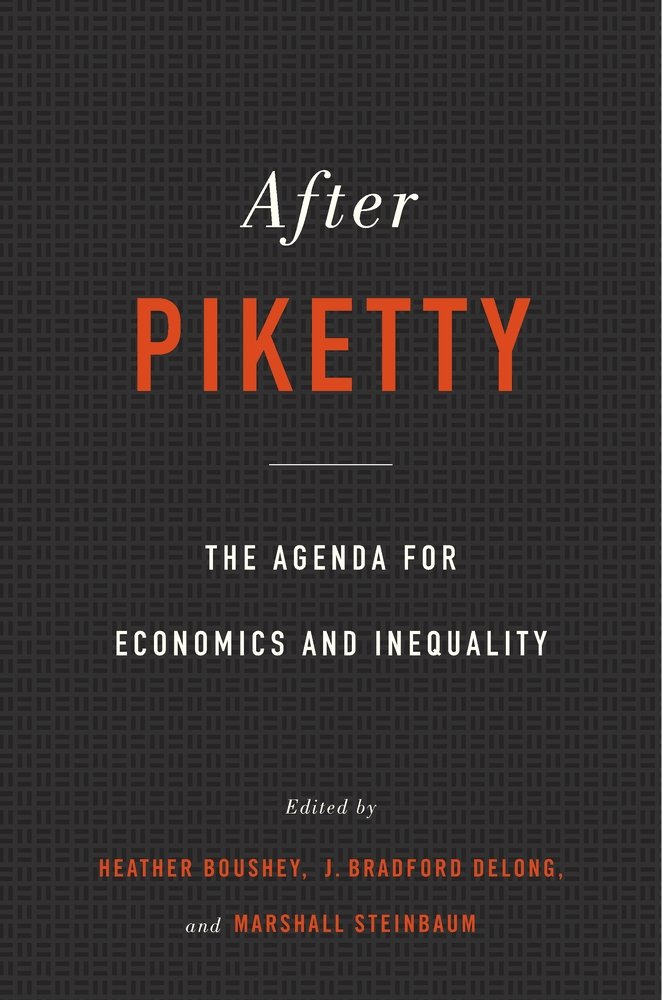
Below is my review of After Piketty edited by Boushey, Delong and Steinbaum, just posted in the Chronicle Review. (The entire Spring Books issue is well worth a look.)

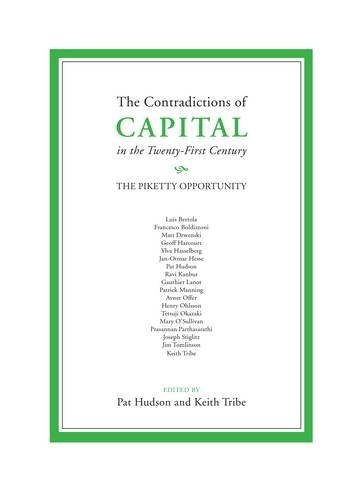
I also recently received another collection, The Contradictions of Capital in the 21st Century: The Piketty Opportunity, edited by Pat Hudson and Keith Tribe. It includes essays by Ravi Kanbur, Joseph Stiglitz, Avner Offer, among others. I haven’t yet read this one, although its take is more clearly historical and global, whereas After Piketty‘s is more inter-disciplinary.41YEl+rJjaL

61yDGMM3rBL


Review of After Piketty: The Agenda for Economics and Inequality edited by Heather Boushey, J Bradford Delong and Marshall Steinbaum

The Chronicle Review

Contradictions of Capital: Taking on Thomas Piketty

By Diane Coyle

For all the influence economics is supposed to have on policy and the character of our societies, not many economics professors make any impression on public consciousness. Fewer still attain Thomas Piketty’s rock star status (well, minor rock star at any rate) following the publication in English of his Capital in the 21st Century[i] in 2014. Piketty captured and gave authoritative confirmation of something many people believed to be the case, given their own experience and observation: that inequality in western economies had increased to a great degree.

Many economists see Piketty’s dedicated effort – with colleagues Emmanuel Saez and the late Tony Atkinson – to put together the data on income and wealth over a long period of time as the main merit of his work. While there is some debate about the figures, this effort is a titanic contribution to knowledge, making possible further study of the trends and causes of inequality.

The essays in After Piketty have a different focus, however: an assessment of Piketty’s arguments about the dynamics of capitalist economies that generate the observed patterns of income and wealth inequality. Some of these perspectives concern the economics, others the links between economic and social or political forces.

Piketty’s empirical observation is that inequality in the western economies declined through the entire middle part of the 20th century, but from around 1980 it had started to increase again, to return to the levels of the Gilded Age. His theoretical argument is that there is an inherent dynamic in the process of economic growth tending to increase inequality, a dynamic halted and reversed in the 20th century by the two cataclysmic world wars, by the post-war welfare state and social market economies (especially in Europe) and by rapid post-war growth. The key point he makes is that when the growth rate slows, the rate of return on capital falls more slowly, increasing the ratio of capital to income and further widening the gap. This is the r>g formula fashionably adorning some t-shirts for a while.

For economists, there is nothing inexorable about this. As Paul Krugman points out in his essay in After Piketty, the theoretical argument depends (among other things) on it being easy enough to substitute machines for workers, and there is no definitive empirical evidence this is so. Devesh Raval points out a number of other problems. Among them, Piketty uses the term ‘capital’ as an abstraction, but the empirical claim that r>g elides physical capital used in production, housing capital, and the human capital resulting in high earnings for some people. Indeed, the share of top incomes coming from earnings (rather than rents and dividends) is a great contrast with the inequality of the early 20th century. Suresh Naidu underlines this point, calling Piketty’s argument “institution and politics free”: “When wealth is understood as police-backed paper claims over resources, rather than the resources themselves, the undemocratic nature of wealth inequality becomes much clearer.” A number of other essays in the volume round out the economists’ (sympathetic) critique of Piketty’s book.

The two subsequent sections cover extensions of Piketty. His collaborator Emmanuel Saez argues for continuing and extending the data collection effort. This is a significant point: phenomena for which the data are not readily available are invisible in political and policy discourse. In many ways Capital in the 21st Century was published much too late. The political consequences of great inequality were already playing out in the anger and division so visible now in politics in the United States and across Europe. Saez makes the point that although there has been significant data collection since the 1960s and 70s on individual incomes, largely through surveys, this statistical approach severs the connection between income distribution and macroeconomic outcomes. Economists in the late 20th century thinking about the economy in the aggregate largely stopped noticing the macro-level inequality trends. There is little reliable data on wealth (as opposed to incomes) at all, and research into wealth distribution and its evolution is correspondingly sparse (as Mariacristina de Nardi and her co-authors point out in their essay).

Filling some of the other research and policy gaps will be crucial for anyone who considers the extent of modern inequality to be problematic. One made visible by the British EU referendum and the US Presidential election is the spatial dimension. Economies have a geography, something economists have until recently been prone to overlook; financial capital is highly mobile geographically and – as Gareth Jones points out here, has also created ‘extra legal’ zones in tax havens where it can safely land. (In a fascinating book, Capital Without BordersHeather Boushey explores in After Piketty the implications for women’s economic and political autonomy of ‘patrimonial capitalism’, particularly given the gender bias of inheritance.

The book ends with some reflections from Piketty himself. He is disarmingly open to critiques of his work: “I would like to see Capital in the 21st Century as a work-in-progress of social science rather than a treatise about history or economics,” he writes. As he argues here, all the social science disciplines are needed for a complete picture. However, the critiques matter, at least to the extent that one thinks the current degree of inequality is unsustainable. Two other recent books point to contrasting possible futures. In his The Great Leveler[iii], Walter Scheidel paints a picture not unlike Piketty’s of an inexorable internal dynamic whereby societies become progressively more unequal, until this provokes a reset through war or revolution. In complete contrast, Tony Atkinson’s Inequality[iv], published the year before his death, presents a wholly pragmatic 15-point list of policy measures to limit and reduce inequality. Taking these together, it is hard to avoid the conclusion that if you do not adopt the Atkinson approach you get the Scheidel outcome. This was exactly the realization that led to the creation of the post-war social contract in the late 1940s.

The editors’ introduction in After Piketty zeros in on this contradiction at the heart of Piketty’s work and its reception: are there fundamental, intractable laws of capitalist dynamics, making garden-variety policy analysis of inequality ultimately futile? Or rather are there, “historically contingent and institutionally prescribed processes that shape growth and distribution?” Capital in the 21st Century does not resolve this; neither do the essays in After Piketty. Perhaps it is a purely academic question, but to the extent that any of us troubled by the new Gilded Age, we have to act as if the second is true regardless.

Diane Coyle is Professor of Economics at the University of Manchester & Co-Director of Policy@Manchester.

[i] Thomas Piketty, Capital in the 21st Century, Belknap Press, Harvard, Cambridge MA, 2014.

[ii] Brooke Harrington, Capital Without Borders: Wealth Managers and the One Percent, Harvard University Press, Cambridge MA, 2016.

[iii] Walter Scheidel, The Great Leveler: Violence and the History of Inequality from the Stone Age to the Twenty-First Century, Princeton University Press, Princeton NJ, 2017.

[iv] Anthony Atkinson, Inequality: What Can Be Done?, Harvard University Press, Cambridge MA, 2015.


How do the French think?

Well, we will find out tonight I suppose, with the exit polls from the first stage of the French presidential election. After Brexit and Trump, I’m bracing myself. It seemed a good week to read Sudhir Hazareesingh’s How The French Think, out now in paperback, and I’ve greatly enjoyed it. I was a teenage existentialist (just like Sarah Bakewell), deeply influenced by Simone de Beauvoir’s The Second Sex, and a Francophile since primary school. Who knows why? It might just have been the most exotic place I could imagine growing up in a small Lancashire mill town. So How The French Think has been just the ticket for my reading pleasure. The book has all kinds of nice details (like the fact that hedonist thinker Julien Offray de la Mettrie died form over-indulgent consumption of pheasant and truffle pate. Or that Jules Verne had an early work (not published until 1994, as his publisher turned it down), Paris au XXe Siecle, a grim dystopia dominanced by Finance and Machinery and featuring a Demon of Electricity.

One of the great puzzles about France for an economist, however, is how it combines being uniquely resistant to economic logic with being a rather successful economy. This

combination doesn’t always pay off. As Jean Tirole points out in his Economie du Bien Commun (out in English later this year), the absence of economic analysis as applied to the labour market explains the high unemployment rate, particularly for young people. However, the average level of productivity is higher than in the UK, there are many successful multinationals, and the quality of life (if you have a job) remains high. This doesn’t stop the French being consistently pessimistic – among the (self-reported) unhappiest in the world given their average level of income. And as the electoral polls – and no doubt results – will show, a large proportion of voters are attracted to candidates promising to defy conventional economic wisdom (not to mention economic reality) with greater protectionism and far less of the market.

The book concludes: “It would be wrong to give the impression that xenophobia and intellectual closure have become the exclusive traits of the French today ot that they will be dominant forever.” But …. there are immense contradictions. Strong believers in the State in the abstract, but now firmly of the belief that it is too distant from the citizens. Against the ‘Elite’ but still profoundly elitist by instinct, “decisive architects of an economically liberal Europe” and yet “profoundly contemptuous of capitalism”. No wonder this election feels so uncertain.

91H8TB0RmFL

The dialectic of fraud

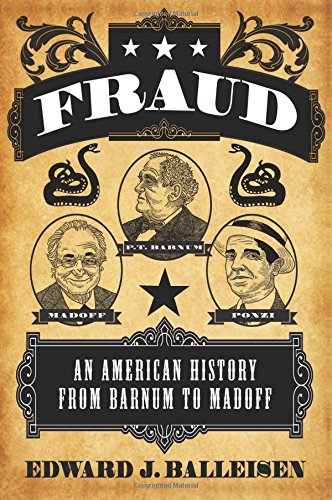
Not only is it a holiday weekend, but our broadband has been down most of the time, so it’s been epic for reading. I polished off Fraud: An American History from Barnum to Madoff by Edward Balleisen.

This is a scoot through some of the more colourful chapters of US financial history, constructed around the line of argument that there has been a steady swing of the pendulum when it comes to official responses to fraud, or a kind of dialectic. A riproaring era of innovation – when inherent asymmetries of information are made greater by the newness of what the market has to offer – is characterised by a ‘caveat emptor’ approach. If it looks too good to be true, it is – and anyway, is a product that doesn’t work fraudulent or its era’s equivalent of vapourware? There’s a fuzzy boundary, an enduring “dilemma of how to distinguish unacceptable deception from the pardonable exaggerations and enthusiastic dissembling that so often characterized efforts by new firms to establish a commercial foothold.” Perhaps, if it succeeds, it’s enthusiasm, but if it fails, then it’s fraud. No innovation would get off the ground without potentially delusional belief in its prospects. Some people intend to be fraudsters, others have it thrust upon them by over-optimism and failure.

But as the scandals pile up, and particularly when great numbers of ordinary consumers or savers are affected, officialdom intervenes in some way. This can be government intervention, as in the US Post Office’s crackdown on mail fraud – which nearly strangled the famous Sears, Roebuck mail order catalogue in its infancy (purveying, as it did, quack medicines and dodgy ‘free gifts’  – or civil society as in the business-backed Better Business Bureaux.

The book ends by observing that the pendulum may be about to swing back to cracking down, as the multiple bedraggled chickens of the freewheeling global financial era flutter home; but who can say for sure, looking at the evergreen inclination to fleece retail savers and investors. For finance, of course, is the most fertile territory for fraud. The pickings are rich, the asymmetries of information are gargantuan, and the innovation is still plentiful. This is a story with many volumes still to come.61K5fXe2TML

Economics and its soul

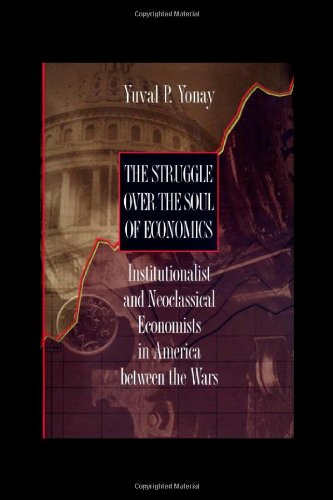
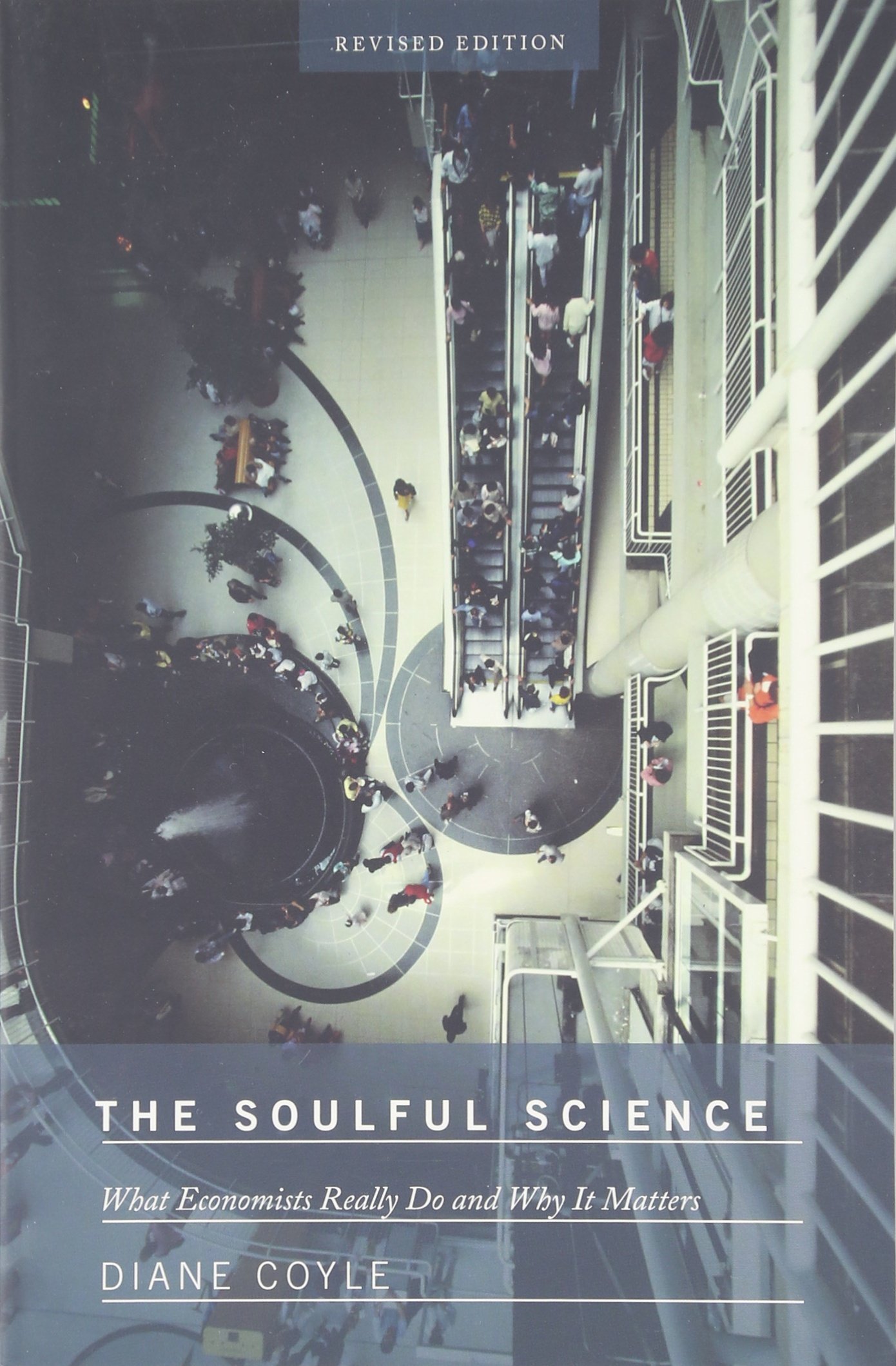
I picked up Yuval Yonay’s The Struggle Over the Soul of Economics: Institutionalist and Neoclassical Economists in America Between the Wars in a 2nd hand bookshop, the wonderful Westwood Books in Sedbergh. How could I, the author of The Soulful Science, resist such a title? It’s quite interesting, although you do have to be pretty interested in the history of thought and methodology of economics to read it (cough). It was published in 1998, which I’d say was past the peak of the rational expectations/RBC takeover of economics. Still, there was still plenty of that kind of economic modelling around.

Yonay uses ‘Actor Network Analysis’ to describe the way that particular neoclassical mainstream – which started to take deep root with Samuelson after WW2 – had ousted the institutionalist school in the US. He argues that this latter had remained reasonably strong in the interwar period. (The actor network approach, which is obviously well-known in sociology although not well known to me, is a superior alternative to either Kuhnian or Lakatosian approaches to intellectual history he argues – I leave this to people better qualified than I am.)

I’m not completely convinced by the argument mainly because the book gathers so many people under the umbrella of ‘institutionalist’. Veblen, of course, John Commons and Wesley Mitchell his successors. Both of these were obviously highly influential. Yonay then lists a number of others around the same time whose names were new to me, such as Charles Cooley and Robert Hoxie. He also identifies a later wave of institutionalists, one branch pursuing issues of industrial organisation and labour relations, another the questions of measurement and business cycles: John Maurice Clark, Gardiner Means, Arthur Burns, Simon Kuznets. This category, it seems to me, could be labelled ‘anybody not solely theoretical’.

While it’s certainly true that the status of theory (of a particular kind) in the economics profession grew and grew in the post-war decades, the empirical approaches informed by a deep knowledge of institutional reality were always there, even through the height of the rational expectations, real business cycle revolution. The proportion of top journal articles that were purely theoretical increased until probably around the time Yonay published this book, and has since declined considerably. Institutions now feature big time in economics, economic history and geography are expanding sub-fields, behavioural economics is altering the choice assumptions in economic models, information asymmetries and transactions costs are everywhere. These were the kinds of developments I described in The Soulful Science. Even economic measurement is baaaack now.

Perhaps it will turn out with hindsight 10 years from now that the period from about 1975-1995 was the aberration in economics. It had deeper roots of course – Lionel Robbins gave forceful expression to the ‘neoclassical’ individualist and reductionist approach in 1932 – and it lingers on too, in Chicago and elsewhere. But it would be interesting to see an update of the detailed sociological approach Yonay takes in The Struggle over the Soul of Economics  – as opposed to the usual mud-slinging by some sociology critics of economics who don’t read what most economists themselves do, but assume the bowdlerised version of 1980s and 90s economics still dominant in the policy world remains the intellectual mainstream. Anybody who doubts me should just look at the programmes for the Royal Economic Society or American Economic Association conferences this year. I still contend economics has (regained) its soul.

41R5XKdr3nL81BQ0SQuQXL