
The Carbon Crunch – book review

Dieter Helm has written a terrific book about energy policy and climate change, [amazon_link id=”0300186592″ target=”_blank” ]The Carbon Crunch: How We’re Getting Climate Change Wrong and How to Fix It[/amazon_link]. I’d recommend it to everyone, no matter what their prior views. Helm has the clarity of analysis and respect for evidence that characterises the best empirical economists, combined with an understanding of the messiness of practical politics and the difficulties we all have in coping with great uncertainty about events far into the future.

His own conclusions and recommendations are clear, and clearly explained; but even readers who disagree with some of those views will get a lot out of the book, even if only by facing up to challenges to their own assumptions.

Helm accepts the mainstream scientific view that man-made climate change is likely to increase global temperatures by at least 2°C, so he will get off on the wrong foot with those who do not believe this. However, he shares with them a distrust of past arguments by green campaigners and the climate change ‘industry’ of officials and academics, not to mention certain industry lobbies truffling around for subsidies. This might make the book interesting even to readers who do not believe there is a climate change problem. (Indeed, it’s possible that it will most annoy some green campaigners!) According to The Carbon Crunch, green advocates and politicians have landed the UK, and the EU in general, with “one of the most expensive ways of generating low-carbon electricity known to man – intermittent offshore wind.” (p6)

The chapter on wind power makes a strong argument against the case for this form of generation, whether onshore or offshore. Helm points out that deriving 15% or 20% of our electricity from this source requires investment in a whole new generation, distribution and transmission system – it is not a marginal change to our existing infrastructure but will require tens of billions of pounds in investment year after year for decades. Wind doesn’t blow all the time, and there is less of it in the winter when the demands are highest. So investing in turbines has to be combined with investing in back-up generation. This will be more expensive than if it were the main source of power – for example, suppliers could not take out long-term contracts for gas imports if they are only required to generate power intermittently. A new system of wires connecting widely-dispersed turbines to the grid would be needed, a big investment. The number of turbines needed to contribute a significant proportion of our electricity is huge, and the environmental impact (including the roads built to construct them and service them) correspondingly large. And so on. I would be interested to see a ‘windy’ response to this chapter, but I found it persuasive. Solar is an even more expensive alternative and makes no sense in northern latitudes. Nuclear is a less unrealistic part of the generation mix, Helm argues, but new reactors cannot be built on a large scale quickly enough. With high initial capital costs and then very low marginal operating costs, the main obstacle is the political uncertainty involved in running nuclear power stations over many decades: Germany is a good example of how fickle governments can be, given that its politicians opted to switch from existing nuclear to dirty coal post-Fukushima. Helm is sceptical about the prospects for nuclear investment. (NB I’m on a stakeholder advisory group for EDF Energy until my term expires next March; it is planning to invest in new reactors.)

The book also points out how fanciful it is to rely on changes in people’s demand or behaviour to reduce CO2 emissions. As long as China and other developing countries continue to grow, emissions will grow too. Helm is scathing about European self-satisfaction over reduced emissions in the EU: this has only come about thanks to deindustrialisation and importing carbon embedded in imports from China, he points out. The EU also has mutually incompatible policies: a renewables directive that will bring about an increased supply of low-carbon electricity, reducing the price of carbon in the EU emissions trading scheme – which would encourage gas or coal generation: “Countries with large-scale renewables progammes will end up selling on their surplus emissions permits, so others can increase their emissions.”

As for energy efficiency, Helm is sceptical about the existence of large unexploited opportunities to use an expensive resource more efficiently. Besides, greater efficiency would reduce the price of energy, causing people to use more of it (the ‘Jevons Paradox’). Demand has increased steadily as countries grow richer. For example, the average house in Britain was kept at a temperature of 13°C in the 1970s, compared with 18°C now (a staggering increase – no wonder I remember always being cold when I was young!) And those houses are now packed with electricity-hungry gadgets.

However, the book does not end up in despair, but rather with some straightforward proposals. First, charge a carbon tax to increase the price we pay for anything carbon-intensive, whether coal-fired electricity or imports of aluminium from China. It won’t be perfect but will have a powerful effect on demand, as we saw in the 1970s energy crisis. “It cannot be stressed too strongly how powerful the carbon price is in underlining the carbon pork-barrel, and with it all the lobbying and vested interests that exploit government decision making.” (p179) Secondly, stop generators burning coal and instead switch to gas as a transitional fuel for power generation, with some new nuclear build – this is happening in the UK and US but other countries, notably Germany, have gone the other way, and China is still burning coal massively. Finally, invest in R&D into new forms of generation, storage, electric cars and so on – some of the investment won’t work out, but some will. Well, I’m an economist too, so using the price mechanism seems pretty sensible.

Too sensible? Helm’s final words: “World leaders have a lot to answer for, and it is unlikely that history will judge them kindly. There remains hope that, at this late stage, effective action will be taken. Climate change is a problem that can be cracked – but it won’t be on current policies.”

[amazon_image id=”0300186592″ link=”true” target=”_blank” size=”medium” ]The Carbon Crunch: How We’re Getting Climate Change Wrong – and How to Fix it[/amazon_image]
Poetry, and economics

It has taken me some weeks to read Mary Poovey’s [amazon_link id=”0226675335″ target=”_blank” ]Genres of the Credit Economy: Mediating Value in 18th and 19th Century Britain[/amazon_link]. She is a Professor of English, so writing in a different academic language than the one I’m used to, and it’s quite a dense book of subtle argument and loads of detail about the evolution of finance in early capitalist Britain. Yet it has amply repaid the effort. Poovey’s argument is fascinating and, I think, persuasive.

The book traces the separation from the 18th century onward of three different genres of writing that were not all that distinct to start with. The era described in the book saw huge growth in the amount being written and published, and in literacy and the appetite for information among readers. It was the Information Age 1.0. (In fact, I learned from the book that Thomas Carlyle designated 1774-1784 the start of the ‘Paper Age.’)

One ‘genre’ considered here is the writing on financial instruments, including bank notes: what began as quite discursive text on bills of exchange about the creditor and debtor, and the hands through which the bills passed, and the specific promises and dates they contained gradually became standardised and more or less invisible (as fictional writing). By the late 19th century, the leap of faith that was needed to trust the fiat money of Bank of England notes and commercial bills only ever came into focus during financial crises.

The second genre is writing about political economy, or factual writing about money, and the third literary writing. Poovey demonstrates that in the early part of the period she looks at, writers did not hesitate to use fiction and fables to write about financial matters. Yet steadily both the abstract language of professional scholarly economics and the factual writing provided by the emerging class of financial journalists drove out literary and imaginative ways of understanding credit. In parallel, literary writers were at pains to demarcate their fictional writing from the taint of the marketplace – although increasing numbers of literary writers sought to sell their work, they were disdainful about commerce, including the non-literary fictions and publications that sold well to the emerging mass market of readers. Indeed, criticism of the market became the only acceptable way for the literary world to relate to the market.

From my perspective as an economist, the most interesting parts of the book concern the causes and consequences of the professionalisation of economics as a serious intellectual discipline. As Poovey writes:

“If economic writers had not pursued natural philosophical and then mathematical models to the exclusion of other ways of modelling value, if these writers had not been successful in popularizing a theoretical consensus about which economic questions mattered, and if they had not embraced marginal utility theory in a way that narrowed the discipline and ignored what their models could not explain, economics as a discipline might not have assumed the form it now takes. By the same token, …. if Literary writers had not cloaked their participation in the market economy …. then imaginative writing of all kinds might now seem to have something to  contribute to the discussions about value we need so desperately to restart. …. Writers developed genres that seemed to be different in kind and were arranged in an increasingly rigid hierarchy that divided their audiences in ever-more-differentiated segments too.”

It is interesting to note that she sets economics’ ambition to attain the status of the natural sciences far earlier than often claimed – in the marginal revolution and adoption of utilitarianism, rather than in the cybernetic era (as claimed for example by Philip Mirowski in [amazon_link id=”0521775264″ target=”_blank” ]Machine Dreams: Economics Becomes a Cyborg Science[/amazon_link]). I also found it illuminating to follow Poovey’s tracing of the increasing abstraction and adoption of jargon by early economics writers. Some, including J.S.Mill, acknowledged that this abstraction had limitations when it came to describing the reality of the economy, and suggested this would change as the infant science grew to maturity, and political economists learned more. As we know, however, the habit of abstraction has stuck.

The argument in this book has some similarities to Richard Bronk’s [amazon_link id=”0521735157″ target=”_blank” ]The Romantic Economist[/amazon_link] – he advocated bringing the techniques and habits of mind of literature to an understanding of the economy. I also found echoes of Deirdre McCloskey’s [amazon_link id=”0472067443″ target=”_blank” ]How To Be Human (Though An Economist)[/amazon_link], a marvellous dissection of the kinds of rhetoric used in economics. What Poovey adds, that ought to be thought-provoking for economists, is the realisation that our habitual way of thinking about the economic and financial world does not have a natural epistemological superiority over other ways of thinking about the subject, not even poetry.

Perhaps the problem is that the poets have abandoned the territory.

 [amazon_image id=”0226675335″ link=”true” target=”_blank” size=”medium” ]Genres of the Credit Economy: Mediating Value in Eighteenth- and Nineteenth-Century Britain[/amazon_image]

A mess beyond fixing?

I’ve thoroughly enjoyed reading Robert Peston’s [amazon_link id=”1444757091″ target=”_blank” ]How Do We Fix This Mess?[/amazon_link] Its author is so famous, as the BBC’s Business Editor, that his photo is on the front cover. Yet he’s modest enough to start the book with: “I don’t know. But don’t stop reading now.” Indeed, the title is misleading because he sensibly does not try to dole out generalised policy prescriptions. (Oh and – note to publishers – that’s enough long and chatty subtitles, thank you. They’re becoming annoying.)

[amazon_image id=”1444757091″ link=”true” target=”_blank” size=”medium” ]How Do We Fix This Mess?: The Economic Price of Having it All, and the Route to Lasting Prosperity[/amazon_image]

The book draws on Robert’s long experience as a journalist covering the banking industry. (I should say that I’ve known him for years and followed, albeit far less successfully, in his footsteps at The Investors Chronicle and then a national newspaper, The Independent in my case, the FT and Sunday Telegraph in his.) As he says, it must seem to others to have been a boring reporting beat, but it has paid off handsomely in equipping him with the knowledge and the contacts to report superbly on the financial crisis to UK and worldwide audiences.

How Do We Fix This Mess combines chapters giving the context for the crisis, and – the heart of the book – chapters describing what happened in the course of the crucial events starting in late 2007. Scene-setting chapters describe the process of innovation and growth in financial markets and the creation of new kinds of derivatives; the inadequacy of the regulatory regime, and how it came to be so feeble; and the globalisation of the world economy and rise of China. These are all excellent overviews, although some readers will find this familiar territory.

I found the chapters on the early days of the unfolding crisis the most interesting, from the warning signs about Northern Rock through 2007 and the extraordinary run on the Rock in September that year. As Robert points out, the fact that Northern Rock’s business model involved online banking, with very few branches, meant that even a small proportion of depositors wanting to withdraw their money (my sister was one of them) translated into a big queue outside the branch. Some people accused him of causing the crisis, as if the drying up of credit markets and an unsustainable business model were somehow caused by the reporting of it. He is also very interesting on the part played by the Bank of England, much criticised for its handling. As Robert says, Mervyn King was right to say bailing out the banks would contribute to moral hazard – look at where we are now, still hostage to these titanic, toxic institutions – but the book criticises the Bank of England for not raising interest rates or taking other actions in the years before 2007 to puncture the evident bubble in asset markets. MPC minutes from 2005 and 2006 show little concern with its unsustainability or the need to raise interest rates: they were reduced once in 2005, and raised twice in 2006, but by just 0,25% points each time.

The book then turns to the Euro crisis and ends with the Libor scandal, and, rather than a list of things governments and regulators must do, Robert writes: “Perhaps the most important [cause of sluggish growth] is that there is a growing realisation that we have to take steps to live within our means, over the longer term….  The innocent pay a price for the national indebtedness that they did not cause or choose.” He professes himself optimistic:

“The clean up will take years. And there is no quick fix, so you need to brace yourself for perhaps a decade of economic stagnation. As it happens, I don’t think that is reason to weep. We are a very rich country. And we can be a very happy country if we learn how to make the most of what we have got.”

I must say, I’m far less optimistic about the way the economics and politics of the coming lost decade will play into each other. Let’s hope I’m wrong and the mess is fixable. Either way, this is a terrifically interesting and well-written book, which benefits greatly from its author’s detailed knowledge of the banking industry that is at the heart of this crisis.

Look on the bright side of life

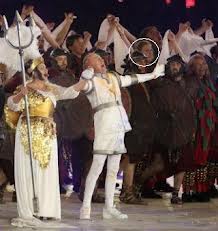
One of the highlights of the Olympics closing ceremony was Eric Idle getting the 80,000 crowd in the stadium to singalong to ‘Always Look on the Bright Side of Life’:

A natural optimist

This cheerful song was brought to mind by [amazon_link id=”1451614217″ target=”_blank” ]Abdundance: The Future is Better than You Think[/amazon_link] by Peter Diamandis and Steven Kotler. Diamandis is one of the founders of the Singularity University and so clearly a techno-optimist. It struck me that there’s a whole optimism genre, and one I generally greatly enjoy. There’s Mark Stevenson’s excellent [amazon_link id=”1846683564″ target=”_blank” ]An Optimist’s Tour of the Future[/amazon_link] and Matt Ridley’s [amazon_link id=”0007267126″ target=”_blank” ]The Rational Optimist[/amazon_link]. Mark Lynas tried to debunk conventional eco-gloom with [amazon_link id=”000731342X” target=”_blank” ]The God Species[/amazon_link]. In a way, my [amazon_link id=”1587990822″ target=”_blank” ]Paradoxes of Prosperity[/amazon_link] from 2001 riffs on the same theme, that technology is a powerful lever for increasing prosperity ad solving problems, and that its power often takes us completely by surprise.

[amazon_image id=”1451614217″ link=”true” target=”_blank” size=”medium” ]Abundance: The Future Is Better Than You Think[/amazon_image]

Abundance has the slightly breathless eagerness of a New York Times bestseller, not entirely to my taste, but it’s a highly readable summary of several areas of important technical progress. It starts with an interesting discussion of the characteristics of how our brains evolved to make us natural pessimists, and also touches on the speed with which successful new technologies can spread (although it doesn’t acknowledge the many techno-failures that therefore spread with zero speed – there’s too much determinism in this account).

The book also looks at forces that might bring about the technological nirvana humans have the capability to create – the possibility of ‘DIY’ or entrepreneurial innovation in many fields, philanthropic activity by rich technology entrepreneurs, and the large and growing market in developing countries with great unmet needs. While these are perfectly valid, this is obviously only part of the story. I wish the book had looked more closely at the economic and social forces acting for and against the embodiment of new technologies in people’s lives. This – as Paul David has so brilliantly pointed out – is the hard, and slow, part. Invention is easy by comparison. In short, I wish Abundance had been a bit less excited and more nuanced. But I enjoyed reading it – an ideal airport purchase.

The power elite revisited

In [amazon_link id=”0199538751″ target=”_blank” ]Père Goriot[/amazon_link], Balzac wrote: “Le secret des grandes fortunes sans cause apparente est un crime oublié.” Brecht and Weill had their bankers in [amazon_link id=”041377452X” target=”_blank” ]The Threepenny Opera [/amazon_link]start out as street racketeers. C.Wright Mills, author of [amazon_link id=”B000U35R6Y” target=”_blank” ]The Power Elite[/amazon_link], took the same view of the financiers and industrialists he perceived to be controlling the America of his day – the 1950s, Cold War era. His analysis was even darker than Eisenhower’s construction of the military-industrial complex. Mills saw a polity and economy directed towards perpetual war in order to prolong power and profit.

[amazon_image id=”B000U35R6Y” link=”true” target=”_blank” size=”medium” ]The Power Elite.[/amazon_image]

The Power Elite was criticised by other sociologists such as Daniel Bell for its abstraction. Its themes were seen as too big, insufficiently rooted in empirical evidence and institutional analysis. And certainly, the 1950s are remote from our own times in so many ways. Communism and the Cold War seem long, long ago.

Yet Stanley Aronowitz’s intellectual biography, [amazon_link id=”0231135408″ target=”_blank” ]Taking It Big[/amazon_link], does well to remind us of Mills’ work and thought, which was extremely influential on the nascent New Left in the US, and has subsequently been largely forgotten. One reason is that Mills did so much to try to carve out the space for public intellectuals in American culture, albeit not with much lasting success – but at least demonstrating the scope for engagement with a wide public in accessible language.

The other is that for all the abstraction of the analysis of ‘the power elite’, the current crisis reminds us that the idea and reality of the elite is crucial. If only we had not forgotten about it between the 1960s and 2008. Events have reopened people’s eyes to the exercise of power by the wealthy and connected, and authors from Simon Johnson and James Kwak in [amazon_link id=”0307379051″ target=”_blank” ]13 Bankers[/amazon_link] to Ferdinand Mount in [amazon_link id=”1847378005″ target=”_blank” ]The New Few[/amazon_link] have started to analyse this again.

[amazon_link id=”0231135408″ target=”_blank” ]Taking it Big[/amazon_link] is a good introduction to the arc of Mills’ thinking, culminating in his newly-relevant analysis of power. It is also quite well written, something I can’t remember ever saying before about a book by an academic sociologist – Aronowitz has evidently taken Mills’ lead on accessibility. Although the author has a political perspective that I don’t share, I enjoyed reading it.

[amazon_image id=”0231135408″ link=”true” target=”_blank” size=”medium” ]Taking it Big: C. Wright Mills and the Making of Political Intellectuals[/amazon_image]