Through the Eye of A Needle

Over the past few days of holiday I’ve read Peter Brown’s [amazon_link id=”069115290X” target=”_blank” ]Through The Eye of A Needle[/amazon_link]. It’s about the effect of increasing wealth in the early church in western Europe, changing it from a new religion emphasising austere living and personal charity, in the Roman empire, to a rich institution increasingly exercising worldly influence after the Fall of Rome. The duty of well-off Christians morphed from using their money in individual acts of philanthropy (in what the author describes as a ‘counterculture’ like flower power in the 1960s) to, instead, donating it to the church. From the end of the fourth century, the rich converted to Christianity and, as they entered the church, took leadership roles in it. From the late fifth century onwards, the book shows, church leaders turned their energy to the administrative role this implied.

[amazon_image id=”069115290X” link=”true” target=”_blank” size=”medium” ]Through the Eye of a Needle: Wealth, the Fall of Rome, and the Making of Christianity in the West, 350-550 AD[/amazon_image]

This is not at all a subject on which I’ve got any background knowledge, but it proved an interesting dip into a time and subject about which I know very little. The book is packed with description and spans all of western Europe and the Mediterranean. It was intriguing to try to step into the mental world of people living in the centuries right after the fall of Rome – not that the mediaeval mindset was much less different from our own, but the high Middle Ages are a somewhat more familiar period.

This was also, of course, a decisive period for the church as an institution that fundamentally shaped western societies, and I had never really thought before about how it came to be so influential from its early beginnings as a protected but minority religion, among the pagans, in the Roman empire. As this is a big book, more than 750 pages of beautifully produced hardback, the worldly festival of Christmas is probably the ideal time to have read it, in more than one way – propped up with it on the sofa, surrounded by material goodies but with ethereal carols on the radio in the background.

Reviewers who know far more about this period than I do have given the book glowing praise – for example Tim Whitmarsh in The Guardian and Tom Holland in History Today.


Freaks of Fortune

Jonathan Levy’s [amazon_link id=”B00AFS6LXW” target=”_blank” ]Freaks of Fortune: The Emerging World of Capitalism and Risk in America [/amazon_link]is a fascinating book. It is a history of the commodification of risk, the development of life insurance and, in time, the growth of wider markets for risk. Professor Levy, a Princeton historian, portrays the modern risk-based finance industry as the counterpart of the freedom of individuals in a capitalist society to manage their own lives. That responsibility of individuals for their own destiny meant the growth of institutions offering them the tools to do so, and the translation of highly individual risks into standard types of policy or financial instrument.

The early chapters start with the origins of risk management in marine insurance, and how those specific origins shaped early legal precedent in considering whether insurance policies should pay out. A cargo of slaves was considered insurable property whereas a working man who had taken out a policy could not successfully claim against his employer after being badly injured in an accident, because he had voluntarily taken the job, which paid a premium because of the dangers. The book’s descriptions of the historical examples are the best thing about it, revealing as they do patterns of thought so different from our own. It is particularly interesting about the link made between emancipation and the assumption of personal responsibility for risk – including by slave owners making the opposite argument, that slaves need never worry about their future as owners bore all the risks! – although I’m sure there is room for different interpretations of the historical record. (I’m a long way out of my areas of expertise here.)

There is also an interesting section on the early opposition to a secondary market in life assurance policies in the US – one existed then in the UK – and for the same kind of moral arguments that Michael Sandel raises in [amazon_link id=”184614471X” target=”_blank” ]What Money Can’t Buy[/amazon_link]. The need for policy holders to be able to gain some value from their policies (otherwise, why would they not just save money?) led to the early application of actuarial science to calculate surrender values. Indeed, early on most life policies taken out by farmers would benefit their creditors – they were used to raise working capital.The book goes on to trace the shift from a mass of small insurance companies starting up in the 19th century to the machinations of the big trusts at the turn of the century.

The underlying theme of the book is that, if we don’t put our faith in Providence, or rely on a master (whether a Feudal lord, or a slave owner, or indeed a husband), then we will of course seek other means of mitigating life’s risks. Some of these are a constant, such as storms or illness, and financial services have replaced a combination of fatalism and community support. Other risks are inherent to capitalism – “an economic system that thrives of radical uncertainty”, as the author describes it. Mitigating these means capitalism is inherently financial. However, individual responsibility for risks arising from personal choices will always have to be supplemented by collective responsibility, at a minimum by regulation of the financial services industry.

The epilogue points out that there was an era when risk seemed to have been tamed, in the 1960s, and the previously common phrase ‘freaks of fortune’, meaning the unexpected events that cause upheaval in every life, dropped out of use. The phrase lies dormant still, but that moment of stability in capitalism has passed. It is certainly obvious, post-crisis, that the state is the “risk manager of last resort”.

So it’s a fascinating story. I must say that the book was heavy-going despite the masses of terrific stories it tells – I think it’s because one has to chew quite a lot to extract the marrow of the argument, and my brief summary has no doubt not done it justice. Still, it’s worth perservering, with so much food for thought, and the stories are great. I would never have imagined finding a history of life insurance at all interesting, and it turns out to be very much so.

[amazon_image id=”B00AFS6LXW” link=”true” target=”_blank” size=”medium” ]Freaks of Fortune: The Emerging World of Capitalism and Risk in America[/amazon_image]

A re-set proposal for the Euro

It seems a bold mission, to propose a solution to the Euro crisis in 80 pages. All the more so when the authors of The Euro in Danger: Reform and Reset, Jagjit Chadha, Michael Dempster and Derry Pickford, compare the present situation in Euroland with Lord Palmerston’s verdict on another European crisis: “Only three people…have ever really understood the Schleswig-Holstein business – the Prince Consort, who is dead; a German professor, who has gone mad; and I, who have forgotten all about it.”

This short book or long pamphlet also acknowledges that, as in the old joke, if you wanted to get to a sustainable Eurozone currency union, you wouldn’t be starting from here. It has some extraordinary charts, including one recording the movement of Target 2 balances, another showing the movement of unit labour costs – the message of every one of them is a story of dramatic divergence between the core and the periphery since 2009.

Nevertheless, the authors argue that the Euro should be saved, and they have some proposals for doing so. Their suggestion is what they describe as the ‘reset’ option: the peripheral countries should be allowed out temporarily in order to return as members when certain conditions, including those elusive structural reforms in labour markets, had been met.

Meanwhile, the book argues, the monetary union of the core Euro states should be strengthened, with steps towards full banking union and the ECB to act as a classic lender of last resort in future crises, an independent fiscal monitoring body, and a European Sovereign Bankruptcy Court. The authors would also ban certain derivatives transactions including the ‘Tobashi swaps’ used to hide the scale of Greek and Italian sovereign debt (widely sold, the book reports, by Goldman Sachs, Morgan Stanley, JP Morgan Chase, Deutsche Bank, Bank of America, Merrill Lynch, Nomura…..).

As for the ‘reset’ option, this would require temporary departure for the Eurozone and devaluation before joining a crawling peg against the Euro, a haircut on sovereign debt, monitoring of fiscal policy by an independent body, and increased reserve and capital requirements for domestic banks, as well as economic reform.

Reading about such details always makes me feel about as well-informed about the Euro crisis as I am about Schleswig-Holstein. The one thing that’s perfectly clear to me is that the peripheral countries will need to default in some form, as their debt burdens are unsustainable. Others who are more expert than I am will be better placed to evaluate the specific proposals in this book. It does all seem entirely level-headed, but one has to wonder about the political feasibility of sensible reforms.

The Assumptions Economists Make

On my journeys to and from The Hague this week (one of the joys of travel – offline time when nobody can email, phone me or ask me what’s for dinner), I read Jonathan Schlefer’s enjoyable [amazon_link id=”0674052269″ target=”_blank” ]The Assumptions Economists Make[/amazon_link]. It’s a book of two halves: a combination of a critique of modern economic methodology in general and a polemic against actually existing neoclassical economics in particular. The former, the first half, is much stronger, although the latter is probably more populist. The two halves will also appeal to different audiences – to professional economists and other social scientists in the first case, and to more general readers who are inclined to blame economics for the mess we’re in in the second.

The author is a political scientist and writer who undertook the commendable task of learning economics and reading widely before embarking on a critique. This distinguishes him from almost all other non-economist critics and in itself means economists must offer him equal respect and take this book seriously. The book starts with a very clear description of general equilibrium theory and the microfoundations built on it. Schlefer makes some extremely interesting points about the theory, drawing on the literature – as he notes, there is a “breach between the subtle world of proper neoclassical theory, which faces quandaries head on, and the corrupt world of neoclassical practice, which just ignores those quandaries.” (p89) One point, for example, is why a stable equilibrium cannot exist in the imaginary general equilibrium economy. All students of economics learn about the impossibility theorem – and then motor on with the rest of their studies as if it were not true. Similar points have been made elsewhere, such as Steve Keen’s [amazon_link id=”1848139926″ target=”_blank” ]Debunking Economics[/amazon_link], but I found it to be much clearer in [amazon_link id=”0674052269″ target=”_blank” ]The Assumptions Economists Make[/amazon_link].

The first chapters set out the basics of economic theory through a history of thought progression from Adam Smith to the marginalists – Jevons stands out here – along with Walras and Menger –  as the driving force in turning economics into a purely deductive science concerned with (in his words) ‘the mechanics of self-interest and utility’. (p76) (I wanted to know more about Jevons, especially having seeing his Logic Machine (below) in a Science Museum exhibition.)
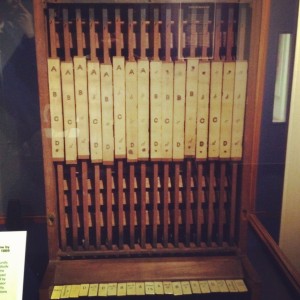
Jevons’ Logic Machine (‘The machine is capable of replacing for the most part the action of thought required in the performance of logical deduction’.)

The book then turns to the consequent flaws in basic microeconomics, especially the concept of the production function and the assumption of marginalism and competition in investment. It revisits the ‘Two Cambridges’ debate (which I was taught about in graduate school, but with the neoclassical side the unquestioned victor in the version I learned), and goes on to question the logical coherence of aggregation in the way it’s done in conventional macroeconomics. Well, I’m with that idea wholeheartedly; my own journey from macroeconomics to micro started with a PhD thesis that confronted macro labour market models with industry-level data, a very effective way of lifting the rock of aggregation to reveal the nasty creepy-crawlies underneath.

However, after that, the book becomes less compelling for me. Schlefer spends the remaining chapters discussion Keynesianism as the master intended it and as his neoclassical interpreters shaped it in the post-war years. This is well-written, and I enjoyed discovering, for example, that Paul Samuelson was almost regarded as a dangerous Commie for taking Keynes seriously, so paranoid was early Cold War America (p192). However, a turn to a discussion of macroeconomic aggregates not what I wanted to read as a follow-on to a persuasive argument about why macroeconomic aggregates are problematic. Schlefer, like Keen in his book, attacks the conventional three-equation DSGE models – quite right too – but seems to want to replace it with an alternative abstract macro framework. Keen’s is a Minsky-esque version of disequilbrium dynamics. Schlefer’s is a structuralist approach following his teachers, especially Lance Taylor. (No doubt he would approve of Justin Yifu Lin’s [amazon_link id=”0691155895″ target=”_blank” ]The Quest for Prosperity[/amazon_link], setting out a ‘new structural economics’, although he doesn’t cite it.) He also mentions favourably ecological models.

He writes: “It is legitimate to impose informed assumptions on macro data – profits, wages, consumption, investment and the rest – in order to build rough macroeconomic models of cause and effect. The role of models is to be sure that assumptions are consistent, to understand their implications as well as possible, and to frame a coherent view that you can compare with historical experience.”  (p267) The huge mistake in modern macro, he says, was introducing the illusory quest for ‘microfoundations’. I suppose it’s correct to say an assumed macro framework is necessary, but this leaves me with a question not answered here, which is how on earth we should choose between them. Schlefer obviously likes the look of ecological predator-prey models. Other critics of macroeconomics prefer agent-based modelling, or econo-physics-style empirical exploration of datasets to derive regularities. Steve Keen has his own Keynes-Minsky set of abstractions. Many mainstream macroeconomists are insistent on the relevance of New-Keynesian DSGE models with stickiness in wages and prices, and some finance added in, post-crisis. [amazon_link id=”0674052269″ target=”_blank” ]The Assumptions Economists Make[/amazon_link] raises important questions but doesn’t answer the one raised half way through the book: “Is macroeconomics possible? There are serious doubts.”

[amazon_image id=”0674052269″ link=”true” target=”_blank” size=”medium” ]Assumptions Economists Make[/amazon_image]

Greek tragedy – politics, not economics

One of the books I’m currently reading, Dominic Sandbrook’s [amazon_link id=”0141032154″ target=”_blank” ]State of Emergency[/amazon_link], is too big to carry around so on the Tube I’ve read [amazon_link id=”184954400X” target=”_blank” ]Greekonomics: The Euro crisis and why politicians don’t get it[/amazon_link] by Vicky Pryce. It’s an excellent contribution to understanding the Eurozone crisis.

Pryce is Greek by origin and so has the authority to criticise her native country about its genuine faults – clientilism is one of the major issues she highlights. However, she rejects two arguments sometimes heard: that the Greeks are to blame for the crisis because they’re lazy and expected to consume without producing; and that the Euro crisis is all the fault of the peripheral indebted nations – Portugal, Ireland and Spain as well. She writes: “While the political, administrative and judicial systems in Greece are dysfunctional, there is potential in sectors of the economy which could be harnessed to drive a more prosperous future.”

In fact, politics is the major theme of the book: it argues that the Euro’s creation was a political project not rooted in sound economic analysis. The initial hubris involved in launching the single currency was followed by a failure to either plan for the inevitable tensions or crises, and total failure to enforce and implement the structural reforms that might have made the Eurozone economically viable. She makes a forceful case. Before the Euro was launched, while seeing it as mainly a political project, I thought the macroeconomic inflexibility it involved would be more than offset by supply-side improvements, including the achievement of a genuine single market without currency barriers. This optimism was obviously misplaced. Indeed, we are still seeing in the crisis countries how hard it is politically to deliver structural economic reforms.

What to do next? Pryce argues, first, that European leaders need to recognise that if Greece leaves, the Euro itself will collapse, at huge economic cost. And, secondly, that a large chunk of the peripheral country debts will have to be written off. Germany cannot avoid either accepting partial default or the collapse of the Euro. However, she is optimistic about the scope for continuing progress on productivity in Greece.

No doubt some readers will disagree with parts (or all) of her analysis, but the book sets out the debate very readably, and underlines the links between the political and the economic forces at play –  links everybody overlooked in those long-ago pre-crisis years.

[amazon_image id=”184954400X” link=”true” target=”_blank” size=”medium” ]Greekonomics: The Euro crisis and why politicians don’t get it[/amazon_image]