Power and legitimacy

Paul Tucker’s book Unelected Power: The Quest for Legitimacy in Central Banking and the Regulatory State is a significant contribution to the literature about the trade-off between participatory democratic influence over policy decisions and the technical complexity of much policy and regulatory activity. The focus is on central banking, not surprisingly given the author’s long experience at the Bank of England. However, the book also dips into competition policy. This is my territory, having spent 8 years on the Competition Commission. I’m not entirely convinced by the argument here.

Tucker’s conclusion is that when politicians delegate policy decisions to independent, technocratic bodies, they need to do so in accordance with some key ‘principles of delegation’. To date, they have not done so, and hence the crisis of legitimacy, at least as far as it applies to economic institutions. There are five design principles: there should be a clear statement of the body’s purposes, objectives and powers, to stop mission creep; its operating procedures should be set out; so should its operating principles – how will it go about conducting its delegated policies; there should be sufficient transparency that the institution can be monitored and held to accunt by elected politicians; and there should be some rules for how it can respond to emergencies.

These seem on the face of it perfectly reasonable. But pause on the third – central banks and independent competition authorities should have the way they implement policy set out for them. Thus, Tucker argues, a competition authority’s remit might be set in broad terms as ensuring markets are competitive, or ensuring there is no abuse of dominance; but it should not be left to the competition authorities themselves to turn this into operational rules. He notes that there have been significant changes in competition policy in the US and EU over time, shifting from the older institutionalist tradition to a focus on consumer welfare. As the book notes, this reflected developments in economic theory, adding: “The significance of these momentous changes is not whether they were grounded in good economics but that each occurred without any amendments to the governing legislation.” Thus, “This gives us a glimpse of why the public might not be clear about the pupose and objectives of antitrust regimes.”

Like a number of commentators on competition policy recently, Tucker believes – wrongly  – that the ‘Chicago School’ approach of using a consumer welfare criteria means competition authorities can only look at prices. On the contrary, although that has been the practice (because measuring prices is easier), they can take into account other aspects of economic welfare such as quality or range, or incentives to invest and innovate – this is set out in the CMA’s guidance documents, for instance. In the world of zero priced digital goods, that is exactly what they should do.

But that’s by the by. My hesitation about this principle is that the alternative – having operating rules set by elected politicians – would in reality defeat the purpose of giving economic regulators their independence. For what would stop legislators deciding that the economy is best served by preserving jobs at incumbent firms because they have the biggest economies of scale? This would be the pre-independence world of ministers deciding all mergers on public interest grounds. The time inconsistency problem common to so many regulatory contexts would return with a vengeance if legislatures can change the operating rules whenever they choose. Better to have these rules set by the technical experts, after wide public consultation. Sure, ideologies and tides in the realm of ideas would influence them, but less, it seems to me, than in the counterfactual world. Anyway, are elected politicians so respected now that they would reinject legitimacy back into economic governance? Opinion polling suggests they are among the groups the public trusts least.

Unelected Power engages an essential debate, however. There is a crisis of legitimacy in the western democracies. With QE, central banks have launched a radical change of policy with huge distributional consequences. The book has four sections: welfare, values, incentives and power are their headings. Although it touches on all the economic regulators, it is mainly about central banking, and on this is it authoritative. It will be an essential read for everybody involved in monetary policy, or researching it. It has a long bibliography; Tucker refers to legal and political science literatures as well as economics. One flaw is that it is heavy going in parts, surprsingly because he is a compelling speaker. Nevertheless, this is an important book.

[amazon_link asins=’0691176736′ template=’ProductAd’ store=’enlighteconom-21′ marketplace=’UK’ link_id=’12de507e-4bc5-11e8-994c-7f5fe15163db’]

Rational ignorance, redux

I’m preparing for the start of the new semester & picked up Mancur Olson’s The Rise and Decline of Nations, his follow up to The Logic of Collective Action. It has a wonderful clarity of explanation. For instance, explaining why it can be that tax systems are usually progressive, while their loopholes are usually regressive:

“Since the probability that a typical voter will change the outcome of an election is vanishingly small, the typical citizen is usually ‘rationally ignorant’ about public affairs. … Just as lobbies provide collective goods to special interest groups, so their effectiveness is explained by the imperfect knowledge of citizens, and this in turn is mainly due to the fact that information and calculation about effective goods is also a collective good.”

People know they pay income tax and so the headline figures need to be progressive, but few pay attention to the detail, and special interest groups (such as the well off and their professional advisers) can craft the details to suit themselves.

The book has chapters on trade, development and macro policies. Less relevant to me but equally enjoyable to read. For instance, he was on to the role of institutions in development some time before it became so prominent (and indeed helped make it prominent): “In the many countries that have failed to grow as far or as fast as the leaders, there are quite enough stupidities, rigidities and instabilities to explain the lack of success.”

I always find myself heading down rabbit holes at this stage of preparation: so much interesting stuff, old and new, to read.

[amazon_link asins=’B00E32AI1M’ template=’ProductAd’ store=’enlighteconom-21′ marketplace=’UK’ link_id=’2d5eed0b-8989-11e7-a847-270279d0f463′] [amazon_link asins=’0674537513′ template=’ProductAd’ store=’enlighteconom-21′ marketplace=’UK’ link_id=’33525cf0-8989-11e7-af2f-4754df2ab32f’]

The social life of electricity, continued

I devoured Then There Was Light: Stories Powered by the Rural Electrification Scheme in Ireland on my train journey back from the Bristol Festival of Economics yesterday. It’s a delightful collection of reminiscences about this scheme taking electrification to the countryside (ie most of Ireland) during the 1940s and into the 1950s. In fact, coverage only reached 100% of all the remote islands in 2000, and some hamlets were eventually depopulated as electricity never got to them.

The book is a reminder of what a poor and agrarian country Ireland was until, well EU accession really. The essays by men who worked digging post holes and driving trucks often start with the relief they felt on getting, not only a job, but one for a government body paying decent wages. Being hired for the work changed their lives. Most are written by people who spent at least part of their childhood in darkness lit only by candles and paraffin lamps, with mothers doing all the laundy by hand. One writer calls the scheme one of the most transformative events in Ireland’s 20th century history as a nation, and by the end of the book, this doesn’t seem like hyperbole.

It’s fasinating to read about the hesitations some people had: about the cost not only of getting hooked up to start with but also the vulnerability to having to make ongoing payments for power. For many new customers, this was the first regular bill payment they experienced; about the dangers – would it harm the cattle or burn down the house? And about whether it would change the character of life for the worse. Parish priests were often key advocates for electrification, and so were women, who quickly saw the potential benefits of electrical domestic appliances. The company also had a PR and sales team – the book has illustrations showing some of the demos and delightful adverts: “Electricity saves money in the farmyard!”

Above all, the book is a reminder that all technology is social. Not only do new technologies need complementary investments  – households paying for their internal wiring and switches, or street lights, for example – people have to be able to see the benefits as well as the costs (faster milking, no more washing by hand), and these often need demonstrating in practice before they are believed. Electricity in particular is also a social technology, involving collective decisions to create and sustain the incentives to make it function. The investments are long-term, they change places dramatically; and although the technology is now old, it is both essential and dangerous.

So it is that many countries still cannot provide a consistent universal electricity supply and even advanced economies experience power cuts and underinvestment. If western political systems lose their ability to create consensus and collective, long-term action there will be many bad consequences but one of them might well be disrupted electricity supplies. This is not alarmist: I spent chunks of my teenage years doing homework by candlelight too. We had the power stations and the wires, but not the social and political infrastructure in the years of unrest and strikes in the 1970s.

41r6lcy3c5l

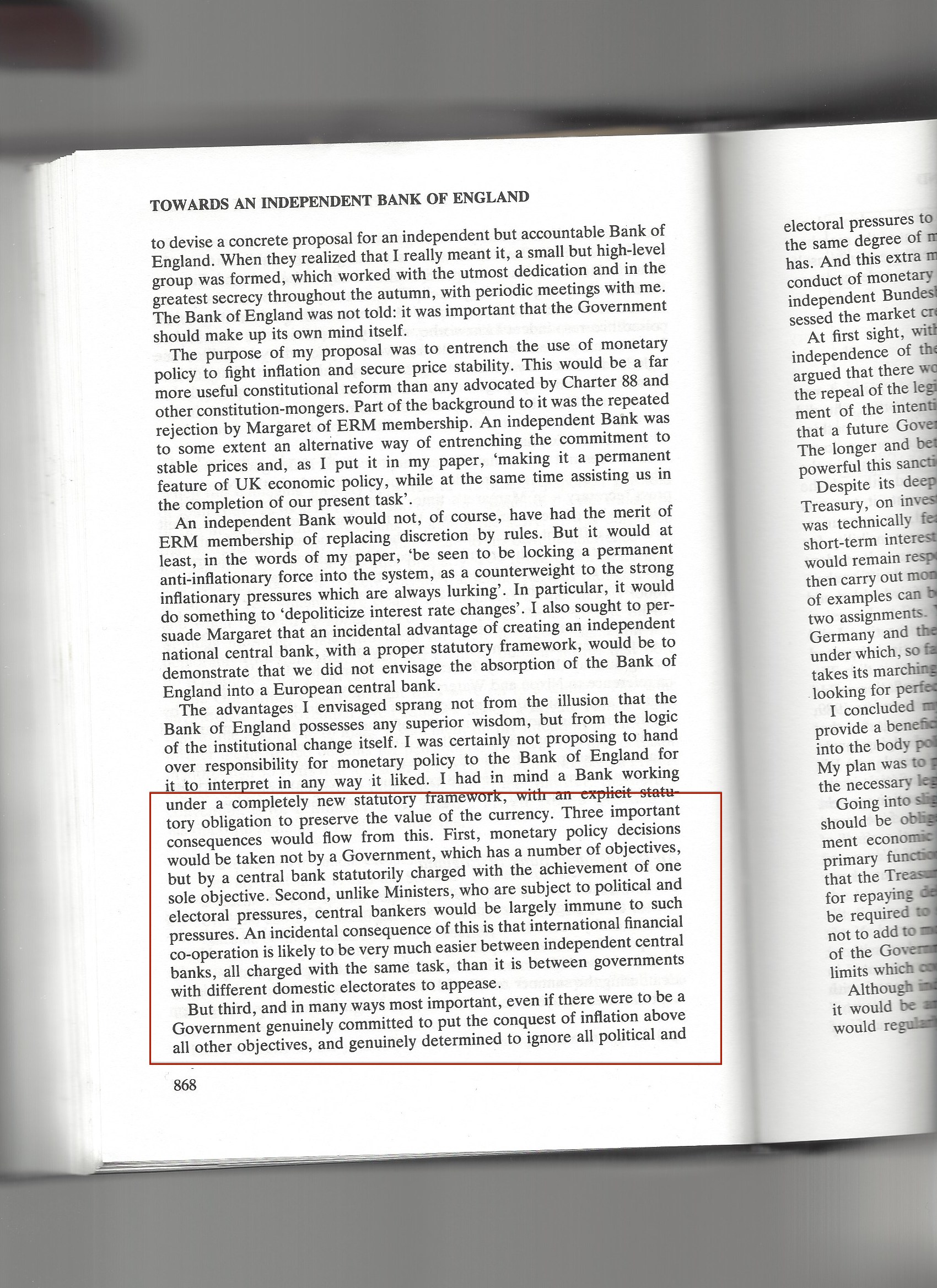
Bank of England independence from Nigel Lawson

This is a bit late but it has been in the back of my mind this week that Lord Lawson used to be keen on isolating central banks from political pressure. I remembered right. He made the case to a sceptical Margaret Thatcher, arguing it would give UK monetary policy an anchor that was necessary if the country was not to commit to an external anchor such as ERM membership. Here is Nigel Lawson in 1992, in his autobiography The View from Number 11:

scan-6

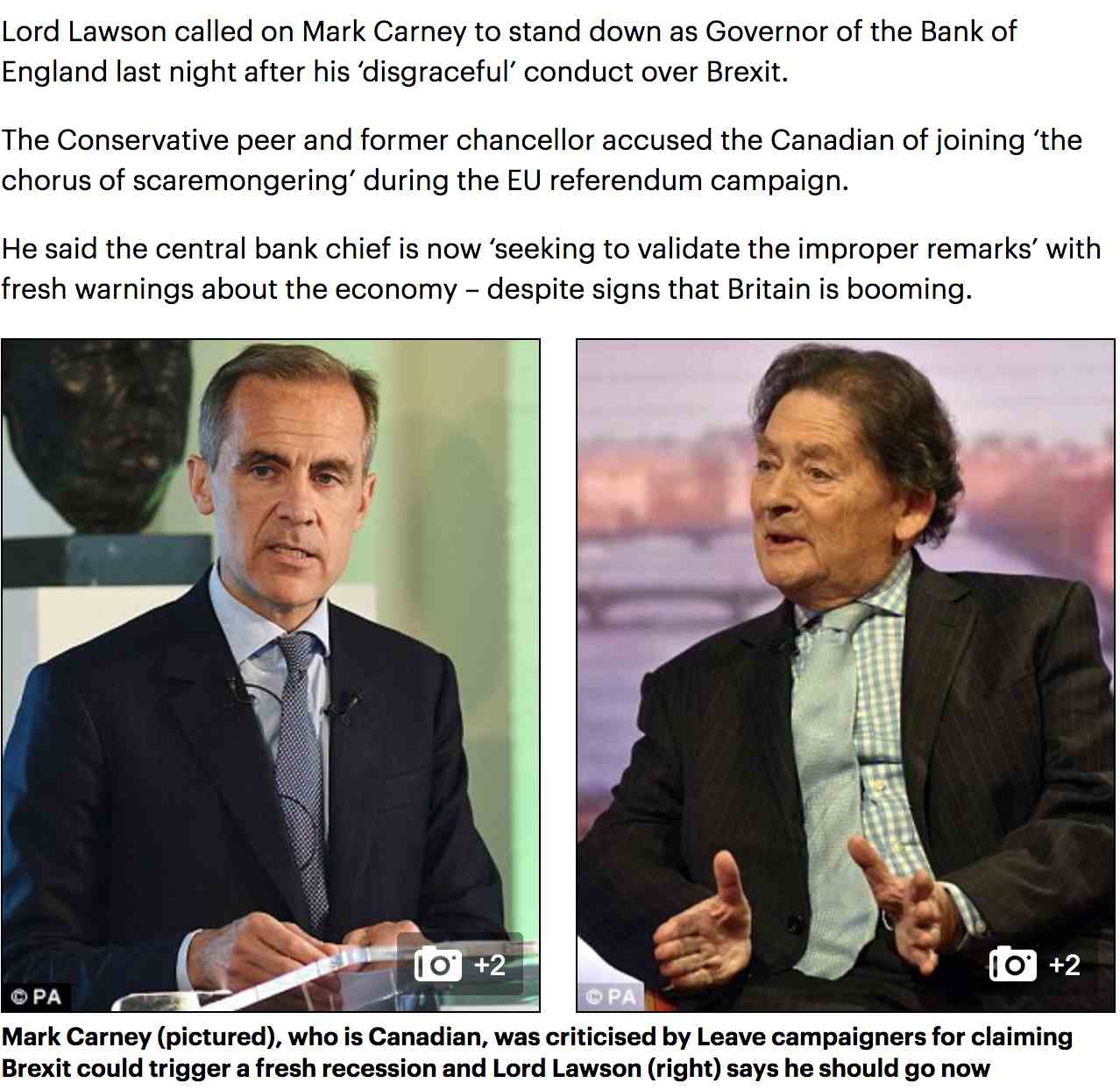
Nigel Lawson in 2016, about Mark Carney – a change of tune about the propriety of political pressure on an independent central bank, then:untitled

Corruption with Chinese characteristics

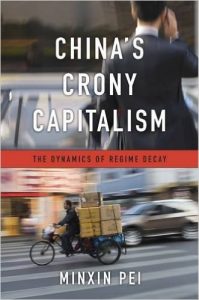
As it happened, I read Minxin Pei’s China’s Crony Capitalism in the couple of days after I’d written this article about the importance of property rights in the Financial Times. In this interesting short book, Pei links the emergence of the rampant corruption in today’s China to “partial and incremental reforms of property rights associated with nominally state owned assets in the post-Tiananmen era.” These changes decentralized control over the assets to regional and local officials, without clarifying the ownership rights. The incentive was there, from the early 1990s, to exploit the lack of clarity. At about the same time, a political decentralization created the opportunity. The appointment system went from one where senior officials appointed people one and two ranks down, to one where each layer appointed the next layer down. A market for patronage emerged, which encouraged corruption because officials needed deals with private business to make the money to pay for their jobs. Finally, a fiscal reform enabled local governments to keep the proceeds from land sales while re-centralizing tax revenues to Beijing.

The book concludes: “It is inconceivable that the CCP can reform the political and economic institutions of crony capitalism because these are the very foundations of the regimes monopoly of power.” Even if the corrupt authoritarian regime were to fall, the book argues, liberal democracy would not be the outcome. Something more like Russia’s kleptocracy would emerge. Or will, rather. “The fragility of the institutions of the party state … raies fears that even modest reform efforts could unleash a revolution. The prospect of genuine market-oriented reform is equally unpromising because such a change would eliminate the rents for the ruling autocratic elites.” Any kind of change seems to spell collapse.

In another coincidence, as I finished this book, the FT’s Jamil Anderlini (author of a brilliant e-book about the rise and fall of Bo Xilai) published a big feature on neo-Maoism in China, which he portrays as am anti-elite, anti-inequality, populist movement in the same spirit as Trumpism, Brexiteering and right-wing and left-wing populism around the continent. Sobering stuff.

5131lkoptl-_sx329_bo1204203200_