Productivity everywhere

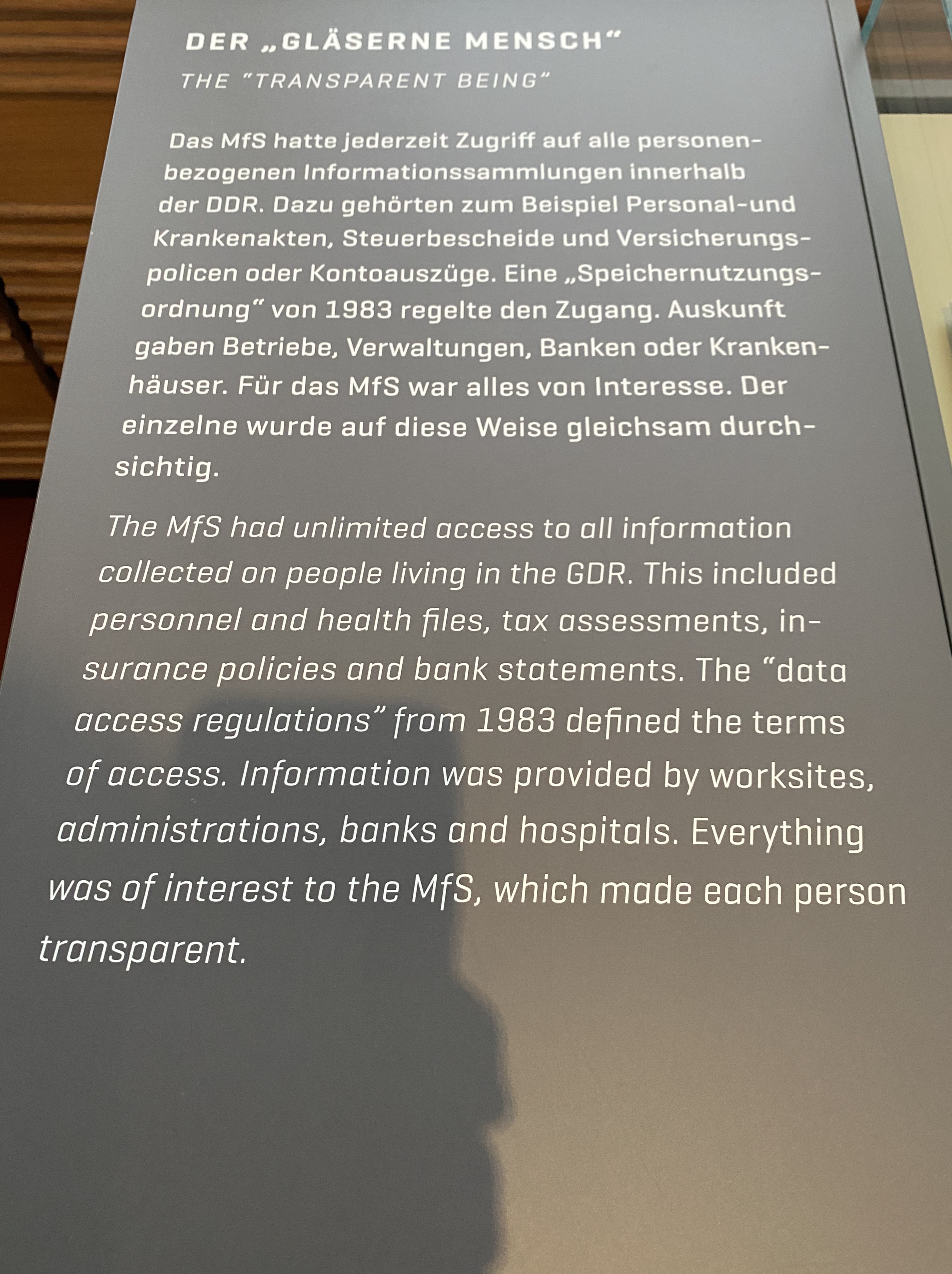
The best museum I’ve ever visited is the Stasi museum in Berlin. Mainly text and photos, it gives a compelling image of life under surveillance socialism. It even had its own technologies, from the steam iron (to steam open letters), to the pinhole cameras and disguises for agents in the field, to the unique rotating filing systems and square punch cards to record the masses of information. (And how the ratio of information to physical mass – although not energy use – has changed over the decades. Nordhaus’s well-known paper on the cost of computation tries to measure a related phenomenon.)

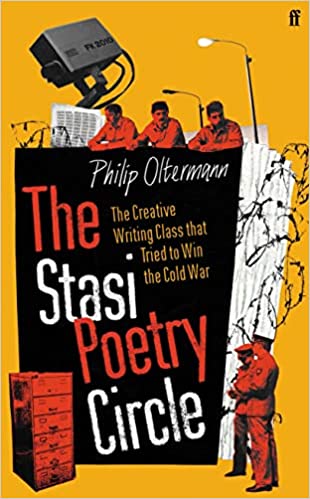
All this by way of prelude to recommending The Stasi Poetry Circle by Philip Oltermann. Although vaguely aware of the cultural dimension to the Cold War, it was still striking to learn that the East German regime had a poetry initiative among its elite Stasi regiment to try to win hearts and minds. It’s a marvellous book.

One nugget I particularly enjoyed was this: “Publishers, like their customers, had to adhere to the principles of a planned economy: in terms of books printed, the stated aim was a yearly increase in productivity of four to five percent. Between 1950 and 1989 both the number of books printed and the proportion of those that were fiction more than tripled.” It seems to have had some payoff: one international survey in the late 1980s found that East Germans had a higher reading comprehension age than their West German counterparts. This is the kind of productivity initiative I can get behind.

Another anecdote that leapt out: one Stasi guard to one of the poets who refused to join the Party’s youth wing on the grounds of preferring his own interior world: “If you are a decent human being, then there’s no world inside you other than the world you can see from the outside.” The concept was the gläserne mensch, transparent person.

Highly recommended book, and museum.

51UkZtgOxeL._SX308_BO1,204,203,200_IMG_1834

An economist in the real world

I was a bit sceptical about John List’s The Voltage Effect: How to Make Good Ideas Great and Great Ideas Scale mainly because of its presentation as a how-to business book. This goes right through to the design, which would sit nicely in an airport bookstore (remember those?….) But my fears were groundless. It’s a terrific read, and despite the business gloss is full of good advice for all kinds of public and non-profit organisations too.

For those not familiar with his work, List runs field experiments and has done so across a huge range of organisations and contexts, testing behavioural hypotheses. He has also worked as chief economist for Uber and Lyft and so has hands-on experience of how businesses operate, a rare qualification among academic economists. The book clearly draws on this trove of experience, ranging from fishing villages in Brazil to primary schools in Chicago Heights to creating incentive programmes for Lyft drivers and riders. I don’t know Prof List but I admire any economist who has spent so much time out in the ‘real world’.

The book has two halves, the first covering five diagnostics to help assess whether an idea that works at small scale will scale up – whether that’s a policy to assist progress among toddlers in deprived areas to a new digital wellbeing app. The diagnostics boil down to some basic (but evidently challenging) statistical and economic analysis – for example, do you have a representative sample when you test an idea, can you identify false positive results, do you have economies of scale to capture or will costs go up with revenues? The second half is more general econ/business advice – sunk costs are sunk, risk compensation and other behavioural responses are a thing, focus on allocating marginal effort and identifying marginal revenues. I was particularly struck by the last point in the context of cost benefit analysis, List having also spent some time as an economist responsible for CBA in the George W Bush administration in 2002-3.

All in all, this doesn’t topple Shapiro and Varian’s Information Rules from my number 1 position as best ever business book (written by economists), or indeed Dixit and Nalebuff’s The Art of Strategy from number 2, but The Voltage Effect is definitely in the top handful and well worth a read by anbody who wants their organisation to succeed and grow.

41WbNbc8GCL._SY291_BO1,204,203,200_QL40_ML2_


A quarter century of weightlessness

It’s 25 years since my first book The Weightless World was published, back in 1997. We were early adopters of the online world at home, and in my job (journalism for The Independent at the time) I had been reporting on technology companies. So when approached by an agent, I knew what the subject would be. How does it stand up to the test of time?

The headline is that the central metaphor, of economic value becoming increasingly intangible, was spot on. The role of ideas and intangibles in how economies progress has become ever more apparent – watch out for the new Haskel and Westlake book on this shortly. The material intensity of economic output has declined. At the same time, I missed two big issues: energy use and climate change; and the adverse trends in concentration in digital markets & the power of big tech. The tone is more upbeat than it might be if I wrote it now, although to be fair to myself The Weightless World does flag trade-offs and the transition costs of digital adoption.

I’m most impressed with my young self in looking at the chapter headings. It was a time of higher unemployment than now so jobs are a focus, including flexibility and what we now refer to as the gig economy. As one of the jobs chapters points out, the technology offered a lot of potential for changing patterns of work but to date it had operated solely in favour of employers, not individuals. Perhaps the pandemic and WFH will finally shift that balance. Other chapters cover the impact of digital on globalisation, economic geography and clustering in cities, the need for a new social contract, the role of the third sector and reforming government. For example, I was very clear that the need for more and more exchange of ideas would enhance clustering, as has indeed happened over the past quarter century.  I even flag up the increasing scope of increasing returns.

It’s highly embarrassing reading one’s old work, so I’m not going to recommend others go back to it. This post is just to pat myself on the back for having been in on the ground floor of the digital economy. I published the book too early, probably – prescience is no use if nobody pays attention! With luck, though, digital transformation will keep me busy for the next 25 years.

IMG_2237

Here I am in 1996, writing The Weightless World too early

Here I am in 1996, writing The Weightless World too early


I try to be open-minded about WFH

I’ve been dipping into Julia Hobsbawm’s forthcoming book The Nowhere Office: Reinventing Work and the Workplace of the Future, which is a very nicely written and upbeat assessment of the shift in white collar working habits as a result of the lockdowns.The book sees the pandemic-wrought changes as an opportunity for a healthier model of office work.

I’m not an unbiased commentator, having (a) long been able to work a day or two a week at home and (b) absolutely *loathed* work-from-home rules. It has been bad for my mental health, bad for the generation of ideas and energy, and made running a research team, and teaching, far harder. So I’m emotionally disinclined to agree either with the prediction that WFH will be the new norm or with the assessment that this will be a good thing. To wrap some logic around it, the force of agglomeration economies in knowledge-based activities has not reduced.

Still, lots of very smart people disagree so I’m trying to keep an open mind. My Productivity Institute colleague Cary Cooper is one, and he and I have debated this (on Zoom….). Nick Bloom at Stanford is another, with some super-impressive research. And now Julia’s book. I don’t want her to be right, but perhaps she is, at least about office workers. After all,  many jobs have no WFH option.

41mzrusXzFL._SY291_BO1,204,203,200_QL40_ML2_

How to invent ideas

I found Zorina Khan’s Inventing Ideas: Patents, Prizes and the Knowledge Economy very interesting. It uses an impressive assembly of empirical evidence about inventors, patents, the administrators and recipients of innovation prizes and awards, and industrial exhibitions – largely in the US, UK and France – to support a specific analysis of what enabled the US to become the most innovative and richest industrial nation from the late 19th century on. As she points out, much of the literature asks why Britain was the first country to experience an industrial revolution, so the question itself is distinctive.

Her argument is that compared with Europe, there were “dramatic differences in the new approach to growth that were manifested in early US policies.” The key difference – supported by the mass of evidence – is a far greater emphasis in the US on patents (as a market-oriented innovation system) rather than prizes and awards (an administered system). A second and consequential difference is the preponderance of incremental and commercially successful innovations in the US. “Elites have always mistrusted markets: wealth and influence often lead to the convistion that the insights of the favored fiew can outperform spontaneous co-ordination,” Khan observes. The US was strongly anti-elitist (at least in that era), whereas “the most significant variable affecting whether or not a British inventor received a prize was elite education at Oxford or Cambridge,” neither university at the time focused on technical or scientific excellence.

Along the way to supporting its argument that the marketplace of ideas beats elite technocracy, the book demolishes quite persuasively the recent trend toward innovation prizes as an effective incentive mechanism. Less persuasive is the argument that patent trolling is no greater a problem than it ever was (although there clearly was a lot of litigation over patents in the 19th century).

It also makes the point that European and American patent systems operated differently. The specific institutional details mattered. So the conclusion one could draw is that the underlying elitism of European societies and egalitarianism of the US does more to account for latter’s emergence as technological leader. In which case, the longer term outlook for the US staying at the frontier may be less rosy. In any case, much food for thought in the book, and fascinating empirical and historical detail.

41oRCed1IrL._SX329_BO1,204,203,200_