
June books

It’s the stage of the academic year where everyone, including me, is feeling pretty burned out. So there is a bit more escapist fiction than usual here. First the work-related reading.

We Are Not Machines – Sarah O’Connor. I wrote about this at more length, excellent reflections on how AI might change the world of work

The Thinking Machine – Stephen Witt. This was the FT Business Book of the Year. It’s a terrific read, a bio of Jensen Huang and Nvidia both. The ending is spectacular. Highly recommended

Trade World – Ed Conway. I read a proof copy. You are all in for a treat when it’s published.

The Political Economy of Artificial Intelligence – eds Ajay Agrawal, Joshua Gans, Avi Goldfarb and Catherine Tucker. This is a collection of papers from a 2024 NBER conference on AI and although they are quite interesting on the whole – covering for example subjects like defence and political preferences – they feel dated already.

And the non-work books:

Taiwan Travelogue, Yang Shuang-Zi. Winner of the International Booker Prize. I loved, loved, loved this book.

There’s No Turning Back – Alba De Cespedes. This was my Daunts subscription book this month, set in a girls’ college in Rome in the 1930s. Daring for the time, I would guess, and still shedding light on the trade-offs young women have to confront in life.

The Moro Affair – Leonardo Sciasia. An investigation of why the investigation into the kidnapping failed, and discussion of the convoluted Italian politics of those dark days. Not sure why I picked this up except that period in the 70s is generally interesting and odd.

She Walks At Night– Seishi Yokomizo. A newly translated Japanese crime classic.

The Burning Grounds – Abir Mukherjee. The latest in the excellent crime series set in Calcutta as the British Empire limps towards its end.

There are Places in the World Where Rules are Less Important Than Kindness – Carlo Rovelli. A collection of essays by the always-eloquent and thought-provoking physicist. Most of them are not about physics at all. The book made me fantasise about the day jobĀ  leaving me with enough energy to pen elegant essays about philosophy or Dante.
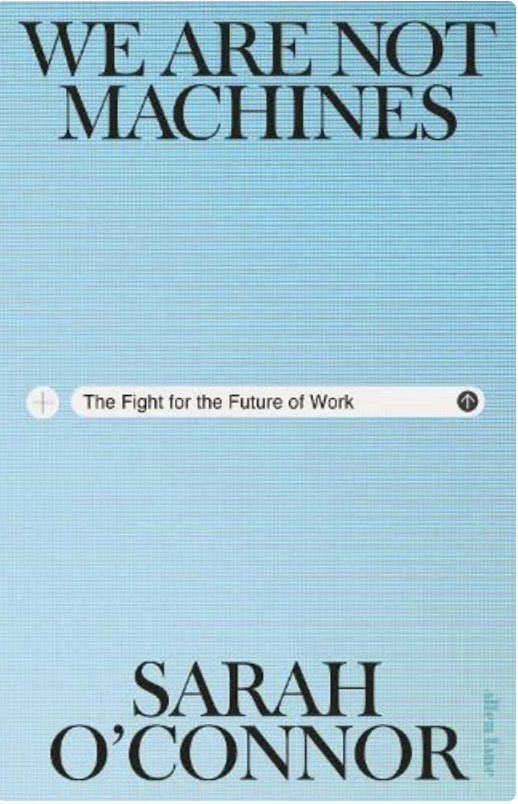
Machines are not the enemy

I have really enjoyed reading Sarah O’Connor’s new book We Are Not Machines: The Fight for the Future of Work. It weaves dispatches from the frontline of how AI and other digital tech is changing people’s jobs – from screenwriting and translating to truck driving, mining and working in an Amazon warehouse – into broader reflections on the nature of work. Some of the most powerful sections are about decisions not to work to the rhythm of machines but rather to find alternative ways of finding satisfaction and doing work that other humans value.

Readers of Sarah’s articles in the Financial Times – the only newspaper worth reading regularly any more – will be aware that she (& fellow journalist John Burn-Murdoch) keep up heroically with the vast amount of academic work on AI and labour markets, so the book is very well-informed about those debates. Combining that with reportage brings the issues to life, but also raises questions the academic literature rarely surfaces.

The one that stands out in my mind is why on earth our societies and politicians are going along with the use of AI to dehumanise the humans, to make people work to the rhythm of the machines. Truck drivers have long and unhealthy shifts because of the requirements imposed by the tachygraphs that regulate driving hours – the maximum becomes the target – and the answer to their risk of dozing off in the cab is still more machines to monitor them. In warehouse jobs, as the AI gets faster, the demands on the people serving the logistic robots become more relentless.

To some extent the answer is collective organisation – the Hollywood writers strike being one example, the Dutch Buurtzorg home care nursing organisation another. But of course there are bigger issues about the course modern capitalism has taken, making it seem inevitable that we will end up with lower-quality but cheaper AI-inflected services.The positive stories here of humans being able to make machines work for them are encouraging, but are also small victories in the bigger conflict.

The book has a wonderful quote from Lewis Mumford: “The purpose of art has never been labor-saving but labor-loving, a deliberate examination of function, form and symbolic ornament to enhance the interest of life itself.” Public opinion studies show that substituting for creative endeavour was the last thing people want AI to do, but it has ended up being the first thing. As the book concludes, “The future of work can be more worthy of the human mind, more careful of the human body, more satisfying to the human soul. But not without a fight.”

Technology will be the means to achieve a better future of work; the fight (as it always has been) is against the institutions using it to enrich and empower themselves at the expense of the common good.

Screenshot 2026-06-07 at 16.55.11