UK economic performance: who to blame for what

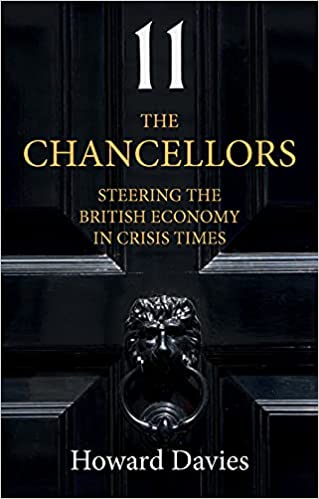
The Chancellors: Steering the British Economy in Crisis Times by Howard Davies is a really interesting read. It’s an account of aspects of the UK’s economic performance since 1997, based on a mixture of looking at data and research, his own personal experience at the heart of the events covered, and interviews with the Chancellors and other senior officials during the past 30-odd years. Now, this could be a bit pedestrian, and it is certainly inside the UK equivalent of the Beltway (London postcode SW1 for Whitehall to EC2 for the Bank of England to E14 for Canary Wharf).

What makes it so interesting is that Sir Howard was in the middle of some key events. He was Deputy Governor of the Bank of England when Gordon Brown made the surprise announcement of its independence in mid-1997. (I was an economics journalist at the time, and remember the press conference vividly – my political editor colleague and I looked at each other asking silently, Did I just hear what I think I heard?) He was also close to the post-GFC debates about how to restructure financial regulation/supervision, having headed the then new FSA from 1997 to 2003. Indeed, his public service career started as an adviser in the Treasury, so he knows the institutions and the people well.

This could still be made dull, in the right hands. But adding to the reading spice, he also makes his not entirely flattering views about certain people perfectly plain. Often on picking up a new book, it’s gratifying to find that you’re cited – with this one, more anxiety-making (my work gets two references, both pretty neutral. Phew). There may be readers who are less than thrilled.

The book covers a mix of events – the GFC, the Scottish and Brexit referendums – and issues – public spending, climate change, macro policy and performance. It ends with some interesting reflections on the Treasury as an institution and whether it is in the right shape or has the right culture to tackle the challenges ahead, including Covd and climate. His conclusion is no, but not so much because of the embedded Treasury culture that drives many of its critics to despair as because of its under-resourcing. He argues this takes two forms: just not enough money and people, unable to retain staff; and also too many smart generalists who get moved around, and not enough people with deep expertise in say tax policy or financial regulation who stick around. Together these make for inadequate institutional memory and expertise.

So whether you’re interested in the soap opera aspects – who blames whom for what – or the underlying policy debates – how good/bad has the impact of QE been or how should financial supervision be structured – there is a lot to enjoy in this book. Highly recommended for anyone interested in UK economic policy.

41wWb94zw1L._SX317_BO1,204,203,200_

Swimming against the tide

There are some books whose success mystifies me. One was Yuval Noah Harari’s Sapiens, which I tried when it was published and couldn’t get past p50. I tried with Homo Deus recently and got as far as p138 before giving up. Despite my fondness for Big History, I just can’t figure out what it’s about. As far as I can tell, there’s no original body of research underpinning a popular synthesis (unlike, say, Oded Galor’s interesting new book The Journey of Humanity, or a book like Joseph Henrich’s big cultural history The Weirdest People in the World).

But nor is there in Homo Deus a structured synthesis of other people’s work – ample references of course, but what’s the actual analysis and argument? I could cheat and look at some reviews by people who have actually read the whole thing.* But I think 138 pages gives it a fair shot at grabbing my attention, and it has failed, despite the positive blurbs from Jarvis Cocker and Kazua Ishiguro, and the many millions of sales and high profile fans.

No doubt somebody will explain why I’m wrong.


*OK, I cheated. Here’s a helpful review in the LRB by Steven Shapin who read the whole thing, found the argument and sums it up (‘technology has given us the power to reshape ourselves as a species and it’s full of risks’). I get the sense he wasn’t overwhelmed but is politely positive anyway.

71+YEgdMG-L._AC_UY436_QL65_911PEYbv7VL._AC_UY436_QL65_


In thrall to games?

Hidden Games: The surprising power of game theory to explain irrational human behaviour by Moshe Hoffman and Erez Yoeli does exactly what it says on the cover. It’s an interesting strategy (ahem): irrational behaviour turns out to be rational after all! When being over-optimistic about our own abilities, fooling ourselves by only believing social media comments that reinforce our prior beliefs, spinning the truth, or over-spending on costly luxury goods, all these and more behavioural phenomena can be explained as dominant strategies in appropriately described games. It’s all about the Nash equilibria, stupid.

I enjoyed the book on the whole. It’s a breezy introduction to game theory applications, written with a light touch and plenty of anecdotes. An early chapter sets the scene with the classic evolutionary explanation for observed sex ratios, moving on then to the Hawks and Doves game, and of course the Prisoners’ Dilemma features extensively too.

It has always astonished me how few people think strategically at all, such that a read of the classic (1993) Thinking Strategically on how to apply game theory by Avinash Dixit and Barry Nalebuff would help almost anybody. I can remember once observing in a committee meeting (all economists) what the Nash equilibrium in a certain policy situation involving all EU member countries would be, which did my reputation among those colleagues a power of good as this made it obvious what decision our (UK) politicians would take, regardless of any economic advice we delivered.

Hidden Games does some of the same groundwork as Thinking Strategically in its first half, throwing in a brief explanation of Bayes theorem en passant. I found it less compelling when it gets to the second half, explaining the ‘irrational’ as Nash equilibria in various games. Perhaps this is because there are already pretty powerful models, whether cognitive – eg the rule-of-thumb argument about conserving brain energy in making decisions – or economic – classic signalling models. The application of game theory seems more interesting in contexts of collective choices (as in Kaushik Basu’s wonderful The Republic of Beliefs) than in individual decision-making.

Having said that, if you don’t mind the trope about rationalising the irrational, Hidden Games is a very nice introduction to applying game theory to life, an enjoyable read.

41D7N2EMYTL._SX321_BO1,204,203,200_

Spending our time, the ultimate scarce resource

On the face of it, The Internet Is Not What You Think It Is: A History, A Philosophy, A Warning by Justin Smith and Four Thousand Weeks: Time Management for Mortals by Oliver Burkeman are pretty different. The former a philosophical disquisition on the parallels (and differences) between historical communication networks and today’s internet of disinformation. The latter a self-help guide to being less busy and happier.

What they have in common is identifying digital platforms as the cuplrit gobbling up our time and attention through addictive design – that familiar ‘swipe down to refresh’ for a dopamine hit – and a business model that requires human fodder. One travels by way of classical Indian philosophers and the Enlightenment, the other via useful advice from popular psychology. Both have at their heart a concern with the manipulation of how we spend our time. I read them one after the other and enjoyed both – and both with more useful insight than the much-hyped Surveillance Capital doorstop.

Have I stopped scrolling so much? Not yet. I will be trying to take some of Burkeman’s advice in the hope of stopping feeling constant pressure to empty that inbox, tick off the whole to do list. As we’re stuck with the internet, it makes sense to resist the way it manages us humans. I don’t think Smith would reckon much for my chances. Wish me luck.

Screenshot 2022-04-28 at 15.53.39Screenshot 2022-04-28 at 15.54.17


The experiment has started so let’s make it work

An optimistic book about the future of liberal democracies – surely not? But yes, that’s what Yascha Mounk has delivered with The Great Experiment: How to Make Diverse Democracies Work. It’s a book of three parts, the first of which is all about why diverse societies generally fail, starting with the innate human tendency to divide into us and them.

After this gloomy start, which is what we now expect from books about democracy, Mounk notes that this is too bad as most OECD (and other) countries now have diverse populations, and despite populism it is hard to conceive that going back to the more homogenous mid-20th century is possible. So the book goes on in the second part to set out a vision of what a diverse liberal democracy might look like. It argues strongly for “the core commitment of philosophical liberalism,” namely that the state has a responsibility to respect the moral autonomy of its citizens, which means setting limits to its own authority and also protecting individuals from the “cage of norms”, restrictions on autonomy set by their own religious or ethnic group. It also advocates for cultural patriotism, rather than nationalism or the civic patriotism of shared values. I like this alternative very much – it seems to me we are brought together by language, landscape, tv shows, sport, the way buildings and shops look etc. I’d add humour, very distinctive between different countries.

The final part starts with “reasons for optimism” – one of which is that actually, most of the diverse democracies are slowly making progress toward better integration, accepting that people have diverse and multiple identities. The book also argues that optimism is important because it will affect actions and outcomes. It acknowledges what it terms the ‘Chapter 10 problem’ – the generally unsatisfying list of policies at the end of a book, as demanded by publishers and indeed readers. It doesn’t really provide this so much as a few general reflections, concluding: “Constructing diverse democracies that command the enthusiastic support of the great majority of their citzens is going to be hard.” But what choice do we have other than to try? The Great Experiment is already well under way.

So I liked the upbeat message. I don’t think there’s much that’s new here for readers of the death of democracy genre, but the arrangement of the argument into an optimistic outlook is very welcome.

41PkbRR0u0L._SY291_BO1,204,203,200_QL40_ML2_