The joy of measurement

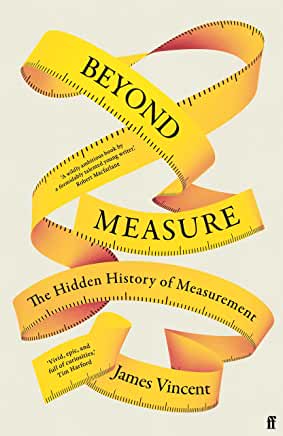
Beyond Measure: The Hidden History of Measurement by James Vincent had the good fortune to be published more or less when the Johnson government here decided a good wheeze to distract voters’ attention from – well, everything – would be to launch a consultation on the reintroduction of imperial measures alongside metric. The recent by-election results suggest the wheeze failed; maybe the population just isn’t overwhelmed with excitement by the subject of measurement standards.

I am of course one of the minority who does find measurement an unbelievably exciting subject, and I enjoyed reading the book. It uses a chronological structure to explore different aspects of measurement, starting with the ancient world and the emergence of standard measures for trade, moving on to early modern states, the Scientific Revolution and French Revolution, with a separate chapter on early statistics, and ending up indeed with a chapter subtitled “Metric vs imperial and metrology’s culture war” and finally measurement today (including the concept of the ‘quantified self’.

I quite like this summary of the purpose of measurement: “From the ancient world onwards, measurement has been embraced not only for its practical benefits – for its utility in tasks like construction and trade – but also for its ability to create a zone of shared expectations and rules; to mediate our experience with the world and one another, ensuring that the interactions between two strangers who live under the same set of measures can be validated and trusted.” This purpose of mutual benefit sits alongside the use of measurement by rulers and states – and the book indeed cites classic authors like James Scott and Theodore Porter.

Although books such as the wonderful Seeing Like A State, or more recent ones on specific areas of measurement such as Andrew Whitby’s recent The Sum of The People about the history of the census, obviously have a lot more detail than the chapters here, Beyond Measure delivers on its aim of providing an accessible overview of the history of measurement and many of the issues of meaning. It’s a great starting point for anyone not as immersed (as nerds like me) in the measurement literature.

It’s also an enticing read, with anecdotes aplenty (visiting a nilometer, chatting to Brexiteers about pints and miles) and full of my favourite kind of useful facts. Who knew, for example, that, “In England, measurement disputes in markets were settled by a special tribunal known as the ‘court of piepowder’.” It dates to the 11th century, that is prior to the normal court system, and doled out on the spot justice on market day. Piepowder is apparently a corruption of ‘pieds poudrés’ or dusty feet, characterising travelling merchants.

Perhaps the UK Government will, in its ever-more desperate attempts to show something, anything, for Brexit, re-establish piepowder courts in markets up and down the land, should remoaniac stallholders not want to replace their kilos and metres with pounds and feet. For, as the book illustrates, questions of measurement are not (just) technical, but highly political.

81e2r7e6hAL._AC_UY436_QL65_

Decarbonising travel – room for optimism?

Our new Perspectives title, Good To Go: Decarbonising Travel After the Pandemic by David Metz is out. It looks at how the pandemic has affected pre-existing trends in travel – not as much as optimists might have hoped, is his conclusion, although recognising that it is probably too early to know whether commuting patterns will change permanently. Nevertheless, improved neighbourhood planning and flexible working could capture some of the benefits of the pandemic years even if there is a significant reversion to the old normal.

However, One of David’s points is that people relish mobility, with faster travel always having translated into travel further. That means that tackling the contribution of transport to solving the climate challenge will need technological contributions. The book holds out some hope for electric vehicles and digital tools contributing to decarbonising transport. But as David points out, the system is complex, involving economics, demography, technology, policy and human behaviour. There is a lot of wishful thinking about how easy it will be to change. Complexity means (as so often in policy) there is no easy solution. The book outlines a range of investments and policy interventions that will be needed to decarbonise travel.

Good to Go? is a terrific addition to our Perspectives roster on transport: David’s previous book, Travel Fast or Smart?; Transport for Humans: Are we nearly there yet? by Pete Dyson and Rory Sutherland; and Are Trams Socialist? Why Britain Has No Transport Policy and  Driverless Cars: On a Road to Nowhere  by Christian Wolmar. They complement each other wonderfully  – a great collection for transport nerds! As a special offer for readers of this blog, all five (£71 if bought individually) are available for £45 plus postage if you email sam@londonpublishingpartnership.co.uk.

9781913019624-e1655710170750


Economics – people or facts?

In preparing for a small workshop I’ve co-organised* in Oxford tomorrow, on “Rebooting Welfare Economics”, I’ve been browsing my bookshelves. Two titles jumped out: Ariel Rubinstein’s wonderful Economic Fables (winner of the first ever Enlightened Economist annual prize in 2012 – I’ve only just realised this blog is 10 years old) and John Hicks’s The Social Framework. Hicks states (p3 of my 1947 edition): “Economics studies facts and seeks to arrange the facts in such ways as make it possible to draw conclusions from them.” The positivist claim to separate ‘facts’ and positive knowledge from the normative shines out (see Chapter 3 of my Cogs and Monsters). Rubinstein says (p15): “Economic theory is concerned precisely with the abstract concepts related to the interaction between people.”

People or facts? I’m in the people camp.

41JABeG4t-L._SX354_BO1,204,203,200_

B00804MR7M.01._SCLZZZZZZZ_SX500_


*With Eric Beinhocker, Tim Besley, Mark Fabian and Margaret Stevens.

Co-operation vs sovereignty in an unequal world order

Global governance is understandably something of a preoccupation as economic globalisation seems to be in retreat at the same time that the scale and intensity of global challenges – climate change, the AI race, actual or simmering conflict, organised crime – is increasing. The Bretton Woods institutions – IMF and World Bank – established in the wake of World War Two remain important and powerful, and will have a lot on their plates in the next year or two, including the possibility of a new debt crisis alongside a surge in poverty and hunger. This context raises two questions. One is what is their guiding philosophy in terms of economic analysis and policy recommendations going to be now the old Washington Consensus version of conditionality has been more or less ditched? The other is whether they can help address the new kinds of challenges, or whether instead new institutions are needed?

They were forged out of a crisis of course, but in The Meddlers: Sovereignty, Empire and the Birth of Global Economic Governance Jamie Martin traces their forbears in the international economic institutions established near the beginning of the 20th century. The key issue he highlights is on the one hand the delicate balance between mutually beneficial co-ordination and voluntary loss of sovereignty among peer countries, and on the other the exercise of power by some countries over others (Imperial powers over colonies or later the US over its debtors) at the expense of the latters’ sovereignty. Co-ordination and co-operation require ceding some decision-making ground but when there is a parity of power this expands the opportunities or benefits each party experiences. However, the international institutions also embed inequalities of power – symbolised by the Asian crisis image of an IMF bureaucrat (Michel Camdessus) leaning over a local politician (Indonesia’s President Suharto) signing up to loan conditions.

Some technocratic institutions governing for example international post or shipping have lasted throughought the century plus, while the BIS (established in 1929/30) is an interesting example of an organisation with a broader mandate yet lasting throughout the 20th century and beyond, despite its missteps during the 1939-45 conflict. Other pre-WW2 international bodies such as the Economic and Financial Section of the League of Nations fell with the implosion of the international order at the outbreak of war. The book argues that the context of post WW1 reparations, the tensions in the European empires, the growth of US economic power and the pressures of the gold standard and the tariff wars of the 1930s all contributed to their downfall. International co-ordination was both essential and impossible.

The lesson for the 21st century, it concludes, is that today’s context of shifting economic power and economic crisis pose similar challenges for the Bretton Woods institutions. The history of earlier institutions suggests that it is fundamentally hard to resolve the core dilemma of a need for co-operation with the desire for sovereignty in a world of unequal power: “Tweaks to existing international institutions, like the IMF and World Bank, may be insufficient to produce a more stable reconciliation of global governance and democratic politics.” But what form should new institutions take? This very interesting book leaves the question hanging.

41TWDGc1FdL._AC_UY436_QL65_

Predecessors and outsiders

I’m a sucker for books about innovation, and enjoyed reading Gavin Weightman’s Eureka: How Invention Happens. It’s a jolly account of five 20th century inventions: flight, TV, bar codes, personal computers and mobile phones.

Despite the title, the main argument is that there is no single Eureka moment. While we often credit some well-known individuals (such as the Wright brothers or John Logie Baird) with an invention, all inventions rely on bringing together a prior series of other inventions. For example, Babbage never could build his mechanical computers; computing had to wait for electronic valves, transistors and then chips, as well as the insights of Turing and Von Neumann. Predecessor inventions are essential. Yet at the same time, it is often an outsider – such as the Wrights or Baird – who question received wisdom and join the dots to bring the new thing into being. It takes an outsider to not know that something isn’t possible…

The most interesting chapter in a funny way was the one on barcodes (which also feature in Tim Harford’s Fifty Things…). Apart from the fact that they’re less obvious as ‘an invention’, the corporate aspect to this was very interesting. Tech companies were pitching a product to supermarkets that would cost a good deal in upfront investment and needed co-ordination across competing chains to set technical standards. Retail has undergone some huge, productivity-enhancing technical changes over time. It has gone from entirely labour-intensive (shelf stacking, checking out, packing) to using increasing amounts of capital (conveyor belts, scanners) and free labour (customers doing the packing), then still more hard and soft capital (automated checkouts with scanners and sophisticated software) and free labour (we do our own scanning now too) to eventually Amazon-style stores where the paid human labour has gone and the free human labour reduced, but the software greatly augmented. All of this requires barcodes.

It was interesting to learn about some of the prior contributions to the iconic innovations, and the book is an easy read thanks to a lot of biographical background on the various people, often eccentric. The computer and mobile phone histories are ones I’ve read a lot about before.  I think Francis Spufford’s Backroom Boys (albeit only UK focused) is a far better read, if you’re only going to read one general interest book about a range of inventions. But Eureka is very enjoyable, and looks at different technologies from a US perspective, & I’d recommend it.

Screenshot 2022-06-03 at 14.00.47