A long time in life – and books

As I was listening to the report on the radio this morning about Aung San Suu Kyi’s first visit to the UK in 24 years, it set me thinking about how much has changed since 1988. The London of those days – a city to which I’d recently moved from the US – was dirtier, not as lively, far less cosmopolitan. We were all much poorer, even the bankers, well worth remembering in the midst of the crisis. According to the new IFS and Joseph Rowntree Foundation study, 3.4 million children here lived in poverty in 1988-89, down to 1.7 million in the latest figures (still too high, but the biggest decline in the years since 1961 when the data start).

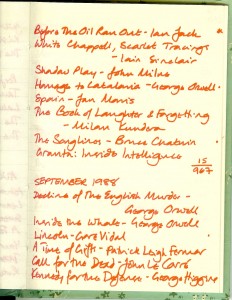
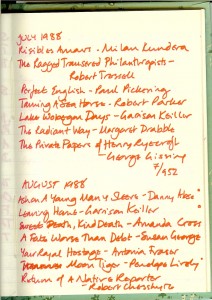
Personally, 1988 is so long ago that I was still doing macroeconomics, and hadn’t yet quite begun my 13-year journey in journalism. I had just met the man who became my husband, and our now grown-up eldest son hadn’t been imagined yet. And here is what I was reading in 1988. Some good stuff among the detective novels. Ian Jack’s [amazon_link id=”0099754215″ target=”_blank” ]Before the Oil Ran Out[/amazon_link] is a marvellous piece of reportage about how Britain had been changing in the 1980s. I was obviously also in the middle of a lot of travel writing and a [amazon_link id=”0141183063″ target=”_blank” ]George Orwell[/amazon_link] fest.

July 1988 books


August 1988 books

Who can end the end-of-worldism?

It is hard to find reasons to be cheerful about the state of the world economy, especially after reading Dani Rodrik’s all too scarily plausible scenario for a replay of the Great Depression, but worse, ‘The End of the World As We Know It.’ His scenario starts with a Syriza victory. The news that the Greek people decided to stay teetering on the brink of the financial and economic precipice rather than leaping over it right now is a small comfort.

I turned to Benjamin Friedman’s 2005 book, [amazon_link id=”1400095719″ target=”_blank” ]The Moral Consequences of Economic Growth[/amazon_link], a powerful argument that growth and public values, economics and politics, are inextricably related. He traces back to its Enlightenment roots the idea that progress in one sphere is related to progress in another. He sees the Great Depression in the United States (but not Europe) as the one exception to the general rule that economic stagnation or decline leads to an erosion of a society’s openness and commitment to democracy: “America during the Great Depression strengthened its commitment to these positive values and, moreover, did so in ways that proved lasting.” (p159) The reason, of course, was the exceptional response of the New Deal, and FDR’s leadership.

One reason for feeling so gloomy about the US and Europe alike now is that there is no sign of exceptional political leadership. Extremists are gaining political ground. The false consciousness of the anti-GDP and happyism movement is alluring for some people who ought to know better than to stick their heads in this romantic sand. I know economists have no reason to act complacent these days, but where are the politicians?

[amazon_image id=”1400095719″ link=”true” target=”_blank” size=”medium” ]The Moral Consequences of Economic Growth[/amazon_image]

Enough, and what to do about it

As I started to write this post, I looked up the URL for a review by Giles Fraser (the former Canon of St Paul’s Cathedral who departed that job over the Occupy issue) of Michael Sandel’s [amazon_link id=”184614471X” target=”_blank” ]What Money Can’t Buy[/amazon_link] and [amazon_link id=”1590515072″ target=”_blank” ]How Much is Enough?[/amazon_link] by Robert and Edward Skidelsky. The Observer’s website promptly served me with an ad for insights into growth markets in the global economy from Goldman Sachs. There’s hardly any need to say more.

I’ve read Michael Sandel’s book, and reviewed it for The Independent, and debated it with him on Start The Week, so won’t repeat myself. I haven’t read the Skidelskys’ book yet, although I can’t resist wondering whether they have read yet my own [amazon_link id=”0691156298″ target=”_blank” ]The Economics of Enough[/amazon_link] from last year. The review concludes that the Sandel and Skidelsky books are worth reading together and: “form a part of a much broader picture about the multiple failures of free-market fundamentalism and the moral vacuum in which it has trapped us.”

If I may indulge again in praise of [amazon_link id=”1444703951″ target=”_blank” ]Spitalfields Life[/amazon_link], the book has a moving essay called ‘At Stephen Walters & Sons Ltd, Silk Weavers. This business, now in Suffolk but founded in Spitalfields in 1720, is run by a ninth generation silk weaver in the Walters family. The present Mr Walters says:

“With eight generations behind you, it changes the way you approach your life. It’s not just about this year, it’s about managing the company from one generation to the next, so you deal with your employees and your customers differently.”

Master Weaver Joseph Walters

We all have eight generations behind us, and, we hope, ahead of us. The issue is weaving an awareness of our responsibilities to past and future into the institutions and organisations we participate in.

Niall Ferguson, as a conservative historian, is on the same point in his first BBC Reith Lecture, summarised here. He refers to Edmund Burke, who wrote in his [amazon_link id=”0199539022″ target=”_blank” ]Reflections on the Revolution in France[/amazon_link]:

“Society is indeed a contract. ….. It is a partnership in all science; a partnership in all art; a partnership in every virtue, and in all perfection. As the ends of such a partnership cannot be obtained in many generations, it becomes a partnership not only between those who are living, but between those who are living, those who are dead, and those who are to be born.”

As the Greeks file into their polling stations today to vote for chaos, I think the broader picture Giles Fraser speaks of is now widely accepted and it’s time to move into a discussion about what to do.

[amazon_image id=”1590515072″ link=”true” target=”_blank” size=”medium” ]How Much Is Enough?: Money and the Good Life[/amazon_image]

What next?

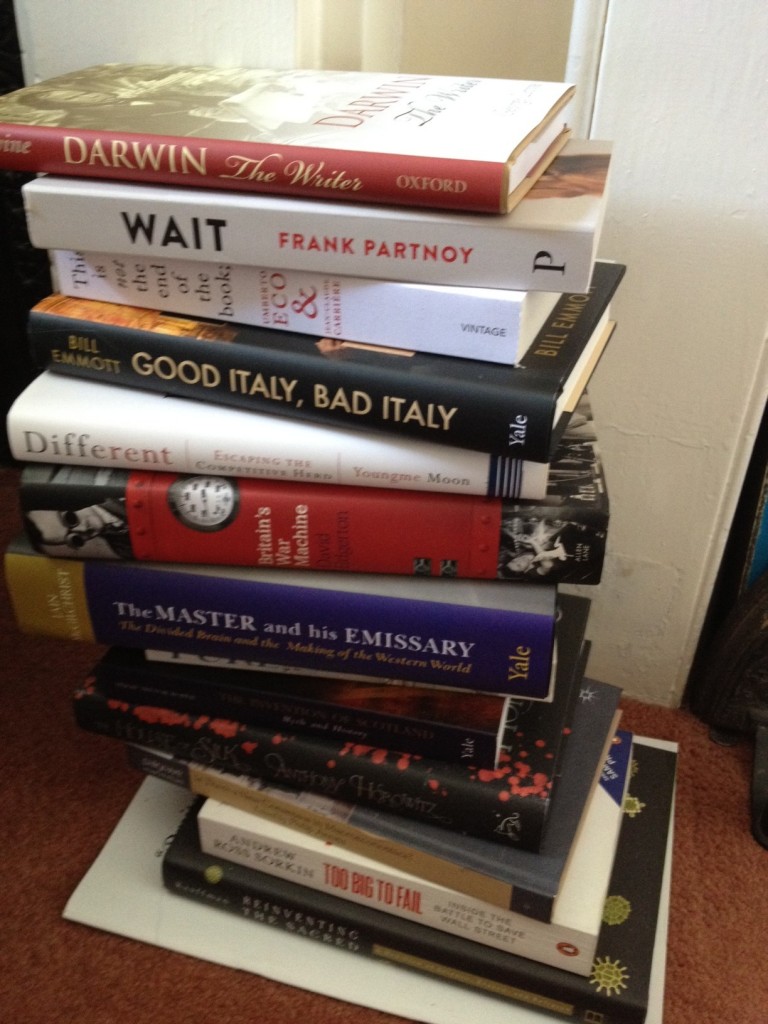
I’m still reading both Steve Keen’s [amazon_link id=”1848139926″ target=”_blank” ]Debunking Economics[/amazon_link] and [amazon_link id=”1444703951″ target=”_blank” ]Spitalfields Life[/amazon_link] by The Gentle Author. But I’m prepared to take your suggestions on what to pick out of my book pile next. [amazon_link id=”0199608431″ target=”_blank” ]Darwin The Writer[/amazon_link] by George Levine is my personal leading contender.

The in-pile, 16 June 2012

The big issue

It’s been a hectic week so each night I’ve been taking twenty minutes or so to relax with a completely marvellous book, [amazon_link id=”1444703951″ target=”_blank” ]Spitalfields Life[/amazon_link] by The Gentle Author. I’ve been a devotee of the blog of the book for some time, and this is a collection of posts by the anonymous author who is documenting one of my favourite areas of London in what is turning into an all time classic of social observation.

Many of the posts/chapters concern the small businesses and markets of the area. I’ve been forcefully struck by the difficulties of operating at a small scale. For example, a visit by The Gentle Author and Leila McAlister to Covent Garden Market to buy fruit and veg reveals Leila to be the only buyer looking for small quantities of seasonal crops – most are wholesalers looking for large purchases of consistent (and bland) produce. There are many other examples.

We have created an economy where only large scale is viable, which cannot be healthy. In almost any sector I can think of, a handful of very large firms have such economies of scale that only very small businesses clinging on around the margins can co-exist with them, and that’s tough anyway. Large scale does bring consumer benefits in the form of much lower prices than would otherwise prevail, in the products or services on offer; but also the large consumer detriment of a narrower range of products and characteristics. What’s more, an economy of giants whose shadow prevents any competition from growing to fruition is vulnerable over time to a loss of innovation and dynamism. As we are seeing.

So all thanks to The Gentle Author for this reminder, page after page, of what an alternative might look like.

[amazon_image id=”1444703951″ link=”true” target=”_blank” size=”medium” ]Spitalfields Life: In the Midst of Life I Woke to Find Myself Living in an Old House Beside Brick Lane in the East End of London[/amazon_image]