Advice to young economists

Today I gave a talk to sixth formers at Gosford Hill School, near Oxford: “I never meant to become an economist,” was the title. (This was via the excellent Speakers for Schools initiative set up by Robert Peston.)

It was a riff on my own career history, and what being an economist means, set in the context of some of my family history and the structural changes in the economy between 1935, when my dad started work at 14, and now, as the young people think about their future careers. Here’s my dad in his first job, front row extreme right. He stayed there most of his working life, apart from the army, although after the mill closed in the late 1970s he was lucky enough to find a job as a meter reader.

Joseph Coyle, The Old Ground Mill

The students were extremely polite and asked lots of good questions. One was what I’d recommend them to read to see if they were interested in economics at university. Off the top of my head, I recommended Tim Harford’s [amazon_link id=”0349119856″ target=”_blank” ]The Undercover Economist[/amazon_link] (which turned my eldest boy into an economist) or any of his books, the Keynes- Hayek rap, Thomas Schelling’s [amazon_link id=”0393329461″ target=”_blank” ]Micromotives and Macrobehaviour[/amazon_link], Ha Joon Chang’s [amazon_link id=”0141047976″ target=”_blank” ]23 Things They Don’t Tell You About Capitalism[/amazon_link], and anything by David Smith, like his recent [amazon_link id=”1781250111″ target=”_blank” ]Free Lunch[/amazon_link]. I forgot to mention Ariel Rubinstein’s [amazon_link id=”1906924775″ target=”_blank” ]Economic Fables[/amazon_link]. There are surely lots of other good resources I should have mentioned too – but not [amazon_link id=”0141019018″ target=”_blank” ]Freakonomics[/amazon_link], which I found too gimmicky.

[amazon_image id=”0349119856″ link=”true” target=”_blank” size=”medium” ]The Undercover Economist[/amazon_image]

Digital origins and robotic futures

I’ve been waiting for ages for the paperback of George Dyson’s [amazon_link id=”014101590X” target=”_blank” ]Turing’s Cathedral: The Origins of the Digital Universe[/amazon_link], and a couple of chapters in am already *loving* it. It’s the kind of book that stuffs in all sorts of information, well suited to a magpie mind like mine. For example, did you know that Francis Bacon knew in 1623 that two symbols sufficed to represent all information? “A man may exprese and signifie the intentions of his mind, at any distance of place, by objects … capable of a two-fold difference onely.” Turing of course formalized this in his 1936 paper. He noted: “Being digital should be of more interest than being electronic.” The electronics distracted us, however. Dyson follows this section with a diversion into the history of the site of Princeton’s Institute for Advanced Study during the Revolutionary War. Perfect.

[amazon_image id=”014101590X” link=”true” target=”_blank” size=”medium” ]Turing’s Cathedral: The Origins of the Digital Universe (Penguin Press Science)[/amazon_image]

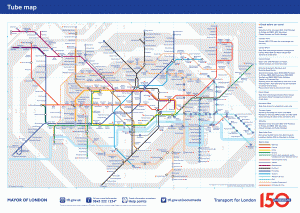
Coincidentally, I was reading bits of and about Bacon’s [amazon_link id=”1440042500″ target=”_blank” ]Novum Organum[/amazon_link]  recently, particularly about his notion of myths that distract us from scientific knowledge. The key myth or ‘idol’ he labels ‘Idols of the Market Place’: “Men associate through conversation, but words are applied according to the capacity of ordinary people. Therefore shoddy and inept application of words lays siege to the intellect in wondrous ways.” This was for my presentation at The Story 2013, in which I talked about the usefulness of models and equations, rather then verbal narratives, for describing aspects of the world. After all – as Margaret Bray and others have pointed out – the London Underground map is a useful model, not an accurate representation of London’s geography.

[amazon_image id=”1176418432″ link=”true” target=”_blank” size=”medium” ]Novum Organum[/amazon_image]

A useful model

Robots have been on my mind anyway, having been thinking about Luddites and jobs. This book, [amazon_link id=”1448659817″ target=”_blank” ]The Lights in the Tunnel[/amazon_link] by Martin Ford, looks rather interesting, from this extract from the introduction. I couldn’t agree more with this statement: The evidence is pretty clear: a race between technology and our ability to reform our political and economic systems is really no race at all. So if we can foresee that technology is likely to have a highly disruptive impact on our economy in the coming years and decades, then we really need to start thinking about that well in advance.

[amazon_image id=”1448659817″ link=”true” target=”_blank” size=”medium” ]The Lights in the Tunnel: Automation, Accelerating Technology and the Economy of the Future: 1[/amazon_image]

When the money runs out….

I’m excited by the arrival of proofs of [amazon_link id=”0300190522″ target=”_blank” ]When the Money Runs Out: The End of Western Affluence[/amazon_link] by Stephen King.

[amazon_image id=”0300190522″ link=”true” target=”_blank” size=”medium” ]When the Money Runs Out: The End of Western Affluence[/amazon_image]

I greatly enjoyed his last book, [amazon_link id=”0300170874″ target=”_blank” ]Losing Control.[/amazon_link] There’s an embargo on the new one – the review will follow in a while…..

[amazon_image id=”0300170874″ link=”true” target=”_blank” size=”medium” ]Losing Control: The Emerging Threats to Western Prosperity[/amazon_image]

Robots and Luddites

For various reasons, I’ve been thinking about Luddites. My husband called me a Luddite for mildly complaining that our TV set-up has become so complicated that I no longer know how to play a DVD. Seriously, though, the ‘robots are eating our jobs’ argument has been gaining traction – in the interesting Brynjolfsson and McAfee book [amazon_link id=”0984725113″ target=”_blank” ]Race Against the Machine[/amazon_link], in Paul Krugman’s Robots column, and assessed in this recent Economist survey article (with handy links).

Oddly this is simultaneous with the interest in Robert Gordon’s argument that the days of significant technology-driven productivity gains are over, in his paper Is US Economic Growth Over? The awesome analytical power of economics tells us these arguments can’t both be true at the same time, even if it doesn’t tell us which one is correct.

Luddites have an unfair reputation, as if they should have realised that the tide of technological change was unstoppable so why bother protesting? Eric Hobsbawm once argued (in The Machine Breakers) that there wasn’t a big difference between the Luddites of 1811-13 and the “collective bargaining by riot” that had been going on for donkey’s years. Besides, expressing opposition to one’s job becoming technologically redundant is highly (individually) rational. In my part of the world, East Lancashire, the big riots were in the 1820s – our ‘local’ riot was written up in the lovely book [amazon_link id=”1871236177″ target=”_blank” ]Riot! [/amazon_link] by William Turner. The ‘[amazon_link id=”0140600132″ target=”_blank” ]Captain Swing[/amazon_link]’ riots in the South occurred in the 1830s.

Machine-prompted industrial unrest is the result of the combination of the normal innovation-driven dynamics of capitalism with the failure of the system to find a way of sharing productivity gains outside their originating sector. So inequality, not innovation, is why the robots matter now.


Banking the World

A Guest Review of [amazon_link id=”026201842X” target=”_blank” ]Banking the World: Empirical Foundations of Financial Inclusion[/amazon_link]

By Dave Birch, Consult Hyperion

Singapore has 600 bank branches per 1000 km² of land area whereas Ethiopia has less than one. So does Singapore have lots of banks because it is rich, or is it rich because it has lots of banks? You would think that the former clause explains everything, but it doesn’t and this book deals with that latter clause. Why? Because the availability of private credit leads to economic growth and with no access to private credit and the other financial tools necessary for entrepreneurship, the poor will remain so. To a technologist like me, there is no doubt about what to do. Having a mobile phone increases the chances of being banked, across-the-board, by around 12%. Therein lies optimism. So I know how to connect the excluded. But connect them to what?

Well, there are quite a few ideas in this terrifically interesting and useful collection of chapters – [amazon_link id=”026201842X” target=”_blank” ]Banking the World[/amazon_link], eds Cull, Demirgüç-kunt, Morduch –  written by a variety of experts that will be of interest to anyone working in the field. Do not make the mistake of imagining that this is only for those working in the developing world: I think there are a great many lessons we can draw from the examples here to help us deal with the difficult problem of excluded groups in the developed world right now.

[amazon_image id=”026201842X” link=”true” target=”_blank” size=”medium” ]Banking the World: Empirical Foundations of Financial Inclusion[/amazon_image]

If I were to be pedantic, I might spoilt the neat title by arguing that access to formal financial services is not the same things as being “banked”, which may be why I found the chapter on the role of social capital particularly interesting. I am very curious about the relationship between formal, informal and social institutions as providers of financial services into otherwise excluded groups because the new technology allows a great many possibilities beyond the “standard” bank account. The detailed statistical examination in this chapter distinguishes between the social capital of individuals and the generalised trust in a society and shows how the ability to build up social capital delivers access to both informal and semiformal capital. By contrast, access to formal capital depends more on generalised trust.

In fact the book contains a great many very detailed data tables and statistical analyses (e.g., on mortgage finances in Central and Eastern Europe) as well as high level commentary and these are a great strength. Having the data is vital. To take one example: Detailed longitudinal studies from sub-Saharan Africa dispel a number of myths about the link between financial and social inclusion as well as showing that access to financial services measurably increases income. One myth that I was surprised to see dispelled in this study was that there is a correlation with gender. This turns out not to be the case. We need to reach both men and women.

I have to say that the book made me even more convinced that electronic transaction networks, whether through mobile phones or agent networks or whatever, have a direct impact on the lives of the least well-off. I read, to give one example, that fertiliser use depends on the farmer having savings at the right time. Therefore the financial tools to overcome this problem contribute directly to alleviating hunger. This isn’t theoretical or esoteric work, it’s practical and vital work.

My favourite quote from the book was that “remittances may promote idleness on the part of recipients”. As the father of teenage son, I can attest to this, a phenomenon I have observed in my own home. Now that I have sound empirical foundations for doing so, I will be instituting my own economic revolution, starting this weekend.