
Theory of unemployment reconsidered

The news of Edmond Malinvaud’s recent death at the age of 91 caught up with me yesterday. It sent me back to his book [amazon_link id=”0470268832″ target=”_blank” ]The Theory of Unemployment Reconsidered[/amazon_link], published in 1977 and based on his earlier Yrjo Janssen lectures. The subject of the lectures was how – if at all- to reconcile different theories of large-scale involuntary unemployment. To simplify, the mid-1970s were a time of Punch and Judy macroeconomic debate, monetarists then Real Business Cycle advocates versus Keynesians, supply shocks plus rigidities versus demand shocks.

The book notes that a successful theory needs to explain why quantities, not wages, adjust in the labour market, and why wage/price moves are asymmetric (sticky downard but not upward). Malinvaud took labour and goods markets together, and explicitly recognised the need to think about disequilibrium outcomes. “In each market, the short side decides on the amount transacted and the long side is rationed,” he wrote. He argued that depending on which side was rationed in which market, different macroeconomic regimes would prevail, either Keynesian unemployment or classical unemployment or a regime of ‘repressed inflation’, “when both prices and wages are so low that individual assets have a large amount of purchasing power, and when people choose leisure to such an extent that the demand for goods, which may be high…, cannot be fully met.”

It’s a slim book – and not his best known – but made a big impression on me at the time (my copy is dated 1980) simply because it seemed intuitively true that different kinds of (disequilibrium) states of the world could prevail, with different dynamics and different policy implications. But Malinvaud’s approach was pushed to one side by the juggernaut of the political victories of monetarism and the later  academic consensus about equilibrium DSGE models, albeit with frictions. As regular readers know, I subsequently moved away from macroeconomics, and looking back now over [amazon_link id=”0470268832″ target=”_blank” ]The Theory of Unemployment Reconsidered[/amazon_link] it seems to me just as abstract – including with regards to time – as all macro. But that’s another post.

Here is an interview Malinvaud did with Alan Krueger in 2003.

Edmond Malinvaud
Edmond Malinvaud

Revolutionaries, old and new

One of the enticing books reviewed this weekend (here in the FT by Francis Fukuyama, for instance) was Robert Putnam’s latest, [amazon_link id=”1476769893″ target=”_blank” ]Our Kids: The American Dream in Crisis[/amazon_link]. Fukuyama describes it as: “A truly masterful volume that should shock Americans into confronting what has happened to their society.” The US has become a class-based society; the solid middle has been eroded both by economic and by cultural change. It has happened or is happening throughout the OECD, some of whose member countries (including the UK) were always class-riven. The loss of the middle has just made the social chasm clearer. (Indeed, it’s being built into the fabric of the land, as this report including a description of separate doors for the lower classes living in “social housing” shockingly demonstrates.)

[amazon_image id=”1476769893″ link=”true” target=”_blank” size=”medium” ]Our Kids: The American Dream in Crisis[/amazon_image]

I had just been looking through the new paperback edition of a 2013 book, [amazon_link id=”B00MK2WM98″ target=”_blank” ]The Citizen’s Share: Reducing Inequality in the 21st Century[/amazon_link], by Joseph Blasi, Richard Freeman and Douglas Kruse. It’s a very American book in that it roots the case for restoring greater equality in the writings of the Founding Fathers of the American Revolution, Jefferson, Hamilton and Madison, with many quotations. Here is Madison: “There are various ways in which the rich may oppress the poor; in which property may oppress liberty; and that the world is filled with examples. It is necessary that the poor should have a defense against the danger.” The defence advocated in the book is an extension of ‘broadbased’ capitalism, particularly through increased employee ownership and ownership of other assets. Specific recommendations include not allowing share incentive schemes to count as a cost of business unless they apply to all employees, giving all newborns a small amount of capital, an effective capital gains tax and so on. All perfectly sensible, although I’m slightly sceptical about the scope for or desirability of much more extensive employee ownership, as the same few examples of success stories are cited all the time.

[amazon_image id=”B00MK2WM98″ link=”true” target=”_blank” size=”medium” ][(The Citizen’s Share: Putting Ownership Back into Democracy)] [ By (author) Joseph R. Blasi, By (author) Richard B. Freeman, By (author) Douglas L. Kruse ] [January, 2014][/amazon_image]

Tackling corrosive inequality will be a complicated business, and there will be detailed debates about all the policies required. But the underlying question is simple – do we want to accept the end of our representative democracies based on a solid middle class, or not? It’s a political question – politics and culture trump economics even if the underlying economic/technological trends seem inexorable. So meanwhile, while waiting for Putnam’s book to come out here, I’ve ordered [amazon_link id=”B00RYGKVAW” target=”_blank” ]Blueprint for Revolution[/amazon_link] by Srdja Popovic, having been intrigued by Otpor since reading this in Foreign Policy. It might come in useful.

[amazon_image id=”B00RYGKVAW” link=”true” target=”_blank” size=”medium” ]Blueprint for Revolution: how to use rice pudding, Lego men, and other non-violent techniques to galvanise communities, overthrow dictators, or simply change the world[/amazon_image]

Economics and its women problem

It’s International Women’s Day and my Sunday newspaper has a big feature asking ‘Does Tech Have a Women problem?’ (bizarrely, for a tech supplement, not online). A question to which the answer is ‘Duh!’ Shockingly (for a social science), economics isn’t any better. Noah Smith forcefully pointed this out in a recent column.  In the UK, the Royal Economic Society is soon due to publish another report on the proportion of women at different levels in the academic hierarchy, but there’s no reason to think it will be better than the 2012 outcomes. My university is celebrating its women with a little film (including me, hmm) but I don’t think my department is any better than the norm for economics.

There’s no quick fix; it will take a mixture of encouraging female role models for young women economists and students (especially while still at school), making sure all-male panels don’t feature at conferences, raising the consciousness of hiring and promotion panels so they do not confuse “best candidate” with “male”, and so on.

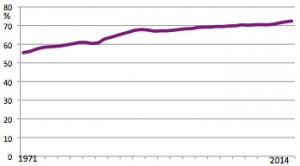
Start today by reading some relevant economics books! I just read Katrine Marçal’s [amazon_link id=”1846275644″ target=”_blank” ]Who Cooked Adam Smith’s Dinner?[/amazon_link] (I’m reviewing it elsewhere) and although irritating in some if its generalizations about economics, it’s terrific about the role of women in the economy and economics, and is a short and enjoyable read. One of its central arguments is about the need to measure better (mainly) women’s unpaid work outside the market, not included in GDP, something also advocated in my [amazon_link id=”0691156794″ target=”_blank” ]GDP[/amazon_link]. As the chart below shows, the increase in the UK’s female economic activity rate during the past generation has been substantial (up from 55.5% to 72.4%) and it is extraordinary not to have regular data that make it possible to evaluate the consequences of switching between unpaid and marketed work.

UK female economic activity rate 1971-2014, source ONS

Jonathan Gershuny and his team gather time-use data to explore who does what in the non-market economy in the UK – a new survey is due to be published early in 2016. The database on their website has a bibliography of relevant publications covering time use data from around the world.

[amazon_image id=”B00TOLYFOS” link=”true” target=”_blank” size=”medium” ]Who Cooked Adam Smith’s Dinner?: A Story About Women and Economics[/amazon_image]  [amazon_image id=”1861342004″ link=”true” target=”_blank” size=”medium” ]Seven Years in the Lives of British Families: Evidence on the Dynamics of Social Change from the British Household Panel Survey[/amazon_image]  [amazon_image id=”B00MXDLPSI” link=”true” target=”_blank” size=”medium” ]GDP: A Brief but Affectionate History by Coyle, Diane (2014) Hardcover[/amazon_image]

Recently I reviewed here [amazon_link id=”B00KAJJBYM” target=”_blank” ]Why Gender Matters in Economics[/amazon_link] by Mukesh Eswaran. Women younger than me are unlikely to have read Simone De Beauvoir’s [amazon_link id=”009974421X” target=”_blank” ]The Second Sex[/amazon_link] – it was all the rage among 1970s/80s vintage feminists. It’s a book that changed my life. Although far more about culture than about economics, it places huge emphasis on the vital need for economic autonomy for women. There is of course a Journal of Feminist Economics. Amartya Sen’s eye-opening article about missing women is 15 years old now. Nothing has changed. The attitudes in India to rape are shocking evidence of that.

[amazon_image id=”B00QASWUU4″ link=”true” target=”_blank” size=”medium” ][(Why Gender Matters in Economics)] [ By (author) Mukesh Eswaran ] [September, 2014][/amazon_image]  [amazon_image id=”0140034633″ link=”true” target=”_blank” size=”medium” ]The Second Sex (Penguin Modern Classics)[/amazon_image]

It would be great to gather more reading suggestions – welcome in comments or via Twitter.

Reading on the train

I’m off in a while to Bath to speak at the Literary Festival about [amazon_link id=”0691156794″ target=”_blank” ]GDP: A Brief But Affectionate History[/amazon_link] – both delighted and mildly surprised at the continuing interest in the subject. To read on the train to and fro, I’m dithering between [amazon_link id=”0674725654″ target=”_blank” ]The Rise and Fall of Neoliberal Capitalism[/amazon_link] by David Kotz and [amazon_link id=”1846684749″ target=”_blank” ]Pinkoes and Traitors[/amazon_link], Jean Seaton’s history of the BBC over the years 1974-1987.

[amazon_image id=”0691156794″ link=”true” target=”_blank” size=”medium” ]GDP: A Brief but Affectionate History[/amazon_image]  [amazon_image id=”0674725654″ link=”true” target=”_blank” size=”medium” ]The Rise and Fall of Neoliberal Capitalism[/amazon_image]  [amazon_image id=”1846684749″ link=”true” target=”_blank” size=”medium” ]Pinkoes and Traitors: The BBC and the nation, 1974 – 1987[/amazon_image]

The former looks like an economic version of the political history of the creation of the “free market” economics described so well in Daniel Stedman-Jones’s excellent book [amazon_link id=”0691161011″ target=”_blank” ]Masters of the Universe[/amazon_link]. At a couple of gatherings of people who are ‘masters of the universe’ recently, it’s clear to me they think the writing is on the wall for the model from which they’ve profited so much. What’s odd about today’s political discourse is that politicians won’t acknowledge (in public) that a big structural change is under way – hence, I guess, the general despair about politics as usual and appeal of populists.

[amazon_image id=”0691151571″ link=”true” target=”_blank” size=”medium” ]Masters of the Universe: Hayek, Friedman, and the Birth of Neoliberal Politics[/amazon_image]  [amazon_image id=”B00EDJEVWM” link=”true” target=”_blank” size=”medium” ]Armchair Nation: An intimate history of Britain in front of the TV[/amazon_image]

The Jean Seaton book covers my formative years as a teen and young adult. I loved Joe Moran’s cultural history of British TV, [amazon_link id=”1846683912″ target=”_blank” ]Armchair Nation[/amazon_link], not least for the reminders of the shared culture that shaped me. At the time I was completely unaware of BBC corporate issues, as most people are most of the time. At the end of April I get to the end of my nine year stint as a BBC Trustee, so am in reflective mode and might go for this book first. (After the end of April, I can reverse the opinion-ectomy anyone linked with the BBC has to undergo because there is always some moron who thinks one’s personal views reflect organisational “bias”….)

Preparation for a public policy degree

Yesterday I received this email request: “I am an undergraduate at … I was wondering if you could let me know which introductory textbooks you would recommend for micro- and macroeconomics in preparation for master’s programmes in public policy?”

The answer depends on whether or not my correspondent has done economics as an undergraduate, and the email didn’t specify. For an absolute novice in economics, I’d recommend starting with a couple of the popular books – I like Tim Harford’s [amazon_link id=”0349119856″ target=”_blank” ]The Undercover Economist[/amazon_link] on micro and [amazon_link id=”0349138931″ target=”_blank” ]The Undercover Economist Strikes Back[/amazon_link] on macro. Then I’d go on to the new (and free) CORE online textbook, Economics.

[amazon_image id=”0349119856″ link=”true” target=”_blank” size=”medium” ]The Undercover Economist[/amazon_image]   [amazon_image id=”0349138931″ link=”true” target=”_blank” size=”medium” ]The Undercover Economist Strikes Back: How to Run or Ruin an Economy[/amazon_image]

Moving on from there, the undergraduate macro text I’d recommend would be [amazon_link id=”0199655790″ target=”_blank” ]Macroeconomics: Institutions, Instability and the Financial System[/amazon_link] by Wendy Carlin and David Soskice, recently published and addressing the challenges the financial crisis has presented to macro. On micro, I’m less sure. I’ve always stuck to Hal Varian’s [amazon_link id=”B007IP646O” target=”_blank” ]Intermediate Microeconomics[/amazon_link], and there’s a recent edition.  The two new textbooks, [amazon_link id=”3642374336″ target=”_blank” ]Microeconomics[/amazon_link] and [amazon_link id=”3642374409″ target=”_blank” ]Macroeconomics[/amazon_link], by Peter Dorman are an alternative.

[amazon_image id=”0199655790″ link=”true” target=”_blank” size=”medium” ]Macroeconomics: Institutions, Instability, and the Financial System[/amazon_image]   [amazon_image id=”0393935337″ link=”true” target=”_blank” size=”medium” ]Intermediate Microeconomics: A Modern Approach[/amazon_image]

However, one book I’d strongly recommend is the new Angrist and Pischke book, [amazon_link id=”B00MZG71MC” target=”_blank” ]Mastering Metrics[/amazon_link]. It’s very clear, the technical material is cordoned off and can be skipped if not needed, and the empirical nous is a great foundation for a public policy course. It’s micro-focused, not covering any time series/macro econometrics at all.

[amazon_image id=”B00MZG71MC” link=”true” target=”_blank” size=”medium” ]Mastering ‘Metrics: The Path from Cause to Effect[/amazon_image]

Finally,  I’ve been looking at public policy economics texts for the undergraduate course I now teach, and haven’t found the perfect text. Some chapters from the LeGrand, Smith and Propper book [amazon_link id=”B00C7GE32G” target=”_blank” ]The Economics of Social Problems[/amazon_link] work well but they focus is very much on social policy. Parts of Joseph Stiglitz’s [amazon_link id=”B00GSD3D7K” target=”_blank” ]Economics of the Public Sector[/amazon_link] and Charles Wheelan’s [amazon_link id=”B00OHXI2YC” target=”_blank” ]Introduction to Public Policy[/amazon_link] are also very useful. None of them is entirely the right shape for my purposes but the latter two would be a good overview for a public policy course.

Those are my suggestions – others welcome in comments.