On The Economy of Machinery

[amazon_link id=”184637927X” target=”_blank” ]On The Economy of Machinery and Manufactures[/amazon_link] by Charles Babbage was published in 1832. I discovered it courtesy of Sydney Padua’s [amazon_link id=”0141981512″ target=”_blank” ]The Thrilling Adventures of Lovelace and Babbage[/amazon_link], not having known Babbage had written at all about political economy.

[amazon_image id=”1511434422″ link=”true” target=”_blank” size=”medium” ]On the Economy of Machinery and Manufactures[/amazon_image]

It’s a marvellous book. Babbage clearly had a joyous, expansive interest in everything. The first half describes and discusses all kinds of innovations in manufacturing – how machines work, what different industries have been introducing, and a long chapter on different types of copying, from copperplate printing to mass production techniques making copies of manufactured items.

The second half turns to questions of political economy and it is fascinating to see how Babbage links his observations about actual businesses that he visits – clearly, very many of them – and the price lists he sees, and the machines he has seen built – with analytical principles. He describes the importance of fixed costs and increasing returns to scale; the importance of asymmetric information in explaining many phenomena in business; the way large productivity gains depend on a reorganisation of production, but may be left untapped unless there is enough pressure from competitors because old techniques are still profitable; the phenomenon of geographic clustering for exactly the reasons Alfred Marshall more famously set out his 1890 [amazon_link id=”1573921408″ target=”_blank” ]Principles of Economics[/amazon_link]; and the sheer restless dynamism of the industrial economy. He even has thoughts about the relationship between automation and jobs.

All in all, it adds up to a very modern-seeming view of how the economy operates. Although of course it would have seemed very old-fashioned to 20th century economics, having no equations, no steady state equilibrium, no machinery of assumptions and axioms.

I love Babbage’s detailed empiricism. He is overjoyed by the potential of the division of labour, and takes Adam Smith’s example of pin manufacture. He visits pin makers of all kinds and describes the 10 stages of pin making in some detail. He tells us whether tasks are mainly done by men, women or children, and what their typical wages are. He describes the tools used and how they work. He also has a detailed account of pin making from half a century earlier. He can put a figure on the productivity gain from the division of labour!

It turns out Babbage wrote a fair bit of economics. I might move on to another of his works.

[amazon_image id=”1616407522″ link=”true” target=”_blank” size=”medium” ]Passages from the Life of a Philosopher[/amazon_image]  [amazon_image id=”110341688X” link=”true” target=”_blank” size=”medium” ]Reflections on the Decline of Science in England, and on Some of Its Causes[/amazon_image]  [amazon_image id=”B00X61XRDM” link=”true” target=”_blank” size=”medium” ]Thoughts on the principles of taxation, with reference to a property tax, and its exceptions[/amazon_image]

Generalizing about Africa (& why it’s a bad idea)

This morning I attended a breakfast at the Centre for Global Development at which Morten Jerven spoke about his new book, [amazon_link id=”1783601329″ target=”_blank” ]Africa: How Economists Get It Wrong[/amazon_link],” which I’m now looking forward to reading – especially after enjoying his previous book, [amazon_link id=”080147860X” target=”_blank” ]Poor Numbers: How We Are Misled by African Development Statistics[/amazon_link]. The new book is published today.

[amazon_image id=”1783601329″ link=”true” target=”_blank” size=”medium” ]Africa: Why Economists Get it Wrong (African Arguments)[/amazon_image]  [amazon_image id=”080147860X” link=”true” target=”_blank” size=”medium” ]Poor Numbers: How We are Misled by African Development Statistics and What to Do About it (Cornell Studies in Political Economy)[/amazon_image]

His talk kicked off with a critique of two successive approaches to ‘Africa’ by economists – a category refined in discussion to macroeconomists, and not absolutely all of those. The first approach was cross-country regression analysis, given its definitive shape by [amazon_link id=”0262522543″ target=”_blank” ]Robert Barro[/amazon_link], in which a dummy variable for African countries would have a negative coefficient. (Charles Kenny has an excellent critical review of growth regressions, and Dani Rodrik has a terrific paper on the limitations of trying to get policy prescriptions from this approach.) The second approach takes low growth in African countries as a given and tries to pin that to institutional failures – corruption, clientilism, lack of transparency etc – and is perhaps symbolized by Acemoglu and Robinson in their ambitious [amazon_link id=”1846684307″ target=”_blank” ]Why Nations Fail[/amazon_link]. Morten Jerven said, “There are economists who have written non-modest books.” He argued that the latter approach leads to policy prescriptions of the kind that ask, “Why aren’t you like Denmark?”

[amazon_image id=”0262522543″ link=”true” target=”_blank” size=”medium” ]Determinants of Economic Growth: A Cross-country Empirical Study (Lionel Robbins Lectures)[/amazon_image]  [amazon_image id=”B007HLIUN4″ link=”true” target=”_blank” size=”medium” ]Why Nations Fail: The Origins of Power, Prosperity and Poverty[/amazon_image]

Instead, he suggests focusing on trajectories from today’s specific situation, rather than seeking to explain deviations from a rich world ‘norm’. He argued too for, “Fingertip knowledge of each country’s data.” Yes!! The standard international datasets lead researchers to think history started in 1960, and also are misleading because they interpolate or otherwise guess to fill in the many gaps “They should leave gaps if there are no data – or at least put them in a different colour,” Jerven says.

There was some challenge from the attendees. One said that there clearly is something distinctive to explain about most African economies, where people are still poor on average. Another argued that most economists in the development field do recognise the need for a rich description of specific economies, so the book attacks a straw man. However, I think Jerven is right to highlight the cavalier approach far too many economists have to the data, and their tendency to generalise. Surely he is right when he says, “A paper about ‘Africa’ gets more citations than a paper about ‘Tanzania’.”?

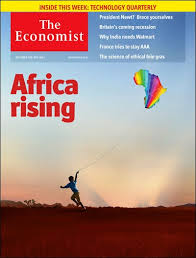
And how valid are those generalisations, when you consider the following Economist covers from 2000 and 2011. Was there really so much change in just over a decade?

Hopeless?

Hopeless?

Or Rising?

Or Rising?

Enlightened economists

It’s hard for me to resist a book about the Enlightenment, and I’ve just read [amazon_link id=”0691161453″ target=”_blank” ]The Enlightenment: History of an Idea[/amazon_link] by Vincenzo Ferrone. I have to confess it was quite hard work because it’s written in the scholarly language of another discipline. But the argument is interesting: that the Enlightenment as a set of philosophical ideas and as an historical phenomenon need to be kept separate, and are all too often conflated.

[amazon_image id=”0691161453″ link=”true” target=”_blank” size=”medium” ]The Enlightenment: History of an Idea[/amazon_image]

There is a definition in the introduction of the historical Enlightenment: “A conscious and passionate creative effort aimed at bringing about a fairer and more equitable society, made by man for man [sic], an attempt to put into practice individual rights, giving political space to what was the truly revolutionary discovery of the natural right of man to pursue happiness as the ethical foundation of a new universal morality.” I suppose it’s historically accurate that it was mainly by and about men, but it would have been good if Ferrone had explicitly acknowledged this limitation, as this language is so exclusionary.

He adds: “One can scarcely imagine a greater challenge to the political action and coherence of those European citizens who were working with passion and intellectual honesty to spread the new political language than the deportation of millions of African slaves mostly to the United States of America, the self-styled homeland of rights and freedom.” Economics, or rather political economy, was born of the Enlightenment, and economists were on the side of the angels in the anti-slavery campaign. Carlyle labelled it the ‘dismal science’ because he was pro-slavery and disliked the argument by political economists such as J S Mill and  – I learned from Sydney Padua’s [amazon_link id=”0141981512″ target=”_blank” ]The Thrilling Adventures of Lovelace and Babbage[/amazon_link] – by Charles Babbage. (I’ve now started Babbage’s 1832 book [amazon_link id=”B004TS7610″ target=”_blank” ]On The Economy of Machinery and Manufactures[/amazon_link], which is a ripping good read so far.)

[amazon_image id=”0141981512″ link=”true” target=”_blank” size=”medium” ]The Thrilling Adventures of Lovelace and Babbage: The (Mostly) True Story of the First Computer[/amazon_image]  [amazon_image id=”1511434422″ link=”true” target=”_blank” size=”medium” ]On the Economy of Machinery and Manufactures[/amazon_image]

Back to Ferrone. He wants to preserve a historical understanding of the Enlightenment from those from the post-modernists to [amazon_link id=”0691151725″ target=”_blank” ]Jonathan Israel[/amazon_link] who, he argues, make it too philosophical: “The idea of natural rights is not philosophical in origin. It is an extraordinarily important moral idea …. that in the course of the 18th century became a powerful new political and juridical discourse. … Far from being a project single-mindedly aimed at the goal of modernity, the Enlightenment is more accurately understood as a cultural experience defined first and foremost by the values it has bequeathed us.” As a process or experience, it has no definitive conclusion, he concludes. Of course I understand the importance of the historical context, but I must say I don’t see that Ferrone entirely avoids the same pitfall himself as the scholars he critiques. Aren’t ‘inherited values’ staking a philosophical claim? Luckily I feel no need to reach a firm conclusion about a debate in another discipline.

[amazon_image id=”0691169713″ link=”true” target=”_blank” size=”medium” ]Revolutionary Ideas: An Intellectual History of the French Revolution from The Rights of Man to Robespierre[/amazon_image]

Lovelace & Babbage

I’ve loved reading [amazon_link id=”0141981512″ target=”_blank” ]The Thrilling Adventures of Lovelace and Babbage[/amazon_link] by Sydney Padua.

[amazon_image id=”0141981512″ link=”true” target=”_blank” size=”medium” ]The Thrilling Adventures of Lovelace and Babbage: The (Mostly) True Story of the First Computer[/amazon_image]

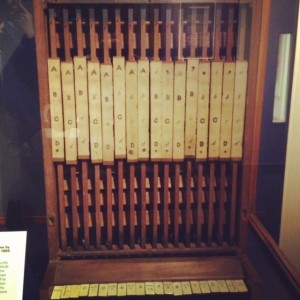
It’s funny, and full of nuggets of information. I never knew Babbage had written a book, [amazon_link id=”B004TS7610″ target=”_blank” ]On The Economy of Machinery and Manufactures[/amazon_link]. That’s on order now! (Browsing around, he seems to have written quite a bit on economics eg there is also [amazon_link id=”B00X61XRDM” target=”_blank” ]Thoughts on the principles of taxation, with reference to a property tax, and its exceptions[/amazon_link]; and [amazon_link id=”0217545602″ target=”_blank” ]Comparative View of the Various Institutions for the Assurance of Lives[/amazon_link].) I didn’t know Herschel had originally named Uranus ‘George’. I didn’t know Boole had tried to prove money doesn’t by happiness in a literal utilitarian calculus. I *did* know about W.S.Jevons’ Logic Piano because once I saw it in the Science Museum:

Jevons' Logic Piano

Jevons’ Logic Piano

Doron Swade’s [amazon_link id=”0349112398″ target=”_blank” ]The Cogwheel Brain[/amazon_link], which I read some years ago, is a less amusing intro to Babbage. [amazon_link id=”0571172431″ target=”_blank” ]Cultural Babbage[/amazon_link] edited by Francis Spufford and Jenny Uglow is wonderful. Sydney Padua writes that her favourite book on Babbage is [amazon_link id=”0136047297″ target=”_blank” ]Mr Babbage’s Secret: Tale of Cypher and APL[/amazon_link] by  Ole Franksen.

[amazon_image id=”0349112398″ link=”true” target=”_blank” size=”medium” ]The Cogwheel Brain[/amazon_image]  [amazon_image id=”0571172431″ link=”true” target=”_blank” size=”medium” ]Cultural Babbage: Technology, Time and Invention[/amazon_image]

Angry statisticians and fiddled figures

Merijn Knibbe (@MerijnKnibbe) alerted Twitter yesterday to an extraordinary statement on the website of ELSTAT, the Greek official statistics agency. It was issued by the Members of the European Statistical System – the professional group of official statisticians in Europe  – and includes this statement:

“Therefore, we confirm our concern with regard to the situation in Greece, where the statistical institute, ELSTAT, as well as some of its staff members, including the current President of ELSTAT, continue to be questioned in their professional capacity. There are ongoing political debates and investigatory and judicial proceedings related to actions taken by ELSTAT and to statistics which have repeatedly passed the quality checks applied by Eurostat to ensure full compliance with Union legislation.”

The story – told in the opening pages of my book [amazon_link id=”0691156794″ target=”_blank” ]GDP: A Brief But Affectionate History[/amazon_link] – is that at the start of the Greek crisis, one of the most benign conditions required by the IMF was that the Greek government stop fabricating its GDP statistics, which it had been doing for some years in order to keep the loans flowing. The EU statistics body had refused to approve the statistics but international lenders (hello Goldman Sachs) didn’t seem to mind.

So the Greek statistical agency was dissolved, the new one (ELSTAT) created, and a former IMF economist, Andreas Georgiou, was appointed to lead it. One of his graduate school friends told me Mr Georgiou is one of the most honourable people he has ever known. Yet, almost immediately after his appointment to the job, some of the sacked former board members accused him of treason for cleaning up the Greek statistics and brought legal proceedings. “I am being prosecuted for not cooking the books,” Mr Georgiou said at the time. The continuing legal and political shenanigans are what the new statement refers to.

The independence and integrity of official statistics really matters. We take economic statistics far too seriously in one sense, often ignoring the margins of error and the judgements involved in their calculation (so it’s encouraging to see a vigorous debate about these issues), not to mention the fact that the categories we define are social constructs. Yet independent and freely available official statistics are a vital part of the fabric of a democracy, one of the key tools for holding governments to account – see my new working paper on this. The only OECD country moving away from independence for its official statisticians has been, bizarrely, Canada; all others have moved in the opposite direction. The statisticians’ statement this week about Greece does not augur well for how things there will turn out.

[amazon_image id=”0691156794″ link=”true” target=”_blank” size=”medium” ]GDP: A Brief but Affectionate History[/amazon_image]