Read more (e-)books!

There were some new figures from the Association of American Publishers that seemed to indicate e-book sales growth picked up in 2014 after a dip but the trend has slowed; and that paperback sales growth was strong while sales at retail stores increased modestly after some years of decline. Total sales revenues were up about 4.5% and unit sales 3.5%.

I’ve often written about how innovative publishers have been in their response to digital, compared to the music industry – okay, not a high hurdle, but still. It has certainly been a tough environment for the business but how encouraging it is to see more words (and pictures) being read in more formats than ever.

Another of my perennial themes is that people assume new technologies or formats are pure substitutes for pre-existing ones. Often with communications technologies (although not always – bye-bye fax machines and telegrams) they are complements, or start out as substitutes but the older technology then finds a stable and complementary niche.

Of course there is a binding constraint that ensures some substitutions have to occur, and that is time to spend on the various leisure pursuits. Looking on the bright side, if the robots do all the work, we’ll all have more time for reading.

The information economy

I very much enjoyed reading Cesar Hidalgo’s [amazon_link id=”B00R3C1V0Q” target=”_blank” ]Why Information Grows: The evolution of order, from atoms to economies[/amazon_link]. It’s a very original perspective on the process of secular economic growth, bringing together not only several strands of the economics literature – growth theory, institutional economics, social capital etc – but also physics, biology and information theory. So it’s certainly ambitious, and I found it largely persuasive.

[amazon_image id=”B00R3C1V0Q” link=”true” target=”_blank” size=”medium” ]Why Information Grows: The Evolution of Order, from Atoms to Economies[/amazon_image]

Hidalgo’s first point is that we are misled by thinking of the information economy as ‘weightless’ (a term I think I coined, or at least popularised, in my 1996 book The Weightless World) into forgetting that information is nevertheless physical. “Information is not a thing; rather, it is the arrangement of physical things. It is physical order.” He links the order of the economy to the order of the universe that can exist in pockets despite entropy. Economic order comes about through information embodied in things (‘crystallised imagination’) and in the way people organise themselves to apply knowledge and know-how. The first section is rather poetic. Hidalgo describes a tree as a computer powered by sunlight. “A tree processes the information that is available in its environment.” He describes a colleague at MIT who lost both his legs to frostbite while mountaineering, and built his own prosthetics: “He is walking on solidified pieces of his own imagination.”

The book goes on to consider products imported and exported by countries in terms of ‘crystallised imagination’, which requires “an enormous amount of knowledge and know-how.” Knowledge is the set of instructions – a book describing how to play a guitar – and know-how is the practical experience enabling application – the process of learning and practising playing to produce lovely music. Hidalgo introduces the concept of a ‘personbyte’ – the limit to the knowledge and know-how that can be embodied in one individual. For an economy to go beyond that requires collective organisation. He argues against the normal economic argument that economic development is the process of acquiring the ability to consumer more goods and services. “Economic development is based not on the ability of a pocket of the economy to consumer but on the ability of people to turn their dreams into reality.” (This part doesn’t wholly convince me – it’s an appealing case but surely consumption matters too.)

The book then turns to the idea of the economy as a social and technological system for amplifying knowledge and know-how, and looks at institutional economics and the role of social capital in growth in this context. Conveying know-how is difficult, and becoming more so as time goes by and the economy becomes more diverse and complex. The “computational capacity” of the economy needs to grow, but it is constrained by the ability for knowledge and know-how to be embodied in networks of people – hence the value of trust, as it makes that easier.

Hidalgo’s work on the [amazon_link id=”B00OX8YWZE” target=”_blank” ]Atlas of Economic Complexity[/amazon_link] enters here: there is a strong positive correlation between a complexity index and long term growth (over 10 years). The falling cost of communications and the emergence of standards have increased the number of long-distance market links (instead of transactions within single firms), and this know-how transfer is made far easier by high trust, which enables larger networks. Low trust economies are often characterised by more family firms and rely more on the state to spread knowledge and know-how through its support for industries.

There is a very nice analogy of the economy as a jigsaw. “Moving a complex industry is like trying to move a jigsaw puzzle from one table to another. The more pieces in the puzzle, the harder it will be to move it, as the puzzle falls apart when we fail to move all the pieces at the same time.” It is easier to move just a few pieces to another table that already has part of the puzzle in place. Thus economies mostly grow out from their earlier set of products, which embody the know-how they already have – they already have some of the pieces. The description of this process would very much appeal to evolutionary economists.

A final point that very much intrigues me is measuring growth. Hidalgo makes the same point as the final chapter of my [amazon_link id=”0691156794″ target=”_blank” ]GDP[/amazon_link] book, that in adding things up in terms of their monetary value we are not capturing the value of diversity: three spoons are not as valuable as a knife, fork and spoon. He says that using market price denomination to aggregate implicitly assumes there is friction-free trading; but this is often not possible, especially with stock variables. He advocates looking at the disaggregated economy via input-output tables.  “The mix of products exported by a region’s industries represents a fingerprint of its productive capacities that does not suppress the identity of the economic elements involved.”

So a highly recommended read for anyone interested in economic growth and development. The insistence on the embodied-ness of knowledge and know-how is surely correct, and also a useful corrective to overly-abstract accounts of economic development, including quite a lot of the newer institutional literature (as [amazon_link id=”1783601329″ target=”_blank” ]Morten Jerven [/amazon_link]argues, this often amounts to the advice to poorer countries to “be more like Denmark”, ignoring the trajectory from here to there). It’s also a pleasure to read such a well-written economics book; from now on I’ll be envisioning the economy in terms of crystals of imagination.

Railways and plutocrats

This is a bit off-topic i.e. isn’t an economics book, but I enjoyed Iain Sinclair’s latest, [amazon_link id=”024114695X” target=”_blank” ]London Overground: A Day’s Walk around the Ginger Line[/amazon_link]. It’s an absolutely characteristic dyspeptic take on what’s happening in the unfashionable parts of London, the places linked by the tarted-up, more-or-less linked-up overground rail lines where Londoners can afford to live, if they’re lucky, pushed ever-further out by the tide of foreign plutocrat money drowning the housing market, leaving swathes of the city deserted because of the absentee landlords.

[amazon_image id=”024114695X” link=”true” target=”_blank” size=”medium” ]London Overground: A Day’s Walk Around the Ginger Line[/amazon_image]

Sinclair’s work is an acquired taste but I love it. This is not one of his best – not up to [amazon_link id=”0141014741″ target=”_blank” ]London Orbital[/amazon_link] standard –  but it does feature one of my favourite things, a Victorian-built railway. Sinclair writes of the “functional elegance of Victorian arches” – indeed. And then there’s the anger, the anger, about the money: “Dirty money was never so bright, so blatant. So protected by the politics of no-nothing quiescence.” This week the Chancellor of the Exchequer said we should stop the banker-bashing; but I’m with the Governor of the Bank of England, saying there had been ‘ethical drift’, and the time really has come for the money people to regain their social licence to operate.

Information, information, information

Yesterday my dear husband (@ruskin147) interviewed César Hidalgo (@cesifoti) about his new book [amazon_link id=”0241003555″ target=”_blank” ]Why Information Grows: The Evolution of Order from Atoms to Economies[/amazon_link] for next week’s edition of Tech Tent (19 June) on the BBC World Service. I’m very excited about reading this book. I’ve long been a fan of The Atlas of Complexity, on which Prof Hidalgo has worked. Besides, here is the overlap of information, complexity and spontaneous order, computing and economics – what’s not to like?

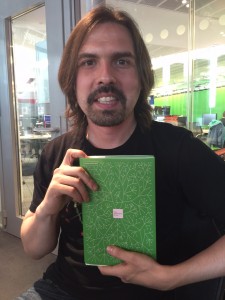
Prof Hidalgo in the BBC's New Broadcasting House yesterday

Prof Hidalgo in the BBC’s New Broadcasting House yesterday

Economists will naturally think immediately of Hayek’s famous 1945 article, The Use of Knowledge In Society, which is cited in the introduction here. Although information asymmetries are huge in many areas of economics now, I still don’t think we work out often enough or in sufficient detail the implications of information mattering so much. For years – since the mid-90s – I’ve been saying to colleagues that information technology is a profoundly important deal for economic organisation and even now too often get the reaction, well we know how to handle a transaction cost reduction in our models so what’s the big deal?

Anyway, I’m immensely looking forward to reading this and will report back.

[amazon_image id=”0241003555″ link=”true” target=”_blank” size=”medium” ]Why Information Grows: The Evolution of Order, from Atoms to Economies[/amazon_image]

More to read

The catalogue from my own publisher, Princeton University Press, arrived in the post & is packed with books I want to read – oh dear, the in-pile is already mountainous. I did read the proofs of the new book by George Akerlof and Robert Shiller, [amazon_link id=”B00WAM14RE” target=”_blank” ]Phishing for Phools: The Economics of Manipulation and Deception[/amazon_link], and recommend it strongly as an alternative take on the fashionable behavioural economics. Among other enticing new titles are Martin Sandbu’s [amazon_link id=”B00WAM14PQ” target=”_blank” ]Europe’s Orphan[/amazon_link], [amazon_link id=”0691145113″ target=”_blank” ]Empire and Revolution: The Political Life of Edmund Burke[/amazon_link] by Richard Bourke, [amazon_link id=”B00WAM14OW” target=”_blank” ]Capitalism: A Short History[/amazon_link] by Jurgen Kocka, [amazon_link id=”069115922X” target=”_blank” ]Political Turbulence: How Social Media Shape Collective Action[/amazon_link] by Helen Margetts, Peter John, Scott Hale and Taha Yasseri, and Robert Gordon’s [amazon_link id=”0691147728″ target=”_blank” ]The Rise and Fall of American Growth[/amazon_link] (although we’ve all read all his papers of course).

[amazon_image id=”B00WAM14RE” link=”true” target=”_blank” size=”medium” ]Phishing for Phools: The Economics of Manipulation and Deception[/amazon_image] [amazon_image id=”B00WAM14PQ” link=”true” target=”_blank” size=”medium” ]Europe’s Orphan: The Future of the Euro and the Politics of Debt[/amazon_image] [amazon_image id=”0691145113″ link=”true” target=”_blank” size=”medium” ]Empire and Revolution: The Political Life of Edmund Burke[/amazon_image]

[amazon_image id=”B00WAM14OW” link=”true” target=”_blank” size=”medium” ]Capitalism: A Short History[/amazon_image] [amazon_image id=”069115922X” link=”true” target=”_blank” size=”medium” ]Political Turbulence: How Social Media Shape Collective Action[/amazon_image] [amazon_image id=”0691147728″ link=”true” target=”_blank” size=”medium” ]The Rise and Fall of American Growth: The U.S. Standard of Living since the Civil War (The Princeton Economic History of the Western World)[/amazon_image]

But the really big news: my own [amazon_link id=”0691156794″ target=”_blank” ]GDP: A Brief But Affectionate History[/amazon_link] will be out in paperback in the autumn!

[amazon_image id=”B00WAM16BS” link=”true” target=”_blank” size=”medium” ]GDP: A Brief but Affectionate History[/amazon_image]