
This morning I attended a breakfast at the Centre for Global Development at which Morten Jerven spoke about his new book, [amazon_link id=”1783601329″ target=”_blank” ]Africa: How Economists Get It Wrong[/amazon_link],” which I’m now looking forward to reading – especially after enjoying his previous book, [amazon_link id=”080147860X” target=”_blank” ]Poor Numbers: How We Are Misled by African Development Statistics[/amazon_link]. The new book is published today.
[amazon_image id=”1783601329″ link=”true” target=”_blank” size=”medium” ]Africa: Why Economists Get it Wrong (African Arguments)[/amazon_image] [amazon_image id=”080147860X” link=”true” target=”_blank” size=”medium” ]Poor Numbers: How We are Misled by African Development Statistics and What to Do About it (Cornell Studies in Political Economy)[/amazon_image]
His talk kicked off with a critique of two successive approaches to ‘Africa’ by economists – a category refined in discussion to macroeconomists, and not absolutely all of those. The first approach was cross-country regression analysis, given its definitive shape by [amazon_link id=”0262522543″ target=”_blank” ]Robert Barro[/amazon_link], in which a dummy variable for African countries would have a negative coefficient. (Charles Kenny has an excellent critical review of growth regressions, and Dani Rodrik has a terrific paper on the limitations of trying to get policy prescriptions from this approach.) The second approach takes low growth in African countries as a given and tries to pin that to institutional failures – corruption, clientilism, lack of transparency etc – and is perhaps symbolized by Acemoglu and Robinson in their ambitious [amazon_link id=”1846684307″ target=”_blank” ]Why Nations Fail[/amazon_link]. Morten Jerven said, “There are economists who have written non-modest books.” He argued that the latter approach leads to policy prescriptions of the kind that ask, “Why aren’t you like Denmark?”
[amazon_image id=”0262522543″ link=”true” target=”_blank” size=”medium” ]Determinants of Economic Growth: A Cross-country Empirical Study (Lionel Robbins Lectures)[/amazon_image] [amazon_image id=”B007HLIUN4″ link=”true” target=”_blank” size=”medium” ]Why Nations Fail: The Origins of Power, Prosperity and Poverty[/amazon_image]
Instead, he suggests focusing on trajectories from today’s specific situation, rather than seeking to explain deviations from a rich world ‘norm’. He argued too for, “Fingertip knowledge of each country’s data.” Yes!! The standard international datasets lead researchers to think history started in 1960, and also are misleading because they interpolate or otherwise guess to fill in the many gaps “They should leave gaps if there are no data – or at least put them in a different colour,” Jerven says.
There was some challenge from the attendees. One said that there clearly is something distinctive to explain about most African economies, where people are still poor on average. Another argued that most economists in the development field do recognise the need for a rich description of specific economies, so the book attacks a straw man. However, I think Jerven is right to highlight the cavalier approach far too many economists have to the data, and their tendency to generalise. Surely he is right when he says, “A paper about ‘Africa’ gets more citations than a paper about ‘Tanzania’.”?
And how valid are those generalisations, when you consider the following Economist covers from 2000 and 2011. Was there really so much change in just over a decade?

Hopeless?
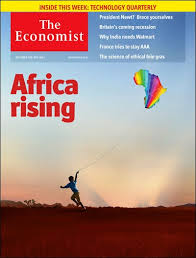
Or Rising?
Pingback: Generalizing about Africa (& why it’s a bad idea) | Homines Economici
A large part of Africa’s problem is simply geographical. Through most of the region, the terrain is harsh which causes high development costs. There aren’t a whole lot of natural trade networks, which means the only places that can be involved in trade are coastal regions.
In the population of Africa, a few countries account for most of the population (top 7 countries account for about 50% of population). In most of Africa, trade/commerce is difficult, but many of those areas have very fertile regions that can sustain large populations preventing population corrections (ex. Niger river delta). So you end up having exploding populations that prevent capital accumulation and, in most cases, actually destroy capital.
With all that being said, I don’t think there’s really much hope for most of Africa. Especially when you consider most of their economies are based on rent extraction. Foreign aid is a problem, but without it, I think you could see regime collapses and large population corrections.