Weightlessness redux

There is a wave of interest in dematerialization – I spotted it this past weekend thanks to Justin Fox, and his article has been picked up elsewhere. I therefore can’t resist bigging up my own book, The Weightless World (pdf), published in the UK in 1996 and US in 1997.

[amazon_image id=”0262531666″ link=”true” target=”_blank” size=”medium” ]The Weightless World: Strategies for Managing the Digital Economy (Obex Series)[/amazon_image]

Although it shows its age, it was (I’m pretty sure) one of the first to pick up on this physical manifestation of the structural and technological changes under way. (And I now regret that it didn’t consider energy use in the weightless economy.)

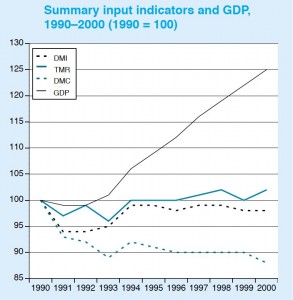
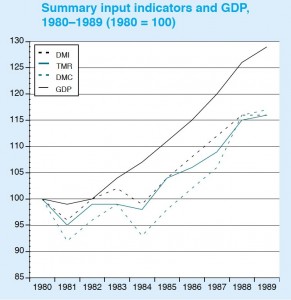
Here are the ONS charts that triggered the use of weightlessness as a prism for understanding the structural change in the economy. They show for the 1980s then the 1990s the level of real GDP and the material flows for the economy for the two decades. Around the mid or late 1980s, the link broke, and while real GDP continued to rise, the ‘weight’ of the economy stayed roughly level.

Real UK GDP and weight of economy, 1980s

Real UK GDP and weight of economy, 1980s

Real UK GDP and 'weight' of economy, 1990s

Real UK GDP and ‘weight’ of economy, 1990s

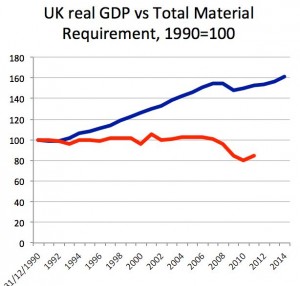
Update: Here is the latest ONS data, also based to 1990.

GDP vs 'weight' of economy up to 2011

Let cities borrow to build new infrastructure

The blurb introducing [amazon_link id=”1137519843″ target=”_blank” ]The Public Wealth of Nations[/amazon_link] by Dag Detter and Stefan Folster begins: “We have spent the last three decades engaged in a pointless and irrelevant debate about the relative merits of privatization or nationalization.” Yup. And that futile framing of the issues could intensify now that Labour Party members have elected Jeremy Corbyn, a cheerleader for old-style nationalization, as their leader. Which is a shame, because this book makes a persuasive argument that it is not the ownership of assets that determines how well they perform, but instead how they are managed.

[amazon_image id=”1137519843″ link=”true” target=”_blank” size=”medium” ]The Public Wealth of Nations: How Management of Public Assets Can Boost or Bust Economic Growth[/amazon_image]

Specifically, the authors argue for the creation of sovereign wealth funds or holding corporations, with independent, non-partisan governance structures, to manage public assets. As Dag Detter used to run the Swedish government’s holding company, he has some direct experience of how such structures might operate and there is plenty of practical advice in the book. It focuses on publicly-held commercial assets, and argues for the state holding them (as opposed to privatizating them) but with independent management protected from short-term politics, and delivering a reasonable commercial return to the government. The role of politicians is to act as advocates for the public interest.

A short final chapter turns to infrastructure, and argues for state entities investing in infrastructure projects, but it does still presume that these should all be expected to deliver a commercial rate of return. So the book omits altogether the public good case for non-commercially viable state activity, which seems an odd – and large – gap.

It’s hard to argue with the general thrust of the argument for professionalising the management of sovereign wealth funds or state corporations, and shielding them from political short-termism; but the privatization/nationalization debate is not merely about commercial efficiency but also about the purpose of the entities involved and how they serve the broader public interest. The authors write: “Public wealth should aim to yield financial returns similar to comparable assets in the private sector.” Well, sometimes, perhaps even often, but not always – especially when the reason they are in the public sector is that there are not comparable market assets. Nor does the book tackle any political economy questions about how to move toward such a different kind of governance structure for public assets.

Lots of economists would like to see more infrastructure investment, with the real interest rate the government would have to pay to borrow the money so low. (Few think paying for it by ‘printing money’ or so-called ‘people’s QE’ makes any sense; if not financed by borrowing, then raise taxes.) However, it seems unlikely to happen unless either the Conservative government has a change of heart, and separates out capital spending from its deficit targets; or the borrowing and investment decisions for some infrastructure investment are devolved to the newly empowered city regions.

I can’t see any problem at all with experimenting on a modest scale with municipal bonds, and surely Manchester would leap at the chance to pilot this to go ahead with the upgrade of the trans-Pennine rail route, and much more. Clearly national politics has become a circus, but perhaps city politics will be relatively unaffected by the national Punch and Judy show. Let’s hope so. But the new political context means transparency, accountability and professionalism in investing in and managing public assets will be all the more vital. For all its narrow market efficiency pespective, the point the book makes about the sound management and independent governance of any new or existing public investments is an important one.

(Im)moral markets

A snippet from Dani Rodrik’s [amazon_link id=”0393246418″ target=”_blank” ]Economics Rules[/amazon_link]:

“As Albert Hirschman reminds us in his magisterial book [amazon_link id=”0691160252″ target=”_blank” ]The Passions and the Interests[/amazon_link], the thinkers of the late 17th and early 18th centuries reasoned that the proft-seeking motive would countervail baser human motivations such as the urge for violence and domination over other men. The term ‘doux’ (sweet) was often appended to ‘commerce’ to suggest commercial activities promoted gentle and peaceful interactions. …. These early philosophers [eg [amazon_link id=”1514328127″ target=”_blank” ]Montesquieu[/amazon_link]] encouraged the spread of markets, not for reasons of efficiency or for the expanson of material resources but because they thought it would promote a more harmonious, more ethical society. It is ironic that thre centuries later markets have come to be associated in the eyes of many with moral corruption.”

Shades of Deirdre McCloskey’s [amazon_link id=”0226556646″ target=”_blank” ]The Bourgeois Virtues: Ethics for an Age of Commerce.[/amazon_link]?

[amazon_image id=”0393246418″ link=”true” target=”_blank” size=”medium” ]Economics Rules: The Rights and Wrongs of the Dismal Science[/amazon_image]

The weirdness of economists

I was meandering around in the stacks of the university library, always a pleasure – all those enticing books, the musty smell, the peace – and succumbed to the temptation to fetch out some unintended books. [amazon_link id=”0521709849″ target=”_blank” ]The Philosophy of Economics: An Anthology[/amazon_link] edited by Daniel Hausman (1984/2008) won the competition between the books to be picked up. It’s a collection of essays that runs from John Stuart Mill, Max Weber, Thorsten Veblen, Lionel Robbins etc via Schumpeter, Friedman, Kaldor, Sen to Vernon Smith, Colin Camerer, Geoffrey Hodgson and Julie Nelson. All these and more. There’s also (accepting that this is a specialized taste) a bibliography of books on economics methodology.

I open at random to an essay by Daniel Hausman and Michael McPherson, which sets out the (usually implicit) framework of normative economics: economics appraises outcomes (not processes), using a single appraisal perspective, looking at the consequences for individuals (not groups or ‘society’) in terms of their welfare (not freedom or rights), welfare being defined as the satisfaction of preferences and assessed in terms of market outcomes and the Pareto criterion. We economists are early socialized into this approach and forget how weird it seems to others.

Anyway, it looks like a good random pick from the stacks.

[amazon_image id=”0521709849″ link=”true” target=”_blank” size=”medium” ]The Philosophy of Economics: An Anthology[/amazon_image]

Futurology: more sense, less bollocks

I’m not a fan of futurology. There’s something about the genre that demands a breathless writing style and over-confident future-bollocks. However, I’ve just been looking at a book that isn’t nearly as bad as the typical example. It’s [amazon_link id=”1781254974″ target=”_blank” ]The Future of (almost) Everything: the global changes that will affect every business and all our lives[/amazon_link] by Patrick Dixon.

[amazon_image id=”1781254974″ link=”true” target=”_blank” size=”medium” ]The Future of Almost Everything: The global changes that will affect every business and all our lives[/amazon_image]

The breathlessness is there – after all, it fits all of (almost) everything affecting everybody into 350 pages. It has lots of words CAPITALIZED and loads of headings and bullet points. The chapters are titled according to the acronym: Fast; Urban; Tribal; Universal; Radical; Ethical – geddit? Having harumphed, there is also some perfectly sensible trend extrapolation. Even so, there is an early demonstration of the fickleness of the future when it arrives. In a long list early in the book of “highly predictable” long term trends comes “rapid growth in global trade”. Well, maybe, but that’s not looking so good at the moment.

Apart from the stylistic tics – which are obviously popular given how well such books sell – my main problem with futurology is the absence of broader social scientific analysis. Take as an example the section in [amazon_link id=”B00V6R4MZ0″ target=”_blank” ]The Future of (almost) Everything[/amazon_link] on big data. It makes some obvious-to-reasonable points about the benefits of personalisation, and the costs to privacy or in increased cyber-crime. But there is no discussion about, say, who owns the data and benefits from the likely gains in exploiting it; or whether it will cause insurance markets to collapse (because they require a pooling of risk which will be subverted by the personalisation of risk premia); or what legal framework will be required to assign big data property rights and rein in the massive corporate invasions or privacy, or indeed the eating up of mobile data allowances by ads and cookies.

Still, having grumbled, if you want a futurology read, the ratio of common sense to future-bollocks in this book is high, it gives a broad survey of current global trends such as demographic change , urbanisation and environmental pressures, and it would nicely fill a plane journey.