
Agents and theorists

There are three books in one in Richard Bookstaber’s The End of Theory, it seemed to me. This compôte is even flagged up in the subtitle: ‘Financial Crises, the Failure of Economics, and the Sweep of Human Interaction’.

One sub-book is a tedious critique of economics, tedious because like all (the many) similar critiques it (a) says ‘economics’ but means ‘macro/financial economics’; (b) assumes economics is a monolithic subject stuck some time around 1980-85, which was indeed the height of the rational expectations, real business cycle approach. Some of the points Bookstaber makes are perfectly valid. Macroeconomists have responded to the implications of the financial crisis for their approach, but not yet enough – this is why the ESRC has funded the new ‘Rebuilding Macroeconomics‘ network. I also agree in particular with his point about economics needing to get to grips better with self-fulfilling phenomena and performativity. But, really, a lot of economists – at least in academia but I think out in the non-ivory tower world too – are now doing exactly the kind of work Bookstaber enthuses about. I’d argue that even when economists are using rational choice equilibrium modelling, or ignoring the radical uncertainty of the real world, it is often done in a knowing way – that is, understanding the assumptions fail, but using the conclusions they lead to as a way of evaluating what is happening and why. Anyway, his complaints about economics are both wearily familiar territory and decreasingly true; economics is and has been changing a lot. In finance specifically, think of Andrew Lo’s new book, Adaptive Markets.

The second element of The End of Theory is a useful mini-survey of some alternative approaches (alternative to rational choice, maximising, equilibrium) models for financial markets in particular: this includes complexity and emergent phenomena, non-ergodic processes, heuristics in decision making, and so on. None of these is novel either – for example, Paul Ormerod’s Butterfly Economics and Why Most Things Fail tackle many of the same areas, Kahneman’s Thinking Fast and Slow was a best seller and Gigerenzer’s heuristics approach is widely discussed among behavioral economists, while Taleb’s books have brought the ideas about radical uncertainty to millions. Still, having these ideas set out again in a concise and accessible way is useful.

The third book-in-a-book is a very interesting approach to an agent-based modeling approach to the financial system, looking back at the 2008 crisis. Here, the author’s expertise shines through. But this section is very condensed – I wished the whole book had been about this and had used the extra room to say more about the complexities of the financial structure and how the agent based approach can illuminate them. For example, the section on the 2007-8 liquidity crisis in US markets is fascinating but condensed. Again, agent based modeling is hardly new, and is even growing more popular in economics, but I found the detail from someone who is an experienced market participant very interesting, although the idea that agent based modelling really spells the end of theory is not really addressed explicitly.

In the end, I wondered what audience Bookstaber had in mind. The final chapter ends, “I’m a frustrated novelist.” He is a indeed a good writer but needs to work on the narrative arc. I’d have thought the three components of this book appeal to at least two different sets of readers; and it distracted at least this economist reader to have the argument keep heading off on a tangent to criticise economics: ‘And another thing,….’. I hope he goes on to write the book starting to emerge from this one diagnosing the past about an agent based future for finance. If this is the right way to model financial markets, what do we do with it?

PS I see The End of Theory is doing well on Amazon, with some 5* reviews, so my perspective may be jaundiced!
50 Economics Classics

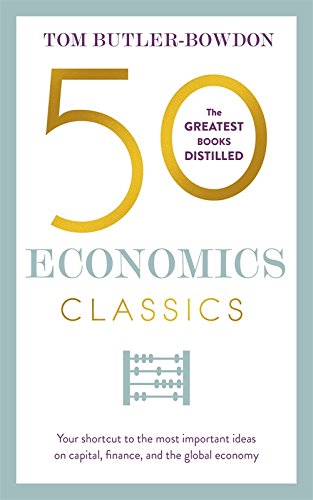
I was very chuffed that my GDP: A Brief but Affectionate History was included in 50 Economics Classics: The greatest books distilled by Tom Butler-Bowdon. This is a mildly eclectic – and so rather interesting – list ranging from Liaquat Ahamed to Max Weber, passing through Becker, Coase, Friedman, Jacobs, Krugman, Malthus, Marx, Sen, Smith on the way.

The book has lots of additional reading suggestions, in fact a bonus 50 at the end. Each book included naturally gets only a few pages, the argument in a nutshell, but it adds up to a nice overview of 250 years of economic ideas and is actually a good starting point for someone new to economics wanting a general overview. The list is alphabetical by author but they are arranged by theme in the introduction and each chapter cross-references other on the same theme. Capturing the essence of a book in 3 pages is a difficult task. Tom Butler-Bowdon is obviously a very well-read person with this rare skill.

41KEBDczN5L

100 Years of Economics

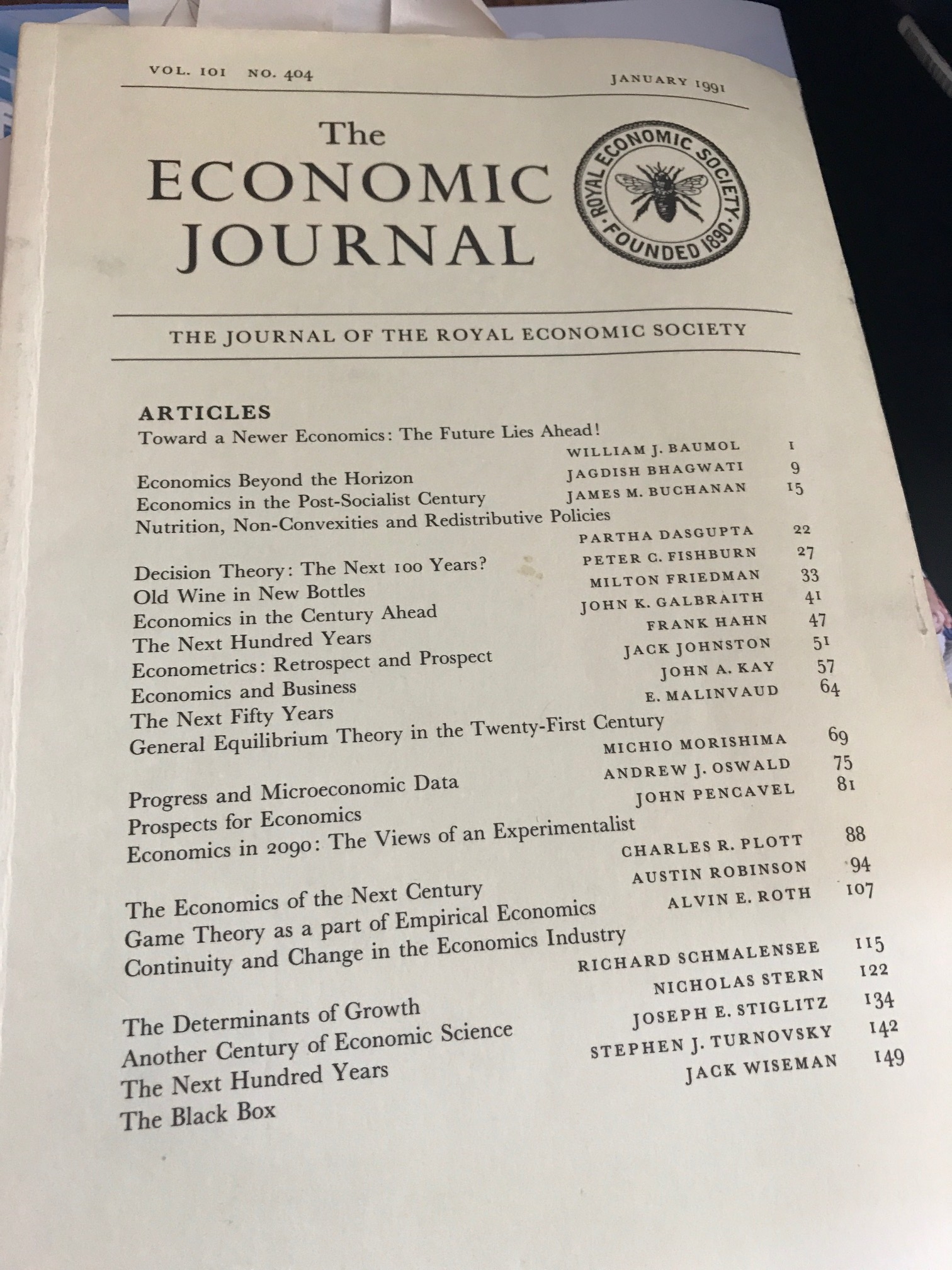
The wonderful Beatrice Cherrier (@Undercoverhist) has been tweeting about the articles in the January 1991 special edition of The Economic Journal, a centenary issue which published articles by eminent economists looking forward to the next century of the subject. For more on the individual articles, go to Beatrice’s tweets (or read the articles!). But she sent me to my shelves to blow the dust of my copy & I thought the contents list was very striking:IMG_4111The first thing that strikes me now is that there are zero women contributors. Another is the poignancy of reaching for this the day after the death of the wonderful Will Baumol. I think he was one of the most creative and observant economists, as well as a truly delightful person, and in a sense paid the penalty for the breadth of his interests in not being more recognised inside and outside the profession. His article in the special issue is in fact very prescient – calling for more eclecticism, more economic history especially in the curriculum, less short-run macro, less “display of technique for its own sake”, more emphasis on behavioural economics.

And this underlines another striking think about the contents list, which is how little it anticipates the current areas of interest in the subject, whether that be inequality or economic geography, behavioural research or data and measurement. Forgivable though – who would like to predict the next 100 years of economics??

And now, off to a day of more disciplinary introspection, at the Economics Network Event on Economics: The Profession and the Public.


Fear, greed, fairness, imagination and finance

I’ve thoroughly enjoyed reading Adaptive Markets: Financial Evolution at the Speed of Thought by Andrew Lo. I should say that, apart from being a distinguished MIT finance professor and the co-author of the classic A Non-Random Walk Down Wall Street, Andrew is an old friend. But this should not put off any readers. This new book will become another essential read for anybody interested in financial markets.

The book aims to do what ultimately all of economics must do, and situate economic decisions and behaviour in the context of our biology and evolutionary history. Behavioural economics and finance have gone some way toward this in introducing the now-familiar heuristics such as loss aversion and framing effects, and herding is a familiar phenomenon in finance models. The issue with these has been how if at all they relate to rational choice models and the Efficient Markets Hypothesis. The Adaptive Markets Hypothesis is a synthesis, proposing that context makes the difference, and when conditions are sufficiently stable for long enough, financial markets are efficient. Otherwise, fear, greed, fairness, imagination – the characteristics evolution has given the human brain – kick in.

The opening chapter starts with a powerful demonstration of the potential efficiency of markets: after the Space Shuttle Challenger tragically exploded on 28 January 1986, a five month inquiry pinned the blame on a part, the O-ring, manufactured by one of four contractors, Morton Thiokol. Yet on the day of the accident, the share price of Morton Thiokol plummeted – the markets knew the company was to blame almost immediately, without the expert verdict: “Somehow the stock market in 1986 was able to aggregate all the information about the Challenger accident within minutes, come up with the correct conclusion and apply it to the assets of the company.”  The decline in its market capitalization – about $200m – was  almost exactly equal to the damages, settlement and reduced future cash flow, a later study found.

But often, of course, financial markets are all too obviously sometimes not efficient. The intellectual challenge is to figure out when they are in which mode. The book voyages through neuroscience, psychology, evolutionary biology and AI to try to answer this. The Adaptive Markets Hypothesis reverses the conventional framing: rather than thinking about a rational benchmark with a set of psychological quirks sometimes kicking in, we are a collection of quirks, but sometimes we can get beyond the heuristics to rational choice.

Frustratingly, although perhaps inevitably, there is no neat list of conditions for being in efficient rather than non-efficient mode: it depends, in particular on having had enough time in stable conditions to learn from experience. But Andrew does hold out hope for the prospects of being able to make better investment decisions – with socially useful outcomes – and being able to manage financial markets better so events like the 2008 crisis are far less likely to recur. In line with the Adaptive Markets perspective, he argues for treating financial markets as an ecosystem (so the interconnections are front of mind), using AI techniques to monitor markets and adjust regulatory instruments such as cyclical buffers. There is an interesting section on the role of technology in finance, including HFT, a technological arms race being one of the predictions of the Adaptive Markets Hypothesis. Currently, he is exploring ideas from biology such as immune responses and ecosystem management techniques. He also recommends introducing a body similar to the National Transportation Safety Board that would analyse market crashes and make recommendations for regulatory change. (One thing not spelled out here is whether this would have to be a global body.)

The book is a thoroughly interesting and enjoyable read. It is not technical, the explanations are super-clear, and there is some excellent story telling. Andrew recounts how in 1986 he and his co-author Craig MacKinlay, presenting at the NBER the work that turned into A Non-Random Walk Down Wall Street, were savaged by discussants from the world of academic finance. Since then, the academic community’s faith in the Efficient Markets Hypothesis has wavered significantly, but it is still the benchmark – as the book says, it takes a theory to beat a theory. I find the Adaptive Markets Hypothesis a persuasive theory, but then I firmly believe economics must be consistent with what we learn about ourselves from the other human sciences. I guess the test will come in the shape of how widely market participants themselves embrace it.41CpHzPtybL


Books, books, books

The Publishers Association just published its 2016 figures for the UK book trade, so it’s time for my annual post about (a) how well the publishing industry has innovated its way through the wave of digital disruption compared with the music industry and (b) it isn’t always obvious which goods and services are susbstitutes and which are complements.

From the figures, it looks like digital is becoming steadily a platform for academic and professional texts, and those formats where it is inherently part of the product (audio) – consumer ebook sales have peaked and are declining. This is the substitutes-complements point: it’s always wrong to assume that a new technology will completely replace an old technology, and hard to tell a priori which will settle down to be the majority version in use. It is particularly the case that communications technologies tend to complement each other: on the whole people want more of all, although some do become redundant (telex).

Interestingly, sales of fiction have declined substantially in recent years, while children’s books and non-fiction have increased. This supports my theory about the demand for understanding in uncertain times, although probably it will turn out the growth was mainly stars’ memoirs and recipes….

As for the innovation, there has been experimentation with formats – for example, the popularity of short books (such as the excellent Perspectives series 🙂 – a new one, Before Babylon, Beyond Bitcoin by Dave Birch, will be out soon. Click here to pre-order for a signed copy at a discounted price!). But a key one has been to focus on the inherent distinctiveness of books: their physical bookness. The design and quality of books has improved enormously, in my view.

Of special interest to the academic world, academic and professional sales were up by 10% to £2.4bn. The sales of books rose 9% to £1.1bn,  total income from journals rose 10% to £1.2bn, and the share of journal income from subscriptions fell 1 percentage point to 79% of the total while income from Open Access article processing charges increased by 46% to £81m. For the time being (until government policy irrevocably damages one of the UK’s most successful sectors through a deranged approach to overseas students, and the impact of Brexit on employment and research funding), the UK accounts for 10% of journal article downloads and 12% of citations, and produces 16% of the world’s most‑cited journal articles. Only the US does better, the Yearbook says.