Sorting out the complements from the substitutes

There’s an interesting report about Yale University Press’s plans to publish a paperback series of books accompanying the free Open Yale Courses online lecture series. The article debates the question of whether enough people will pay for books when the source material is free.

This is an empirical question, of course, but I’ve always found the doubt about whether the answer can ever be ‘yes’ hard to understand. There are, after all, countless examples in the past of people assuming that goods and services are substitutes when in fact they are complements: telephony and face-to-face contact; online documents and paper documents; perhaps even free music paid-for music. What’s more, the economic theory is set out with admirable clarity in the excellent [amazon_link id=”087584863X” target=”_blank” ]Information Rules[/amazon_link], a 1998 book by Carl Shapiro and Hal Varian.

Free online access to the lectures seems to me more likely to generate demand for a paid-for book than to displace it. It will displace demand for something else, some other activity taking the users’ time and attention, but that displaced demand is likely to be spread across a range of activities. Anyway, I hope Yale University Press (follow them on Twitter, @YaleBooks) will keep us up to date with the results.

[amazon_image id=”087584863X” link=”true” target=”_blank” size=”medium” ]Information Rules: A Strategic Guide to the Network Economy[/amazon_image]

The paradox of teaching

Unusually for me, I have three books on the go at once. One is [amazon_link id=”0224071785″ target=”_blank” ]The Hemlock Cup[/amazon_link] by Bettany Hughes, about the life of Socrates and the character of Athens. I started it on holiday and although interesting, it’s a huge hardback so I read it in bed. Another is [amazon_link id=”1933633867″ target=”_blank” ]Debt: the first 5000 years [/amazon_link] by David Graeber, which is my on-the-go book at the moment.

The third is one I started on a plane journey and didn’t quite finish, Alberto Manguel’s [amazon_link id=”0300172087″ target=”_blank” ]A Reader on Reading[/amazon_link]. Yesterday I came across this comment in one essay about the nature of teaching, which struck me as true and worth reflecting on as we endlessly debate education policy:

“A fierce paradox exists at the heart of every school system. A society needs to impart the knowledge of its codes to its citizens so they can become active in it; but the knowledge of that code…..enables those same citizens to question that society, to uncover its evils and attempt a change. In the very system that allows a society to function lies the power to sibvert it, for better or worse.” (p161)

Teachers, he continues, are in a bind. They must teach students to think for themselves, “while teaching according to a social structure that imposes a curb on thinking.” Coincidentally, this was the bind Socrates found himself in, and the reason the Athenian court found him guilty of corrupting the city’s youth.

My friend Bethan Marshall, in her book [amazon_link id=”0415240786″ target=”_blank” ]English Teachers – The Unofficial Guide[/amazon_link], concluded that in the group she researched teachers selected themselves into categories depending on their choice about this bind. Some teach conformity but a substantial minority become ‘critical dissenters.’ Each individual chooses their relationship to their society.

Harder to resolve, though – and perhaps not capable of ever being resolved –  is the political debate about what should be in the curriculum.

[amazon_image id=”0300172087″ link=”true” target=”_blank” size=”medium” ]A Reader on Reading[/amazon_image]

What to read next? You choose….

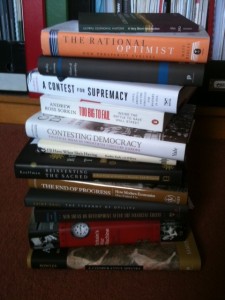
I have a lot of travelling coming up, so am dithering about which books to select from those to hand. I’m currently part way through [amazon_link id=”1933633867″ target=”_blank” ]Debt: The First 5000 years[/amazon_link] by David Graeber, which is brilliant (a review will follow). Your suggestions please for the next selections from this tottering pile.

The in-pile

What markets are really good for

It’s the end of the week and I’ve been wandering down online byways, prompted by a comment on my earlier post on Michele Bachman and Ludwig von Mises. The comment (a pointer to a book by von Mises cited in Sandmo’s [amazon_link id=”0691148422″ target=”_blank” ]Economics Evolving[/amazon_link]) led me off to Hayek’s famous 1945 AER article on The Use of Knowledge in Society.

It’s a terrific article, the central argument being that the point of markets is as a social mechanism for co-ordinating many decentralized sources of information about supply and demand. The price set in the market contains all the information individuals on either the buy or the sell side need in order to match the varied preferences and needs of customers with the resources and goods and services available. This is a task beyond a central planner – one of the aims is to explain why a market economy is superior to a centrally planned one, without relying on the professional economist’s incantations about the welfare properties of general equilibrium – Hayek not being daft enough to think this is real. He says:

“The problem is precisely how to extend the span of our utilization of resources beyond the span of the control of any one mind; and therefore, how to dispense with the need of conscious control, and how to provide inducements which will make the individuals do the desirable things without anyone having to tell them what to do.”

He also offers the following marvellous quotation from Alfred Whitehead:

“It is a profoundly erroneous truism, repeated by all copy-books and by eminent people when they are making speeches, that we should cultivate the habit of thinking what we are doing. The precise opposite is the case. Civilization advances by extending the number of important operations which we can perform without thinking about them.”

This question of what we can get our minds around in making economic decisions is becoming ever more important, the more information we are flooded with. Next week I’m attending what looks like a fantastic workshop at the Toulouse School of Economics on the Economics and Psychology of Scarce Attention. It’s organized by Paul Seabright, whose book [amazon_link id=”B003TXTC6I” target=”_blank” ]The Company of Strangers: A Natural History of Economic Life[/amazon_link] is a brilliant, accessible overview of the marvel of co-ordination by the market in the social and anthropological context in which actually existing markets (rather than theoretically pure markets) have evolved. I think this book is a must for anyone interested in the overlap between economics and anthropology/evolutionary biology.

[amazon_image id=”B003TXTC6I” link=”true” target=”_blank” size=”medium” ]The Company of Strangers: A Natural History of Economic Life (Revised Edition)[/amazon_image]

The other terrific supplement to the Hayek article is Francis Spufford’s docu-novel [amazon_link id=”0571225233″ target=”_blank” ]Red Plenty[/amazon_link], the first successful attempt in (more or less) fiction to explain the formal equivalence between a centrally planned economy and the Arrow-Debreu general equilibrium. It is, believe it or not, a completely gripping read, and an essential part of the education of anyone too young to remember the Soviet Union. If nothing else, it stands alongside Hayek’s article as a perfect reminder – at a time when there is understandable scepticism about the merits of markets in theory – of why they are essential in practice.

[amazon_image id=”0571225233″ link=”true” target=”_blank” size=”medium” ]Red Plenty[/amazon_image]

The economist as hero

By chance, two new novels featuring economist heroes arrived recently. This is a rare occurrence, so to get two together was striking, and perhaps says something about the zeitgeist – that there is enough interest in the economy, for obvious reasons, to make fiction worth a go.

One of the newcomers is [amazon_link id=”0262015757″ target=”_blank” ]Something for Nothing[/amazon_link] by Michael W Klein, a professor at the prestigious Fletcher School at Tufts University. Its hero is a recently-minted Columbia PhD, whose only job offer is a temporary contract at a minor liberal arts college. His efforts to publish enough to secure a permanent job – ah, the allure of the tenure-track – bring him into contact with an evangelical Christian think tank. Misunderstandings and mishaps ensue but all ends well. Our economist hero finds a job, and love too. It’s an enjoyable book, well plotted and with moderately rounded characters. I liked the realistic detail, such as the delays waiting for elevators in hotels at the annual meetings of the American Economic Association, where job interviews are held in their hundreds. This book’s market might be a niche one, however – I’m not sure about the wider appeal of the career travails of the would-be academic economist. This doesn’t quite make it as a campus novel of wider interest because its focus is so firmly on the world of economics rather than the world of the university.

[amazon_image id=”0262015757″ link=”true” target=”_blank” size=”medium” ]Something for Nothing[/amazon_image]

The second of these recent novels is [amazon_link id=”0982903804″ target=”_blank” ]The Economics of Ego Surplus: a novel of economic terrorism [/amazon_link]by Paul McDonnold. The hero here is a graduate student working on his dissertation. As the summer vacation approaches, he is recruited by the FBI to assist them in investigating a terrorist attempt to bring about the collapse of the US economy and western consumerism through a stockmarket crash and run on the dollar. (Does it need a terror mastermind to accomplish this, one asks, reading the Financial Times.) So we are in the thriller genre, and this novel is a page turner, while at the same time explaining (sometimes with footnotes – unusual, for a thriller) basic economic concepts. I enjoyed the author’s evocation of Dallas and its environs. However, the plot has some infelicities, and – like many in this genre – weak characterisation.This needn’t put off someone looking for a light read for a plane journey; this book is better than many on the airport bookshelves.

[amazon_image id=”0982903804″ link=”true” target=”_blank” size=”medium” ]The Economics of Ego Surplus: A Novel of Economic Terrorism[/amazon_image]

Besides, both authors are to be commended for aiming to bring economics to life in fiction. The vast expanse of life affected by the subject is almost untouched by novelists. The other economics novels I’ve read are: [amazon_link id=”0262681358″ target=”_blank” ]The Invisible Heart[/amazon_link] and [amazon_link id=”0691143358″ target=”_blank” ]The Price of Everything[/amazon_link], both by Russ Roberts; [amazon_link id=”0316731919″ target=”_blank” ]The Burning[/amazon_link] by Thomas Legendre; and the Marshall Jevons detective mysteries featuring economist Henry Spearman, such as [amazon_link id=”0345331583″ target=”_blank” ]The Fatal Equilibrium[/amazon_link] and [amazon_link id=”0691000980″ target=”_blank” ]Murder at the Margin[/amazon_link].

All are written by economists about economists. As far as I’m aware, though, no literary novelist has yet portrayed the economist as hero.