Happy Birthday Alan Turing

In honour of the centenary of Alan Turing’s birth, I’ve been reading [amazon_link id=”B008CJ4EE4″ target=”_blank” ]Computing: A Concise History[/amazon_link] by Paul Ceruzzi. It’s a delightful small book, very nicely produced and with illustrations, perfect for a journey or to slip in a pocket for commuting. It’s also, in 150 pages, a super overview of the history of this utterly transformational technology from the early days of applications of digital approaches in mechanical forms (including – I never knew this – holes punched into old movie tape) to the Web.

[amazon_image id=”B008CJ4EE4″ link=”true” target=”_blank” size=”medium” ]Computing (MIT Press Essential Knowledge)[/amazon_image]

What I like about the book is that it draws out the important analytical milestones such as binary code or the principle of storing programmes naturally from the course of events – it is not simply a catalogue of inventions, as a short book covering a huge territory could be. It also emphasizes the way the converged computing and communication we have today is the confluence of very many rivers of innovation. While this looks inevitable with hindsight, there was much happenstance along the way.

In a short book, Alan Turing himself gets little space. I enjoyed Andrew Hodges’ biography [amazon_link id=”069115564X” target=”_blank” ]Alan Turing: The Enigma[/amazon_link]. George Dyson’s [amazon_link id=”B0076O2VXM” target=”_blank” ]Turing’s Cathedral: The Origins of the Digital Universe[/amazon_link] is on my wishlist. There’s a new paperback out, [amazon_link id=”1845136330″ target=”_blank” ]The Secret Life of Bletchley Park [/amazon_link]by Sinclair Mackay. Another recent book, on the analytics of computing, is John MacCormick’s 9 Algorithms [amazon_link id=”0691147140″ target=”_blank” ]That Changed the Future[/amazon_link], which I reviewed here.

For the commercial history of the American computer industry, the best I’ve come across is Robert Cringely’s [amazon_link id=”0140258264″ target=”_blank” ]Accidental Empires[/amazon_link] – a bit outdated now, though. Georgina Ferry’s [amazon_link id=”1841151866″ target=”_blank” ]A Computer Called Leo[/amazon_link] is a nice bit of the UK industry’s history. And for something more reflective about computers and society, [amazon_link id=”0571172431″ target=”_blank” ]Cultural Babbage: Technology, Time and Invention[/amazon_link] edited by Francis Spufford and Jenny Uglow is an all-time favourite.

[amazon_image id=”069115564X” link=”true” target=”_blank” size=”medium” ]Alan Turing: The Enigma The Centenary Edition[/amazon_image]

The BBC website has a series of nice essays about Turing. There’s also the Science Museum exhibition to look forward to.

Just in

A handful of new books have arrived recently, all looking enticing and/or useful:

[amazon_link id=”0300186304″ target=”_blank” ]Good Italy, Bad Italy[/amazon_link] by Bill Emmott

[amazon_image id=”0300186304″ link=”true” target=”_blank” size=”medium” ]Good Italy, Bad Italy: Why Italy Must Conquer Its Demons to Face the Future[/amazon_image]

[amazon_link id=”1610390040″ target=”_blank” ]Wait: The Art and Science of Delay[/amazon_link] by Frank Partnoy

[amazon_image id=”1610390040″ link=”true” target=”_blank” size=”medium” ]Wait: The Art and Science of Delay[/amazon_image]

[amazon_link id=”0571279201″ target=”_blank” ]Positive Linking: How Networks Can Revolutionise the World[/amazon_link] by Paul Ormerod

[amazon_image id=”0571279201″ link=”true” target=”_blank” size=”medium” ]Positive Linking: How Networks Can Revolutionise the World[/amazon_image]

[amazon_link id=”0230392547″ target=”_blank” ]Going South: Why Britain will Have A Third World Economy by 2014[/amazon_link] by Larry Elliott and Dan Atkinson

[amazon_image id=”0230392547″ link=”true” target=”_blank” size=”medium” ]Going South: Why Britain will have a Third World Economy by 2014[/amazon_image]

[amazon_link id=”B008CJ4EE4″ target=”_blank” ]Computing: A Concise History[/amazon_link] by Paul Ceruzzi

[amazon_image id=”B008CJ4EE4″ link=”true” target=”_blank” size=”medium” ]Computing (MIT Press Essential Knowledge)[/amazon_image]

I’d better get reading.

A macroeconomist tells me off

I’ve been taken to task by a friend – a macroeconomist – for being overly dismissive about macroeconomics. I won’t name him – he can always do so himself if he likes.

He agrees that macro is not covered in glory at the moment, but disagrees with my charge that its intellectual flaws are substantial, and that it does not stand on the same kind of increasingly sound empirical footing as much of microeconomics. He also is sure, absolutely sure, that UK government policy is wrong-headed and what we need is an urgent dose of fiscal stimulus.

I’d already annoyed my friend by criticising the state of macro, no doubt in exaggerated terms, in my recent Tanner Lectures (pdf). (I confess I did compare it to Mr Rochester’s mad wife in the attic, too embarrassing to acknowledge.) The more recent prompt for my telling off was my tweet suggesting the first of this year’s BBC Reith Lectures by Niall Ferguson was worth a listen. Ferguson argues that public debt burdens in the UK and elsewhere represent a breakdown of the social contract between us and future generations. He believes ‘austerity’ policies remain necessary. I think this is an important argument to acknowledge in public debate – taking due account of the future is an important theme of [amazon_link id=”0691145180″ target=”_blank” ]The Economics of Enough[/amazon_link]. My friend doesn’t disagree with this but says Prof Ferguson is empirically wrong in his reasoning about why a fiscal stimulus is a bad idea, and consequently in his blanket dismissal of the standard macro analysis, and therefore shouldn’t be taken seriously in economic policy discussions (to quote, he thinks Ferguson should have suffered ‘a terminal loss of credibility’).

I’ve got a three-fold answer to my friend (if he’ll still talk to me).

First, macroeconomists simply do not realise how low their stock has sunk in the eyes of their microeconomist colleagues. When popular critics attack ‘economics’, they mean macro. It’s bringing us into disrepute, we fear. Although macroeconomists will insist that there are known scientific facts, they do not appear to agree on what these are. One of the (micro)economists I discussed my lectures with sent me this email about a public occasion when he’d been on a panel with four (macro)economists:

“They disagreed fundamentally with each other and almost every statement was introduced by “in my opinion…” or “I think…” leaving the audience with no way of coming to an intelligent way of judging between the opinions. But I think that is a different issue (is it?) from what happens in academic macro where the failure of macroeconomists to agree on the basic model feels to me more like some other social sciences where there are very
basic disagreements which seem impossible to reconcile using evidence.”

In a forthcoming collection of essays about the teaching of economics, What’s the Use of Economics? (out in September), the section on macro reveals an extraordinary spread of views, from those who think existing models just need a few tweaks to those who argue for an entirely new intellectual project involving network science (one of these is Paul Ormerod in his new book [amazon_link id=”0571279201″ target=”_blank” ]Positive Linking[/amazon_link]). I’m trying to educate myself by reading the excellent macro blogs such as those by Simon Wren-Lewis and Jonathan Portes, but I don’t see them acknowledging at all the possibility of an entirely new approach to modelling economic aggregates. No wonder the ESRC is sponsoring an important conference this autumn on the state of macro.

[amazon_image id=”0571279201″ link=”true” target=”_blank” size=”medium” ]Positive Linking: How Networks Can Revolutionise the World[/amazon_image]

This takes me to my second point, which is that it is hard to believe in the existence of a significant consensus about empirical truths in macro policy when the discussion among macroeconomists is so shouty. Paul Krugman in his new book [amazon_link id=”0393088774″ target=”_blank” ]End This Depression Now[/amazon_link] plainly thinks those who disagree with him about a fiscal stimulus now are blithering idiots. OK, maybe I am, but it’s not a good tactic to win me over in the debate. Chris Giles’s views in his recent FT column were more persuasive: a fiscal stimulus might be needed soon, he says, but it won’t fix the economy and it will need reversing later – and by the way, there would be an adverse impact on policy credibility.

[amazon_image id=”0393088774″ link=”true” target=”_blank” size=”medium” ]End This Depression Now![/amazon_image]

Finally, and following on from the point about shoutiness, all economists need to do far, far better at explaining their work to the general public. This is all the more important for macroeconomists in the context of a macro crisis in which voter attitudes materially limit the courses of action open to politicians. The process of education will need to start from what macroeconomists do agree about, not what they disagree about in vituperative public rows. My friend assures me that some theories have performed well in recent years. I – a professional economist, albeit of the micro and possibly even blithering idiot kind – do not know what they are. I shouldn’t have to keep up with the professional literature in a different field from mine to know, either. So I’ll end with a challenge. Can some of the macroeconomists out there agree about what they agree is empirically well-founded, including the policy implications, and let us know? It will be a lot more interesting than the polemics, and maybe it would stop me being so naughtily dismissive about macroeconomics.

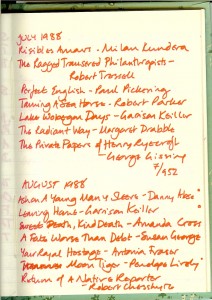
A long time in life – and books

As I was listening to the report on the radio this morning about Aung San Suu Kyi’s first visit to the UK in 24 years, it set me thinking about how much has changed since 1988. The London of those days – a city to which I’d recently moved from the US – was dirtier, not as lively, far less cosmopolitan. We were all much poorer, even the bankers, well worth remembering in the midst of the crisis. According to the new IFS and Joseph Rowntree Foundation study, 3.4 million children here lived in poverty in 1988-89, down to 1.7 million in the latest figures (still too high, but the biggest decline in the years since 1961 when the data start).

Personally, 1988 is so long ago that I was still doing macroeconomics, and hadn’t yet quite begun my 13-year journey in journalism. I had just met the man who became my husband, and our now grown-up eldest son hadn’t been imagined yet. And here is what I was reading in 1988. Some good stuff among the detective novels. Ian Jack’s [amazon_link id=”0099754215″ target=”_blank” ]Before the Oil Ran Out[/amazon_link] is a marvellous piece of reportage about how Britain had been changing in the 1980s. I was obviously also in the middle of a lot of travel writing and a [amazon_link id=”0141183063″ target=”_blank” ]George Orwell[/amazon_link] fest.

July 1988 books


August 1988 books

Who can end the end-of-worldism?

It is hard to find reasons to be cheerful about the state of the world economy, especially after reading Dani Rodrik’s all too scarily plausible scenario for a replay of the Great Depression, but worse, ‘The End of the World As We Know It.’ His scenario starts with a Syriza victory. The news that the Greek people decided to stay teetering on the brink of the financial and economic precipice rather than leaping over it right now is a small comfort.

I turned to Benjamin Friedman’s 2005 book, [amazon_link id=”1400095719″ target=”_blank” ]The Moral Consequences of Economic Growth[/amazon_link], a powerful argument that growth and public values, economics and politics, are inextricably related. He traces back to its Enlightenment roots the idea that progress in one sphere is related to progress in another. He sees the Great Depression in the United States (but not Europe) as the one exception to the general rule that economic stagnation or decline leads to an erosion of a society’s openness and commitment to democracy: “America during the Great Depression strengthened its commitment to these positive values and, moreover, did so in ways that proved lasting.” (p159) The reason, of course, was the exceptional response of the New Deal, and FDR’s leadership.

One reason for feeling so gloomy about the US and Europe alike now is that there is no sign of exceptional political leadership. Extremists are gaining political ground. The false consciousness of the anti-GDP and happyism movement is alluring for some people who ought to know better than to stick their heads in this romantic sand. I know economists have no reason to act complacent these days, but where are the politicians?

[amazon_image id=”1400095719″ link=”true” target=”_blank” size=”medium” ]The Moral Consequences of Economic Growth[/amazon_image]