Turing’s Cathedral, remarkable men and even more remarkable women

I’ve loved this book, [amazon_link id=”014101590X” target=”_blank” ]Turing’s Cathedral: The Origins of the Digital Universe[/amazon_link] by George Dyson. It’s a history of the days when computers were so new and rare that they had names – ENIAC, MANIAC, JOHNNIAC, Baby – and of the early history of the Institute for Advanced Studies at Princeton, and of bits of the career of John Von Neumann and other mathematicians and engineers. It’s the story of the days when the world had 53 kilobytes of random access memory altogether, a significant proportion of them in Princeton, New Jersey.

[amazon_image id=”014101590X” link=”true” target=”_blank” size=”medium” ]Turing’s Cathedral: The Origins of the Digital Universe (Penguin Press Science)[/amazon_image]

It’s also about the relationship between the Second World War, and subsequent military funding for Cold War atomic research, and digital innovation. Military needs so often drive major technological innovations. Part of the story concerns Norbert Wiener and Julian Bigelow, researching how to improve the trajectory of anti-aircraft fire during the war, as London was blitzed. My late mother, as she explains in this video, sat outside the gun emplacements in East London during the Blitz shouting instructions to gunners as they aimed at aircraft overhead – she could have done with the innovation a bit sooner. (It was lovely to have this excuse to watch it again and remember her on UK Mothers’ Day.)

One of the things I love about the story is the sense it gives of the atmosphere of the new research establishment and the personalities, and the way invention rests on both a collection of happenstances and a large number of individuals. Turing’s Cathedral has similarities to some other recent histories of innovation, such as Jenny Uglow’s outstanding [amazon_link id=”0571216102″ target=”_blank” ]The Lunar Men[/amazon_link].

Dyson is very good at describing the people involved, all extraordinary, from John von Neumann down. For example, a paragraph summing up Gödel’s famous incompleteness result (which I sometimes think I understand, if I concentrate hard – after all, I did read Douglas Hofstadter’s [amazon_link id=”0140289208″ target=”_blank” ]Gödel, Escher, Bach[/amazon_link] – twice) is followed by this:

“After retreating to the sanatorium at Purkersdorf, where he was diagnosed with nervous exhaustion, he returned to Princeton in September of 1935, where he fell into an even more severe depression, resigning his position and returning to Austria at the end of November. He readmitted himself to the sanatorium in Rekawinkel, and then recovered sufficiently to spend several weeks with his future wife, Adele Nimbursky (nee Porkert), a Viennese cabaret dancer.”

Whoah! Tell me more about the Viennese cabaret dancer! The IAS website tells me he had met her when he was 21, in the Vienna nightclub ‘The Moth’. It was his second relationship with an unsuitable older woman, to the annoyance of his parents.

I also like Bernetta Miller, an administrator at the IAS in its early days. She was the fifth woman to get a pilot’s licence in the US, received the Croix de Guerre in World War I for assisting the injured Allied troops and visiting the front lines to take cigarettes to the men, and then became bursar of the American School in Istanbul. After the war she settled with her partner Betty Faville, and stood between Albert Einstein and the world until fired by Robert Oppenheimer, who didn’t like her. He goes down in my estimation, I must say. Strong women – like Bernetta Miller and indeed Kathleen Coyle – not only helped win the war, but were vital to the far harder task of building post-war society.
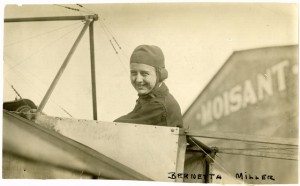
Bernetta Miller

There’s so much more, most of it about the construction of the computers. Do, do read it. I’ve not quite finished yet, but this line from the Introduction sums up the book: “In answering the Entscheidungsproblem [David Hilbert’s ‘Decision problem’], Turing proved that there is no systematic way to tell, by looking at a code, what that code will do. That’s what makes the digital universe so interesting, and that’s what brings us here.” We don’t know where we’re going, but it helps to understand the origins.

Advice to young economists

Today I gave a talk to sixth formers at Gosford Hill School, near Oxford: “I never meant to become an economist,” was the title. (This was via the excellent Speakers for Schools initiative set up by Robert Peston.)

It was a riff on my own career history, and what being an economist means, set in the context of some of my family history and the structural changes in the economy between 1935, when my dad started work at 14, and now, as the young people think about their future careers. Here’s my dad in his first job, front row extreme right. He stayed there most of his working life, apart from the army, although after the mill closed in the late 1970s he was lucky enough to find a job as a meter reader.

Joseph Coyle, The Old Ground Mill

The students were extremely polite and asked lots of good questions. One was what I’d recommend them to read to see if they were interested in economics at university. Off the top of my head, I recommended Tim Harford’s [amazon_link id=”0349119856″ target=”_blank” ]The Undercover Economist[/amazon_link] (which turned my eldest boy into an economist) or any of his books, the Keynes- Hayek rap, Thomas Schelling’s [amazon_link id=”0393329461″ target=”_blank” ]Micromotives and Macrobehaviour[/amazon_link], Ha Joon Chang’s [amazon_link id=”0141047976″ target=”_blank” ]23 Things They Don’t Tell You About Capitalism[/amazon_link], and anything by David Smith, like his recent [amazon_link id=”1781250111″ target=”_blank” ]Free Lunch[/amazon_link]. I forgot to mention Ariel Rubinstein’s [amazon_link id=”1906924775″ target=”_blank” ]Economic Fables[/amazon_link]. There are surely lots of other good resources I should have mentioned too – but not [amazon_link id=”0141019018″ target=”_blank” ]Freakonomics[/amazon_link], which I found too gimmicky.

[amazon_image id=”0349119856″ link=”true” target=”_blank” size=”medium” ]The Undercover Economist[/amazon_image]

Digital origins and robotic futures

I’ve been waiting for ages for the paperback of George Dyson’s [amazon_link id=”014101590X” target=”_blank” ]Turing’s Cathedral: The Origins of the Digital Universe[/amazon_link], and a couple of chapters in am already *loving* it. It’s the kind of book that stuffs in all sorts of information, well suited to a magpie mind like mine. For example, did you know that Francis Bacon knew in 1623 that two symbols sufficed to represent all information? “A man may exprese and signifie the intentions of his mind, at any distance of place, by objects … capable of a two-fold difference onely.” Turing of course formalized this in his 1936 paper. He noted: “Being digital should be of more interest than being electronic.” The electronics distracted us, however. Dyson follows this section with a diversion into the history of the site of Princeton’s Institute for Advanced Study during the Revolutionary War. Perfect.

[amazon_image id=”014101590X” link=”true” target=”_blank” size=”medium” ]Turing’s Cathedral: The Origins of the Digital Universe (Penguin Press Science)[/amazon_image]

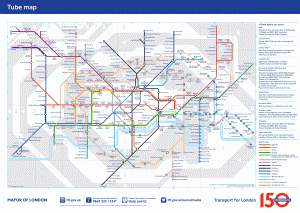
Coincidentally, I was reading bits of and about Bacon’s [amazon_link id=”1440042500″ target=”_blank” ]Novum Organum[/amazon_link]  recently, particularly about his notion of myths that distract us from scientific knowledge. The key myth or ‘idol’ he labels ‘Idols of the Market Place’: “Men associate through conversation, but words are applied according to the capacity of ordinary people. Therefore shoddy and inept application of words lays siege to the intellect in wondrous ways.” This was for my presentation at The Story 2013, in which I talked about the usefulness of models and equations, rather then verbal narratives, for describing aspects of the world. After all – as Margaret Bray and others have pointed out – the London Underground map is a useful model, not an accurate representation of London’s geography.

[amazon_image id=”1176418432″ link=”true” target=”_blank” size=”medium” ]Novum Organum[/amazon_image]

A useful model

Robots have been on my mind anyway, having been thinking about Luddites and jobs. This book, [amazon_link id=”1448659817″ target=”_blank” ]The Lights in the Tunnel[/amazon_link] by Martin Ford, looks rather interesting, from this extract from the introduction. I couldn’t agree more with this statement: The evidence is pretty clear: a race between technology and our ability to reform our political and economic systems is really no race at all. So if we can foresee that technology is likely to have a highly disruptive impact on our economy in the coming years and decades, then we really need to start thinking about that well in advance.

[amazon_image id=”1448659817″ link=”true” target=”_blank” size=”medium” ]The Lights in the Tunnel: Automation, Accelerating Technology and the Economy of the Future: 1[/amazon_image]

When the money runs out….

I’m excited by the arrival of proofs of [amazon_link id=”0300190522″ target=”_blank” ]When the Money Runs Out: The End of Western Affluence[/amazon_link] by Stephen King.

[amazon_image id=”0300190522″ link=”true” target=”_blank” size=”medium” ]When the Money Runs Out: The End of Western Affluence[/amazon_image]

I greatly enjoyed his last book, [amazon_link id=”0300170874″ target=”_blank” ]Losing Control.[/amazon_link] There’s an embargo on the new one – the review will follow in a while…..

[amazon_image id=”0300170874″ link=”true” target=”_blank” size=”medium” ]Losing Control: The Emerging Threats to Western Prosperity[/amazon_image]

Robots and Luddites

For various reasons, I’ve been thinking about Luddites. My husband called me a Luddite for mildly complaining that our TV set-up has become so complicated that I no longer know how to play a DVD. Seriously, though, the ‘robots are eating our jobs’ argument has been gaining traction – in the interesting Brynjolfsson and McAfee book [amazon_link id=”0984725113″ target=”_blank” ]Race Against the Machine[/amazon_link], in Paul Krugman’s Robots column, and assessed in this recent Economist survey article (with handy links).

Oddly this is simultaneous with the interest in Robert Gordon’s argument that the days of significant technology-driven productivity gains are over, in his paper Is US Economic Growth Over? The awesome analytical power of economics tells us these arguments can’t both be true at the same time, even if it doesn’t tell us which one is correct.

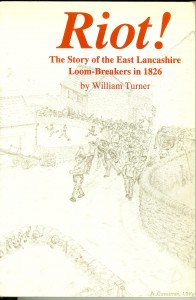
Luddites have an unfair reputation, as if they should have realised that the tide of technological change was unstoppable so why bother protesting? Eric Hobsbawm once argued (in The Machine Breakers) that there wasn’t a big difference between the Luddites of 1811-13 and the “collective bargaining by riot” that had been going on for donkey’s years. Besides, expressing opposition to one’s job becoming technologically redundant is highly (individually) rational. In my part of the world, East Lancashire, the big riots were in the 1820s – our ‘local’ riot was written up in the lovely book [amazon_link id=”1871236177″ target=”_blank” ]Riot! [/amazon_link] by William Turner. The ‘[amazon_link id=”0140600132″ target=”_blank” ]Captain Swing[/amazon_link]’ riots in the South occurred in the 1830s.

Machine-prompted industrial unrest is the result of the combination of the normal innovation-driven dynamics of capitalism with the failure of the system to find a way of sharing productivity gains outside their originating sector. So inequality, not innovation, is why the robots matter now.