
The shadow economy

The focus of economic policy is the economy that is counted; little attention is paid to the shadow economy. The reason is partly that it’s obviously hard to direct what’s unmeasured, and partly embarrassment about the very existence of shadow work – policy is supposed to aim at eliminating it. Yet of course it forms a substantial proportion of economic activity, in fact a minimum of around 10% of official GDP (the UK is at 12.5%) and more than half of official GDP in some (mainly poor) economies. Indeed it is so much more prevalent in the developing world that it shades into activity with a different name there, the informal economy.

The measurement of the shadow economy has been almost a one man activity. That man, Friedrich Schneider, has a new book or pamphlet out with co-author Colin Williams, published by the IEA, The Shadow Economy. It sets out his most recent estimates and surveys very usefully the drivers of shadow activity and the possible policies to reduce its size. This publication is a useful summary of Schneider’s longer works on the subject, such as [amazon_link id=”1107034841″ target=”_blank” ]The Shadow Economy: An International Survey.[/amazon_link] It’s good to be reminded about what we don’t have measures of, as well as what we do.
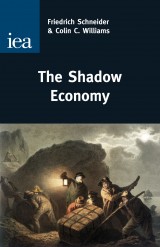
The Shadow Economy

The book, which is short, looks entirely at the legal shadow economy, which is to miss the criminal activities. That’s another story I suppose, the parallel globalization by organised crime, and one that Misha Glenny looks at in his books [amazon_link id=”0099481251″ target=”_blank” ]McMafia[/amazon_link] and [amazon_link id=”0099546558″ target=”_blank” ]Dark Market[/amazon_link].

[amazon_image id=”0099481251″ link=”true” target=”_blank” size=”medium” ]McMafia: Seriously Organised Crime[/amazon_image]

Economists should take far more seriously this phenomenon. It impinges, with horrific results so often, on many people’s lives and is a part of 21st century globalization.

Schneider and Williams concentrate on labour market activities. Still, even with a relatively narrow focus, this is a very useful book for anybody interested in the issue.
Impulse buying

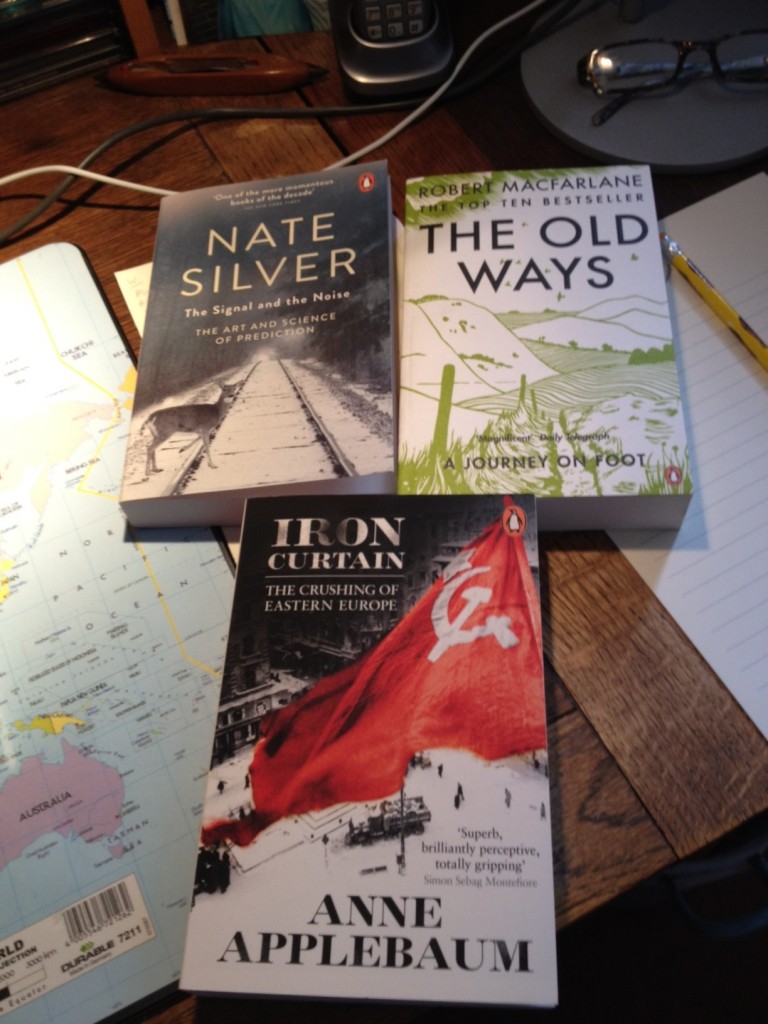
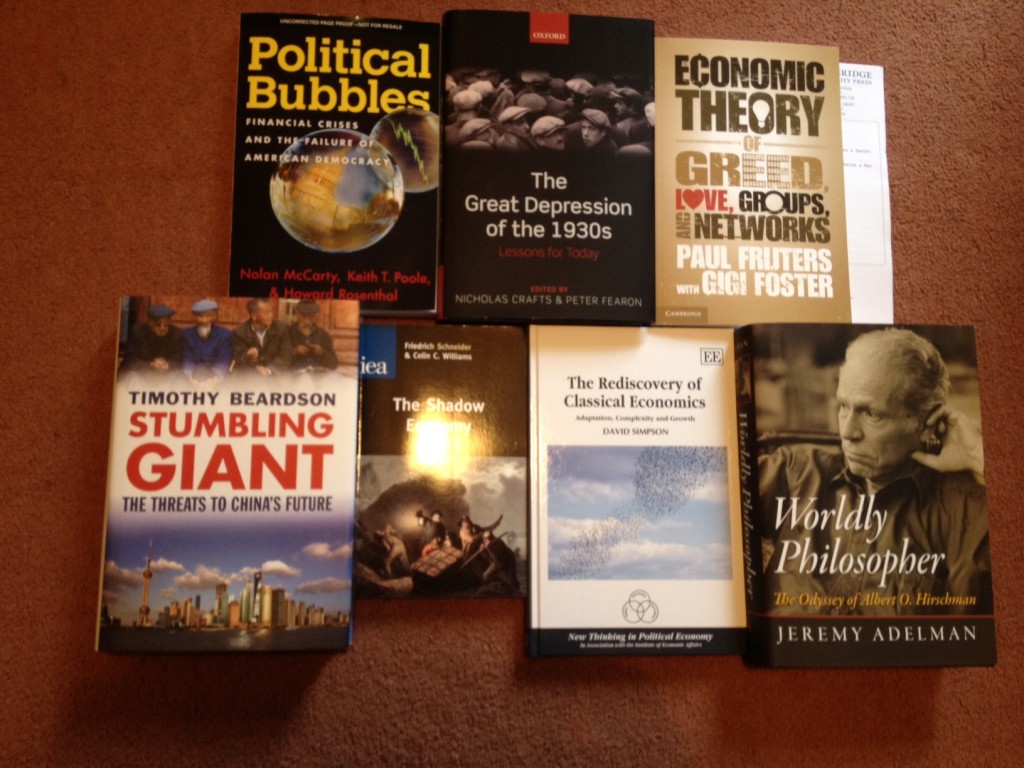
Oh dear, oh dear. I wandered past a branch of Foyles this morning with 10 minutes to spare. Here’s the result. I’d already acquired a hardback of [amazon_link id=”0141975652″ target=”_blank” ]The Signal and The Noise[/amazon_link], but my eldest son seems to have that now.

Still, I need plenty to read for my flights to Istanbul and back. Good thing it’s all calming down now in Tacsim Square…..

Impulse buying

(The shuttle on my desk is one that came from the weaving shed of the cotton mill my aunties used to work in, when it closed down in the early 1980s.)

Books unread and not-yet-read

What next? There’s a great selection of books in my pile at the moment (and how marvellous to discover the word tsundoku for the unread ones, although of course some of the content seeps out from between the covers and into the mind by a kind of osmosis). Practicalities will make me save the biography of Albert Hirschman, [amazon_link id=”0691155674″ target=”_blank” ]Worldly Philosopher[/amazon_link], until the summer holiday because it’s a big book, and so too is [amazon_link id=”0300165420″ target=”_blank” ]Stumbling Giant: Threats to China’s Future[/amazon_link]. Among the others, I’m not yet sure. But I love the moment of being poised to choose to the next book to read. Maybe there’s a word for that too.

Today’s choice

Invisible wealth

Rebecca Solnit is one of my favourite writers. Her previous books include [amazon_link id=”1844675580″ target=”_blank” ]Wanderlust[/amazon_link], [amazon_link id=”1841957453″ target=”_blank” ]A Field Guide to Getting Lost[/amazon_link] and [amazon_link id=”0747568413″ target=”_blank” ]Motion Studies [/amazon_link]about Eadweard Muybridge. As this (rather lukewarm) Observer review of her new book, [amazon_link id=”1847085113″ target=”_blank” ]The Faraway Nearby[/amazon_link], notes, she ought to be far better known in the UK. I’ve nearly finished the book, best described as a memoir of illness, I suppose. I particularly liked this:

“Kindness sown among the meek is harvested in crisis, in fairy tales and sometimes in actuality. I know a man who lost a fortune suddenly and was penniless with a legal battle to fight and children to support. He found that he had another kind of wealth in the ties of affection and respect he had built up, wealth he would never otherwise have seen. Lawyers took on his case pro bono, the grocery store extended credit, the schools gave scholarships and he got by on wealth that was invisible before the money dried up.”

It’s what we economists would prosaically label ‘social capital’.

[amazon_image id=”1847085113″ link=”true” target=”_blank” size=”medium” ]The Faraway Nearby[/amazon_image]

Her writing is probably an acquired taste – I can understand why some readers would find it too, well, Californian. If you’ve not tried, though, I’d strongly recommend giving it a go, especially if you like the genre constituted by authors like W.G.Sebald (in [amazon_link id=”1860466095″ target=”_blank” ]The Rings of Saturn[/amazon_link]) and the Iain Sinclair of his John Clare book, [amazon_link id=”0141012757″ target=”_blank” ]Edge of the Orison[/amazon_link].

[amazon_image id=”1860463983″ link=”true” target=”_blank” size=”medium” ]The Rings of Saturn: An English Pilgrimage[/amazon_image]

[amazon_image id=”B002RI9WYS” link=”true” target=”_blank” size=”medium” ]Edge of the Orison: In the Traces of John Clare’s ‘Journey Out of Essex'[/amazon_image]

Economists, spies and imperialists

Many of you will have noticed already that I’m an anorak about economics, and I’ve read a lot of books about economics, not to mention history and politics. So I started Benn Steil’s [amazon_link id=”0691149097″ target=”_blank” ]The Battle of Bretton Woods[/amazon_link] expecting to find a re-telling of a familiar story. In fact, it’s not only full of things I hadn’t already known, but also serves as a great overview of the analytical issues in international monetary arrangements. The book works as a very well-written history, with lively personalities – even though many of them, especially the protagonists John Maynard Keynes and Harry Dexter White, come across as rather unlikeable in their arrogance. It also works as an excellent introduction (for students and others) to the specific history of the era and the general economic principles of the international monetary system.

[amazon_image id=”0691149097″ link=”true” target=”_blank” size=”medium” ]The Battle of Bretton Woods: John Maynard Keynes, Harry Dexter White, and the Making of a New World Order (Council on Foreign Relations Books (Princeton University Press))[/amazon_image]

One prominent sub-plot is, of course, White’s spying for the Soviet Union. He was questioned by J Edgar Hoover’s HUAC, but confirmation of his espionage came late, in the 1990s with the [amazon_link id=”0002570009″ target=”_blank” ]Venona[/amazon_link] and [amazon_link id=”0140284877″ target=”_blank” ]Mitrokhin[/amazon_link] archives. I hadn’t before realised that the FBI had not informed the President of the extent of they evidence they held on White by 1946, in order not to let the spy ring know its cover had been blown. Hence White continued to play such a prominent role in the new World Bank until his death. However, the FBI did ensure he wasn’t appointed as Managing Director of the IMF, as President Truman originally planned, this being the origin of the tradition that a European holds that post.

Nor had I appreciated how badly Keynes went down with the Americans before, during and after the war. Steil makes a strong case that Britain would have done better out of both Lend-Lease and the post-war arrangements if its government had sent somebody else as the British negotiator. Most of the Americans couldn’t abide his intellectual arrogance and smartypants manner. However, nobody in Britain could bring themselves to believe that the Americans didn’t have an innate loyalty to them, whereas the reality was that many on the US side were actively determined to bring about the end of the British Empire and the role of sterling. As this became a reality after the war, Ernest Bevin said plaintively to the US Ambassador, Lew Douglas, surely Britain should not be “lumped in” as if it were “merely another European country?”

The book ends with an interesting Epilogue on China. Although a surplus country, it is not in the same position as America in 1945, as an architect facing a blank page. Chinese officials are also aware – as White was not – of Triffin’s dilemma: the issuer of a reserve currency “cannot pursue different domestic and international objectives at the same time,” as central bank governor Zhou Xiaochuan expressed it. Still, the US-China trade imbalance has brewed monetary trouble and we can’t yet be sure that monetary nationalism won’t be the consequence. How does that old Chinese proverb go?