Machines are not the enemy

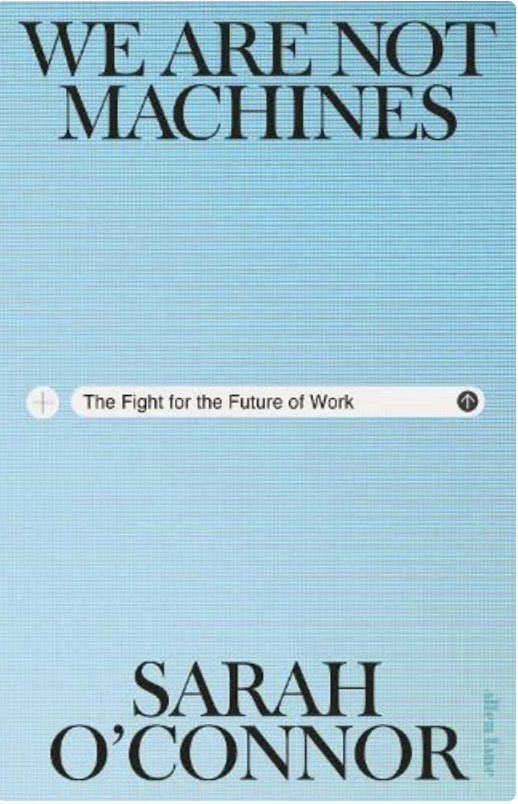
I have really enjoyed reading Sarah O’Connor’s new book We Are Not Machines: The Fight for the Future of Work. It weaves dispatches from the frontline of how AI and other digital tech is changing people’s jobs – from screenwriting and translating to truck driving, mining and working in an Amazon warehouse – into broader reflections on the nature of work. Some of the most powerful sections are about decisions not to work to the rhythm of machines but rather to find alternative ways of finding satisfaction and doing work that other humans value.

Readers of Sarah’s articles in the Financial Times – the only newspaper worth reading regularly any more – will be aware that she (& fellow journalist John Burn-Murdoch) keep up heroically with the vast amount of academic work on AI and labour markets, so the book is very well-informed about those debates. Combining that with reportage brings the issues to life, but also raises questions the academic literature rarely surfaces.

The one that stands out in my mind is why on earth our societies and politicians are going along with the use of AI to dehumanise the humans, to make people work to the rhythm of the machines. Truck drivers have long and unhealthy shifts because of the requirements imposed by the tachygraphs that regulate driving hours – the maximum becomes the target – and the answer to their risk of dozing off in the cab is still more machines to monitor them. In warehouse jobs, as the AI gets faster, the demands on the people serving the logistic robots become more relentless.

To some extent the answer is collective organisation – the Hollywood writers strike being one example, the Dutch Buurtzorg home care nursing organisation another. But of course there are bigger issues about the course modern capitalism has taken, making it seem inevitable that we will end up with lower-quality but cheaper AI-inflected services.The positive stories here of humans being able to make machines work for them are encouraging, but are also small victories in the bigger conflict.

The book has a wonderful quote from Lewis Mumford: “The purpose of art has never been labor-saving but labor-loving, a deliberate examination of function, form and symbolic ornament to enhance the interest of life itself.” Public opinion studies show that substituting for creative endeavour was the last thing people want AI to do, but it has ended up being the first thing. As the book concludes, “The future of work can be more worthy of the human mind, more careful of the human body, more satisfying to the human soul. But not without a fight.”

Technology will be the means to achieve a better future of work; the fight (as it always has been) is against the institutions using it to enrich and empower themselves at the expense of the common good.

Screenshot 2026-06-07 at 16.55.11


May reading roundup

Another month’s roundup (eek). Well, there’s another week to go but as it’s a long weekend I have time to do this.

Work-related first.

The Irrational Decision: How We Gave Computers the Power to Choose for Us by Benjamin Recht. To begin with I thought this would be another book about the embedding of rational optimising decision-making as computers met operations research and economics in the postwar decades. I’ve read a few of those already. It also has a chapter on why RCTs aren’t everything, which I also read recently in Adam Kurcharski’s book Proof, and in re-reading the Deaton and Cartwright paper on this.

The book comes into its own after the early chapters when it moves on to computational pattern recognition, including why adding more data and compute to the process produces a step change in prediction capabilities via neural networks. “There is no theory of why ‘deep neural networks’ – as we now call them – work well on all these different prediction problems,” Recht writes. He adds a few pages later: “Machine learning only makes sense if an engineer doesn’t know how to write the code.” Prediction rests on patterns in data.

The book ends on machine vs human decision-making: “No matter how good human intuition might be, it is evaluated against a metric that is a statistical count.Once someone decides that the metric is what needs to be met and that metric needs to be maximized on average, then the best decision is necessarily statistical. …. If we can measure why humans might be able to outperform machines, then we can build machines to outperform people. On the other hand, if we can’t clealy articulate a set of actions, outcomes, measurements and metrics, then we can’t mechanize problem-solving.” 

So in the end I thought this was a well worthwhile read.

Screenshot 2026-05-24 at 13.23.43Hayek’s Bastards by Quinn Slobodian is an account of how neoliberals co-opted science, and particularly genetic science, for the extreme right. Today’s offspring of the Mont Pelerin crowd cherry pick from the scientific literature to argue for an ‘essential’ human nature and genetic differences.

How to Win A Trade War by Soumaya Keynes and Chad Bown is a funny (yes, really) explanation of trade in theory and practice. It gives advice to the novice negotiator about how to win, or at least cope with, today’s hostile environment for free trade. It’s an excellent intro for students just embarking on trade economics, and for the famous general readers – or possibly airport bookstore readers.

The Achilles Trap by Steve Coll. I htink this counts as work-related, although it was one of the monthly surprises I get thanks to the Daunt’s subscription my dear husband gave me. It’s a very detailed but yet surprising compelling account of the US-Iraq conflict(s). Fascinating to understand how little the Americans and Iraqis understood the other’s decision-making constraints and context.

Non-work

A Year With Gilbert White by Jenny Uglow is a lovely reflection on the nature writer himself, the emergence of nature writing, and the changes happening now in nature.

Common Ground by Rob Cowen is also about nature, this time in the edgelands of modern Harrogate rather than 18th century rural Hampshire. Reflections about change, and rather optimistically change for the better.

We are Movement by Wayne McGregor. This is a sort of how-to book: how to use your body, feel at ease in your body, with wide references to underlying science. I didn’t do all the exercises, and it does verge on woke, but I enjoyed reading it. It was recommended by my friend Mark Fabian, who is an academic expert on well-being.

Before the Coffee Gets Cold by Toshikazu Kamaguchi. Sweet, slight. Rory’s book group chose it so I read it too.

The Heron’s Cry by Anne Cleves – detective fiction comfort read.

April reads (yes, another month has flashed past)

It’s been a busy, busy academic year so it seems I’m only managing monthly round-ups here at the moment. A little more though on two books i’ve read in the past few days.

One was Mark Fabian’s Beyond Happy. Mark, who was a postdoc with us and is now an associate prof at Warwick University, is a true academic expert on wellbeing. He has a definitive recent scholarly book on this A Theory of Subjective Wellbeing. Beyond Happy is aimed at general readers, and is a lovely book. It refers to the literature in philosophy, psychology and economics to offer practical advice – not ‘how to be happy’, but how to make sure your life is meaningful, full of purpose, rewarding: “Wellbeing is about living a pleasant, fulfilling and valuable life. In recent decades we’ve been too narrowly fixated on the pleasant part, and an a crude way too. We’ve gone in for materialism, hedonism and tranquillity.” He also emphasises – in contrast to the dreadful ‘wellness’ industry – that wellbeing is a social phenomenon. Relationships and community make a huge difference. The book is a bit denser than the typical self-help book because it does synthesise the academic literature, but is correspondingly more rewarding.

The other was Markus Gabriel’s Doing Good. I encountered Markus at several workshops in Oxford and Hamburg in recent years as he developed his arguments that “the business of business is doing good.” The book advocates for ‘ethical capitalism’, with a chief philosopher or ethics officer in every business, having the same board status as the finance director. And extending the vote to children so the voice of the future is better represented in democracies. For my tastes, the book is too utopian, focused as it is on why societies need ethical capitalism rather than how they might get there. I tried to imagine how I’d react to its arguments if I were a troglodyte Milton Friedman-loving, greed is good, free marketeer; and am not sure it would make a dent in my certainties. Still, it’s an elegantly argued book that might provide woolly-liberal me with some ammunition.

Other reads this month:

Three state of the nation books – I’ve reviewed them for the FT in the near future – The Land Where Nothing Works by A.G. Hopkins, Challenging Inequalities by Paul Johnson, and Yesterday: the United Kingdom from Thatcher to Covid by Brian Harrison

Holiday reads with the family in Whitstable:

Number Go Up by Zeke Faux – very funny (sceptical) perspective on the crypto world

Death in the East by Abhir Mukerjee – another in this excellent detective series set in India as the independence struggle heats up

Down Cemetary Road – Mick Herron’s first novel.

Careless People by Sarah Wynn Williams. I was late to this whistleblower’s account of what it’s like inside Meta. Eyebrow raising.

Death of an Ordinary Man by Sarah Perry – a beautiful reflection on death, and life, as she recounts her father-in-law’s last days

And since then:

Tyll by Daniel Kehlmann – odd novel set in 15th century Germany, but compelling

The Playbook by James Shapiro – history of the Federal Theatre Project in the New Deal, and its downfall

Silent Voices by Ann Cleves – a Vera novel, just what I needed one exhausted evening. Though I found this less well-written than some of her others in the series.

IMG_7411Whitstable – a great place to read on holiday

March reading

Another month, another quick catch-up post. And actually I’ve read very few books by my normal standards.

One was a re-read, The Infinite Alphabet by Cesar Hidalgo, as I was ‘in conversation’ with him at Waterstones in Cambridge. It’s a very clear and readable explanation of complexity economics, with loads of vivid examples. I like the complexity approach: it has strong explanatory power empirically, and Cesar has got a long way in developing the underpinning theory. He and I also did a Crossing Channels podcast on the book a little while ago. I’d recommend this as a complement to current debates about industrial policy and the supply side of the economy.

Another work(ish) read was Everything Was Forever, Until it Was No More by Alexei Yurchak. I’d been looking forward to this. It’s about the paradox that Soviet citizens did not expect the end of communism and fall of the USSR but were not surprised when it happened. There are great chapters describing what it was like being a member of Komsomol, for example, living the doublespeak. Unfortunately the core of the book is bookended with critical theory/linguistics, which is so hard for me to read.

Non-work reading:

Suspicion by Seichi Matsumoto – rather dark.

Flesh by David Szalay. Don’t bother. This one got me (internally) ranting about why the Booker Prize winners have become so terrible. I couldn’t finish Orbital because it was soooooo dull, and didn’t bother finishing this one either because I didn’t care at all about what happened to anyone. Prophet Song was the only recent Booker winner I rated – couldn’t put it down. Meanwhile recent Nobel prizewinners have been fantastic – Han Kang, Olga Tokarczuk, Abdulrzak Gurnah, Laszlo Krasznahorkai etc.

Perspectives by Laurent Binet. Wonderful. An epistolary novel featuring 16th century Florentine painters and the murder of a fresco-painter. Very clever. Yes, the solution depends on a shift in perspective.

Hopefully, back to normal reading now as term is over. I’m also going to be reviewing a trio of books about the UK economy for the FT so need to crack on with those.

Meanwhile, here are some beautiful spring tulips.

C1217EC2-989D-40D6-9327-EAAFF8C9AD62_1_105_c

February catch-up

Somehow a whole month scooted by, so this is another round-up post. I read a lot as I was travelling a lot, but wrote little as I also had a big end of month deadline (met just in time).

When the Clock Broke by John Ganz – a good, sobering, read about the deep roots (in Reaganite economic policies as well as loder traditions of white supremacy) of the polarisation of American politics. It tells the tale through a focus on the growing extremist politics of characters like David Duke, Pat Buchanan and Ross Perot.

War and Power by Phillips O’Brien – sent to me by an historian friend. A persuasive framework for understanding how (not to) win wars. My main takeaway was that planning and logistics matter above all else, along with the capacity of the domestic economy to produce what’s needed. Battles – not so much. Mr Hegseth has obviously not read this book.

What Is Intelligence? by Blaise Aguera Y Arcas. I read this very quickly when it first came out and have just re-read it, having picked up a copy at Social Science FOO in Mountain View. Super-interesting, ranging from quantum physics through neuroscience to AI. Lots of great facts I didn’t know (who knew bees could recognise human faces?). But also a thought-provoking argument about the unity of how intelligence evolves across the universe – including AI. I don’t know if I’m completely persuaded, but it has made me pause.

Accounting for Capitalism by Michael Zakim. This is an enjoyable history mainly about the growth of the clerical class in 19th and early 20th century America. It also touches on the technologies of book-keeping and the growth of statistics.

How Data Happened by Chris Wiggins & Matthew Jones. This would be a good introduction for students to the history of statistics from Quetelet on, and to the role of data today and the ethical issues raised by its use. For me, not a lot new here.

I also re-read How Reason Almost Lost Its Mind: The Strange Career of Postwar Rationality, written by a group of academics out of a workshop on the postwar elevation of rational calculation as the basis for policy. It’s interesting but rather superseded by Elizabeth Popp Berman’s Thinking Like An Economist and Jill Lepore’s If Then.

Non work reads:

Nonesuch by Francis Spufford – a new novel by Francis Spufford is always an occasion. I enjoyed it, but it’s a bit odd.

Telling Tales Ann Cleves – one of the excellent Vera series.

The Lost Man of Bombay and City of Destruction Vaseem Khan – two of his detective novels featuring a unique female detective in 1950s Bombay.

Sybil & Cyril by Jenny Uglow – I love her writing but didn’t care much about these two characters in the end

The Afghans by Asne Seierstadt and The Finest Hotel in Kabul by Lyse Doucet – accidentally ended up reading two histories of Afghanistan, both a bit grim. I much preferred the Lyse Doucet one except for the quirk that she refers to herself in the third person – but one could trust that she knows the people she writes about.

In Extremis by Tim Parks – no, don’t bother. Unlikeable main character, not at all funny despite its billing. A shame, as I’ve enjoyed other books by him.

The Garden Against Time by Olivia Laing – a lovely read, about creating a garden in a new home in covid-times and in the face of environmental change.