Prospects for the Swedish model

There’s an interesting new book, Digitalization, Immigration and the Welfare State, by Marten Blix of Sweden’s Research Institute of Industrial Economics. It brings together two deep trends, technology and immigration, in the context of the relatively rigid labour market structures of Sweden and some other European countries. Blix asks, what are the implications for the welfare state, the high tax, high spend social contract? He argues that the combined trends are increasing inequality, and the longstanding social support for redistribution and high taxation is eroding. Sweden has been at the forefront of both trends. It ranks high on measures of digitzation, and has taken in more refugees per capita than most other European countries. It has consequently had one of the biggest increases in income inequality in the OECD (the level of inequality is still relatively low – similar to Canada or Germany).

Ultimately, the book suggests a Swedish model of social democracy can potentially survive, thanks to the country’s high productivity and high initial levels of social capital. Sweden’s public finances are also in better shape than in many other countries. However, it certainly doesn’t look like an easy path. Absorbing the new immigrants will require a focus on enhancing their skills – and also those of the already-resident. One prescription is reducing the rigidities in the labour market and housing market. Another area where greater flexibility will be needed is in accommodating the increase in work – via digital platforms for instance – outside the traditional collective wage bargaining. Some Swedish unions are apparently working to establish employment standards on the digital platforms.

As the book concludes, however, the obstacles to the reinvention of the Swedish model – or any other social contract – are not problems of economic analysis but political obstacles. Economists often talk of the need for ‘structural reform’ when this is code for ‘politically bloody difficult.’ Immigration makes the politics harder, Blix argues: “Sweden is no longer the homogeneous country it used to be and the social contract holding people together is at risk of disintegrating.” All the more dangerous, then, he says to pretend everything is fine and nothing needs to change. The newcomers have to be brought into the fold or the future of the Swedish model looks to be in doubt.

Much of this debate is of course familiar to those of us more familiar with the UK and US economies, as is the kind of political lunge to the populist right or left that accompanies these tech and migration trends. It’s interesting to read about the challenges in the context of a country that has so long been an admired model for the centre left (and even some of the centre right). I accept that it’s essential to try the kind of policy response the book suggests, hard as that is, given the do-nothing alternative. But it’s quite hard to feel optimistic these days. Even Sweden!


41zs6+JULBL

Free innovation

I polished off Eric von Hippel’s Free Innovation on my Washington trip. It’s an interesting, short book looking at the viability and character of innovation by individuals – alone or co-operating in communities. It is free in two senses: the work involved is not paid; and the innovations – or at least their design – is not charged for, although it may subsequently be commercialised by the inventors or by other businesses. The viability of free innovation has been greatly extended by digital technology and the internet: there is more accessible useful information, it is easier and cheaper to co-ordinate among a group. The diffusion of innovations is also easier, although rarely as extensive as when a commercial business takes them up and markets them. In fact, von Hippel argues that there are some strong complementarities between free innovation and commercial vendors, as the latter can bring the scale economies of production and marketing, while the former can enhance the use case, the complementary know-how, that increase the value of whatever it is.

The book has a little theorising, some survey evidence on the wide scope of free innovation, and plenty of nice examples. It ends with a couple of chapters on how to safeguard the legal rights of free innovation and how the pehnomenon might be encouraged. The scope is what interests me particularly. I had already been thinking about phenomena such as open source software as a voluntary public good, which competes with marketed goods – compare Apache with Microsoft’s server software (as Shane Greenstein and Frank Nagle do here). There is clearly a growing amount of substitution across the production boundary going on.

The surveys reported in this book seem to indicate that millions of people are innovating (5-6% of respondents in the UK and US, Finland and Canada) – but equally, some of the innovations are minor contributors to economic welfare and one cannot imagine them ever having a wide market or competing with marketed equivalents. The question is how to get a handle on the scope and scale of all the open source, public good, innovation.

415db3y94YL

Statistics vs truthiness

I thoroughly enjoyed reading Howard Wainer’s Truth or Truthiness: Distinguishing Fact From Fiction By Learning to Think Like a Data Scientist. I even laughed out loud occasionally, as there’s a lot of wit on display here, and one gets a strong sense of Wainer’s personality. This is not usual in a book about statistics (although having said that, Angrist and Pischke also do quite well on the clarity and fun front, especially for econometricians.)

Truth or Truthiness a collection of essays in effect, published as a response to this brave new world of truthiness (ie. lies that people believe because they want to) in politics and public debate. Wainer writes very clearly about statistics in general, and his main theme here, causal inference. This is of course dear to the heart of economists, and gratifyingly Wainer recognises that the profession is more scrupulous than most disciplines about causation. The book starts by underlining the importance of having a clear counterfactual in mind and thinking – thinking! – about how it might be possible to estimate the size of any causal effect. As Wainer puts it, “The real world is hopelessly multivariate,” so untangling the causality is never going to happen without careful thought.

I also discovered that one aspect of something that’s bugged me since my thesis days – when I started disaggregating macro data – namely the pitfalls of aggregation, has a name elsewhere in the scholarly forest: “The ecological fallacy, in which apparent structure exists in grouped (eg average) data that disappaears or even reverses on the individual level.” It seems it’s a commonplace in statistics – here’s one clear explanation I found. Actually, I think the aggregation issues are more extensive in economics; for example I once heard Dave Giles do a brilliant lecture on how time aggregation can lead to spurious autocorrelation results.

Having said how much I enjoyed reading Truth or Truthiness, I’m not sure who it’s aimed at who isn’t already really interested in statistics. For newcomers to Wainer, I’d recommend his wonderful earlier books, Picturing the Uncertain World, and Graphical Discovery. They’re up there with Edward Tufte’s books on intelligent visualisation (rather than the decorative visualisation that’s become unfortunately common).

51ZBzzdWQwL

The polarised republic

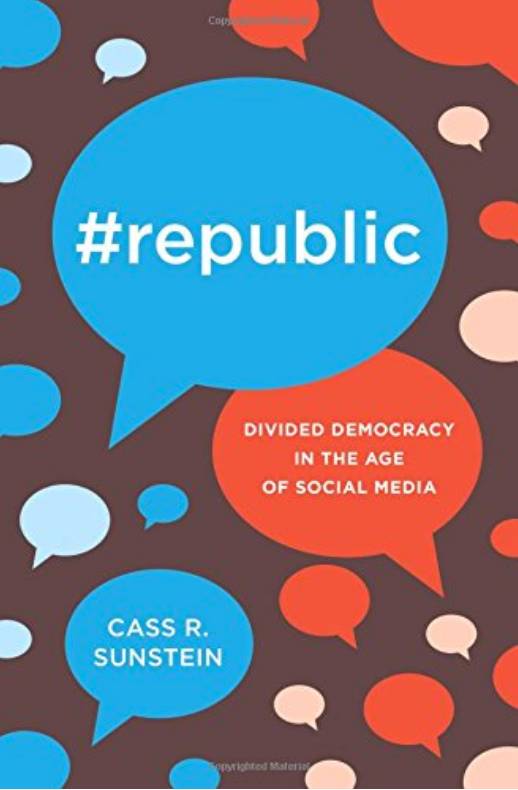
Cass Sunstein’s #Republic: Divided Democracy in the Age of Social Media is very timely, as we all, horrified, watch the American republic splinter ever more irreparably since the election last November. The book links the literature on filter bubbles and social media dynamics with the actual political impact in the US context, and the constitutional implications.

It cites the growing empirical literature on political polarisation as a result of the spread and increasing use of social media, especially Facebook. (Of course, conventional media have contributed to the polarisation as well – there are some empirical studies such as this one.) Some of the figures Sunstein cites are startling, such as the polling showing that both Republicans and Democrats have growing increasingly likely to express “displeasure” if their child were to marry someone with the opposite political affiliation (49% and 33% respectively in 2010, up from 5% and 4% in 1960, presumably higher still now). This far exceeds the “displeasure” expressed about inter-racial relationships.

Much of the book concerns the scope for deliberative democracy, or getting people to talk to each other and talk through problems. Technology could in principle enable this, although it currently does the opposite. At the same time, the other occasions on which we would all ‘meet’ different kinds of people, from different classes and races, and different opinions, have shrunk. There is more social sorting in real life. The conventional broadcast media are being displaced, and narrower themselves. (Not to mention now being under attack by Trump and Bannon.) Sunstein isn’t too starry eyed about democracy, though: “For many political questions, what matters is getting the facts straight, and for that you need experts, not deliberative opinion polls.” Hooray!

Communications and the media are exceptionally important in a democracy (cf Amartya Sen) and are at the epicentre of the current maelstrom of populism. I was interested in Sunstein’s emphasis on the importance of media ‘solidarity goods’, a special form of merit good that promotes social interaction, debate, understanding, a sense of shared citizenship and solidarity. He suggests solidarity goods are essential to build social capital.

The book resists the temptation to offer quick fixes – there aren’t any. Instead it underlines the priciples of any measures that might make things better: exposing people to material and ideas they wouldn’t otherwise choose or experience; ensuring citizens have a range of common experiences; ensuring policy debates have substance – ‘expertise’. It’s clear to me there are some sharp questions about the regulatory framework governing social media and the online world in general, questions regulators have been pretty keen to avoid so far. It’s time for them to do so now.

Untitled

Markets, states and humans

I was eager to read Paul De Grauwe’s The Limits of the Market because I profoundly agree with its premise that the false dichotomy between ‘the state’ and ‘the market’ has led to bad public policies and lower social welfare. The book is a short overview of the flaws of this dichotomous view of the world. It organises its discussion around two sets of reasons why a ‘free market’ is a meaningless abstraction: externalities and ‘internalities’.

The idea of an externality is familiar of course – that individual choices by a person or business have consequences, good or bad, for others. Once you start thinking about it, you realise externalities are pervasive. Indeed, they include many not acknowledged in standard economic theory which assumes fixed preferences, when of course preferences are socially determined. As De Grauwe points out, it is not easy to address externalities with government policies (not that this means there’s no point in trying): “The market fails in the face of externalities. When this happens, the government must step in. However …. that is also the moment at which the discrepancy between individual and collective interest is widest.”

The word ‘internality’ is new to me – though this is the second time I’ve come across it used by a Francophone author. It refers to the capacity humans have to make decisions that damage their ‘rational’ self-interest. I would think of this as a failure of one of the other assumptions of standard welfare economics, namely individual utility maximisation. The book makes use of Daniel Kahneman’s distinction between System I thinking (emotion, instinct) and System II (reasoned calculation). Market outcomes that satisfy the latter can adversely affect – say – our fairness instinct. “This dissatisfaction creates an opportunity for governments to fill the emotional gap left by the free market and to focus on System I, which steers our emotions. Many emotions find an outlet through government.” Well, most people probably have rather negative feelings about government, but one sees what he means.

The book is an extended reflection on this dual set of market failures, and the inevitable involvement of both (coercive) government actions and individual choices in the economy. I ended up being a bit disappointed, as it does fall between the two stools of accessibility for the general readership and technical rigour for professional economists, so I didn’t feel I got tremendous new insights. It’s also expensive for a very short book (£25 for 160 pages), albeit not in stupid academic book price territory. Still, the framework set out for thinking about the roles of government and market is neat, and I’ll recommend it to students who are particularly interested in the welfare economics but won’t want anything technical.