
Work (and more) in digital times

This week I’ve been dipping in to Work in the Digital Age: Challenges of the Fourth Industrial Revolution, edited by Neufeind, O’Reilly and Ranft. This is a collection of short essays brought togoether by Policy Network, the centre-left ‘progressive’ think tank. It’s a chunky book, starting with sections essays on prospects for employment and the character of work. These cover, for example, the likely impact of automation in destroying and creating jobs, and the nature of work in the ‘gig’ economy. A section on labour relations and the welfare state follows. There are then chapters on individual European countries, ordered according to the ‘digital density’: Scandinavia and the Netherlands are classed as high, the UK and Germany medium, France, Italy and Central and Eastern Europe as low. There are also chapters on the US, Canada and India. The comparisons between countries were at the heart of the project, and I admit to not having read these chapters.

Given that I read so much of the economic literature on these issues, I haven’t found anything startlingly new so far, although there are some interesting perspectives. For example Martin Kenney and John Zysman consider the question of financing technology start-ups when they face a long period of losses because of what’s known in the platform literature as the chicken and egg problem: a platform needs users on both sides – riders as well as drivers for instance – because it won’t attract riders without enough drives and won’t have enough drivers unless it has a user base. The winner-take-all success stories then look for a long period of rents to recover those early losses, although many platforms simply fail. The essay argues that it is not clear whether this financing model is creating economic and social value. (I argue in a forthcoming paper that this is one aspect of the wider failure of competition economics to have figured out how to compare static welfare gains and losses to dynamic ones.)

In other chapters, Ursula Huws et al report new surveys on the extent of gig work or crowd work – from 9% in the UK to 22% in Italy, usually as part of a broader spectrum of casual work; Monique Kremer and Robert Went set out an agenda for ensuring automation does not increase inequality, covering the direction of robotisation, the enhancement of complementary skills, and distributional policy instruments; and in an introductory essay Luc Soete on the productivity paradox discusses similarities with and differences from previous technological revolutions. The final chapter sets out a reform agenda – education and training; work transitions; social protection; redistributive taxes and transfers; and investing in infrastructure and innovation. This is high level stuff, and therefore a bit motherhood and apple pie. Having contributed essays to this kind of collection myself, I know this pitch of generality is inevitable, but do ache for some policy specifics as opposed to ‘a new inclusive narrative’.

For an overview of the technology and work debate, this is a useful volume, though, and it can be downloaded free from here. It’s certainly a good place to start for a comparative perspective, and the references to country-specific literature look really useful.

[amazon_link asins=’B07D5ZZD77′ template=’ProductAd’ store=’enlighteconom-21′ marketplace=’UK’ link_id=’35442710-9322-11e8-93ed-f1b496423b7d’]
The not-so-secret secrets of research

The Secret Life of Science: How it Really Works and Why It Matters by Jeremy Baumberg won’t hold many surprises for economists working in academia. The increasing role of publication metrics in career prospects, even though everyone knows them to be counter-productive or even pernicious. The narrowing of scholarly horizons within disciplinary silos partly for this reason and partly (in the UK) because of the REF exercise. The creaking peer review system. The debate about open access and the monopoly power of certain journal publishers. I don’t know whether the same is true in the humanities and other social sciences, but the description of the systemic pressures and the way they make it ever harder to allow intellectual curiosity and boundary-crossing work free rein – for some very good reasons – makes this book a reflection on more than the natural sciences, but rather on the institutional framework for research as a whole, into which citizens pour a good deal of funding.

There are, however, additional issues in the sciences, not least the very high cost of equipment and facilities in some areas, and the failure of the funding system as a whole to be able to reflect on and implement societal priorities. Another difference is the institutional framework, with much scientific research (to varying degrees across countries – there are interesting figures in the book) occurring in the private sector. Baumberg also discusses the ever-rising number of scientific researchers, in what seems to be a sort of winner-takes-all dynamic of funding concentrating in elite groups and no signs of increasing diversity, producing seemingly ever-decreasing returns.

Although the issues may be familiar, the book usefully presents them all as a combined system challenge. It is pretty factual and even handed, but one ends with a strong sense of the need for some system-wide reforms. Baumberg has no silver bullet solution, and quite right too. He makes some suggestions such as introducing other kinds of metrics than citations, finding some ‘anarchic’ ways to fund science, creating better and different career structures for postdocs.

I read the book just after Richard Jones’s and James Wilsdon’s thought-provoking and trenchant report on ‘biomedical bubble’ in the UK. I doubt The Secret Life of Science will appeal to the general audience as it’s much more about the institutional framework than about the scientific research. But although researchers will already know – and live in their daily lives – the issues flagged up in the book, it’s a timely warning that the scientific endeavour that has brought our societies astonishingly greater prosperity and improvements in the quality of life is sclerotic and failing to deliver for the societies funding research. Hard as it may be for a young researcher struggling under all these pressures to regard herself as part of the despised ‘elite’, that’s the big issue facing scientific and other research. Time to tackle it.

[amazon_link asins=’0691174350′ template=’ProductAd’ store=’enlighteconom-21′ marketplace=’UK’ link_id=’d3269161-8fdb-11e8-8b3d-e1165f417ac3′]

Is my argument covered in gargoyles?

Now that I’m paddling at the edge of the inter-disciplinarity ocean – dangerous waters – I read – on the recommendation of esteemed colleagues – Metaphors We Live By (1980) by George Lakoff and Mark Johnson. I gather it has been highly influential, and it was indeed stimulating read. However, I struggled with parts of the argument, which started brilliantly: we use metaphors, often informed by our bodies, in language and thought. ‘Up’ and ‘forward’ are powerful when incorporated in metaphors, because we stand up and walk forwards. I really enjoyed being prodded to think about the use of language and what it would mean to take metaphors seriously. Why does ‘ your argument has a solid structure’ work but ‘your argument is covered in gargoyles’ not? Why can we have raw facts and half baked ideas but not sautéed or poached data?

However, I struggled with the labelling of some ways of speaking as metaphors at all. I can see ‘argument as war’ is one. But is ‘inflation is an entity’? It’s an analytical construct for sure, but it isn’t exactly not a thing either. So is ‘inflation is lowering our standard of living’ really a metaphorical construction. Are ‘time is a resource’ and ‘labour is a resource’ metaphors at all? The further I got into the book, the less I was persuaded.

Evidently the book played into the objectivism vs relativism debate, and the authors sensibly accept that the ‘real world’ clearly constrains our conceptual system, although they are on the relativism end of the see-saw. As the title of chapter 27 puts it: “How metaphor reveals the limitations of the myth of objectivism.” They argue that the way we use language means objects (out there in the real world, as it were) are entities relative to our interaction with the world, and our projections onto it. Properties of objects are interactional rather than inherent, in their view. No doubt this is philosophically incoherent, but I’m not sure why there can’t be inherent properties as well as those we perceive through our interactions with the world and categorise, metaphorically or not.

The book ends with a paragraph on economics which is half spot on: “Political and economic ideologies are framed in mataphorical terms. Like all other metaphors, political and economic metaphors can hide aspects of reality. But in the area of politics and economics, metaphors matter more because they constrain our lives.” I think Deirdre McCloskey (The Rhetoric of Economics) or Albert Hirschman (The Rhetoric of Reaction) would agree. However, this coda seems half gibberish too, at least to this literal-minded economist: why is ‘labour is a resource’ a metaphor because it fails (as a metaphor) to distinguish meaningful from meaningless labour?

Anyway, among other reading, Meetings with Remarkable Manuscripts by Christopher de Hamel is marvellous. I laughed and I cried (literally, not metaphorically). I only quite enjoyed Cees Nooteboom’s Roads to Santiago. I read Cass Sunstein’s latest, The Cost Benefit Revolution, out in September – when I’ll review it. I’m spoilt for choice for my next one, as the in-pile is teetering at the moment. When I’m super-busy, as these at months have been, acquiring a new book seems to be a purchase of the implicit time to read it. If only!

[amazon_link asins=’0226468011′ template=’ProductAd’ store=’enlighteconom-21′ marketplace=’UK’ link_id=’572167ca-8c1c-11e8-8eb2-dbe1f5eb2256′]


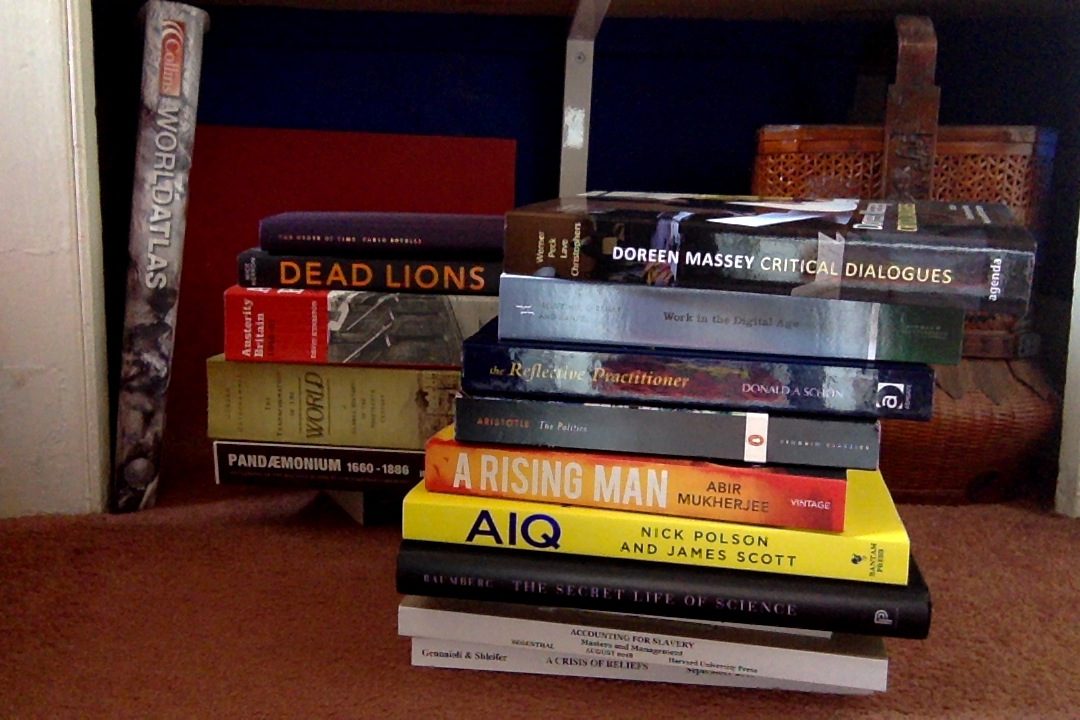
And the in-pile:

Photo on 20-07-2018 at 14.01


Our Gilded Age (India version)

James Crabtree’s The Billionaire Raj is a page turner – really informative and well written (as one would expect from the FT’s former Mumbai bureau chief), full of surprises, and above all a fascinating window on India’s super-wealthy. The theme of the book is corruption, and its co-evolution with the Indian economy as the ‘licence raj’ restrictions were progressively removed, and new sectors like telecoms grew dramatically. In this new world, the super-wealthy businessmen and the politicians found they needed each other: the deployment of legislation and contracts helped the former, the opportunity to take part in business helped the latter. As one of the interviewees puts it: “They [the politicians] are saying: ‘We don’t want briefcases full of cash and Swiss bank accounts and all that any more. We want to own businesses ourselves. We want equity stakes.”

The scandals covered in the book – from airlines to cricket – are extraordinary, as are the descriptions of wealth flaunted. It is somewhat cheering to know that some scandals resulted in at least disgrace and sometimes arrest. There are also some thoughtful reflections on whether the practices described are always entirely bad: might they in some phases of development ensure that infrastructure gets built? One example in the book is a half-built steel mill and power station complex, halted by the cancellation of coal mining licences  due to allegations of corruption. Crabtree writes: “Watching him [Naveen Jindal], I was struck by the stress of his position: the billions in loans, the half-finished projects and the thousands of workers who …expected him to find a way to fix them.” The downside of doing business by politica favours is the unpredictability of it all.

There is something of this flavour in David Pilling’s Lunch with the FT with Nigeria’s Aliko Dangote, who recounts how he got his big break:

‘“Obasanjo called me very early in the morning and said, ‘Can we meet today?’ ” says Dangote, recalling the presidential summons. He wanted to know why Nigeria couldn’t produce cement, instead importing it by the boatload. Dangote told him it was more profitable to trade than to produce. Only if imports were restricted would it be worthwhile. Obasanjo agreed. Dangote has never looked back.’

Crabtree also cites Katherine Boo’s book Behind the Beautiful Forevers, (reviewed on this blog), which describes corruption at the bottom of the income scale. Although this clearly acts as a tax on low incomes, she has sympathy for those who earn so little that they can’t afford not to demand bribes.

I ended up not sure whether to be optimistic about India’s dynamism and scale, seeing this Gilded Age as growing pains, or pessimistic because of the debt mountain involved, and the nationalist politics of the present government – the chapters on Narendra Modi do not leave the reader reassured. Either way, this book opens a window on an extraordinary period of change in India, a country too big and important for its future not to affect all of us.

[amazon_link asins=’1786073803′ template=’ProductAd’ store=’enlighteconom-21′ marketplace=’UK’ link_id=’f054b83c-882d-11e8-8122-ad5599381556′]

Here is the author being interviewed about the book on NPR.

Global Britain and national Britain

It has taken me a while to finish David Edgerton’s new book, The Rise and Fall of the British Nation: A Twentieth Century History. This is because of the packaging rather than the contents – it’s a heavy volume I’ve had to read at home propped up with cushions. So although I’ve enjoyed the book, I have a rather impressionistic take on it.

The chief impression is that there isn’t a single piece of received wisdom about Britain in the 20th century the author doesn’t challenge. Edgerton has challenged the ‘declinism’ thesis in his previous books and does so again. But there are other myths to bust. The welfare state wasn’t distinctively new after 1945 – a lot of it had been established in the 1920s. The Labour Government of Harold Wilson wasn’t especially technology-friendly. It is nonsense to claim the Establishment consisted of anti-scientific art historians and classicists, there were loads of technologists and scientists in government. It is indeed refreshing to read such an upbeat take on the 1950s and 60s.

Above all, the book argues, the key phenomenon of the post-world war 2 decades was not welfarism or corporatism but  the creation of a distinctive British nation – until Mrs Thatcher started to turn the country back into an internationalist capitalist one, as it had been in the early 20th century. Edgerton’s British nation lasts only from 1945 to 1979.

This makes for a refreshing read, there’s nothing like a bit of lively contrarianism. In fact, you can see Edgerton’s compulsion to be contrary in his challenge to both industrial declinism and techno-boosterism simultaneously, which – while surely the correct stance – is also pretty argumentative.

But not every bit of his myth-busting is wholly persuasive. On the NHS, for instance, Edgerton argues that most of the provision was in place prior to 1945, and those with low incomes did not have to pay for treatment. He offers some facts on the extent of municipal provision, the role of GPs, and so on. This surely greatly underplays the uncertainty and anxiety of getting medical treatment before the NHS. Even if it is true that people ended up being able to access treatment and not having to pay, I remember from my 1960s childhood the deep, deep financial worry illness caused older people, not habituated to the idea that you could turn up at a surgery or hospital and nobody would ask about your means.

The book is at its best on technology and industry, which is hardly surprising given Edgerton’s wonderful previous books on technology – particularly The Shock of the Old but also Warfare State and Britain’s War Machine. It ends with New Labour, and the attempt to define a forward-looking, techno-optimistic Global Britishness. In fact, it ends with Mrs Thatcher’s state funeral – the first accorded to a PM since Churchill’s:

“There were no cranes left to be dipped in respect by dockers in the unprecedented honour the London proletariat gave Churchill in 1965. In the old and distressed pit villages of England, Scotland and Wales, forgotten former miners celebrated bitterly. Tony Blair meanwhile was making money working for some of the vilest torturers and dictators on earth. Only satirists, not historians, could do justice to this turn of events.”

And then it stops. Hmmm. There were of course loads of cranes on the London skyline, contstructing rather than unloading, and nobody chose to dip them for the funeral. Mrs Thatcher’s governments had indeed ravaged the country’s economy outside of south east England – this book does far better than many histories of Britain in not being a wholly London- and Westminster-centric one, given its focus on industry – and the real criticism of the decision to give her a state funeral would surely be her divisiveness. It’s an unsatisfactory (lack of) ending to a very interesting book.

An earlier chapter considers the emerging divisions in society but also within the main political parties from the 1970s on and it would have been more satisfying to see this rounded out somehow with reference to current debates about the utter mess of Westminster politics, a devolving Britain, the polarisation over Brexit, and in the middle of all this ideas about industrial policy and the technology frontier. Unfair to ask a historian for comment on the present – but the idea of the British nation is surely at the heart of it all today?

Anyway, as noted, these are impressions. It isn’t just the bulk: there is a flavour of one thing after another, as sections plunge into detail – albeit always fascinating. This is well worth a read nevertheless (although in paperback maybe?)

[amazon_link asins=’1846147751′ template=’ProductAd’ store=’enlighteconom-21′ marketplace=’UK’ link_id=’1ee700fc-82bf-11e8-8ac8-97f4afcb54f6′]