Profit and time

Avner Offer’s new, shortish book Understanding the Private-Public Divide: Markets, Governments and Time Horizons is superb. It sets out a persuasive argument for locating the boundary between private and public production in terms of the payback period for investment. The book starts: “In economics… the present is all there is. Past costs are sunk and can be ignored. The future is only what we make of it today.” What if we take seriously the need to invest for the future? As he points out, government accounts for 30-40% of GDP in most rich countries, and when you add in non-profit and household production well under half of economic welfare is produced on a for-profit basis – and that couldn’t happen without government-provided infrastructure or other support such as franchises or patents.

The central point is that for-profit investment needs to pay off in a relatively short period: “The higher the rate, the shorter the wait.” The prevailing interest rate defines a unique break-even period. Private markets can produce efficiently if the pay-off period is shorter. Otherwise, government has to act as the “commitment agent for society.” When it steps back from this, delegating to private agents, corruption is often the result, or else the enrichment of managers and shareholders at the expense of workers and consumers. There are no grounds for expecting efficiency gains – quite the contrary.

Offer writes: “There is no warrant for extending market norms to the rest of social activity, to the family, government, infrastructure, education, healthcare, science and arts, social insurance, old age, defence, protecting the environment and climate. Together, these are the source of most economic welfare.” He adds, for good measure, that much financial sector activity serves no social purpose.

Stirring stuff. The chapters set out the basic economic argument about credit time horizons, and then discuss the ethical and political consequences of governments delegating long-term activities to the private sector. Subsequent chapters discuss specific issues – housing and climate change.

When you add to the mix the well-known Herbert Simon point (in his 1991 Journal of Economic Perspectives article Organizations and Markets: “The economies of modern industrialized society can more appropriately be labeled organizational economies than market economies.”) about the limited scope of the market within private enterprises, it seems hard to understand how we’ve been through the past 40 years of markets-first political philosophy and practice.

Avner Offer has delivered a bracing counterblast to this. His main omission is non-market, non-government economic activity, civil society and the household (hence my book was Markets, State and People). But that would have been a different book. Highly recommended.

Screenshot 2022-07-09 at 11.36.53

Post-neoliberalism?

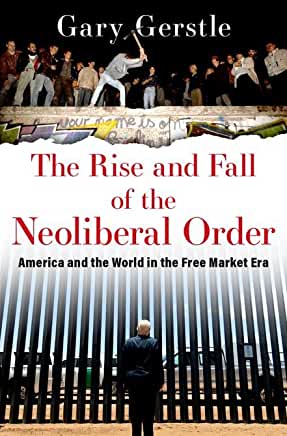
The Rise and Fall of the Neoliberal Order: America and the World in the Free Market Era by my Cambridge colleague Gary Gerstle has quite rightly been highly praised. It covers a whole century, starting with the New Deal and post-world war 2 era to preface the bulk of the book, its characterisation of the neoliberal turn from the start of the 1980s. It ends with Trump and the turn away – so Gary argues – from neoliberalism to something as yet undefined. Neoliberalism is described as a commitment to free trade and financial flows, to free movement of people and openness to others, and to deregulation and the expanded scope of markets. Interestingly, he frames the point about the expansion of the market domain in terms of characterising people as consumers, instead of workers, and argues that Ralph Nader played a key role in this regard through his influence on Jimmy Carter, as the old order started to give way to the new.

The book gives a twin-tracked account of what drives these transitions from one era to another. One set of drivers consists of events – economic crisis in particular, so the 1970s commodity shocks at the start and the GFC at the end. More surprising is the role attributed to the Soviet Union: the 1917 Revolution as a stimulus for New Deal politics; Cold War contestation paving the way for business and financial interests to reach a modus vivendi with organised labour through the 1960s in order to avert any threat of domestic socialism; and consequently the collapse of the Soviet Union in 1989 as a destabilising force because it took the brakes off corporate and financial self-restraint.

Another interesting aspect of the argument is the linking of administrations generally seen as being opposed to each others’ policies – the difference between Republican and Democrat being less decisive than that between Eisenhower and Reagan or Kennedy and Clinton. As Gary puts it, the feature of a ‘political order’ is that the opponents of the government also buy into it; it becomes the water in which almost everyone swims.

The FT review described the book as an instant classic. There are lots of talks and pods online for anybody who wants a taster. As the subtitle says, it’s US-focused; an analysis of how the neoliberal order got exported would be interesting. I highly recommend it – I read it in just a couple of days of travel. And it set me thinking about what the next political order might turn out to be…..

519IOD0MJQL._AC_UY436_QL65_

The joy of measurement

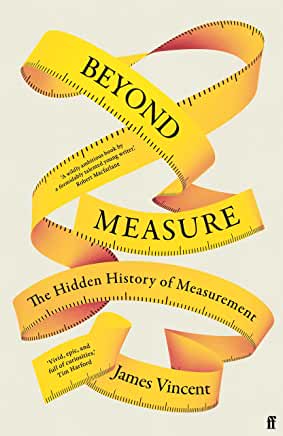
Beyond Measure: The Hidden History of Measurement by James Vincent had the good fortune to be published more or less when the Johnson government here decided a good wheeze to distract voters’ attention from – well, everything – would be to launch a consultation on the reintroduction of imperial measures alongside metric. The recent by-election results suggest the wheeze failed; maybe the population just isn’t overwhelmed with excitement by the subject of measurement standards.

I am of course one of the minority who does find measurement an unbelievably exciting subject, and I enjoyed reading the book. It uses a chronological structure to explore different aspects of measurement, starting with the ancient world and the emergence of standard measures for trade, moving on to early modern states, the Scientific Revolution and French Revolution, with a separate chapter on early statistics, and ending up indeed with a chapter subtitled “Metric vs imperial and metrology’s culture war” and finally measurement today (including the concept of the ‘quantified self’.

I quite like this summary of the purpose of measurement: “From the ancient world onwards, measurement has been embraced not only for its practical benefits – for its utility in tasks like construction and trade – but also for its ability to create a zone of shared expectations and rules; to mediate our experience with the world and one another, ensuring that the interactions between two strangers who live under the same set of measures can be validated and trusted.” This purpose of mutual benefit sits alongside the use of measurement by rulers and states – and the book indeed cites classic authors like James Scott and Theodore Porter.

Although books such as the wonderful Seeing Like A State, or more recent ones on specific areas of measurement such as Andrew Whitby’s recent The Sum of The People about the history of the census, obviously have a lot more detail than the chapters here, Beyond Measure delivers on its aim of providing an accessible overview of the history of measurement and many of the issues of meaning. It’s a great starting point for anyone not as immersed (as nerds like me) in the measurement literature.

It’s also an enticing read, with anecdotes aplenty (visiting a nilometer, chatting to Brexiteers about pints and miles) and full of my favourite kind of useful facts. Who knew, for example, that, “In England, measurement disputes in markets were settled by a special tribunal known as the ‘court of piepowder’.” It dates to the 11th century, that is prior to the normal court system, and doled out on the spot justice on market day. Piepowder is apparently a corruption of ‘pieds poudrés’ or dusty feet, characterising travelling merchants.

Perhaps the UK Government will, in its ever-more desperate attempts to show something, anything, for Brexit, re-establish piepowder courts in markets up and down the land, should remoaniac stallholders not want to replace their kilos and metres with pounds and feet. For, as the book illustrates, questions of measurement are not (just) technical, but highly political.

81e2r7e6hAL._AC_UY436_QL65_

Decarbonising travel – room for optimism?

Our new Perspectives title, Good To Go: Decarbonising Travel After the Pandemic by David Metz is out. It looks at how the pandemic has affected pre-existing trends in travel – not as much as optimists might have hoped, is his conclusion, although recognising that it is probably too early to know whether commuting patterns will change permanently. Nevertheless, improved neighbourhood planning and flexible working could capture some of the benefits of the pandemic years even if there is a significant reversion to the old normal.

However, One of David’s points is that people relish mobility, with faster travel always having translated into travel further. That means that tackling the contribution of transport to solving the climate challenge will need technological contributions. The book holds out some hope for electric vehicles and digital tools contributing to decarbonising transport. But as David points out, the system is complex, involving economics, demography, technology, policy and human behaviour. There is a lot of wishful thinking about how easy it will be to change. Complexity means (as so often in policy) there is no easy solution. The book outlines a range of investments and policy interventions that will be needed to decarbonise travel.

Good to Go? is a terrific addition to our Perspectives roster on transport: David’s previous book, Travel Fast or Smart?; Transport for Humans: Are we nearly there yet? by Pete Dyson and Rory Sutherland; and Are Trams Socialist? Why Britain Has No Transport Policy and  Driverless Cars: On a Road to Nowhere  by Christian Wolmar. They complement each other wonderfully  – a great collection for transport nerds! As a special offer for readers of this blog, all five (£71 if bought individually) are available for £45 plus postage if you email sam@londonpublishingpartnership.co.uk.

9781913019624-e1655710170750


Co-operation vs sovereignty in an unequal world order

Global governance is understandably something of a preoccupation as economic globalisation seems to be in retreat at the same time that the scale and intensity of global challenges – climate change, the AI race, actual or simmering conflict, organised crime – is increasing. The Bretton Woods institutions – IMF and World Bank – established in the wake of World War Two remain important and powerful, and will have a lot on their plates in the next year or two, including the possibility of a new debt crisis alongside a surge in poverty and hunger. This context raises two questions. One is what is their guiding philosophy in terms of economic analysis and policy recommendations going to be now the old Washington Consensus version of conditionality has been more or less ditched? The other is whether they can help address the new kinds of challenges, or whether instead new institutions are needed?

They were forged out of a crisis of course, but in The Meddlers: Sovereignty, Empire and the Birth of Global Economic Governance Jamie Martin traces their forbears in the international economic institutions established near the beginning of the 20th century. The key issue he highlights is on the one hand the delicate balance between mutually beneficial co-ordination and voluntary loss of sovereignty among peer countries, and on the other the exercise of power by some countries over others (Imperial powers over colonies or later the US over its debtors) at the expense of the latters’ sovereignty. Co-ordination and co-operation require ceding some decision-making ground but when there is a parity of power this expands the opportunities or benefits each party experiences. However, the international institutions also embed inequalities of power – symbolised by the Asian crisis image of an IMF bureaucrat (Michel Camdessus) leaning over a local politician (Indonesia’s President Suharto) signing up to loan conditions.

Some technocratic institutions governing for example international post or shipping have lasted throughought the century plus, while the BIS (established in 1929/30) is an interesting example of an organisation with a broader mandate yet lasting throughout the 20th century and beyond, despite its missteps during the 1939-45 conflict. Other pre-WW2 international bodies such as the Economic and Financial Section of the League of Nations fell with the implosion of the international order at the outbreak of war. The book argues that the context of post WW1 reparations, the tensions in the European empires, the growth of US economic power and the pressures of the gold standard and the tariff wars of the 1930s all contributed to their downfall. International co-ordination was both essential and impossible.

The lesson for the 21st century, it concludes, is that today’s context of shifting economic power and economic crisis pose similar challenges for the Bretton Woods institutions. The history of earlier institutions suggests that it is fundamentally hard to resolve the core dilemma of a need for co-operation with the desire for sovereignty in a world of unequal power: “Tweaks to existing international institutions, like the IMF and World Bank, may be insufficient to produce a more stable reconciliation of global governance and democratic politics.” But what form should new institutions take? This very interesting book leaves the question hanging.

41TWDGc1FdL._AC_UY436_QL65_