
How to create a blockbuster

Anita Elberse’s [amazon_link id=”0571309224″ target=”_blank” ]Blockbusters: Why Big Hits and Big Risks are the Future of the Entertainment Business[/amazon_link] is published in the UK in January (it was out in the US earlier in 2013). It’s a clear and well-written series of case studies in how various branches of the entertainment business – movies, pop music, TV shows, books, sport – rely on a ‘blockbuster’ strategy as a business model.

[amazon_image id=”0571309224″ link=”true” target=”_blank” size=”medium” ]Blockbusters: Why Big Hits – and Big Risks – are the Future of the Entertainment Business[/amazon_image]

The economic analysis underlying the argument is not new. It can be traced back to Sherwin Rosen’s 1981 paper on the Economics of Superstars. I wrote about the way digital technologies were amplifying the superstar effect in my 1996 book, The Weightless World (pdf). However, Blockbusters provides plenty of examples of how the analysis translates to the real world. There are many interesting case studies in the book, albeit all American. Elberse also shows very convincingly how the blockbuster business model stacks up, based on her research experience talking to many of the firms she describes – she cites the revenue and cost data for specific movie releases, for example. A Harvard Business School professor, she clearly has terrific experience across a range of entertainment industries, and the details are fascinating. If you can afford to market a new release or title at scale, you’d be an idiot not too.

This means the [amazon_link id=”184413850X” target=”_blank” ]Long Tail[/amazon_link] idea is largely wishful thinking. The profit margins from the handful of blockbusters might support the production of a long tail but it isn’t even the case that there will always be a long tail because producers don’t know which will become hits. For although there is indeed great risk involved in releasing a possible blockbuster, few films or books or albums become blockbusters without a deliberate marketing effort. And scale in marketing is almost always decisive; the book cites a few grassroots successes, such as Lady Gaga’s first album, but they are obviously exceptional. So this means there is little prospect of Hollywood moving away from the model of putting resource including marketing into successful franchises, and most of what will be on offer will be of the same ilk as Harry Potter I to VII, The Hunger Games I to N, etc. Celebrities will only grow larger and more monstrous.

The book ends on the suggestion that the blockbuster strategy is going to have to be adopted by a growing range of businesses. Elberse gives the examples of Apple and Victoria’s Secret for their successful deployment of spectacle around a few products. “Apple releases fewer products and product variations than virtually all its competitors in computer hardware,” she writes. It makes just a few bets, in both production and marketing, in contrast to its competitors.

If I were an executive in any of the entertainment businesses, I’d regard this book as a must-read and consider its lessons very seriously. As a citizen, and a non-American, I found it a bit depressing. As a non-American because the US economic advantage of the scale of the domestic market is becoming even more pronounced than ever; the benefits of that scale are often overlooked anyway. They are even greater in digital markets where fixed costs (including or especially marketing) are high, and marginal cost is low to zero. As a citizen because –  although it would be overstating things to say everything is becoming Hollywoodised and dominated by celebrity – there is something in this.

It is obviously possible to declare independence from popular US-originated or US-inflected celebrity culture, and graze around the vast steppes of the internet for other cultural products. Other countries do succeed in different ways in supporting their own culture. There are different kinds of celebrity – Professor Brian Cox as well as Lady Gaga. Still, it seems it will have to be an increasingly active decision to opt out of Celeb-land. [amazon_link id=”0099518473″ target=”_blank” ]Brave New World[/amazon_link]?
Lifting the iron curtain of the mind

My first trip to Prague was in February 1991. It was my first time away without my eldest son, then one, and I felt extraordinarily light. Memories of the Velvet Revolution were fresh, so I rented an apartment close to Wenceslas Square with a friend for a few days. Vaclav Havel was a hero. It was snowing atmospherically. There were few tourists, and a beer and plate of ham and bread at the famous (still-unrefurbished) Cafe Slavia cost little. The local people were very friendly, as soon as they established that one was not German, and almost nobody spoke a word of English.

(It wasn’t my first visit behind the former Iron Curtain – in early 1990 a stockbroker flew a group of us to Budapest to visit a giant state company first in the line to be privatised, the Ganz works. It was astonishing, a huge plant that started with steel at one end and ended with trams, and other vehicles and electric products, miles away at the other. I was the only woman on the trip, and to go to the toilet had to be escorted by the director’s secretary, bearing the key to the cupboard where the still-scarce toilet paper was kept.)

My second Prague trip was in the autumn of 2000, as a journalist covering the annual IMF-World Bank meetings. There were English signs everywhere, half of them including the word ‘Internet’. Vaclav Havel was still widely admired, although the tourists and designer shops had arrived in force, and there were anti-globalization protests too. One evening I met a senior official for dinner in Old Town Square. We heard music seeping out from the church and walked in to a free concert, a dinner-jacketed pianist playing Rachmaninov. After half an hour we descended into a basement restaurant for a pleasant meal. On climbing the stairs afterwards, we found that a jazz concert was under way in the bar, which was packed full of young people with tankards of beer nodding away in time to the music.

So all in all, like every other visitor since time immemorial, I think of Prague as a magical place. I’ve very much enjoyed reading Derek Sayer’s [amazon_link id=”0691043809″ target=”_blank” ]Prague: Capital of the Twentieth Century[/amazon_link] this past week. It’s a cultural history focused on the unsung Czech role in creating modernity. Sayer makes much of the similarity of things now thought of as opposites. For example, both the USA and the USSR signified the modern in the 1920s, both skyscrapers and socialist realism. A flâneur or radical artist could lean either to the left or the right, be a rebel or a secret policeman.

[amazon_image id=”0691043809″ link=”true” target=”_blank” size=”medium” ]Prague, Capital of the Twentieth Century. A Surrealist History.[/amazon_image]

The surrealists are at the heart of the cultural story told in this book, and the Prague-Paris axis. I confess that surrealism doesn’t do anything for me, and the illustrations here look just enormously dated. As this is an academic book there are also too many long lists of Czech artists with unpronounceable names for the general reader. One can easily lose sight of the wood, while enjoyably wandering around the trees. Still, this is a fascinating, forgotten, cultural history.

It is particularly interesting to read of the closeness of artistic groups working in western and central Europe, and the inspiration they drew from each other. We westerners tend to think only of the thirst people in the east had for western pop culture during the communist years but before the war the cultural exchange was far more mutual. Actually, this aspect of the book reminded me of the underlying theme of Tony Judt’s brilliant [amazon_link id=”009954203X” target=”_blank” ]Postwar[/amazon_link], which is that Europe is one continent with one history, not two. But the Iron Curtain still lives in the public mind – a timely thought, looking at events in Kiev, a place which isn’t really “over there” at all.

[amazon_image id=”009954203X” link=”true” target=”_blank” size=”medium” ]Postwar: A History of Europe Since 1945[/amazon_image]

Dancing nimbly round a stumbling giant?

A while ago I reviewed Jonathan Fenby‘s [amazon_link id=”1847394116″ target=”_blank” ]Tiger Head, Snake Tails[/amazon_link], which I liked because its answer to the question about China’s prospects for economic and geopolitical success is essentially ‘it depends’. It’s a rare book that gives an effective overview while resisting the temptation to be either a China-booster or China-basher. I’ve now read another China book that probably falls into the latter camp, Timothy Beardson’s [amazon_link id=”0300165420″ target=”_blank” ]Stumbling Giant: The Threats to China’s Future[/amazon_link].

[amazon_image id=”0300165420″ link=”true” target=”_blank” size=”medium” ]Stumbling Giant: The Threats to China’s Future[/amazon_image]

The author would surely describe it as China-realism though. It is certainly more nuanced than some others, pointing to the country’s amazing recent achievements. He lives in Hong Kong and has done business in China for decades. The book is full of interesting and informative detail and insights. For example, in the chapter on the knowledge economy, I learned that plagiarism is a pervasive problem in the Chinese academic world. One biologist, Fang Shimin, documented 500 cases of plagiarism in his field in one year, 2007. A professor named as a culprit arranged for criminals to attack Fang with a hammer. Beardson goes on to claim that while plagiarism is a global problem, the culprits in other universities are often Chinese, citing a consultancy to US universities advising clients to expect half of all Chinese applicants to submit forged transcripts. Of course I haven’t done any additional research into Beardson’s figures but this is indeed an interesting perspective on the capacity of the country’s education system to turn out creative, innovative thinkers. Another example – the description of an increasing number of incidents of large-scale public violence in the past 20 years, including more very large scale incidents, albeit against the background of very high (80-80%) support for the government and belief the country is heading in the right direction.

The book runs through a series of important challenges facing China’s leaders: its ‘broken’ economic model (other authors might dispute that description of course); the elusiveness of the knowledge economy; a fragile financial sector distorted by state intervention in lending; the absence of adequate social welfare; adverse demography; environmental degradation and pollution; civil stability; the future of the Communist party; the geopolitics of east Asia and relations with the US; ethnic unrest in central Asia; the battles in cyberspace. That’s quite a list – it’s a chunky book covering lots of ground.

Can they be overcome? Beardson concludes: “Many of the challenges which China confronts appear to an international audience to have clear solutions. However, they must be viewed in the context of a government which is driven by the desire to stay in power and yet has a sense of fragility. Many obvious policy solutions are avoided as they carry political costs or risks.” He thinks it “inconceivable” that China will overtake the US this century. The challenges have solutions but these will not be implemented. I found it impossible to assess this ultimately political judgement.

What does seem clear is that events in China will be – one way or the other – extraordinary. If you’re interested, this book is a very welcome addition to the collection of well-informed perspectives on a country that has unavoidably become part of our future. ‘[amazon_link id=”0300165420″ target=”_blank” ]Stumbling Giant[/amazon_link]’ is an apt title: it’s an alarming prospect and it could take some nimble footwork from the rest of us to avoid collateral damage.

What does Cleveland, Ohio have that London doesn’t?

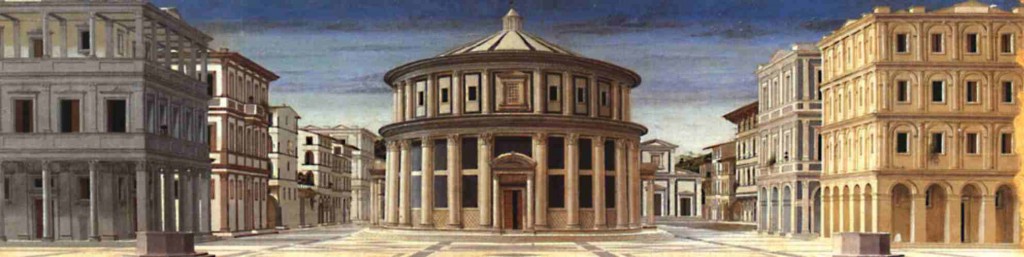
This summer we visited the wonderful gallery in the ducal palace in Urbino, where the painting that most absorbed me was Laurano’s Citta Ideale.

Citta Ideale

Of course it isn’t ideal – no people, no bustle. For any fan of Jane Jacobs’ [amazon_link id=”067974195X” target=”_blank” ]The Death and Life of Great American Cities[/amazon_link] or [amazon_link id=”0394729110″ target=”_blank” ]Cities and the Wealth of Nations[/amazon_link], it’s the anti-ideal.

Cities are clearly having a major renaissance, in debate if not in reality. Last year brought Ed Glaeser’s excellent [amazon_link id=”0330458078″ target=”_blank” ]Triumph of the City[/amazon_link]. Benjamin Barber has just published If [amazon_link id=”030016467X” target=”_blank” ]Mayors Ruled the World: Dysfunctional Nations, Rising Cities[/amazon_link], which I’ve not yet looked at. I’ve just been reading a very interesting analysis of the economics and politics of US cities, [amazon_link id=”081572151X” target=”_blank” ]The Metropolitan Revolution: How Cities and Metros are fixing our broken politics and fragile economy[/amazon_link] by Bruce Katz and Jennifer Bradley. The first part is descriptive, looking at four American urban areas and the ground-up initiatives under way to stimulate economic revival and involve citizens in urban and civic renewal. The four are New York, Denver, north eastern Ohio (Cleveland, Akron, Canton etc) and Houston. For a non-American it is simply interesting to learn what’s been happening, although the chasm between rich and poor areas is in my experience far greater in the US than anywhere in Europe (bad as it is in our cities too).

[amazon_image id=”081572151X” link=”true” target=”_blank” size=”medium” ]The Metropolitan Revolution (Brookings Focus Book)[/amazon_image]

The second part is analytical, drawing together some of the themes about the effectiveness of different approaches to economic development, in the context of big technical, demographic and cultural changes. Technology-driven innovation has clearly increased the value of the externalities that occur in densely-populated and well-connected cities – ideas and trade are the vital ingredients.

The recipe for combining them to achieve economic and cultural success is the subject of the final two chapters. They constitute a call to enhance the devolution of political power down to the city-region level (and of course American cities already have freedoms to act that British city leaders can only wistfully dream of), and to have the confidence to act with conviction in creating their own destiny. I particularly like Katz’s and Bradley’s emphasis on “the informal power to convene.” It’s what I think of as proper, old-fashioned politics, talking the people and getting them to line up in support of a common aim. The Ohio example is particularly interesting here, as the book describes its (partial) economic recovery as a matter of building networks of enterprise, investment and civic engagement. The details are specific to the US, but it seems obvious to me that the general principles apply here in the UK too.

The other new book to mention in this context is Bridget Rosewell’s Reinventing London, in our Perspectives series. Bridget is probably the most knowledgeable and authoritative commentator on the London economy, given her involvement over many years in developing its economic strategy. The book draws lessons about the post-financial crisis shape of London’s economy from the city’s past successful adaptations to profound structural changes. Its recommendations cover four areas: supporting service industries other than finance, making London a place people want to live especially by ensuring there is enough housing in pleasant areas, and investing urgently in infrastructure and also specifically connectivity – including deciding soon on new airport expansion, wherever the new runways are to be built.

[amazon_image id=”1907994149″ link=”true” target=”_blank” size=”medium” ]Reinventing London (Perspectives)[/amazon_image]

Needless to say, I strongly recommend it!

Is this the dawn of an era of powerful cities and weak nations – much like the age of city states half a millennium ago? It seems highly likely. More than half the world’s people live in urban areas now. Most economic activity consists of trade in ideas and people and goods and services between cities. Mayors are important figures, who for the most part feel less bound by the constricting conventions of national party politics. As ever, though, political and social institutions lag behind technological and economic trends, and in centralised polities like the UK urban renaissance would involve some big changes. Even London, with more powers than any other UK city, has only limited control over its own destiny, airport included. But if all these books are right about the inexorable trend towards city-driven economies, this will be an important debate.

Democracy, the El Farol bar and Captain Kirk

The El Farol problem, named by Brian Arthur (pdf), concerns a popular bar in Santa Fe. It’s so popular it gets very crowded, to such a degree that people then start to stay away. Then, when the crowds thin out, people start going back. The bar oscillates between being over-crowded and being too empty.

David Runciman’s superb book [amazon_link id=”0691148686″ target=”_blank” ]The Confidence Trap: A History of Democracy in Crisis from World War I to the Present[/amazon_link] reminded me of the El Farol model. He uses the examples of several turning points in democracy – World War I, the Depression, post-war reconstruction, the Cold War, the mid-70s economic crisis, the collapse of communism in 1989 and the global financial crisis – to argue that democracies exist in a (so far) stable instability. Democracies are inherently flexible, adaptable (echoes of Tim Harford’s [amazon_link id=”0349121516″ target=”_blank” ]Adapt[/amazon_link]), and so are better than autocracies at coping with crisis; but having coped with so many crises, don’t bother to adapt because of a high degree of confidence that everything will turn out ok in the end.

The book is full of wonderful variations on this central paradox. “Democracy is more durable than other systems of government not because it succeeds when it has to, but because it can afford to fail when it has to. It is better at failure than its rivals.” “Autocrats are often highly sensitive to public opinion, which is why they go to such lengths to control it.” Echoes in this next one of Dominic Sandbrook’s entertaining TV history of the Cold War, Strange Days: “To take their minds of nuclear Armageddon they [Western citizens] watcheyd TV and went shopping. And that’s how the Cold War was won: by people whose attention was elsewhere.” “Democracy is only doomed if people come to believe it is doomed; otherwise, it can survive anything.” On President Obama: “He symbolized change, which meant he did not need to specify it.”

The continuing ability to cope is messy and unattractive, if so far effective. There is a pervasive and constant disappointment with actually existing democracies. Still, muddling through is a better outcome than the alternatives.

[amazon_image id=”0691148686″ link=”true” target=”_blank” size=”medium” ]The Confidence Trap: A History of Democracy in Crisis from World War I to the Present[/amazon_image]

In the end, democracy involves a kind of collective game of chicken. If things get really bad, we’ll do something about it. Until then, no need to change because it will turn out ok in the end. As Runciman points out, this kind of game is fine – until it isn’t, when it turns out to be catastrophic.

Is this “typical democratic recklessness: short term gain at the expense of long-term stability” sustainable? The book doesn’t answer the question definitively. Yet the historic, existential challenges of war, political rivalry, environmental collapse, and financial over-extension remain. Runciman is not optimistic:

“We should not assume that democracies will always be able to improvise a solution to whatever challenges they face. …. The assumption that it is bound to happen increases the likelihood it will stop happening. It breeds the sort of complacency that allows dangerous crises to build up, invites decisive action to be deferred and encourages brinksmanship. This is tempting fate.”

There is no ultimate crisis, but the crises keep on coming, and there is no reason to expect democratic adaptability to remain successful indefinitely, he writes. He even suggests that the current crisis may be decisive, marking as it does the unwinding of an extended political/economic experiment – call it ‘neoliberalism’ – since the mid-1970s. The world’s democracies are bound together by complicated financial, technological, and institutional arrangements. Failure in one place can have large repercussions elsewhere. (This systemic nature of modern risks is something Ian Goldin is writing about.) The short-term restlessness of democracy is both its biggest strength and greatest weakness. “I do not know what will happen,” Runciman concludes.

I don’t know either. Watching Strange Days has reminded me of the nightmares I used to have as a child about nuclear winter and being the only person left alive. The late 70s, one of the crisis episodes in [amazon_link id=”0691148686″ target=”_blank” ]The Confidence Trap[/amazon_link], was a terrible period. The emotional impact of the current economic/political/environmental challenges is not as intense for me – I wonder what it has done to today’s teenagers? – but I don’t have great optimism about what our world will look like in another 10 or 20 years. That’s why it’s so important to build the optimism, to create new institutions and insist on our societies living their stated values, and in fact being the adaptability Runciman writes about.

That’s hard to do in an El Farol world. But another story the book reminded me about was the Kobayashi Maru scenario in Star Trek. Star Fleet cadets are placed in a war game with no possibility of victory – it is a test of character, not a test of ability. Captain Kirk is the only cadet ever to triumph; he re-codes the scenario (for which Spock later criticises him). That’s what we have to do.

I’ve not yet read other reviews of David Runciman’s book, but there have been plenty. Here are: The Guardian; The Economist; the FT;  and an extract in Foreign Policy.