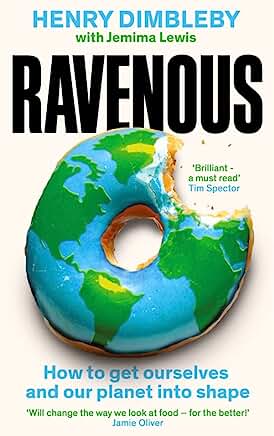
One of my long weekend reads (alongside a detective novel – Death Before Evensong – and Metamorphosis, amazing memoir by Richard Douglas-Fairhurst about his diagnosis with MS) was Henry Dimbleby’s Ravenous: How to get ourselves and our planet into shape. The three sections cover health, nature, and what to do. Much of the material it covers is in his terrific Food Strategy document, which the government commissioned and ignored. But here it is written in compelling manner – this is an excellent and anger-inducing read. In short, the food system is making us obese and diabetic (because processing food is so profitable and is under-regulated), massively contributing to global warming, the depletion of biodiversity and other environmental harms (fertilizer use, red meat eating), lacks resilience to shocks (including because of near-monoculture production), and is inhumane to animals and birds that are industrially farmed and processed.

The food strategy has many sensible recommendations, reproduced here, including the use of taxes to cut the use of sugar and salt, more free school meals, changing the approach to farm subsidies and land use, and starting to tackle the UK’s unhealthy food culture. It is not an easy task though because there are several policy aims and some trade-offs. The aims: better health, greater equality of nutrition in an unequal society, more nature-friendly farming and food trade/consumption, improved food security, better treatment of farmed creatures. For instance one implication of several of these is that food prices should be higher – but this works against reducing food inequality and shifting the British diet to a healthier mix. So while some policies are no-brainers (tax sugar in food processing!) others are less obvious.

The first chapter starts with obesity as a system outcome rather than a failure of individual willpower. Not the ideal read as one tucks into an Easter egg (where lack of willpower definitely comes into play). Still, I hope the book makes some impact – not least shaming the government into action despite the lobbying by the food industry.

51L-qocimbL._AC_UY436_QL65_


Saving liberalism

I liked Thomas Aubrey’s short book, All Roads Lead to Serfdom: Confronting Liberalism’s Fatal Flaw. It could alternatively be called, Confronting the weaknesses of the Anglo-Saxon economic model. But it does this in a thoughtful way, contrasting the utilitarian tradition of UK/US economic policy with (West) Germany and the “underlying ordoliberal principle of power dispersion.” It is quite a philosophical book, which concludes that private and public power must be dispersed across labour markets, product markets and the activities of the state (as well as the liberal market basics of secure property rights and a stable currency). As well as stressing the importance of ideas, though – and I wholeheartedly agree – the book calculates power dispersion indices (“to provide a potential alternative framework to the current utilitarian welfarist approach”) and has a serise of proposals for how to disperse power in the three domains.

The empirics turn out broadly as you might expect. Canada, Switzerland, Denmark and Sweden turn out to have widely dispersed state power, as does the US, and the Scandinavian countries cluster near the top of all three rankings. The UK is near the bottom of all three rankings, while the US is near the top for state power dispersion but not labour or product markets. This seems to me to understate the traction economic power delivers in terms of political power, albeit through sometimes indirect channels.

The book’s compare and contrast with the German model is interesting although Aubrey concludes Germany itself has not delivered on ordoliberal ideals. I rather agree with its final conclusion: “If liberalism is to have a future, it will require those who believe in liberal values to make the case for an alternative ethical foundation; one where freedom and equality can be contsnatly manufactured by the continuous dispersal of public and private power.” Ideas are indeed important for winning hearts and minds. The naive utilitarianism underlying the eocnomic policy playbook of the past 40 or 50 years has lost hearts and minds. But I’m not sure framing what’s needed in terms of ‘ordoliberalism’ with all its free market and Hayekian baggage will be an easy sell, hearts and mind-wise. (And the book has been priced only for libraries by its publisher, Bristol University Press, so it won’t even get much chance to influence people.)A1e0JCBaNuL._AC_UY436_QL65_


Webs of money

A 2016 book that was an eye-opener for me was Brooke Harrington’s Capital Without Borders: Wealth Managers and the One Percent. A sociologist, she had trained as a private client wealth manager and worked among/for the global elite – the Ultra High Net Worth Individuals (UHNWIs).  The rich really are different…. and among her striking findings was their deep-seated belief they have that the money is theirs, or their family’s, and governments truly have no legitimate right to take any of it away from them in taxes.

Spiderweb Capitalism: How Global Elites Exploit Frontier Markets by Kimberly Kay Hoang is a sort of companion or follow-up volume. She is also a sociologist, but in this case conducted academic research as a clear outsider. Her focus is also different: her interest is in the ploys the UHNWIs and their delegated High Net Worth Individuals (professional lawyers and PRs etc who act for them, making pretty vast amounts of money themselves but bearing some legal risk) devise to distance themselves from “playing in the gray” – that is on the borders of legality or beyond – in emerging markets Vietnam and Myanmar. These ploys generally involve complex structures with holding companies in the Caymans, Samoa, British Virgin Islands etc, multiple Special Purpose Vehicles to make investments, professional advisers in Hong Kong or Singapore, and local fixers.

More academic (ie. slightly clunky) in style than the earlier Harrington book, it is nevertheless a fascinating read, reflecting five years of interviewing the different categories of people involved in these global money flows, and following some around on their extensive travels. Again, avoiding – or evading – tax is a regular theme. The book documents the various mechanisms involved, from the on-the-ground bribery (including attempts at mutually assured destruction deterrence such as sharing compromising social events with bribed officials) to the setting up of bank accounts and pitching investments to UHNWIs in the US. The scope of the fieldwork involved is impressive.

What to do about the spider’s web of global money flows? That’s less clear. Each individual (whether dominant or subordinate spider) is one element in a system that ultimately traps all. Although an optimistic note I took from the book is that US legislation does seem to be inhibiting some of the practices documented. In any case, it’s super-valuable to have htis kind of rigorous evidence about how the web operates, and how its inhabitants are motivated and incentivised. This is a very impressive book.

41nJtBDEPmL._AC_UY436_QL65_

Capitalism, property and production

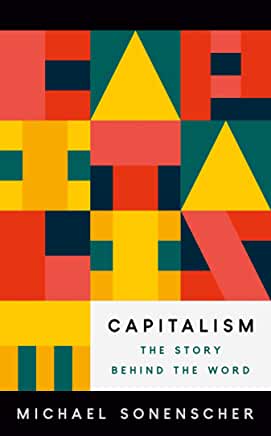
Capitalism: The Story Behind The Word by Michael Sonenscher is an enjoyable short read (with a great cover) that does what the subtitle says. It compares the history of ‘capitalism’ with the history of the idea of ‘commercial society’ and the division of labour, making the case that the two referred to different economic arenas. Capitalism concerned capitalists: people who lent money to governments to fund war and other expenditure. It was thus a concept relating to public finance and taxation, and concerned with private property. Commercial society and the division of labour were concepts used in broader societal debates about the organisation of production, markets and prices – issues that predate the general use of the word ‘capitalism’. The essay argues that the distinction is worth keeping, although this may be a losing battle as ‘capitalism’ has swallowed the wider issues – and much of the wider contemporary literature on these latter has been largely forgotten.

Among other things, a quotation from Hegel struck me: “Money is not in fact one particular resource among others; on the contrary it is the universal aspect of all of them, in so far as they express themselves as an external existence in which they can be apprehended as things. Only at this extreme point of externality is it possible to determine services quantitatively and so in a just and equitable manner.” (This is obviously not the modern usage of the term ‘externality’.) I was surprised to see a rationale for using the measuring rod of money as a common standard from this author.

61r+nrlcRAL._AC_UY436_QL65_

What is the free market?

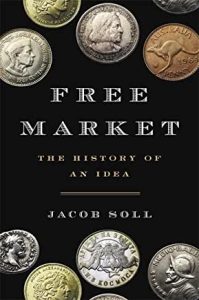
There are a couple of important books out in September that I’ve had to restrain myself from writing about too far ahead of publication. Brad Delong’s Slouching Towards Utopia: An Economic History of the 20th Century will be published mid-month. A week or so later – and it can also be pre-ordered now – is Jacob Soll’s Free Market: The History of an Idea. So I’ll write about the latter first.

The premise of the book is that, “We are in an essentially abusive relationship with free market thought,” which has had adverse consequences that finance and big business have stacked the economic system in their favour while the little people take on high debt burdens and pay taxes, in the pretence that ‘the market’ must prevail. To recover from this dysfunctional relationship requires a task of intellectual history. What is this ‘free market’ idea and how has it come to veil a state and regulatory structure favouring the rich over the rest?

The book takes this task seriously: “To understand the origins of free market thought, it is first necessary to understand Cicero’s philosophy.” So, not Adam Smith then. Successive chapters go on to the conceptualisation of markets and what we would now call ‘the economy’ in the late Roman period, the Middle Ages, Renaissance Italy, early modern Britain, Colbertist France, the Dutch Republic, and on through the Enlightenment, French Revolution, Adam Smith, Industrial Revolution and age of Empire.

The book identifies a sort of historical pendulum: “When there is political stability and a developed economic system, it can seem as if markets just emerge on their own and sustain themselves. The fall of Rome, however, showed that when society collapses, strong and sustained state intervention may be necessary to build back the market.” The Mediaeval period was one of these. Another was the Netherlands after the Dutch War of Independence: “Windmills were the product of Dutch traditions of communcal investment dating from privately-funded medieval public works…. Citizen investors worked together to create public infrastructure. This long tradition of private-public partnership laid many of the commercial foundations of the Republic.”

The post-Adam Smith version of free market thinking is traced here to paradoxical roots in Colbert, usually thought of as the architecht of mercantilist state management. The seeming endless violence and suffering experienced by the mass of 17th century French people led Colbert’s sucessors – children and nephews – to turn back to Cicero’s vision of voluntaty exchange among Rome’s aristocracy. Add in Christian ethics and here are the foundations of rational self-interest and ordered exchange. As is now better appreciated, Adam Smith’s free market vision was founded on the ethical system he had written about in his Moral Sentiments before The Wealth of Nations. The free market was built not on greed but on social responsibility.

The book then canters toward the post-1980 bowdlerisation of this free market ideal, via ever faster swings of the pendulum for and against state activity. Soll concludes that much free market thinking is simply utopian, markets as magic. “This model, however, no longer seems realistic or relevant. After decades of deregulation and expanding free trade, the world has experienced regular cycles of economic crashes and government bailouts, along with burgeoning wealth inequality, wars, and climate and health disasters. Equilibrium eludes us.” And indeed the state remains a major economic actor, in the US as well as China, albeit in different guises.

So the dilemma remains: the ‘free market’ is a fiction and we get closest to it in historical periods of stability. But governments can be at best inefficient and at worst corrupt and authoritarian. “But the historical record shows that, as economies grow in complexity, so governments grow in response, for better or worse.” The free market? It would be a good idea. But more important than how the economy is organised is the social and moral context in which we carry out our investments and exchanges. The final word: “Faith in the market alone will not save us but hewing to those old virtues might.”

So, a very interesting read – I really learned a lot from the long historical perspective on the origins of what became the modern version of free market thought. Some of it was a bit surprising & perhaps historians of thought will contest it. I’d have liked more on the post-world war two aspects but that’s probably a different book (and indeed Delong covers that period).  I fundamentally agree with the conclusion, though: economies exist in and as part of societies, so the social and moral relations are fundamental. And – for economists – ideas about the right way to behave really matter, not just as innovation or endogenous growth, but (as Deirdre McCloskey has pointed out in her major trilogy) as the enabling or limiting environment for both markets and state to function.

51RCTcRkDyL._AC_UY436_QL65_