
Freedom and virtue

On the Eurostar to and from the OECD yesterday, I read [amazon_link id=”B0079EW3ZK” target=”_blank” ]The Needs of Strangers[/amazon_link] by Michael Ignatieff, an old book first published in 1984, with my 2nd hand paperback even more mauled by the fact that the dog got to the post before I did that day.

[amazon_image id=”B0079EW3ZK” link=”true” target=”_blank” size=”medium” ]The Needs of Strangers[ THE NEEDS OF STRANGERS ] By Ignatieff, Michael ( Author )Sep-05-2000 Paperback[/amazon_image]

I wish I’d read it before attending the recent Christ Church, Oxford symposium on [amazon_link id=”0241953898″ target=”_blank” ]How Much Is Enough?[/amazon_link] by Edward and Robert Skidelsky. It’s on the same territory. Ignatieff makes very clear the possibly irreconcilable tension between freedom to choose and a shared agreement on the constituents of ‘the good life’. The book starts with a reflection on the welfare state. It assumes everyone is equal, and reasonably so, but in uniformity of treatment is unable to respond to individuals’ specific needs. Hence the seeming lack of care in the way welfare is sometimes delivered to people. He writes: “We think of ourselves not as human beings first, but as sons and daughters, fathers and mothers, tribesmen and neighbours. It is this dense web of relations and the meanings which they give to life that satisfies the needs which really matter to us.” Hence the utopian aspect of Rousseau’s writing or Marx’s – freedom and happiness have to be reconciled by everybody making choices anchored in equality and fraternity.

The book goes on to explore the tension between communitarian visions of moral agreement about necessities of the good life and the restlessness of commercial society, as reflected by Smith and Hume. “How is moral virtue possible in a society which is constantly pushing back the limits of need?” The Skidelskys claim that needs were satisfied by 1974, but that seems absurd to me. Since then we’ve had everything digital, vastly improved medical treatments, longer life expectancy, lower infant mortality, central heating in most homes in the UK, and so on. Rousseau would have been happy to ban machines and trade – virtuous stasis came above freedom in his eyes.

Ignatieff doesn’t answer the dilemma of course, but the book is a very interesting exploration of how it continues to be relevant to modern societies.
Would Keynes see Fox News as progress?

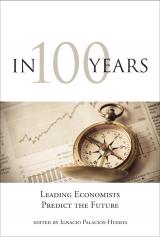
The economics profession has a less than stellar reputation for its forecasting ability, so asking some economists to make predictions for a hundred years from now is a bold move. Yet that’s what Ignacio Palacios-Huerta did for[amazon_link id=”0262026910″ target=”_blank” ] In 100 Years: Leading Economists Predict the Future.[/amazon_link]

One of the inspirations that led him to invite mainly US-based, highly eminent economists such as Daron Acemoglu, Robert Shiller and Robert Solow to think so far ahead was the famous 1930 Keynes Essay, [amazon_link id=”B00HRDZL5C” target=”_blank” ]Economic Possibilities for our Grandchildren[/amazon_link], and it is a starting point for several of the contributions. So, not surprisingly, a common theme is the likelihood of continuing technology-driven improvements in living standards, health and longevity in the long term – despite the clear short-term challenges. But another common theme to many of the essays is one not on Keynes’s horizon, namely the unknown but potentially catastrophic risks posed by climate change. I think many people who dismiss economics as not taking environmental issues seriously might be surprised about how many of these contributors address the question.

Overall, the tone of the essays is generally positive – Andreu Mas-Collel argues that economics should be called, not the ‘dismal science’ but the ‘cautiously optimistic science’. However, none of the economists ignores the reasons for pessimism. Apart from climate change and environmental pressures, they differ more in their pessimism than in their optimism. Daron Acemoglu focuses on ‘counter-Enlightenment’ fundamentalisms or other anti-modernist movements as a political force that will run counter to continuing progress.

In the most interesting essay in the book Ed Glaeser – an economist who has always worked creatively in the areas where economics borders the other social sciences – raises the possibility of social fragmentation in what he calls the ‘self-protection’ society. In addition to the fragilities that come with global interconnectedness – pandemics, terrorism and so on – he writes: “One recurring fear is that this prosperity will produce a self-protective society, more interested in keeping what it has than in creating change. Human kind has become wealthier precisely because we have taken risks.”

He also in this essay brings us the eye-opening fact that on average Americans spend almost as much time watching TV (2.83 hours a day) as working (3.2 hours a day) – as he comments wryly: “It seems quite possible that the recent technological change that has created the most benefit is the proliferation of cable channels.” Whether this is progress or not is another question. What would Keynes have made of Fox News or HBO?

Robert Shiller, Dr Jekyll and Mr Hyde, and Karl Marx

I’ve been lucky enough to have met two of this year’s three economics Nobel winners, Gene Fama and Bob Shiller – my only contact with Lars Peter Hansen was the excitement of learning about Generalized Method of Moments estimates in their early days, while I was mid-way through my PhD. Both Profs Fama and Shiller were a pleasure to meet.

I interviewed the former for The Times in the relatively early days of the financial crisis (I can’t find the archived article but it was linked to his Onassis Prize lecture at the Cass Business School), and he was unmoved in defending the efficient market hypothesis, as the lecture shows.

Prof Shiller is somebody I’ve met a few times, and you couldn’t hope to meet a kinder or more charming person, or one who lives up better to the absent-minded academic label. His best-known book is of course [amazon_link id=”0691123357″ target=”_blank” ]Irrational Exuberance[/amazon_link], perfectly timed before the (first) crash of 2001, followed by [amazon_link id=”069114592X” target=”_blank” ]Animal Spirits[/amazon_link] co-authored with George Akerlof. Both books are appreciated by those who believe financial markets to have become a dangerous excrescence of capitalism and illustration of the dangers of markets in general.

However, Shiller has also in between written [amazon_link id=”0691120110″ target=”_blank” ]The New Financial Order[/amazon_link], [amazon_link id=”0691154880″ target=”_blank” ]Finance and the Good Society[/amazon_link] and [amazon_link id=”0691139296″ target=”_blank” ]The Subprime Solution[/amazon_link], books promoting the greater use of financial markets, or extending markets to areas where there are currently none – such as sovereign insurance against natural disasters. Many commentators have pointed out the apparent paradox of the Nobel committee rewarding both Shiller and Fama for their work on financial markets, but fewer the apparent [amazon_link id=”149228856X” target=”_blank” ]Jekyll and Hyde[/amazon_link] character of Prof Shiller’s own work.

[amazon_image id=”0691123357″ link=”true” target=”_blank” size=”medium” ]Irrational Exuberance: (Second Edition)[/amazon_image]

Speaking of anti-capitalism, this article about the 2008 crash leading to a revival of Marxism among the young reminded me of this 1997 John Cassidy article on – The Return of Karl Marx – sixteen years ago this week. [amazon_link id=”0199535701″ target=”_blank” ]Capital[/amazon_link] is pretty unreadable in my view, but Marx wrote about technology, inequality, power struggles and the disequilibrium dynamism of the economy, and will always look attractive as long as mainstream economics ignores these un-ignorable aspects of the world.

[amazon_image id=”1840226994″ link=”true” target=”_blank” size=”medium” ]Capital: Volumes One and Two (Wordsworth Classics of World Literature)[/amazon_image]

We’re all Coasians now

Of course there has been a lot written about Ronald Coase this week, marking his death at the age of 102. I thought Joshua Gans was very good, and this short paper by Herbert Hovenkamp usefully sets Coase in the context of the economic debates of the times. Justin Wolfers linked to this terrific (pdf) Deirdre McCloskey note on the Coase Theorem from 1998. There’s a lot of commentary, though, and it’s interesting to see how many different perspectives on his work there are – truly, there is a Coase for everyone.

As it happened, Tim Harford wrote last weekend (FT) about one of the intellectual heirs of the Coasian tradition of institutional economics, Elinor Ostrom, in an article contrasting her richness of thought with the catchy but shallower work of Garrett Hardin on the ‘tragedy of the commons’. Ostrom had researched how disputes over water rights in and around Los Angeles had been resolved by negotation, Harford writes:

“She knew of other examples, too, in which common resources had been managed sustainably without Hardin’s black-or-white solutions.

The problem with Hardin’s logic was the very first step: the assumption that communally owned land was a free-for-all. It wasn’t. The commons were owned by a community. They were managed by a community. These people were neighbours. They lived next door to each other. In many cases, they set their own rules and policed those rules.”

Ostrom’s co-winner of the Nobel Prize was Oliver Williamson, who took the Coasian tradition in a different direction, equally fascinating. He studied the structure and activity of businesses, taking forward Coase’s original research questions – why do firms exist? What explains why a large firm can succeed whereas a planned economy like the Soviet Union runs into trouble? I always think Williamson’s brilliant books [amazon_link id=”068486374X” target=”_blank” ]The Economic Institutions of Capitalism[/amazon_link] and [amazon_link id=”0195083563″ target=”_blank” ]The Nature of the Firm[/amazon_link] should be read alongside Herbert Simon’s [amazon_link id=”0684835827″ target=”_blank” ]Administrative Behaviour[/amazon_link]. Simon brings another perspective to understanding business organisations and the institutions of capitalism, introducing the wrinkles of actual human decision-making. As Simon famously observed, an alien landing in a capitalist economy would note that the domain of administered organisations including firms would far exceed the domain of market transactions.

[amazon_image id=”068486374X” link=”true” target=”_blank” size=”medium” ]The Economic Institutions of Capitalism[/amazon_image]

[amazon_image id=”0684835827″ link=”true” target=”_blank” size=”medium” ]Administrative Behavior: A Study of Decision-making Processes in Administrative Organizations: A Study of Decision-making Processes in Administrative Organisations[/amazon_image]

There is a terrific recent guide to using economic theory, including transaction cost and information economics, to the world of modern business in [amazon_link id=”1455525200″ target=”_blank” ]The Org: The Underlying Logic of the Office[/amazon_link] by Ray Fisman and Tim Sullivan – I reviewed it here.

[amazon_image id=”1455525200″ link=”true” target=”_blank” size=”medium” ]The Org: The Underlying Logic of the Office[/amazon_image]

Predatory capitalism

Isn’t all capitalism predatory, some contemporary critics might well ask, looking at the post-crisis economic landscape? Geoff Mulgan, chief exec of NESTA, is more optimistic in his recent book [amazon_link id=”0691146969″ target=”_blank” ]The Locust and the Bee: Predators and Creators in Capitalism’s Future[/amazon_link]. He foresees the possibility of sustainable economic growth built on relationships, with productive health and social care sectors, green innovation and social enterprise.

[amazon_image id=”0691146969″ link=”true” target=”_blank” size=”medium” ]The Locust and the Bee: Predators and Creators in Capitalism’s Future[/amazon_image]

It won’t be business as usual; instead we’ll see “concentrations of capital guided by social and environmental goals as well as commercial ones; circular production systems; the civil and social economy; the ever-growing social industries providing health care, education and support; the collaborations of cyberspace and new tools for collective intelligence; the household reasserting itself as a place of production; the worlds of parallel exchange systems, collaborative consumption and time accounts.”

This lovely vision of ‘creative capitalism’ is some distance from the ‘predatory capitalism’ that brought us the crash, and continues to serve up poor service at high prices to support executive pay packets. The book makes a good case that the dysfunction we’re all too aware of now is itself the dynamic that will change the character of the capitalism mixed economies we live in. Mulgan draws on the literature on technology-driven long waves to explain how cycles of change come about: every crisis contains the seeds of its own destruction, as it were. Of course there are forces of reaction, but he has a fundamental belief in the power of innovation and human creativity to overcome them. The chapters on these dynamics form the core of the book, and set out the dynamics very clearly.

This is cheering, but I’m not so sure. The book is excellent on the economic dynamics of innovation, but oddly quiet – certainly for such a politically-aware author – on the politics of changing ‘the system’. It discusses, and dismisses, the utopianism of anti-capitalist protest, but does not cover the forces of cynicism and inertia. Mancur Olson’s classic work on rent seeking and the political economy of elite predation (for example in [amazon_link id=”0674537513″ target=”_blank” ]The Logic of Collective Action[/amazon_link]) is cited briefly; this theme is underplayed. The predators are in a strong position. They are defended by a barricade of legislation, ways of doing business and social norms.

Take one small example of the ability to resist change: today’s FT reports that the drive to increase the proportion of women in the boardroom of FTSE companies has ground to a halt, might in fact be going into reverse. The reason is almost certainly that the method of recruitment remains the old boys’ network: incumbents and headhunters will say, with sincerity, they’d love to appoint more women, they make huge efforts to shortlist women, but there aren’t enough suitable candidates. But ‘suitable’ means known to them and with the same career path as a male candidate. Of course, nothing will change without a legal quota. What are the odds on getting that legislation? Indeed.

Now pan out, and think about the legal and regulatory changes needed to open large swathes of the economy – banking, transport, pharmaceuticals, farming & agricultural trading – to the innovative start-ups that are indeed, as the book suggests, all around.

So although I like the vision set out in [amazon_link id=”0691146969″ target=”_blank” ]The Locust and the Bee[/amazon_link], and like Geoff Mulgan am encouraged by the opportunity offered by the crisis and inherent dynamics, it’s time to plunge into the legal and political nuts and bolts of turning predation into creation.