Albert Hirschman

I’ve enjoyed a new book about this subtle, inter-disciplinary and creative economist, Albert O Hirschman: An Intellectual Biography by Michele A Alacevich. As the subtitle indicates, this is not an attempt to compete with Jeremy Adelman’s wonderful recent biography, Worldy Philosopher. (In that you get the full, astonishing, early life story of the man.) Rather, it is intended as a complement, focusing on Hirschman’s contribution to economics – mainly development economics – in the context of contemporary debates.

Like many economists trained in the mainstream and never having done development economics, I’ve caught up to Hirschman relatively late. I suspect this is a good thing, as I might have found myself less in sympathy with his views when I was a youngster who had internalised the standard econ of the 1970s and 80s. Now that I’m … not a youngster, his perspective is intuiitively appealing: the emphasis on the importance of political economy, the role of specifics of context (time, place, political happenstance), the dangers of technocratic approaches to policy backfiring.

From this book, I took away Hirschman’s early emphasis on the role of decision-making abilities – and their absence – in development. Not the role of specific factors (the typical list of ingredients for growth), but “the deficiency in the combining process itself.” Moreover, the ‘ability to make decisions cannot be economized’. Thinking about knowledge capital in the context of the UK’s leveling up debate (as part of my research for The Productivity Institute) this seems so relevant to the national/sub-national governance issues.

Another aspect that seems important and also intuitive is the need for significant social capital to operate the more social technologies – network industries such as electricity and rail. Again, this seems relevant to developed economies, thinking about the inability of Texas to maintain power supplies or the mess the UK has made of its rail network.

A third section I *really* liked (yes, this is weird) was about the 1970s debate on the use of cost benefit analysis, and Hirschman’s objection to the idea that this could be a technical, almost mechanical exercise. I’m mid-way through drafting a paper about appraisal of big projects so found this super-interesting.

All in all, I highly recommend this book, along with the Adelman volume (which is the one to start with if you haven’t read it – surprisingly expensive new but there are 2nd hand ones around). I not only learned more about Hirschman’s work and how his ideas evolved but also got some new insights into the history of thought in development economics.

9780231199827

Measuring innovation

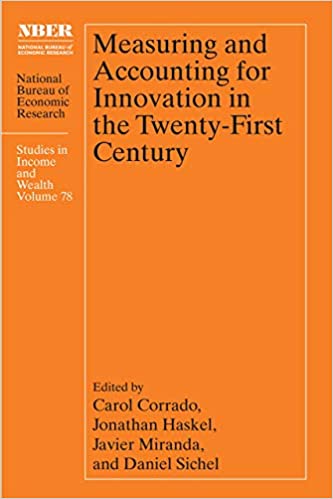
I’ve written a review for another outlet of a weighty new book, but still want to flag it up here. It’s Measuring and Accounting for Innovation in the Twenty-First Century, edited by Carol Corrado, Jonathan Haskel, Javier Miranda, and Dan Sichel. The book is a conference volume, the papers presented at a 2017 NBER conference of the same title that I was lucky enough to attend.It was one of those rare and wonderful conferences where one sits bolt upright througout taking copious notes.

As ever, you don’t read an edited conference volume cover to cover like a normal book, and indeed a number of the papers are (as always in econ) out in the wild in working paper versions. Having said that, for those of us interested in the need to measure better – which means understanding better – the increasingly intangible economy, this is a really interesting book. It covers the waterfront from conceptual frameworks down to nitty gritty measurement questions. It’s much too costly to buy but there is a much much more affordable e-version (and may be worth recommending to the library too).

41thJDlNEGL._SX331_BO1,204,203,200_

Averting catastrophes

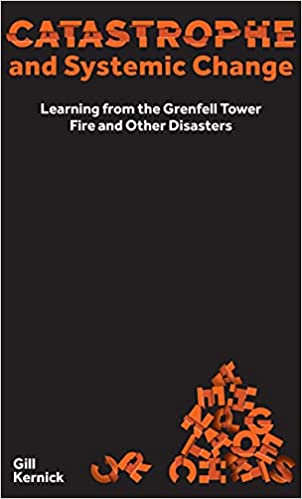
I want to plug a book I’ve edited published (via the Perspectives series with London Publishing Partnership), Gill Kernick’s Catastrophe and Systemic Change.

This is a really important book. Gill is a safety consultant with many years experience advising large, complex businesses about how to avoid disasters. As a former resident of Grenfell Tower, who watched that disaster unfold from her new home nearby, she turned her attention to public sector decision-making. Grenfell was not the first fire of that type. Why had ‘lessons ;earned’ from previous fires in fact not been learned?

We workshopped the questions at a Bennett Institute event in 2019, bringing together practitioners from different fields – fire safety, healthcare, regulatory bodies, the law – and academics from several disciplines. Gill has turned the insights from the workshop and her own experience and research into Catastrophe. There is also a podcast series and we are holding a Bennett Institute public event on June 15th where I’ll discuss the book with her and also with Jill Rutter from the Institute for Government.

The key questions is how to ensure lessons are learned – could there be any excuse for a repeat horror at some time in future? I’m not sure the book fills me with great hope. After a first couple of chapters specifically about how Grenfell happened, it diagnoses the multiple reasons why systems end up being unsafe, from complex and overlapping regulations and responsibilities, to fear of being blamed in political contexts, to the frequent failures to listen to people on the ground thereby losing valuable information about the risks. Having said that, one has to believe that systemic change is possible. Gill’s career has shown many businesses how to embed safety culture. I hope as many decision-makers as possible read the book so the lessons do spread through the public sector. These are often far more complex environments than the private sector, but on the other hand, the responsibilities of those in charge are correspondingly greater.

Do join us on June 15th, and do please read the book.41jIrnIATIS._SX300_BO1,204,203,200_

Public policy & public interest

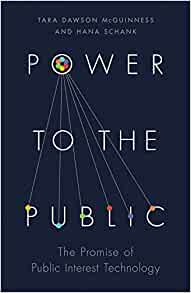
I enjoyed another short book I opted for this holiday weekend, Power to the Public: The promise of public interest technology by Tara Dawson McGuinness and Hana Schank. It’s about the process of making policy and implementing it, rather than the analysis, and that’s one of the key points: that delivery of outcomes is integrated with the design of policies and the data on which analysis is based. The three ‘Ds’ are all essential, and linked to each other. I was interested in this book because we also published one (Digital Transformation at Scale) on the UK (the focus here is the US) about the digital delivery of public services, by Public Digital, the team that originally set up the Government Digital Service.

There are some clear lessons from the experiences on both sides of the Atlantic. One is that talking to the service users and administrators is essential because they contribute information about outcomes and barriers that is otherwise unknowable. Another is that thinking about the data that is not there is as important as the data that’s available, and this is why diversity of experience is important in public service delivery – a somewhat broader point than data bias. A third lesson is that the project of digitising services opens the door to changing processes and even policies – it is not just a matter or replicating paper processes online. Automating a bad policy is not a good outcome. A fourth lesson is the way the decision to digitise helps to bring about policy co-ordination that never happens at the level of policy analysis, for delivery is impossible without tackling all the obstacles to success. This means – fifth lesson – that it can be difficult and slow, and requires building coalitions of support.

The book has lots of examples and convinced me. The rapidly-growing ‘govtech’ or public interest tech movement is encouraging – for instance the US has Code for America and now New America, which these authors lead, and the UK has Public Digital, and State Up. One advantage the US has over the UK is the federal system, meaning different states can provide many opportunities to reform, and natural experiments. As McGuinness and Schank note, successful projects do require consistent political support right from the top. Let’s hope that the imperatives of having to deliver better outcomes for political reasons and needing to restore some order to the public finances during the recovery will mean that support is there.

41XryeEfTXL._SY291_BO1,204,203,200_QL40_ML2_


Humanomics – yes please

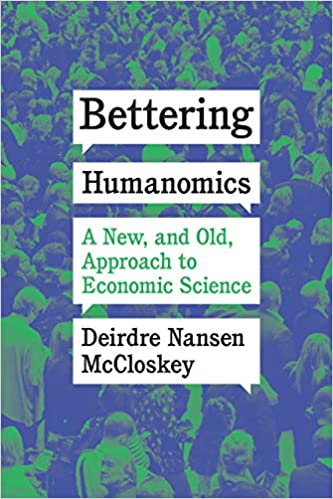
After a 700+ page tome, excellent as it was, I went next for Deirdre McCloskey’s 100 page Bettering Humanomics: A New, and Old, Approach to Economic Science. Her style is something of an acquired taste – I like it, but know some don’t. In any case, there is no doubting the extraordinary breadth and depth of her knowledge (which was on full display in her Bourgeois Virtues trilogy).

This essay is an update on a constant theme through McCloskey’s work, which is the need for a broader methodological approach to economics by economists. The discipline is hobbled by a narrow range of methods, an obsession with one particular style of showy reasoning (often powerful, but often tipping over into ‘mathiness‘ or the cult of statistical significance. Nick Crafts refers to the ‘identification police’, a character everybody who has had a paper rejected by Reviewer 2 because he doesn’t think causality has been demonstrated in the approved way will recognise. The methodological constraints are reinforced by the tyranny of the Top 5 and the insider process for selection that characterises them.

Anyway, I was predisposed to agree with McCloskey in Bettering Humanomics. Her main theme is that ideas and language shape the economy, and economics needs to listen. As she points out, rhetoric has often changed things on the ground in dramatic and sudden ways – we are not deterministic products of centuries of culture. Economies can turn around in short periods – think post-war Germany, Ireland and Portugal, or Thailand and South Korea. Such changes – and many other examples from the impact of advertising to same-sex marriage – torpedo a “notion of preknown preferences derived from utilitarian theory of decision without rhetorical reflection.” The implication is that the kind of arguments about economic development popular among economists based on game theory or some other theoretical structure explain too much: they are too universalist, and ignore the way our actions at any moment are shaped by the expectations of others and the contextual specifics. I cover similar ground in my next book, Cogs and Monsters (out October 12th!).

So, I liked Bettering Humanomics. It’s critical of economics but a critique by someone who knows what she’s talking about and loves the analytical and empirical power of the subject. I think economics is changing, re-embracing the work of economists such as Hirschman and Baumol and Veblen – I hope so. 51jI00dx7mL._SX331_BO1,204,203,200_