War of the words

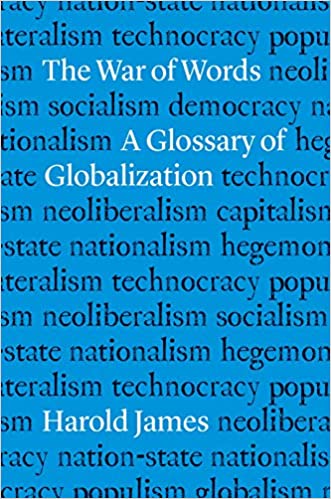
A terrific book I read in proof has arrived here: it’s The War of Words: A Glossary of Globalization by economic historian Harold James. As the book notes at the start, this is a time of the polarisation of ideas about how to interpret the economy, society and politics. Nationalism is on the up and globalisation has become a dirty word. Well, the key point of the book is that the disputes about the world are in part due to the way different uses of the same word can lead to muddled thinking. “This book starts from the notion that moments of profound social transition spark new questions and inspire new vocabularies.” And yet fuzzy concepts obscure discussion rather than clarifying it. The book seeks to clarify potential differences in meaning, so that communication can perhaps become an exchange of ideas more than an angry shouting past people with opposing views.

The chapters each take a word, often an ism: capitalism, socialism, populism, globalism, but also technocracy, democracy, hegemony, debt, and more. They take a journey trough the history of how each term has been deployed, reflecting the changes in society along the way. The complex and changing politics of debt are a great example, and this chapter is a masterly and brief aerial view of why various types of debt – personal, corporate, sovereign – have become so problematic in the 21st century. The historical perspective is essential (I was very struck by Danny Quah’s pointing out on social media today that 2021 is as far from 1980 as 1980 was from 1939…. this is sobering if you remember 1980 as an adult). The debt chapter compares well with David Graeber’s much-praised vast tome Debt, in terms of setting out key political issues of our own time.

I also particularly liked the chapters on technocracy and populism; one could do worse than start students out with these two chapters before diving into the more extensive literature. Again, they have a clarifying focal length, just enough detail to start orienting oneself in these debates of competing isms and politiks. Professor James has the capacious knowledge that makes this possible and a wealth of historical details. Who knew that technocracy was a term born of World War 1, introduced by Californian engineer William H Smyth? He saw it was the means to ensure science and technology servied society. Technocrats took another giant leap forward with World War 2, with the recruitment of science into the comprehensive war effort and then the managerialism of the post-war era. Periodic revolts against the technocrats have occurred, such as Alasdair MacIntyre’s influential polemic After Virtue; but they are essential despite the constant need to maintain a balance between experts (techno-) and people (-cracy) which will inevitably shift over time.

Of course there are omissions but the point is clarification of terms, not exhaustive analysis. As the book concludes: “Words matter: … language can empower citizens.” This is exactly why ‘fake news’ and misinformation have had such a malign influence, why authoritarians control the media, why ‘woke’ and ‘neoliberal’ and many more words can become terms of abuse. We are indeed in a war of the words, and I recommend this book as ammo.
51PoAQgkNUL._SX329_BO1,204,203,200_


Taking ideas seriously

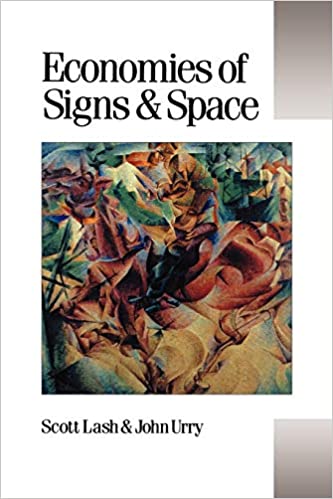
In preparation for delivering the 2021 John Urry lecture at Lancaster University on Thursday, I’ve been re-reading the book that introduced me to his work, Economies of Signs and Space, co-authored with Scott Lash. It was published in 1994, but being an economist, and therefore more ignorant of the other social sciences than I ought to be, I had only just found it when I wrote my 1997 The Weightless World. The commonalities in our ideas were striking – more so to me now than I recall them being 25 years ago, although I cite the book.

These included the intuition about the increasing salience of time and space – both books have a ‘cities’ chapter – fragmenting production systems, the importance of the cultural industries, the deficit of institutions lagging behind economic and cultural change. But above all the increasing share of value assigned to the intangible or weightless. They write: “What is increasingly produced are not material objects but signs,” and note the “increasing component of sign-value or image embedded in material objects.”

The lecture this week will pick up on these insights – I think I and they were pretty prescient – to talk about what it means to have an economy of ideas, but will also talk about the need to re-focus on the material foundation of this economy: giant warehouses and energy-guzzling AIs. Oh, and human brains.

512lA1P034L._SX331_BO1,204,203,200_

Do cities have a future?

For obvious reasons there is a lot of debate about the future of cities, after 18 months when many of us have been stuck at home, and much speculation about whether there will ever be a return to commuting into dense city centres for work. The answer given in Survival of the City by Ed Glaeser and David Cutler is yes – probably. The basic reason is the role face-to-face interactions play in creating economic value, all the more so as increasing automation changes the kinds of jobs left to humans. Creativity, care, tacit knowledge – all require personal interaction. These long months on Zoom have depleted past stocks of social and organisational capital.

The ‘probably’ part, though, is that how successful cities will be depends on some key issues. Foremost among them is managing infectious disease. The book starts with epidemics in history and documents the ways cities have battled their effects, such as clean water and adequate sewage, not to mention the broader provision of good public health systems. For example, drug epidemics and pollution are usually urban blights. However, other aspects of city management are important too. The book singles out crime prevention, adequate supply of housing, and education provision too, for example (not least because the average level of education in a city is a strong predictor of life expectancy for its low income inhabitants even though they are generally not the most highly educated).

In a nutshell, the authors write: “A central theme of this book is that the vulnerability of large, dense, interconnected cities requires an effective, pro-active public sector.” Indeed. And the book ends with a series of recommendations: a “NATO for health”, effective across borders in a way WHO is not; better public health provision; education services that improve opportunities for those who are currently losing out in city life; and (this is a very US-focused book) criminal justice system reform.

I enjoyed reading it, not least because it speaks to my own instincts or prejudice about the role of cities. Lots of great detail too. Who knew the US health system might have been reformed in the 1960s if the then chair of the House Ways and Means Committee, Wilbur Mills, had not been caugh drunk driving with an Argentinian stripper called Fanne Foxe at 2am, and tried to escape the police by jumping into the river? Or that Bayer used to sell heroin as a safe alternative to opium. Or that ‘watered stock’ literally used to be cattle given a lot of water to drink so that they appeared to be fatter?

I’m talking to the authors on 20th October as part of Bristol’s Festival of the Future City – bound to be an interesting discussion.

41480KywbNL._SX327_BO1,204,203,200_

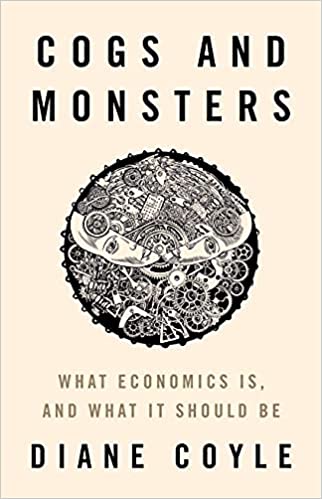
What should economics be? Cogs & Monsters out today!

Today’s the day – another book, by me, launched on the world.
Cogs and Monsters: What Economics Is and What It Should be is a reflection on how economics needs to change, with three main arguments.
One is that the profession is shockingly non-diverse, one of the worst academic disciplines for representation of women and people of colour, and this is intolerable in a social science: how can economists’ even know what questions to ask if there are so few with different experiences of life?
A second is that the long tradition of arguing that economics is like engineering, dentistry or plumbing, seeking objective answers to well-defined problems, so that ‘positive’ economics can be separated from value judgements about questions like inequality, is fundamentally incorrect. Economists’ concept of ‘efficiency’ is itself value-laden, and economists cannot stand outside the society they analyse – although of course seeking to be as objective as possible, using evidence, is to be welcomed. (Page 99 concerns the quality of evidence.)
The third argument is that the benchmark model from which economic reasoning starts is simply misleading in the modern economy of increasing returns, pervasive social influence on each others’ variable preferences, and network dynamics. Economic analysis should concern institutions and not focus on markets. The top academics know this and do outstanding work recognising these features of the world, but it has not changed the basics. For example, the instinct is to start with ‘the market’ and find ‘failures’; but it’s all failures out there and we should be starting with ‘institutions’. And the academic discipline concentrates on quantitative answers to narrow, well-defined problems, instead of tackling the big questions of today.
These are related issues. One reason the same kind of people keep selecting into studying economics is because it speaks to their experiences and preoccupations and not those of different groups. To caricature the top economics departments unfairly – because lots of great work is done by these academics – they have become like Silicon Valley bros. There are lots of parallels between the Econ and tech worlds, including His being coded as ‘homo economics’. But at least everyone is talking about AI ethics. This needs to happen in economics too, reviving political economy and rebooting welfare economics.
I expect critics of economics to agree and lots of economists to disagree. They will point to great papers about X, Y and Z, and will be correct. But the complacency troubles me, the failure to recognise that so few people want to study economics because of the way it is, and that so many blame it for the state of the world.
41duW3ZlMtS._SX320_BO1,204,203,200_

Reforming economics – the heterodox manifesto

Like buses, books about the state of economics seem to come along together. Tomorrow sees the publication of my latest, Cogs and Monsters: What Economics Is and What It Should Be – more on that tomorrow. Do join the launch event if you can.

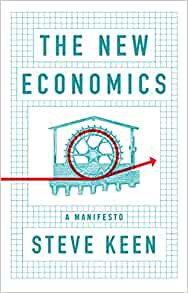
Meanwhile, I read Steve Keen’s recent book The New Economics: A Manifesto. His focus is far more on macroeconomics than is mine, and some of his arguments (about macrodynamics and Minsky’s insights) will be familiar to readers of his earlier book. This new book also covers the environment: its critique of the Nordhaus approach to integrated modelling, that led to a downplaying of the costs of delaying action against climate change, will find hearty agreement among the environmental economists I know. However, even very mainstream people like Daron Acemoglu have joined the call for a more urgent economics of climate change.

I like the book, which is aimed at students embarking on an economics degree, to open their eyes to the limitations of what they’re likely to be taught. Yet having said that I agree with a lot of the arguments in The New Economics, I don’t share the sense that a monolithic ‘mainstream’ of neoclassical economists is determined to resist change becuase they are bad or stupid people. But then, I don’t regard myself as heterodox, and I’m always keen to point out how much brilliant work is going on in the subject, albeit generally in applied micro, because there’s a lot of misundertaning about what economists generally do. My diagnosis is a combination of not stopping to think and institutional inertia (top 5 journals, promotion criteria, disciplinary silos etc.) But more on my book in tomorrow’s post!

51hep0CCdeS._SY291_BO1,204,203,200_QL40_ML2_