
Beyond GDP

[amazon_link id=”019976719X” target=”_blank” ]Beyond GDP: Measuring Welfare and Assessing Sustainability[/amazon_link] by Marc Fleurbaey and Didier Blanchet is a technical book on the profoundly important question of how we measure “the economy”. The authors are two distinguished economists/statisticians who were respectively a member and rapporteur for the Sen-Stiglitz commission appointed by the then French President to consider whether there is a better kind of metric than GDP. This is of course a subject about which there has been considerable debate over the years. Although this is a technical book, the algebra should not defeat a professional economist, and the explanations are very clear. The introduction is well worth a read by anybody interested in this debate.

[amazon_image id=”019976719X” link=”true” target=”_blank” size=”medium” ]Beyond GDP: Measuring Welfare and Assessing Sustainability[/amazon_image]

The book’s concludes that we should be talking about “GDP and Beyond”, because GDP is adequate for measuring production and income. However, when it comes to the ‘beyond’, the authors convincingly show that a number of commonly-proposed alternatives have significant flaws in theoretical terms.The alternatives take one of two forms: a composite index that adjusts GDP in some way, either by subtracting some elements or weighting it with other kinds of indicator; or measuring well-being directly via surveys.

On the composite indices, the book points out that they are arbitrary and lack analytical foundations. They make implicit assumptions about substitution possibilities between their components. They aggregate together inputs, intermediate products and outcomes. There is almost no informational gain from these ‘corrected’ GDP alternatives. They are, to sum up, a dog’s breakfast.

The authors are no more impressed by measures of well-being or happiness. They disagree that happiness is the right or ultimate goal. “Taking happiness as the ultimate goal in life is far from normal and popular.” Indeed, normal views of morality tend to regard hedonism as a negative, not a positive. As for the ‘Easterlin paradox’, they note that subjective well-being indicators fail to account for the way people calibrate their expectations depending on what they are used to; it is simply implausible to think people do not have a strong preference for, say, the greater longevity normal now compared to 50 or 100 years ago, but they answer surveys in ways calibrated to their experience of how things are now. Not only is GDP not bounded, while surveys are answered on a 1-10 scale, but “People are induced to reason in relative terms when they must describe an open-ended object, their lives, on a closed scale.”

As the book points out, measuring current welfare is one thing, but measuring sustainability is another – and much harder. It is a separate challenge, although they are often merged. The reason for the intrinsic difficulty is that it isn’t possible to compare present consumption or activity to as ‘sustainable’ level without taking a view about the future – and not just one specific future but the entire possibility set taking account of uncertainties about how the world is now and how it may change as people’s behaviour and preferences change. “It is illusory to believe that all the information we need about the future is already present in current observations.”

This all sounds rather negative. If the conventionally-proposed alternatives are so flawed, and sustainability is intrinsically hard, is there any better alternative?

The book goes part way to an answer. It recommends looking at a version of ‘adjusted net savings’ to measure sustainability. This involves looking at changes in the stocks of relevant assets, whether physical, human or natural capital. The authors recommend a carefully-structured dashboard of indicators of over-consumption or dissaving, with the ‘Goldilocks’ aim of being neither too aggregated to be meaningful nor too disaggregated to be easily understood. On current social welfare, they recommend the ‘equivalent income’ of non-market activities or outputs, that is the income that would give the same utility as non-market dimensions of welfare such as health, the environment or social connection. This is a well-known bit of the economics toolkit, asking people how much they would need to give up something. This is better, the book argues, than making the a priori assumptions involved in present composite indicators. And it gives a clear metric for assessment, namely money: “Whatever one does, aggregation implies putting relative values on very different items, and doing so in monetary units is no less respectable than the apparently dimensionless valuations implicit in composite indexes.”

I think this carefully-argued book is very persuasive – this is not an easy challenge, and the analytical issues are set out here with great clarity. It did not give me a clear idea of how the preferred methods would be put into practice, but no doubt statisticians are working on this. The effort is certainly worthwhile, and after all, calculating GDP is itself a complex and time-consuming business. The one point on which I’d disagree with them is the throwaway line that GDP itself is ok and should be left alone. I certainly think we need GDP but it will itself need reconsidering as it might not be the best way to measure an increasingly intangible, service-based, economy with a huge proliferation of variety and complexity. More on that in my new book GDP: A brief and affectionate history, out early next year!
Banker bashing*

This week I’m getting to attend an event at which Anat Admati is speaking, which is exciting. Her book with Martin Hellwig, [amazon_link id=”0691156840″ target=”_blank” ]The Bankers’ New Clothes: What’s Wrong with Banking and What to do About it[/amazon_link] is terrific – it’s on the shortlist for The Enlightened Economist prize, and I reviewed it here. The main message is simple: banks need to hold more capital, less debt, on their balance sheet, because it’s too risk to have massive financial institutions made insolvent by a 4% decline (say) in the value of their assets. We’d consider the kind of debt/equity ratio that characterises the banks as ludicrously over-leveraged in any other business, so why is it considered ok for banks to have so little capital? The book thoroughly debunks the claim that higher capital requirements would squeeze lending to businesses: the proportions of debt and equity on the liabilities side of the banks’ balance sheets have no automatic implications for the amount lent on the assets side. (Banks’ cost of funds would increase somewhat.)

[amazon_image id=”0691156840″ link=”true” target=”_blank” size=”medium” ]The Bankers’ New Clothes: What’s Wrong with Banking and What to Do about It[/amazon_image]

I’ll report back on the event. Meanwhile, there is a new book on RBS, Iain Martin’s [amazon_link id=”147111354X” target=”_blank” ]Making It Happen: Fred Goodwin, RBS and the Men Who Blew Up the British Economy[/amazon_link]. Ian Fraser’s [amazon_link id=”1780271387″ target=”_blank” ]Shredded: The Rise and Fall of the Royal Bank of Scotland[/amazon_link] is due out early next year.

[amazon_image id=”147111354X” link=”true” target=”_blank” size=”medium” ]Making it Happen: Fred Goodwin, RBS and the Men Who Blew Up the British Economy[/amazon_image]

[amazon_image id=”1780271387″ link=”true” target=”_blank” size=”medium” ]Shredded: The Rise and Fall of the Royal Bank of Scotland[/amazon_image]

Quick update: Admati has a letter in today’s Financial Timesknocking down the undead myth that ultra-high leverage has some benefits: “If banking shrinks because some banks are not viable at a level of 30 per cent equity, the economy stands to benefit. … Lending suffers when banks are weak, and bankers use subsidised funding to boost their ROE in derivative and other markets.”

* They still deserve it for fighting tooth and nail every post-crisis attempt to prevent the same kind of thing happening again.

The Enlightened Economist Book Prize shortlist, 2013

It is a year since I announced the winner of the inaugural Enlightened Economist Book Prize – it was Ariel Rubinstein’s [amazon_link id=”1906924775″ target=”_blank” ]Economic Fables[/amazon_link]. A little late this year, here is this year’s shortlist.

A reminder of the rules. This prize is wholly idiosyncratic. The entrants are books I happen to have read since the last prize – date of publication, format etc are irrelevant. They are suitable for the general reader as well as the professional economist. The choice of winner is entirely mine, although I’m always interested in other people’s opinions. The prize is the kudos, although I also offer a nice dinner to the winner, should he or she want to take it up.

Just recently I discussed some of the best books of the year with Tyler Cowen and Cardiff Garcia on the FT Alphaville podcast, so there is a small overlap (the first three titles here) with that discussion in my list.

The first time through my notes, I came up with shortlist of 28, which isn’t all that short. So I brutally struck out all the non-economics books, including some terrific histories, such as [amazon_link id=”0713998687″ target=”_blank” ]Iron Curtain: The Crushing of Eastern Europe[/amazon_link] by Anne Applebaum and [amazon_link id=”075381983X” target=”_blank” ]Building Jerusalem[/amazon_link] by Tristram Hunt, and technology books like [amazon_link id=”014101590X” target=”_blank” ]Turing’s Cathedral[/amazon_link] by George Dyson and [amazon_link id=”0262018624″ target=”_blank” ]Robot Futures[/amazon_link] by Illah Reza Nourbaksh.

So here is the final shortlist.

[amazon_link id=”0691155674″ target=”_blank” ]Worldly Philosopher: The Odyssey of Albert O Hirschman[/amazon_link] by Jeremy Adelman

[amazon_link id=”B00BIOFLWE” target=”_blank” ]America’s Assembly Line[/amazon_link] by David Nye

[amazon_image id=”B00BIOFLWE” link=”true” target=”_blank” size=”medium” ]America’s Assembly Line[/amazon_image]

[amazon_link id=”0262019132″ target=”_blank” ]Giving Kids a Fair Chance[/amazon_link] by James Heckman

[amazon_link id=”0525953736″ target=”_blank” ]Average is Over[/amazon_link] by Tyler Cowen

[amazon_link id=”1408704242″ target=”_blank” ]The Undercover Economist Strikes Back[/amazon_link] by Tim Harford

[amazon_link id=”0300197195″ target=”_blank” ]The Carbon Crunch[/amazon_link] by Dieter Helm

[amazon_image id=”0300197195″ link=”true” target=”_blank” size=”medium” ]The Carbon Crunch: How We’re Getting Climate Change Wrong – and How to Fix it[/amazon_image]

[amazon_link id=”0691158681″ target=”_blank” ]The Great Rebalancing: Trade, Conflict and the Perilous Road ahead for the World Economy[/amazon_link] by Michael Pettis

[amazon_link id=”0691156840″ target=”_blank” ]The Bankers New Clothes[/amazon_link] by Anat Admati & Martin Hellwig

[amazon_link id=”B00BBJCUUW” target=”_blank” ]Shooting Star[/amazon_link] by Karl Sabbagh

[amazon_image id=”B00BBJCUUW” link=”true” target=”_blank” size=”medium” ]Shooting Star (Kindle Single)[/amazon_image]

[amazon_link id=”0300190522″ target=”_blank” ]When the Money Runs Out: The End of Western Affluence[/amazon_link] by Stephen King

[amazon_link id=”0691149097″ target=”_blank” ]The Battle of Bretton Woods[/amazon_link] by Benn Steil

[amazon_link id=”0141975652″ target=”_blank” ]The Signal and the Noise: The Art and Science of Prediction[/amazon_link] by Nate Silver

[amazon_image id=”0141975652″ link=”true” target=”_blank” size=”medium” ]The Signal and the Noise: The Art and Science of Prediction[/amazon_image]

I will announce my winner in a couple of weeks.

Living vicariously

My eldest son spent his teenage years saying he was never going to end up as an economist (not that I ever put any pressure on him to choose economics). Then he read [amazon_link id=”0349119856″ target=”_blank” ]The Undercover Economist[/amazon_link] by Tim Harford, and became an economist. Next week he starts an MSc course in Economics. Living vicariously, I was looking at the course outline.

It’s 32 years since I was at the same stage in my education, and it is really startling to see how little the curriculum has changed. This is why I organised a conference in 2012 on the economics curriculum (the pre- and post-conference papers are in [amazon_link id=”1907994041″ target=”_blank” ]What’s the Use of Economics[/amazon_link]); and why Wendy Carlin of UCL is launching an initiative to develop a new, open-access undergraduate core curriculum.

Of course, until there is an alternative, most lecturers will carry on doing the same thing as before. Developing a new course by oneself is time-consuming and unrewarded, and the incentives to stick with existing textbooks and problem sets are overwhelming. I was pondering how I might home-school my son for a master’s level course, should he be in the unfortunate position of relying on mum.

For macro, I might be tempted just to give him Tim Harford’s new book, [amazon_link id=”1408704242″ target=”_blank” ]The Undercover Economist Strikes Back[/amazon_link], and the Bank of England’s suite of publications on its model and the Inflation Reports. I don’t see the point of continuing to teach the mathematical general equilibrium and DSGE models, as they are neither true nor useful. I would add, though, endogenous growth theory, via the Aghion and Howitt textbook, [amazon_link id=”0262012634″ target=”_blank” ]The Economics of Growth[/amazon_link]. For micro, Sam Bowles’ [amazon_link id=”0691126380″ target=”_blank” ]Microeconomics: Behavior, Institutions and Evolution[/amazon_link], Paul Klemper’s [amazon_link id=”0691119252″ target=”_blank” ]Auctions: Theory and Practice[/amazon_link] and one of the game theory texts – Martin Osborne and Ariel Rubinstein’s [amazon_link id=”0262650401″ target=”_blank” ]A Course in Game Theory[/amazon_link]? – supplemented by some business economics texts such as Paul Geroski’s [amazon_link id=”0198288557″ target=”_blank” ]Market Structure, Corporate Performance and Innovative Activity[/amazon_link]. For econometrics, Angrist and Pischke’s [amazon_link id=”0691120358″ target=”_blank” ]Mostly Harmless Econometrics[/amazon_link], maybe Clements and Hendry on [amazon_link id=”0521634806″ target=”_blank” ]Forecasting Economic Time Series[/amazon_link], and an actual software package.

Needless to say, this train of thought is just me living vicariously. Wouldn’t it be marvellous to be a student again? Meanwhile, my son is forewarned that I’ll be eager to look at his reading lists when he starts his actual course.

[amazon_image id=”0691119252″ link=”true” target=”_blank” size=”medium” ]Auctions: Theory and Practice (Toulouse Lectures in Economics)[/amazon_image]

Neglected mental furniture

There’s an interesting article in the new edition of The American Conservative about A.J.P. Taylor. (This journal isn’t one of my regular reads – the wonderful Arts & Letters Daily brought it to me.) The title is ‘A.J.P.Taylor is History’, the double entendre being that he shaped how we conceive of modern history, but is now forgotten. Surely not? I asked Twitter. It emerged that unless you’re of a certain age (i.e. middle aged), the answer is yes, Taylor is a neglected figure.

This is a shame. His scholarly work was important. [amazon_link id=”014013672X” target=”_blank” ]The Origins of the Second World War[/amazon_link] was of course controversial but it did put the spotlight on the fact that conditions in Europe were conducive to conflict, including the economic situation (as Keynes had forewarned in [amazon_link id=”1602390851″ target=”_blank” ]The Economic Consequences of the Peace[/amazon_link]). He was also one of the first media dons, a terrific broadcaster and populariser. These people are rarely popular among their colleagues but serve an important purpose, and act as one of the (too) few conduits between academic research and the taxpayers who fund it. Here he is on the BBC talking about Europe in 1939 and here in the BBC Archive talking about Winston Churchill.

[amazon_image id=”014013672X” link=”true” target=”_blank” size=”medium” ]The Origins of the Second World War[/amazon_image]

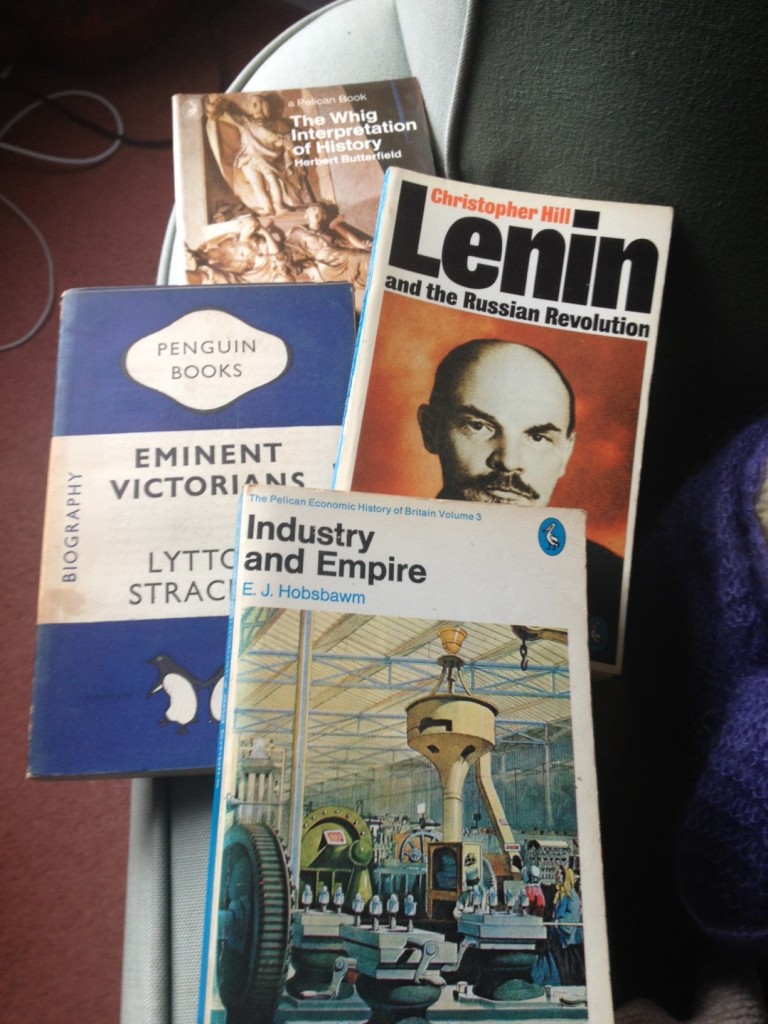
The discussion this morning about Taylor set me to thinking about the writers who formed my mental furniture in the late 1970s, in the sixth form and heading off to university. It was a kind of accident that turned me into an economist, history having been my main interest at school. I just pulled off my shelves as well Lytton Strachey’s [amazon_link id=”019955501X” target=”_blank” ]Eminent Victorians[/amazon_link], Christopher Hill’s [amazon_link id=”0140135359″ target=”_blank” ]Lenin and the Russian Revolution[/amazon_link], Herbert Butterfield’s [amazon_link id=”0393003183″ target=”_blank” ]The Whig Interpretation of History [/amazon_link]and Eric Hobsbawm’s [amazon_link id=”0140257888″ target=”_blank” ]Industry and Empire[/amazon_link], in beaten up old Penguin editions.

I don’t know what students read now, what shapes their mental landscape. Or for that matter what middle-aged folk in other disciplines or from outside the UK read in their formative years?