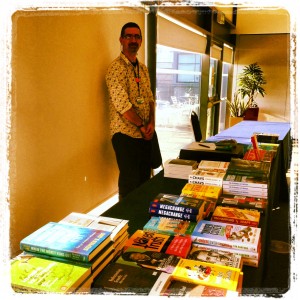
Festival books

It’s the 2nd annual Festival of Economics in Bristol currently – webcast here if you can’t make it in person, hashtag #economicsfest. A number of the speakers have recent books out: Martin Ruhs is the author of [amazon_link id=”0691132917″ target=”_blank” ]The Price of Rights: Regulating International Labor Migration[/amazon_link].  Faisal Islam, in conversation at lunchtime today with Dan Franklin, wrote [amazon_link id=”1781854106″ target=”_blank” ]The Default Line: The Inside Story of People, Banks and Entire Nations on the Edge[/amazon_link]. Tim Harford is speaking on his new book, [amazon_link id=”1408704242″ target=”_blank” ]The undercover Economist Strikes back: How to Run or Ruin an Economy[/amazon_link]. Others with recent-ish books are Stephen King ([amazon_link id=”0300190522″ target=”_blank” ]When The Money Runs Out[/amazon_link]), Stewart Lansley ([amazon_link id=”1908096292″ target=”_blank” ]The Cost of Inequality[/amazon_link]) and Nick Crafts ([amazon_link id=”0199663181″ target=”_blank” ]The Great Depression of the 1930s: Lessons for Today[/amazon_link])

[amazon_image id=”1781854106″ link=”true” target=”_blank” size=”medium” ]The Default Line: The Inside Story of People, Banks and Entire Nations on the Edge[/amazon_image]

[amazon_image id=”1408704242″ link=”true” target=”_blank” size=”medium” ]The Undercover Economist Strikes Back: How to Run or Ruin an Economy[/amazon_image]

There are also three authors from the new Perspectives series launching tomorrow: Bridget Rosewell (Reinventing London); Julia Unwin (Why Fight Poverty?) and Andrew Sentance (Rediscovering Growth: After the Crisis).

The lovely Arnolfini bookshop is running the Festival shop so I shall no doubt be heading home tomorrow evening laden with more books.

Ripping yarns

The FT just announced that [amazon_link id=”059307047X” target=”_blank” ]The Everything Store[/amazon_link] by Brad Stone won its business book of the year competition. Unusually, I’ve not read any of the shortlist this year, apart from half of [amazon_link id=”0753541629″ target=”_blank” ]Lean In[/amazon_link] (a short book), as it was lying around an office where I was waiting for a meeting. The first half was disappointing – it made a perfectly reasonable point about women needing to do a bit of self-promotion as the men around aren’t going to do it for them. But it didn’t even seem to touch – even in the second half – on the institutional and societal barriers to women’s status and income; it is all about the individual.

[amazon_image id=”059307047X” link=”true” target=”_blank” size=”medium” ]The Everything Store[/amazon_image]

Anyway, I’ll pick up some of the other short-listed titles when they’re out in paperback. [amazon_link id=”1848547927″ target=”_blank” ]Big Data [/amazon_link]appeals, as do [amazon_link id=”0755362683″ target=”_blank” ]The Alchemists[/amazon_link] (about central banks) and [amazon_link id=”1471113558″ target=”_blank” ]Making It Happen[/amazon_link] (about RBS).

Although I don’t read as many business as economics books, a few of them are truly ripping yarns – it has to be said that the majority are extremely dull. My husband just read, and strongly recommends [amazon_link id=”1444761978″ target=”_blank” ]Hatching Twitter[/amazon_link] by Nick Bilton. One of my all-time favourites is Robert Cringley’s [amazon_link id=”0140258264″ target=”_blank” ]Accidental Empires[/amazon_link]. My introduction to the oeuvre was Alfred Sloan’s classic [amazon_link id=”0385042353″ target=”_blank” ]My Years With General Motors[/amazon_link]  – a little different as it’s a business autobiography rather than a biography by a more or less objective outsider, but I think it definitely stands the test of time, and it was the first time I realised that there could be good, interesting books about business.

[amazon_image id=”1444761978″ link=”true” target=”_blank” size=”medium” ]Hatching Twitter[/amazon_image]

Value and values, public and private

Last Friday I attended a very interesting workshop organised by Channel 4 on the theme of “Public Value from Private Enterprise: A growing British movement.” It was an open conversation about the overlaps, if there are some, between publicly-funded organisations with a public service remit, public service organisations funded partly commercially, social enterprise, and private enterprise with a wider sense of meaning or service than the profit motive. It was a gathering of like-minded people but I think it did indicate that there can be considerable overlap. The question that prompts is then how do you know an organisation is creating value when its aims are multi-dimensional, when profit is not the only measure of success?

At present, different bodies try to measure their outcomes in different ways. At the BBC Trust (I was speaking on a panel while wearing that hat), we have an explicit public value remit and have published quite a detailed explanation of the methodology. Channel 4 too has a remit set out in legislation and its own methodology (available here). Social enterprises and some private, only for-profit organisations might use triple bottom line reporting (much written on this but it originated with John Elkington’s [amazon_link id=”1841120847″ target=”_blank” ]Cannibals with Forks[/amazon_link]. The thought now is to look at the different approaches and see what is common to them, and whether it is possible to set out the principles clearly enough that even the smallest, hardest-pressed public body or social enterprise could create its own toolkit for assessing impact.

[amazon_image id=”1841120847″ link=”true” target=”_blank” size=”medium” ]Cannibals with Forks: Triple Bottom Line of 21st Century Business[/amazon_image]

The literature on public value is surprisingly small. Mark Moore wrote the book that started it all, [amazon_link id=”B00974H7Q0″ target=”_blank” ]Creating Public Value: Strategic Management in Government[/amazon_link], and a couple of follow-ups. There is an Accenture volume, [amazon_link id=”0471959456″ target=”_blank” ]Unlocking Public Value[/amazon_link]. The think tanks have done quite a lot of work. Nesta has focused most on measuring cultural value. There are several Work Foundation pamphlets. Demos too has looked at aspects of public value. I’m sure there is more around, but it isn’t a big scholarly literature; the focus is largely practical. This is surprising because in fact a lot of organisations – many of them in the arts and elsewhere in the public sector –  use a methodology related to the concept of public value. I’m not sure why academics are so uninterested; perhaps it’s because the language used to describe it does vary quite a lot.

However, I believe – along with my Channel 4 hosts last week – that it is a growing movement, thanks in large part to the increasing number of social enterprises, and that a number (who knows how many) of private for-profit entities are also hungry for more value in all senses of the word in what they do.

[amazon_image id=”B00974H7Q0″ link=”true” target=”_blank” size=”medium” ]Creating Public Value: Strategic Management in Government ( CREATING PUBLIC VALUE: STRATEGIC MANAGEMENT IN GOVERNMENT ) BY Moore, Mark H.( Author ) on Mar-25-1997 Paperback[/amazon_image]

Situation vacant: global hegemon

Serendipitously, I started reading this week a book that has been sitting in my office for a while, [amazon_link id=”069115743X” target=”_blank” ]The Leaderless Economy: Why the world economic system fell apart and how to fix it[/amazon_link] by Peter Temin and David Vines. Serendipitously because this follows on from just having read Jonathan Fenby’s excellent overview of China, [amazon_link id=”1847394116″ target=”_blank” ]Tiger Head, Snake Tails[/amazon_link], which has a big chunk on China’s global position, and also the forthcoming [amazon_link id=”1907994130″ target=”_blank” ]The BRIC Road to Growth[/amazon_link] by Jim O’Neill.

[amazon_image id=”069115743X” link=”true” target=”_blank” size=”medium” ]The Leaderless Economy: Why the World Economic System Fell Apart and How to Fix It[/amazon_image]

All three raise the question of global economic governance. The word is unappealing, but it’s a vital issue. And Temin and Vines, a distinguished combo of economic historian and international economist, do a very interesting compare and contrast exercise between the 1930s and the present global economic crisis (I’m one of those who thinks it isn’t nearly over yet, despite signs of recovering growth). Others have of course drawn parallels with the 30s, but the focus here is on international governance – and also on the political consequences of an ailing global order. I knew I was going to like the book when the introductory chapter kicked off with David Hume’s price-specie flow mechanism. They write: “The price-specie flow model connects internal and external balances.” The two need to be considered together to find a solution to global disorder, they argue (Michael Pettis, in his excellent [amazon_link id=”0691158681″ target=”_blank” ]The Great Rebalancing[/amazon_link] would agree.) One thing that has changed since Hume’s time is the development of an asymmetric response between prices/wages and output/employment, but even so deflationary pressures are still evident in some countries.

The book characterises the current state of affairs as an ‘end of regime’ crisis, and argues that the resolution will depend on the emergence of a hegemonic country in the global economy, just as the 1930s crisis was not fully resolved until the US took that role. The ‘how to fix it’ of the subtitle is to have some leadership. “Continued neglect of international imbalances will lead to conditions reminiscent of the 1930s and possibly even to military conflicts like those of the 1940s,” they write. Scary thought. They note that it took decades for the switch from Britain to America to occur – from 1918 until the late 1940s really.

I suppose it is true that a single hegemon is necessary to orchestrate the co-operation needed to resolve the interaction of internal and external balances around the world. However, this is a depressing conclusion because my sense from my China reading (and I’m not at all an expert) is that the only candidate is far from ready to step into that role, while America’s decline is increasingly apparent with every news story about its bizarre, internally-obsessive politics – it can’t co-operate with itself, never mind other nations. Like Pettis, Temin and Vines see the economic solution as obvious – an expansion of domestic demand in China and Germany.

“The world …needs both co-operation and a way to make durable bargains among nations. … The absence of an obvious hegemonic leader makes it easy to be pessimistic that such co-operation will not be forthcoming.” Maybe, they suggest, the G20 could get its act together. Jim O’Neill’s [amazon_link id=”1907994130″ target=”_blank” ]The BRIC Road to Growth[/amazon_link] is a bit more optimistic about the scope for leadership to come from the fast-growing large emerging economies but also forsees governance change as likely to be too slow. Temin and Vines are pessimists: “Alas, politics in America and Europe seems to be aimed at repeating the mistakes of the 20th century in the first global crisis of the 21st.” A sobering thought as the 100th anniversary of World War I hoves into view.

I would make all political leaders read this book over the holidays – whether in December or a bit later for Chinese New Year – and hope that it prompts them to make a New Year resolution to show true leadership. A globalized world without global leadership is a pretty terrifying prospect.

Google, books and public value

Already much has been written about the American court’s ruling in favour of Google being able to digitize millions of books without express permission from the copyright holder. The EFF warmly welcomed the ruling, other commentators have some reservations, and the Authors Guild has said it will appeal. Judge Denny Chin was absolutely clear, writing:

“In my view, Google Books provides significant public benefits,” the ruling reads. “It advances the progress of the arts and sciences, while maintaining respectful consideration for the rights of authors and other creative individuals, and without adversely impacting the rights of copyright holders.”

The judgement suggests Google Books will act like a store allowing people to browse before they go ahead and buy the book – that it will be an unusual example, in other words, of a monopoly in the public interest.

Hmm. There is obvious potential for researchers and readers to benefit from increased access to books. It is possible that authors will benefit if searchability increases rather than decreases their sales – this is plausible but it is an empirical issue, so we will see.

However, the ruling (on a quick read) ignores other potential side-effects. Google is a commercial company, not a public library, and the architecture it uses to present search results will not be based on the same kind of criteria. It may well divert people away from libraries, which are important social and cultural institutions. It may have a market impact in bookselling depending on the links given alongside search results – can retailers buy those slots? I don’t know. The e-book link is a solo link in the examples I looked at, taking you to pay in Google Play with Google Wallet. There will be other unintended consequences I’ve not thought of yet.

If there is an appeal, it isn’t quite the end of the saga, but I think it is clear the game is probably over for the Authors Guild. However, the remaining delay gives Google time to reflect on how it implements Google Books – what are the principles, and what role does public service play in this initiative?

Coincidentally, I spent this morning at a fascinating conference on public value organised by Channel 4 (talking about how the BBC Trust thinks about public value – here is a link to our publication on it, Public value in Practice). I believe commercial organisations can have a public purpose, that this has a large overlap with the profit motive, rather than conflicting with it. But it behoves Google as a massive commercial entity providing one of the most important public goods – knowledge – to tell us more about the principles by which it will run Google Books.