A lucky escape

It was a mistake to go into Daunt Books on Cheapside yesterday when I had 20 minutes spare before lunch. In a lucky escape, I got out with only three paperbacks: [amazon_link id=”1781681678″ target=”_blank” ]Altai[/amazon_link] by Wu Ming, [amazon_link id=”0099584972″ target=”_blank” ]The Golden Egg[/amazon_link] by Donna Leon, and [amazon_link id=”0571310303″ target=”_blank” ]Geek Sublime: Writing Fiction, Coding Software[/amazon_link] by Vikram Chandra. The blurb asks: Can code ever be called beautiful? It promises the book looks at the links between logic gates and modernism, geeks and machismo, and Indians and coding. Irresistible.

[amazon_image id=”1781681678″ link=”true” target=”_blank” size=”medium” ]Altai: A Novel[/amazon_image]  [amazon_image id=”0099584972″ link=”true” target=”_blank” size=”medium” ]The Golden Egg: (Brunetti)[/amazon_image]  [amazon_image id=”0571310303″ link=”true” target=”_blank” size=”medium” ]Geek Sublime: Writing Fiction, Coding Software[/amazon_image]


Capital in the 19th century

During the mid-late 1970s era of high inflation, I was a teenager growing up in a household with two parents who worked, but not in jobs with unions that could deliver inflation-beating wage increases, and whose small savings were held in a building society account. Rising food and energy prices made things tough. Marked as we all our by personal experience, I’ve ever since believed inflation to be harmful for people on relatively low incomes, tending to mean declining real earnings and negative returns on savings.

The early section of Piketty’s [amazon_link id=”067443000X” target=”_blank” ]Capital in the 21st Century[/amazon_link] has given me pause for thought. He contrasts the Victorian and Edwardian era of stable prices and rentier wealth (in the form of land and then government bonds) with the post-1920s era of declining importance in inherited wealth. He writes:

“Capital is never quiet: it is always risk-oriented and entrepreneurial, at least at its inception, yet it always tends to transform itself into rents as it accumulates in large enough amounts.” (p115-116)

The point of accumulation is to build up enough to stop working, whether at the scale of a character in an Austen or [amazon_link id=”0140440178″ target=”_blank” ]Balzac novel[/amazon_link], or at the scale of a colonial power like France or Britain.

What changed with the onset of the violent 20th century was inflation. In the 19th century, when governments built up war debts, rentier classes bought the government bonds and could live securely on the repayments. “In the 20th century, a totally different view of public debt emerged, based on the conviction that debt could serve as an instrument of policy aimed at raising public spending and redistributing wealth for the benefit of the least well-off members of society. The difference between these two views is fairly simple: in the 19th century, lenders were handsomely reimbursed, thereby increasing private wealth; in the 20th century, debt was drowned by inflation and repaid with money of decreasing value.” (p132)

France inflated far more dramatically than the UK in the period 1913-1950, and French public debt dropped from 80% to 30% of national income over that period. The UK had a colossal 200% of GDP debt in 1950, but made up for it with inflation in the 1950s and especially the 1970s. In both cases, though, inflation was the means of expropriating the rentier classes and, Piketty argues, one of the key reasons the 20th century bucked the tendency of capitalism to create and enhance entrenched wealth inequality. So this is obviously a different perspective on inflation from my teenage perception.

I was chatting about this to Professor Dieter Helm, who chairs the UK’s Natural Capital Committee and is writing a book about valuing natural capital (which will be a must-read when it’s out). He pointed out that the shift towards an inflationary regime coincided with a generational rebellion against the Victorian emphasis on thrift and investment for the future, in favour of consumption and the present. In Britain, the Bloomsbury Group – including Keynes – exemplified this; see for example Michael Holroyd’s tome on [amazon_link id=”0099332914″ target=”_blank” ]Lytton Strachey[/amazon_link].

[amazon_image id=”1845951832″ link=”true” target=”_blank” size=”medium” ]Lytton Strachey: The New Biography[/amazon_image]

This all makes one wonder about the next few decades – I’d bet on a return to inflation and expropriation of the bond-holding classes (pensioners?), even though the pressing concern is deflation. But this is a bet, not a forecast. Besides, the future the Victorians built is the one we’re still living off, the infrastructure and institutions. Anybody who cares about sustainability (in its broadest sense) must surely be thinking in terms of tilting the balance away from consumption and towards investment. Towards capital, in fact, which makes its distribution all the more important.

Capital, statistics and stories

Two hundred pages into Piketty’s [amazon_link id=”067443000X” target=”_blank” ]Capital in the 21st Century[/amazon_link], I’ve found plenty of interest but am not yet bowled over as some reviewers have been. Still, 400 pages to go. I’m not going to live tweet the reading experience but will pick up on some interesting points as I go along before perhaps attempting an overall review.

[amazon_image id=”067443000X” link=”true” target=”_blank” size=”medium” ]Capital in the Twenty-First Century[/amazon_image]

A mere 58 pages in, I was calling out ‘hear, hear’ when I read this:

“One conclusion stands out in this brief history of national accounting: national accounts are a social construct in perpetual evolution. They always reflect the preoccupations of the era in which they were conceived. We should be careful not to make a fetish of the published figures.”

This is needless to say completely in harmony with my own view in [amazon_link id=”0691156794″ target=”_blank” ]GDP: A Brief But Affectionate History[/amazon_link].

[amazon_image id=”0691156794″ link=”true” target=”_blank” size=”medium” ]GDP: A Brief but Affectionate History[/amazon_image]

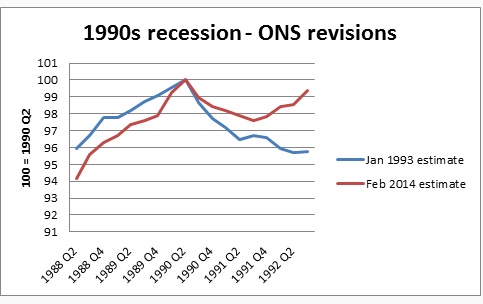
Too many economists pay no attention to the figures they are using, simply downloading time series from handy databases and telling stories around them. This chart showing ONS revisions to 1990s UK GDP data (or something similar) should be pinned above every economist’s desk as a reminder that the figures, although they’re all we have to measure the tide of economic events, are as broad brush as can be. The late 80s boom was even boomier than we remember, but the subsequent bust far less severe. As a reminder, there were a few things happening in 1992 – a general election in April, double digit interest rates in the summer, ‘Black Wednesday’ in September.

The present national accounts – as I describe in my book – co-evolved with Keynesian macroeconomics. The accounting identity C+I+G+(X-M) segued into the theory of aggregate demand and its successors. We’re stuck with GDP until the next Keynes conceives a theory of aggregate dynamics fit for a largely intangible, service and information driven economy, when there will have to be a different statistical framework.

PS I should add that it was @BenChu_ who alerted me to the 1990s revisions

Canada versus Minsky, and the politics of banking

With Eurostar journeys coming up, I anticipate making decent inroads into Piketty’s [amazon_link id=”067443000X” target=”_blank” ]Capital[/amazon_link], but meanwhile the enormous buzz about it makes it harder than ever to understand why the popular and intellectual anger about plutocracy has not translated (yet?) into political consequences.

This thought was underlined by browsing through [amazon_link id=”0691155240″ target=”_blank” ]Fragile By Design: The Political Origins of Banking Crises and Scarce Credit[/amazon_link] by Charles Calomiris and Stephen Haber. They write: “There is no avoiding the government-banker partnership.” The book combines history, economics and political science to analyse the nature of the state-bank relationship, within a framework of bargaining. One section compares and contrasts the US (12 systemic banking crises since 1840) and Canada (zero). Another looks at the relationship in authoritarian contexts and democratic transitions.

[amazon_image id=”0691155240″ link=”true” target=”_blank” size=”medium” ]Fragile by Design: The Political Origins of Banking Crises and Scarce Credit (The Princeton Economic History of the Western World)[/amazon_image]

One important conclusion is that no general theory can explain why banking crises have not been equally likely in all countries in the recent past. For example, [amazon_link id=”0071592997″ target=”_blank” ]Hyman Minsky[/amazon_link]’s theory of endogenous excess followed by fear has enjoyed a revival – indeed there was a recent BBC Radio 4 Analysis on it (Why Minsky Matters) that is well worth a listen – but why was Canada exempt from these oscillations arising from human nature? It isn’t that Minsky is wrong, but rather that context matters for crises too. “Useful propositions about banking generally are only true contingently, depending on historical context.” And, to mangle [amazon_link id=”0140449175″ target=”_blank” ]Tolstoy[/amazon_link], every country (except Canada?) has its own unhappy politics.

Which brings me back to the strange absence of any political consequence of the financial crisis for banking. Bankers will complain about excess regulation but the only result has been to cause them to employ more compliance officers, and more lawyers to game the regulations. There has been little action on leverage and capital ratios, next to none on scandalous rent-seeking bonuses and none at all enforcing competition and new entry. The financial sector isn’t the only locus of the modern plutocracy, but it is one of the most significant.

One possibility is that the political classes are befuddled because – as I describe in [amazon_link id=”0691156794″ target=”_blank” ]GDP: A Brief But Affectionate History[/amazon_link] – the national accounts figures overstate the contribution of the financial sector to the economy. Maybe some politicians genuinely believe they cannot risk killing the goose that’s laying the golden eggs even if it is keeping all the eggs within its own nest. Whatever the explanation, the bargain between banks and politics is working for bankers, and not for other citizens.

Here is an excellent VoxEU interview about the book with Charles Calomiris. For now, I’m off to St Pancras and on with Piketty.

[amazon_image id=”067443000X” link=”true” target=”_blank” size=”medium” ]Capital in the Twenty-First Century[/amazon_image]

(Non-) Digital thinking

It was a good way to end the week: I spent Friday talking to very clever people in London and then Cambridge, about things digital in general and specifically how the tech is affecting democracy. I might write more about both meetings in due course, but meanwhile, these are the books mentioned in the discussions.

[amazon_link id=”067443000X” target=”_blank” ]Capital in the 21st century[/amazon_link] by Thomas Piketty, of course – even Cabbage is interested

[amazon_link id=”0393239357″ target=”_blank” ]The Second Machine Age[/amazon_link] by Erik Brynjolfsson and Andrew McAfee

[amazon_link id=”0393310957″ target=”_blank” ]Revolt of the Masses[/amazon_link] by Jose Ortega Y Gasset

[amazon_image id=”0393310957″ link=”true” target=”_blank” size=”medium” ]The Revolt of the Masses[/amazon_image]

[amazon_link id=”1440047510″ target=”_blank” ]Liberty and the News[/amazon_link] by Wlater Lippmann (which coincidentally I read fairly recently)

[amazon_link id=”B0058TW95W” target=”_blank” ]Thought and Change[/amazon_link] by Ernest Gellner

[amazon_link id=”0141393041″ target=”_blank” ]1984[/amazon_link] by George Orwell and (in the same sentence) [amazon_link id=”0099518473″ target=”_blank” ]Brave New World[/amazon_link] by Aldous Huxley

[amazon_image id=”014118776X” link=”true” target=”_blank” size=”medium” ]1984 Nineteen Eighty-Four (Penguin Modern Classics)[/amazon_image]   [amazon_image id=”0099458160″ link=”true” target=”_blank” size=”medium” ]Brave New World[/amazon_image]

[amazon_link id=”0691148686″ target=”_blank” ]The Confidence Trap[/amazon_link] by David Runciman

[amazon_link id=”1623650623″ target=”_blank” ]From Gutenberg to Zuckerberg[/amazon_link] by John Naughton

Plato [amazon_link id=”0140455116″ target=”_blank” ]The Republic[/amazon_link]

There were several others too, given that it was an academic forum, but those were the ones I happened to note. Interesting, though, that this largely non-tech group was referring back to the politics/democracy literature (and mainly classics) far more than to recent books specifically on digital politics, such as Rebecca Mackinnon’s [amazon_link id=”0465063756″ target=”_blank” ]Consent of the Networked[/amazon_link].

[amazon_image id=”0465063756″ link=”true” target=”_blank” size=”medium” ]Consent of the Networked[/amazon_image]