Oddball economists

The other day I blogged about Paul Seabright’s Princeton in Europe lecture, about the reasons so few people noticed the oncoming Euro crisis. I’ve only just dipped into his new book, [amazon_link id=”0691133018″ target=”_blank” ]The War Between the Sexes[/amazon_link]. The book is glowingly reviewed by Jonathan Ree in the Guardian today. He describes it as “witty, informative and cogent.”

But here was a line that stopped me short:

“Seabright is an economist by trade, though some of his colleagues regard him as an oddball, even a miscreant.”

That’s bizarre. Nobody I know – and that’s a lot of economists – regards him as an oddball economist. On the contrary, he’s a hugely respected microeconomist working at one of Europe’s leading industrial economics research centres. A glance at his website shows – OK, a picture of him wearing a funny hat – but a long list of very serious publications, exactly what you would expect from a serious industrial economics expert, with an interest in interdisciplinary areas.

So I think maybe many non-economists like Ree believe economists they like must by definition be seen as oddball in some way by the rest of the profession, because they have such fixed (and incorrect) ideas about what mainstream economics is like. If you think the norm is a “neoliberal” ideologue obsessed with free markets and austerity, then every normal applied economist is going to look like a maverick.

[amazon_image id=”0691133018″ link=”true” target=”_blank” size=”medium” ]The War of the Sexes: How Conflict and Cooperation Have Shaped Men and Women from Prehistory to the Present[/amazon_image]

Invisible in plain view

Last night I attended Paul Seabright’s Princeton in Europe lecture, ‘On Lying, Risk-Taking and the Implosion of the Euro.’ The lecture was not, as one might have expected, a trailer for Paul’s forthcoming book, [amazon_link id=”0691133018″ target=”_blank” ]The War of the Sexes[/amazon_link], although I got my copy last night and am really looking forward to reading it.

[amazon_image id=”0691133018″ link=”true” target=”_blank” size=”medium” ]The War of the Sexes: How Conflict and Cooperation Have Shaped Men and Women from Prehistory to the Present[/amazon_image]

Rather, the lecture followed up a workshop Paul organised last autumn at the Toulouse School of Economics, about the problem of attention. There is a write-up of the workshop, The Invisible Hand Meets the Invisible Gorilla (pdf). Put briefly, we are very bad indeed at paying attention to obvious events, and particularly when either change is gradual or there is a lot going on at the same time so it’s all very confusing.

I tweeted the lecture under the #PUPSeabright hashtag, but to sum up, Paul argued that this attention problem ‘explained’ why so few people foresaw the financial and Euro crisis. The crisis has many causes, it is a complicated phenomenon. Greece – like Belgium – should not have qualified for Euro membership in the first place. The competitiveness of the southern European economies is poor, so for example, the proportion of young Spaniards going to university declined in the 2000s. The loss of the tool of devaluation was crippling. Government spending was unlikely to be controlled, especially as Greece was in the 2000s the world’s fourth biggest importer of arms – extraordinary fact. There was a housing bubble in Spain and Ireland. And so on. The point is that many causes contributed, and unfurled over a long period of time.

In an illuminating parallel, Paul talked about the crash of the Air France 447 flight from Rio into the ocean in 2009. That had various contributory causes, such as a decision to fly through a thunderstorm, a small technical malfunction in the instruments, and so on. Nevertheless, three pilots, two very experienced, ignored a LOUD cockpit warning that the engines were stalling that was repeated 75 times. (See this explanation in Popular Mechanics.) The warning system worked. The humans didn’t pay attention. This is rather sobering if we think we can learn from the financial crash how to build better warning systems, even with data and computer power.

Anyway, a fantastic lecture. Paul is speaking in Bristol on 14th May, this time about the War of the Sexes – do attend if you can.

Paul Seabright giving the 2012 Princeton in Europe lecture

A tourist’s guide to economic development

I had a bit of a wander around Marrakech on my holiday there last week, and a day-trip to the Atlas Mountains too. Morocco is a medium development country according to the Human Development Index, and that seemed spot on from the few things that I saw. My reaction set me to wondering exactly what it was that a casual visitor encounters that indicates the economic development status of any particular place. Drawing on other travels, I settled on these non-standard but easily visible indicators – but maybe others can challenge them or think of better ones? The criterion (apart from validity) is that they should be easy for anybody to spot even if they know next to nothing abut a place.

1. Waste management – on an ascending scale from human to household to industrial waste (culminating in invisible greenhouse gas management, I suppose). The worst slums I’ve visited have no sewerage, the richest cities are clean and have good air quality. Along the way you get places where people dump rubbish on waste ground, and that includes, for example, parts of Sicily. (I think this indicator also explains why British householders get so cross when their local council tries to reduce garbage collections from weekly to every two weeks. Dealing with rubbish is a basic of effective government.)

2. Paved roads and floors. If they aren’t paved, there is dust or mud everywhere. Houses and children are impossible to keep clean. Transportation is slow – a donkey may be more efficient than a vehicle in the circumstances. Like indicator (1), this impinges on women’s time as well, as women do most cleaning/clearing up.

3. In the same vein, domestic efficiency. I can’t speak for Moroccan homes, having only seen one that was on display for gullible tourists as an example of a “traditional” house; but was interested to learn once from a student from Cameroon that he had never realised that one could have cupboards or shelves that gave things in the home their specific locations. He said his mother could never find anything because items were put down anywhere. I don’t know how universal this indicator is, so include it only tentatively, but nevertheless I think the value of women’s time is a crucial marker of a country’s development. That value is reflected in efficiency in the home and labour-saving devices and features.

4. No set prices. I know there is far, far less everyday haggling than one experiences as a tourist in the market. Even so, having labelled prices that are the same for every customer is essential for the convergence of prices and market efficiency. The alternative is price discrimination to the benefit of sellers rather than consumers, and an absence of the concise summary of information about preferences and resources that is key to the magic of markets. See John McMillan’s brilliant book [amazon_link id=”0393323714″ target=”_blank” ]Reinventing the Bazaar: A Natural History of Markets[/amazon_link] for more on this.

5. Finally, lack of scale. My generalisation here is that lower income countries are more likely to have very few private sector companies operating at sufficient scale. Scale is an important – and sometimes overlooked – aspect of productivity. Here is a picture of the wholesale market for hides in Marrakech, which I stumbled into. These traders have at most a couple of dozen hides each, and are selling them to manufacturers of leather goods in even smaller amounts.(It was an open outcry market.)  One also peers into workshops where youngsters are making small numbers of shoes and bags by hand. Handicrafts? Or just inefficiently small scale?
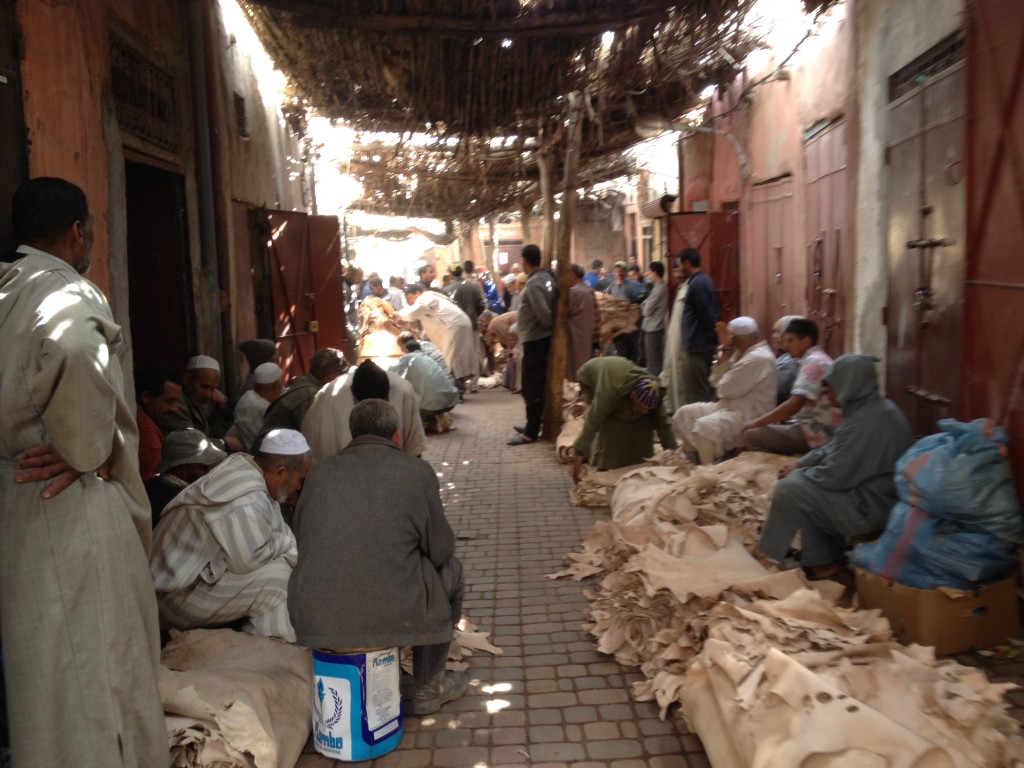
In the market for hides in Marrakech (Picture by Rory Cellan-Jones)

Guess the top economist from the bookshelf

It was Alfred Chandler’s [amazon_link id=”0674789954″ target=”_blank” ]Scale and Scope: Dynamics of Industrial Capitalism [/amazon_link] that caught my eye first on this top London-based economist’s bookshelf, but anyway other people’s book collections are always compelling. The collection included [amazon_link id=”0684824299″ target=”_blank” ]The Bell Curve[/amazon_link] by Herrnstein and Murray, [amazon_link id=”0691123241″ target=”_blank” ]The Box[/amazon_link] by Marc Levison, Krishna’s [amazon_link id=”0123745071″ target=”_blank” ]Auction Theory[/amazon_link] and – as can be seen from enlarging the picture below – a lot of titles on industrial organization and competition.

[amazon_image id=”0674789954″ link=”true” target=”_blank” size=”medium” ]Scale and Scope: Dynamics of Industrial Capitalism[/amazon_image]

I wonder if anybody can guess the owner’s identity? One clue – obviously the parent of a young child.

Whose books?

Chic economics

Another of my holiday reads was Alaa Al Aswany’s [amazon_link id=”0007243626″ target=”_blank” ]The Yacoubian Building[/amazon_link] (which explains a lot about recent events in Egypt). It’s a terrific novel, but one sentence in particular struck me:

“For some reason, the Faculty of Economics and Political Sciences of Cairo University is associated in people’s minds with affluence and chic.”

The author obviously (and reasonably) finds this mystique hard to understand. Of course, I love the idea that economics can be considered chic – an association that would cause people to howl with laughter in the countries I know well.

So this prompted an obvious question, or rather two: in which countries is economics a fashionable subject, and is this correlated with the proportion of female students? I’m looking for a 0-1 variable in answer to the first (a 1 means yes, fashionable) and a percentage of female undergraduates for the second. I can track down UK and probably US data. If readers can help with others, I’ll report the results in due course.

[amazon_image id=”0007243626″ link=”true” target=”_blank” size=”medium” ]The Yacoubian Building[/amazon_image]